Kelly McParland: How decades of Liberal indifference created Danielle Smith

Ron in Regina

"Voice of the West" Party
Apr 9, 2008
32,523
11,748
113
Regina, Saskatchewan
The short answer is no. It is not so much the port itself, it is all the other marine traffic, including whales. All ships for Vancouver, Tacoma, and Seattle use Juan de Fuca Strait. From a security point of view, that is putting all your eggs in one basket. Alberta oil producers would probably be better off contracting out ship loading to Louisiana or Alaska than deal with the BC government and coastal native bands that are opposed because they are not on the pipeline route and don't get any free money for a pipe that doesn't cross their land.
Now, if only there was somewhere on that coast in Canadian waters that happened to have or be naturally a deep water port, & way less traffic, and didn’t have existing bridges that would either have to be redesigned or limit the height of tanker traffic…an already existing rail line, etc…like…
Apparently the port of Prince Rupert just happens to be the third deepest in the world.
 
  • Like
Reactions: Taxslave2

pgs

Hall of Fame Member
Nov 29, 2008
29,266
8,609
113
B.C.
Now, if only there was somewhere on that coast in Canadian waters that happened to have or be naturally a deep water port, & way less traffic, and didn’t have existing bridges that would either have to be redesigned or limit the height of tanker traffic…an already existing rail line, etc…like…
Apparently the port of Prince Rupert just happens to be the third deepest in the world.
They have been loading ocean freight since Rupert was born . Nothing new .
 
  • Like
Reactions: Taxslave2

Dixie Cup

Senate Member
Sep 16, 2006
6,689
4,222
113
Edmonton
The federal government is eyeing a new oil pipeline route in southern British Columbia that some in Ottawa believe would face fewer environmental hurdles and less resistance from Indigenous groups than the northern route Alberta is proposing, two federal sources say.

Prime Minister Mark Carney and Alberta Premier Danielle Smith signed an memorandum of understanding in November, with the goals of unlocking Alberta’s energy sector and diversifying export markets in the face of U.S. President Donald Trump’s trade war. The agreement laid the conditions for construction of a new oil conduit to the Pacific.

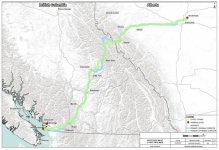
The MOU doesn’t say what path the pipeline will take. Ms. Smith has talked up a northern route that would carry Alberta oil to the Port of Prince Rupert, B.C. Her government is expected to propose such a route to Ottawa’s Major Projects Office this summer. An Alberta government source said the province expects that the federal government will designate the pipeline a project of national importance in the fall. We’ll have to wait and see.

(http://www.theglobeandmail.com/busi...ustry-new-pipeline-national-security-federal/)

Alberta prefers a northern route for two main reasons. First, Prince Rupert is North America’s closest port to Asia by up to three days sailing – around 36 hours closer to Shanghai than Vancouver.

It’s also the continent’s deepest port, which would enable access for the large crude carriers that are favoured for transporting oil to Asia. The massive tankers can transport about two million barrels of the dense, heavy crude that comes from Alberta’s oil sands.

But the two federal sources say Ottawa leans instead toward a route that would run through the province’s south to the port of Vancouver. That pipeline could either run alongside the Trans Mountain pipeline or follow another path. In either case, the sources said, it would require a new terminal for loading oil onto tankers.

The Vancouver Fraser Port Authority is planning to dredge the waters to deepen the channel in the Second Narrows waterway at Burrard Inlet. This will allow Aframax-class oil tankers at the Westridge Marine Terminal to operate at full capacity. The Vancouver Fraser Port Authority is planning to dredge the waters to deepen the channel in the Second Narrows waterway at Burrard Inlet. This will allow Aframax-class oil tankers at the Westridge Marine Terminal to operate at full capacity.
Except where the Feds want the pipeline to (if it ever actually happens) ends up in Vancouver, a port that is extremely busy already & cannot have the large oil tankers in port whereas Prince Rupert is the better choice as it can accommodate the larger tankers. Besides, most First Nations approved of the route initially so there would likely not be the resistance that the Feds are talking about. It was already an approved route with everyone concerned involved & Trudy nixed it!!
 

Taxslave2

Senate Member
Aug 13, 2022
5,764
3,078
113
Except where the Feds want the pipeline to (if it ever actually happens) ends up in Vancouver, a port that is extremely busy already & cannot have the large oil tankers in port whereas Prince Rupert is the better choice as it can accommodate the larger tankers. Besides, most First Nations approved of the route initially so there would likely not be the resistance that the Feds are talking about. It was already an approved route with everyone concerned involved & Trudy nixed it!!
The only bands not in agreement are the ones not on the money route.
 
  • Like
Reactions: Dixie Cup

Taxslave2

Senate Member
Aug 13, 2022
5,764
3,078
113
Lumber in seacans .
Not usually, but some products are. loading and unloading is challenging. There is also a fair amount of biofuel being exported in seacans rather than bulk. WE looked into this on the island about 12 years ago, but so far it hasn't really happened. The idea is to make pellets or bricks for power generation in Asia.There is some small production happening. I think the lack of pulpmills may make this more viable. I burned some of the bricks in the woodstove and it worked OK. They are much like prestologs, only it is pure compressed fiber, no additives. There is(was?) a portable unit made in a seacan, but it only produces about 4 tons a day.
 

pgs

Hall of Fame Member
Nov 29, 2008
29,266
8,609
113
B.C.
Not usually, but some products are. loading and unloading is challenging. There is also a fair amount of biofuel being exported in seacans rather than bulk. WE looked into this on the island about 12 years ago, but so far it hasn't really happened. The idea is to make pellets or bricks for power generation in Asia.There is some small production happening. I think the lack of pulpmills may make this more viable. I burned some of the bricks in the woodstove and it worked OK. They are much like prestologs, only it is pure compressed fiber, no additives. There is(was?) a portable unit made in a seacan, but it only produces about 4 tons a day.
We used to load lumber into sea cans for export to Asia . It is not rare .
 

Ron in Regina

"Voice of the West" Party
Apr 9, 2008
32,523
11,748
113
Regina, Saskatchewan
Speaking to reporters, Smith noted that some opposition to the Trans Mountain expansion (TMX) project last decade focused on the increased tanker traffic tied to more crude shipments leaving the Westridge Marine Terminal in Burnaby, B.C.

Developing a new oil pipeline to the lower B.C. mainland, as some have suggested, would only increase the traffic at the Port of Vancouver, she noted.

“In a very congested port like that, is there an appetite for a doubling, once again, of that amount of traffic? So that’s why I am a bit skeptical that that would be the appropriate route,” Smith said in Edmonton.

On Thursday, Smith indicated Alberta still prefers a new oil export pipeline that goes to a deepwater port in northern British Columbia — not one to southern B.C.
 
  • Like
Reactions: Taxslave2

Dixie Cup

Senate Member
Sep 16, 2006
6,689
4,222
113
Edmonton
Speaking to reporters, Smith noted that some opposition to the Trans Mountain expansion (TMX) project last decade focused on the increased tanker traffic tied to more crude shipments leaving the Westridge Marine Terminal in Burnaby, B.C.

Developing a new oil pipeline to the lower B.C. mainland, as some have suggested, would only increase the traffic at the Port of Vancouver, she noted.

“In a very congested port like that, is there an appetite for a doubling, once again, of that amount of traffic? So that’s why I am a bit skeptical that that would be the appropriate route,” Smith said in Edmonton.

On Thursday, Smith indicated Alberta still prefers a new oil export pipeline that goes to a deepwater port in northern British Columbia — not one to southern B.C.
She's absolutely correct! It should go the northern route!!
 
  • Like
Reactions: Taxslave2

Taxslave2

Senate Member
Aug 13, 2022
5,764
3,078
113
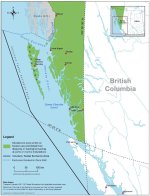
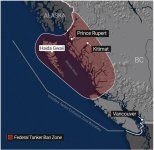
I'm pretty sure Eby is pushing the Southern route because he knows it is a non starter. Juan de fuca Strait is simply too busy to take much more traffic. There is also the location of a terminal to consider. Above Second Narrows bridge has limitations on depth and forshore. Anywhere towards Squamish will have professional protesters from around the wirld camped on our beaches and does nothing to address the overcrowded strait. The only protest against the Northern route comes from foreign funded coastal native group that will not get to milk the cash cow. But, a port in the Alaska panhandle, which is just a good cast with a fly rod from Pr. Rupert is not covered by the tanker ban.
Or, we could push a pipeline to the west side of Vancouver Island and miss all the marine traffic.
 

Ron in Regina

"Voice of the West" Party
Apr 9, 2008
32,523
11,748
113
Regina, Saskatchewan
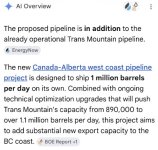
The Trans Mountain pipeline is currently operating with a total capacity of 890,000 barrels per day (bpd), with utilization rates reported around 80% to 90% as of late 2025 and early 2026. While capacity utilization has varied, the system generally operates near full capacity for contracted shippers, though the overall system has not always run at 100% capacity.
Canada's Trans Mountain pipeline is running at full capacity for the first time since the completion of a major expansion two years ago, but an executive ‌said Wednesday that ongoing global turmoil makes predicting future capacity rates difficult.
Asian refineries, particularly in China, are well-suited for Canada's heavy, high-sulphur crude, which helps fill a supply gap from declining production in Venezuela and Mexico. While China is the largest buyer, other notable destinations include South Korea, Singapore, and Japan.
Canadian crude often offers a cost-effective alternative for Asian refiners, despite logistical challenges. The heavy nature of the oil is desirable for specialized, complex Asian refineries, but elbows something sometimes.
 

Ron in Regina

"Voice of the West" Party
Apr 9, 2008
32,523
11,748
113
Regina, Saskatchewan
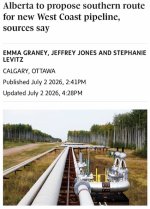
“Alberta’s proposal for building a new million-barrel-a-day pipeline to the West Coast will be unveiled on Thursday, a spokesman for the premier confirmed.
Alberta Premier Danielle Smith and Prime Minister Mark Carney agreed in May that the province’s United Conservative Party government would submit its application for a new pipeline to the federal Major Projects Office “by July 1.”

“We will have a major announcement on July 2 to share new details about the Government of Alberta’s submission to the Major Projects Office for a new one-million-barrel-per-day oil pipeline to Canada’s West Coast,” spokesman Sam Blackett wrote in a statement on Monday, citing that July 1 was Canada Day.

Alberta’s push to build a new pipeline to the West Coast has been the centrepiece of a memorandum of understanding Smith and Carney agreed to last fall, as the pair looked to reset the Ottawa-Alberta relationship after years of acrimony over federal energy policies under former prime minister Justin Trudeau.”

(Acrimony is a noun that refers to bitter, angry, or ill-tempered feelings, speech, or behavior. It describes a state of harshness and resentment, usually surfacing during a heated disagreement or dispute)

“Since taking office, Carney has pledged to transform Canada into an “energy superpower,” with Smith advocating that a new pipeline to the West Coast would advance the federal goal of diversifying the country’s export capacity to Asian markets in the face of tariffs from U.S. President Donald Trump. Her province is also facing a push to separate from Canada, with Smith looking at the pipeline deal as a way to demonstrate improved relations with Ottawa.”
(Smith has signalled that a northern route would be the most advantageous in terms of port access and proximity to Asian markets)
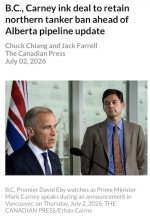
B.C. Premier David Eby has said he is opposed to lifting the oil tanker ban and has panned Alberta’s pipeline proponent as so far lacking any private sector backer. Under the deal with Alberta, Carney’s government has said it is open to amending parts of the oil tanker ban that only applies to the west coast (part of it anyway that aligns with Eby’s ideals) & thus the to the only two landlocked provinces in Canada, being Alberta and Saskatchewan.
Under the deal with Alberta, Carney’s government has committed to working towards designating Smith’s pipeline proposal as a project in the “national interest” by October 2026, with the stated goal of providing it with the conditions necessary to begin construction by September 2027, assuming it’s not all just hot air, smoke & mirrors, and lip service.
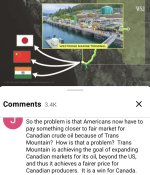
“China—TMX’s biggest buyer—continues to invest in refining capacity for heavy sour crudes, and India expects massive oil demand in the coming decade, accounting for as much as half of global incremental growth, followed closely by growth out of Southeast Asia.

For its part, South Korea is tripling its oil imports from Canada to reduce dependence on the Middle East, and Japan is looking to diversify as well. It will not be hard for Asian energy markets to absorb a million barrels of Canadian crude.”

Keep in mind America’s whatever it’s doing with Venezuela, and if you don’t think that’s not going to be used as a club up against Canada’s head in the upcoming NAFTA/CUSMA/USMCA/LMNOP/EIEIO negotiations then you’re naïve to be worded kindly.