There is evidence of life after death, scientists say

Tonington

Hall of Fame Member
Oct 27, 2006
15,441
150
63
Like this one.From the OP. As to what the ER staff was doing that would have been taken into consideration by the study. Yes - no - maybe? Myself i would state a firm yes it would be.
Thing is we do not know if they were doing it, until reading the study.

This I believe is the study- poached from another board.

http://www.alphagalileo.org/AssetVie...CultureCode=en

a b s t r a c t
Background:
Cardiac arrest (CA) survivors experience cognitive deficits including post-traumatic stress
disorder (PTSD). It is unclear whether these are related to cognitive/mental experiences and awareness
during CPR. Despite anecdotal reports the broad range of cognitive/mental experiences and awareness
associated with CPR has not been systematically studied.
Methods:
The incidence and validity of awareness together with the range, characteristics and themes
relating to memories/cognitive processes during CA was investigated through a 4 year multi-center
observational study using a three stage quantitative and qualitative interview system. The feasibility
of objectively testing the accuracy of claims of visual and auditory awareness was examined using spe-
cific tests. The outcome measures were (1) awareness/memories during CA and (2) objective verification
of claims of awareness using specific tests.
Results:
Among 2060 CA events, 140 survivors completed stage 1 interviews, while 101 of 140 patients
completed stage 2 interviews. 46% had memories with 7 major cognitive themes: fear; animals/plants;
bright light; violence/persecution; deja-vu; family; recalling events post-CA and 9% had NDEs, while 2%
described awareness with explicit recall of ‘seeing’ and ‘hearing’ actual events related to their resusci-
tation. One had a verifiable period of conscious awareness during which time cerebral function was not
expected.

From the OP
One man even recalled leaving his body entirely and watching his resuscitation from the corner of the room.

Despite being unconscious and “dead” for three minutes the 57-year-old social worker from Southampton, recounted the actions of the nursing staff in detail and described the sound of the machines.

We know the brain can’t function when the heart has stopped beating,” said Dr Sam Parnia, a former Southampton University research fellow now based at the State University of New York, who led the study.

“But in this case conscious awareness appears to have continued for up to three minutes into the period when the heart wasn’t beating, even though the brain typically shuts down within 20-30 seconds after the heart has stopped.

The bold above is my emphasis. See, that's just not true. Machines can keep your heart beating even if it can't keep beating on it's own. Lots of brain activity still. Ventilation and CPR is artificial circulation just the same. As long as the brain cells are getting oxygen, there's lots of stored energy, electrolytes to polarize and de-polarize membranes, signalling hormones, etc. I mean just below that sentence he says brain typically stops 20-30 seconds after the heart has stopped. Now, add in CPR and artificial breathing, you've extended the viability, and function, a lot. Otherwise, people would be vegetables after heart attacks. Some are, most aren't.
 

MHz

Time Out
Mar 16, 2007
41,030
43
48
Red Deer AB
Machines can keep your heart beating even if it can't keep beating on it's own. Lots of brain activity still. Ventilation and CPR is artificial circulation just the same.
Be a good reason for the elderly to get a 'DO NOT RESUSCITATE' tattoo right above their heart.
 

B00Mer

Make Canada Great Again
Sep 6, 2008
47,142
8,149
113
Rent Free in Your Head
www.canadianforums.ca
There may be some form of life after death, scientists believe.

The largest ever medical study into near-death and out-of-body experiences has discovered that awareness may continue even after the brain has shut down completely.

It is a controversial theory which has, until recently, been treated with widespread skepticism.

Scientists at the University of Southampton spent four years examining more than 2,000 people who suffered cardiac arrests at 15 hospitals in the UK, US and Austria.

They found that nearly 40 per cent of those who survived described some kind of “awareness” during the time when they were clinically dead before their hearts were restarted.

One man even recalled leaving his body entirely and watching his resuscitation from the corner of the room.

Despite being unconscious and “dead” for three minutes the 57-year-old social worker from Southampton, recounted the actions of the nursing staff in detail and described the sound of the machines.

“We know the brain can’t function when the heart has stopped beating,” said Dr Sam Parnia, a former Southampton University research fellow now based at the State University of New York, who led the study.

“But in this case conscious awareness appears to have continued for up to three minutes into the period when the heart wasn’t beating, even though the brain typically shuts down within 20-30 seconds after the heart has stopped.

“The man described everything that had happened in the room, but importantly, he heard two bleeps from a machine that makes a noise at three-minute intervals.

“So we could time how long the experienced lasted for.

“He seemed very credible and everything that he said had happened to him had actually happened.”

Of 2,060 cardiac arrest patients studied, 330 survived and 140 said they had experienced some kind of awareness while being resuscitated.

Although many could not recall specific details, some themes emerged.


One in five said they had felt an unusual sense of peacefulness while nearly one third said time had slowed down or speeded up.

Some recalled seeing a bright light; a golden flash or the sun shining.

Others recounted feelings of fear or drowning or being dragged through deep water. — In addition, 13 per cent had felt separated from their bodies and the same number said their senses had been heightened.


Dr Parnia believes many more people may have experiences when they are close to death but drugs or sedatives used in the process of resuscitation may stop them remembering.

“Estimates have suggested that millions of people have had vivid experiences in relation to death but the scientific evidence has been ambiguous at best.

“Many people have assumed that these were hallucinations or illusions but they do seem to correspond to actual events.

“And a higher proportion of people may have vivid death experiences, but do not recall them due to the effects of brain injury or sedative drugs on memory circuits.

“These experiences warrant further investigation.”

Dr David Wilde, a research psychologist at Nottingham Trent University, is compiling data about out-of-body experiences in an attempt to discover a pattern which links each episode. He hopes the latest research will encourage new studies into the controversial topic.

“Most studies look retrospectively, 10 or 20 years ago, but the researchers went out looking for examples and used a really large sample size, so this gives the work a lot of validity.

“There is some very good evidence here that these experiences are actually happening after people have medically died,” Dr Wilde said.

“We just don’t know what is going on. We are still very much in the dark about what happens when you die and hopefully this study will help shine a scientific lens onto that.”

The study was published in the journal Resuscitation.

Dr Jerry Nolan, editor-in-chief at Resuscitation, said: “Dr Parnia and his colleagues are to be congratulated on the completion of a fascinating study that will open the door to more extensive research into what happens when we die.”


There is evidence of life after death, scientists say

Can somebody here please kill yourself and send us a signal.. :lol:
 

grainfedpraiboy

Electoral Member
Mar 15, 2009
715
1
18
Alberta The Last Best West
Mrs. GFPB and I have always been complete opposites and that extends to the afterlife. Whereas she believes in anything I believe in nothing. As such, and lacking normal social graces I always ask everyone I know who has died and been brought back to life about their potential NDE in order to illustrate to her the folly of her childish beliefs.

Here is what I have discovered. I know 3 old vets who have all died and come back. None had an NDE. My former boss from 30 years ago was resuscitated without an NDE. One of my Grandfathers died and saw demons and was scared ****less (this is the first time I had even heard of a negative NDE experience). I know two farmers who were brought back and one saw a warm light beckoning and the other nothing.

Evaluating all cases in a very limited pool but knowing these men the way I do it seemed to me the more spiritual one (or less practical) was the more likely there was an NDE.
 

Blackleaf

Hall of Fame Member
Oct 9, 2004
50,106
1,922
113
Here on earth you have a scientific argument... what of beyond?


It's not that often I agree with you.

Some people think science explains everything. But it doesn't. The laws of physics, and science in general, probably don't apply to the afterlife.

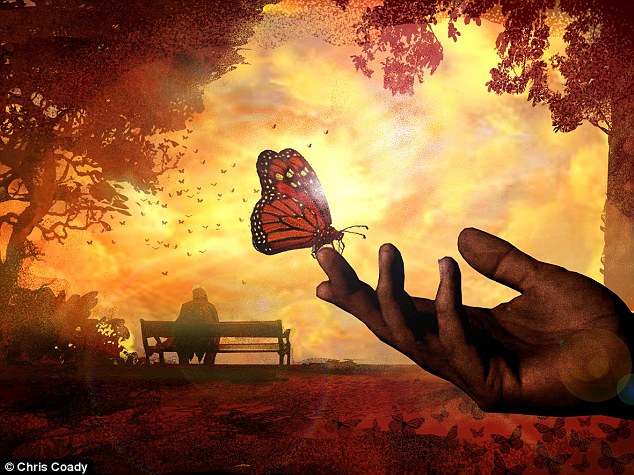
The wife who came back to earth as a butterfly: The poignant moment that a grieving husband lost his scepticism about the after-life

Leading neurosurgeon Dr Eben Alexander was sceptical when anyone said they had experienced the after-life. But then he had a similar experience after going into a coma. In our final extract from his book, The Map Of Heaven, Dr Alexander — who has worked at Harvard Medical School — explains that there is one thing that endures after we die: love.


In his vision of the afterlife, Dr Eben Alexander was a speck perched on the wing of a butterfly