Hezbollah
does operate as an official political party and armed resistance movement within Lebanon. It is (or at least was) officially recognized as a legitimate militia and national resistance force by the
Lebanese government.
Several regional allies, including
Iran and
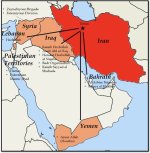
Syria, also viewed (past tense) it as a legitimate actor. Syria doesn’t any longer. That leaves the IRGC endorsing Hezbollah, and the Lebanese government wanting Hezbollah disarmed and defanged.
View attachment 34692
But…in Lebanon, the
Sunni, Christian, and Druze populations largely view Hezbollah as a destabilizing force that undermines Lebanese state sovereignty.
They frequently criticize the group for prioritizing its regional "Axis of Resistance" over domestic Lebanese interests.
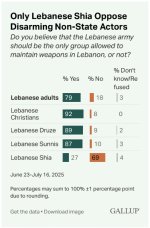
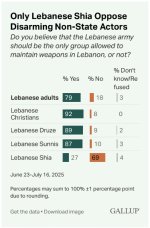
View attachment 34694Nationwide polls indicate that approximately 79% of the Lebanese population believes only the official Lebanese Armed Forces should be permitted to maintain weapons in the country.
While broad national support exists across religious groups for limiting weapons to the Lebanese army, this consensus does not extend to the Shia community, which forms the core base of Hezbollah’s support. Among Lebanese Shia, 27% say that only the army should be allowed to maintain weapons, while 69% disagree. The limited support among Shia for the army alone to have arms compares with overwhelming support among Lebanese Christians (92%), Druze (89%) and Sunnis (87%).
View attachment 34693
Unlike after the war with Israel in 2006, the party has struggled to give financial aid to civilians who lost homes and businesses, straining support within its own political base. With one-quarter of Lebanese Shia supporting the prohibition of weapons for non-state actors, Hezbollah cannot take this community’s support for granted. At the same time, many Lebanese are
likely exhausted by decades of conflict and ready to move on from a cycle of violence driven by armed groups over whom they have no veto.
Amid growing calls for Hezbollah's disarmament, most Lebanese believe that only the army should be allowed to have weapons.

news.gallup.com
Hezbollah “was” and now not “is” an anti-occupation force. It’s now evolved into an occupying force that that the actual Lebanese government and majority of its population want disarmed. The Shia minority of the population in Lebanon and the IRGC don’t want Hezbollah disarmed.
In Lebanon, the Shia communities (and thus Hezbollah itself) are primarily concentrated in the
Beqaa Valley, Southern Lebanon, and the southern suburbs of Beirut (Dahieh).







 .
. Then Iranian forces downed a U.S. Army helicopter patrolling the waters of Oman near the Gulf of