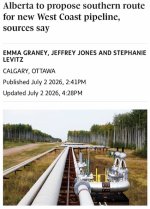
“Alberta’s proposal for building a new million-barrel-a-day pipeline to the West Coast will be unveiled on Thursday, a spokesman for the premier confirmed.
The Trans Mountain Expansion (TMX) pipeline has successfully reached full capacity just two years after its launch, proving its economic viability despite initial skepticism and significant cost overruns. The Canadian government, having invested in the project, is now seeing financial returns...

apple.news
Alberta Premier Danielle Smith and Prime Minister Mark Carney agreed in May that the province’s United Conservative Party government would submit its application for a new pipeline to the federal Major Projects Office “by July 1.”
“We will have a major announcement on July 2 to share new details about the Government of Alberta’s submission to the Major Projects Office for a new one-million-barrel-per-day oil pipeline to Canada’s West Coast,” spokesman Sam Blackett wrote in a statement on Monday, citing that July 1 was Canada Day.
Alberta’s push to build a new pipeline to the West Coast has been the centrepiece of a memorandum of understanding Smith and Carney agreed to last fall, as the pair looked to reset the Ottawa-Alberta relationship after years of acrimony over federal energy policies under former prime minister Justin Trudeau.”
(Acrimony is a noun that refers to bitter, angry, or ill-tempered feelings, speech, or behavior. It describes a state of harshness and resentment, usually surfacing during a heated disagreement or dispute)
“Since taking office, Carney has pledged to transform Canada into an “energy superpower,” with Smith advocating that a new pipeline to the West Coast would advance the federal goal of diversifying the country’s export capacity to Asian markets in the face of tariffs from U.S. President Donald Trump. Her province is also facing a push to separate from Canada, with Smith looking at the pipeline deal as a way to demonstrate improved relations with Ottawa.”
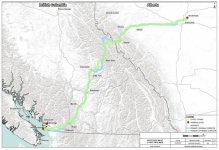
Two big questions looming over Alberta's pipeline pitch are whether a private sector proponent will step forward to build it and the exact route it would take
apple.news
(Smith has signalled that a northern route would be the most advantageous in terms of port access and proximity to Asian markets)

en.wikipedia.org
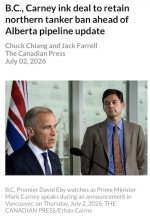
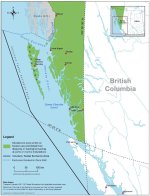
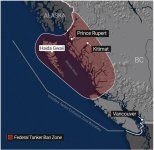
B.C. Premier David Eby has said he is opposed to lifting the oil tanker ban and has panned Alberta’s pipeline proponent as so far lacking any private sector backer. Under the deal with Alberta, Carney’s government has said it is open to amending parts of the oil tanker ban that only applies to the west coast (part of it anyway that aligns with Eby’s ideals) & thus the to the only two landlocked provinces in Canada, being Alberta and Saskatchewan.
en.wikipedia.org
Under the deal with Alberta, Carney’s government has committed to working towards designating Smith’s pipeline proposal as a project in the “national interest” by October 2026, with the stated goal of providing it with the conditions necessary to begin construction by September 2027, assuming it’s not all just hot air, smoke & mirrors, and lip service.
Alberta’s proposed bitumen pipeline to the West Coast has evolved from an energy project into a major test of Canadian national unity, particularly as the province heads toward an October referendum on separation. While Prime Minister Mark Carney’s government has adopted a more supportive...
apple.news
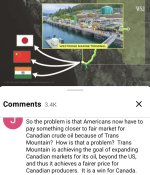
“China—TMX’s
biggest buyer—continues to invest in refining capacity for heavy sour crudes, and India expects massive oil demand in the coming decade, accounting for as much as
half of global incremental growth, followed closely by
growth out of Southeast Asia.
For its part, South Korea is
tripling its oil imports from Canada to reduce dependence on the Middle East, and Japan is looking to diversify as well. It will not be hard for Asian energy markets to absorb a million barrels of Canadian crude.”
Keep in mind America’s whatever it’s doing with Venezuela, and if you don’t think that’s not going to be used as a club up against Canada’s head in the upcoming NAFTA/CUSMA/USMCA/LMNOP/EIEIO negotiations then you’re naïve to be worded kindly.
The Trans Mountain Expansion (TMX) pipeline has successfully reached full capacity just two years after its launch, proving its economic viability despite initial skepticism and significant cost overruns. The Canadian government, having invested in the project, is now seeing financial returns...
apple.news