The Tarriff Hype.

Ron in Regina

"Voice of the West" Party
Apr 9, 2008
32,849
11,823
113
Regina, Saskatchewan
The USMCA/CUSMA/T-MEC is a binding legal agreement, signed by Mr. Trump and ratified by the U.S. Congress. Standing on it makes sense. The President appears to want Canada to accept treaty-violating tariffs, and for Canada to agree to a rewrite of the USMCA that would render Mr. Trump’s treaty violations treaty-compliant.
Mexico said it will monitor the process alongside producers and exporters ⁠until the ITC’s final ruling, expected in early 2027, and argued the criteria used by Commerce ⁠are inconsistent with the World Trade Organization’s Anti-Dumping Agreement and with provisions of the United States-Mexico-Canada Agreement.
 

Ron in Regina

"Voice of the West" Party
Apr 9, 2008
32,849
11,823
113
Regina, Saskatchewan
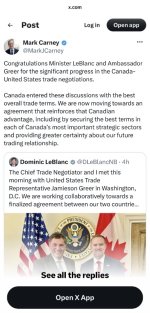
Prime Minister Mark Carney was scheduled to brief his cabinet and the premiers on Wednesday afternoon as Canadian and U.S. negotiators close in on a trade deal that would avert new tariffs and potentially offer relief to hard-hit industries in exchange for…??? In exchange for what?
1787173802907.jpeg
Now we wait for the US or some other foreign media to come up with details that aren’t being given to us by our own government?
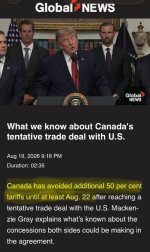
U.S. President Donald Trump said U.S. stakeholders will be “thrilled” with the tentative deal struck between Canada and the U.S., as negotiations continued Wednesday to finalize an agreement between both countries. “Our farmers are going to be thrilled; our manufacturers are going to be thrilled,” he said, during a press conference in Washington on Wednesday. “And basically, we have no tariffs going into Canada anymore?”

Tariffs going into Canada anymore? Surely at this point, Trump must understand how tariffs work, right? Prohibitive tariffs only trigger if total imports cross those established quotas (in USMCA, that Trump himself signed). U.S. dairy and agricultural groups confirm that American exporters do not fill or exceed these quota volumes, ever, so consequently Canadian consumers have never paid prices inflated by these specific over-quota penalties, ever. Ever. It has never happened as the U.S. fills about 1/2 way to those quotas so it’s not even close.
Maybe Trump is talking about the reciprocal tariffs though, and just forgot to use the word reciprocal as in response to his tariffs?
 

Ron in Regina

"Voice of the West" Party
Apr 9, 2008
32,849
11,823
113
Regina, Saskatchewan
Prime Minister Mark Carney was scheduled to brief his cabinet and the premiers on Wednesday afternoon as Canadian and U.S. negotiators close in on a trade deal that would avert new tariffs and potentially offer relief to hard-hit industries in exchange for…??? In exchange for what?
Carney, who briefed cabinet ministers and premiers about the draft plan Wednesday, said the deal it builds on Canada's existing trade advantages with the U.S. ???

All Canadian provinces pulled U.S. booze from store shelves last year after Trump imposed tariffs. The bans on U.S. liquor remain in place in all but Saskatchewan and Alberta. Nova Scotia Premier Tim Houston says Prime Minister Mark Carney has asked provinces to restock American alcohol on their shelves as Canada finalizes a trade deal with the U.S. "Whether Nova Scotians or whether Canadians will actually buy it when it gets back on the shelves, that's a whole other discussion."

Houston said provinces were also asked to ensure their procurement policies don't include anything that specifically excludes the United States. U.S. states generally do not (?) have procurement policies that specifically name and exclude Canada or Canadian provinces. Instead, they use broad domestic preferences—such as "Buy American" or "Buy Local" laws—that favor U.S.-made goods or local in-state suppliers over all foreign sources equally.

Speaking about the deal, Houston said he was "optimistic," adding that "the broad strokes of it seem really good for Canada."

Houston said the "core elements" of supply management are set to remain intact under the agreement, but did not provide specifics. He also some areas of defence procurement aren't being touched, which he said is good for Nova Scotia? Some?

Saskatchewan Premier Scott Moe echoed Houston's comments during a press conference Wednesday, saying the prime minister had asked provinces to change their procurement of U.S. alcohol.

“(That) doesn't impact Saskatchewan or Alberta," he told reporters in Prince Albert, Sask. "We've allowed consumers to make their own choice all along."
1787190114860.jpeg
Wow, so we have avoided pile on top of Trump tariffs that would go on top of the other Trump tariffs until at least Saturday (?) in exchange for what?
 

Ron in Regina

"Voice of the West" Party
Apr 9, 2008
32,849
11,823
113
Regina, Saskatchewan
Might be good if they use an insignia to indicate Canadian distillers so people are clearly aware of the choice they are making.
U.S. states generally do not (?) have procurement policies that specifically name and exclude Canada or Canadian provinces. Instead, they use broad domestic preferences—such as "Buy American" or "Buy Local" laws—that favor U.S.-made goods or local in-state suppliers over all foreign sources equally.
Yep. That sounds like it doesn’t violate anything. America is already doing it. Good for the goose is good for the gander.

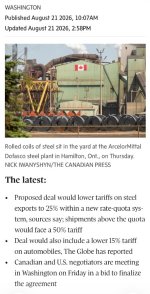
While none of the details of what's being considered have been made public, a source with knowledge of the forthcoming agreement said Trump’s U.S. tariffs on Canadian steel and aluminum are being lowered from 50 per cent to 25 per cent. Discussions regarding derivatives and exemptions are ongoing. The deal is also expected to cut Trump's headline tariff rate on Canadian-built cars and trucks from 25 per cent to 15 per cent, a source said.
1787234253671.jpeg
Since the North American auto market is so highly integrated, a vehicle assembled in Canada often contains 50 per cent or more of U.S.-manufactured components. If the tariff is applied only to the non-U.S. portion, the effective rate would drop by up to half (7.5 per cent), the source said?
1787234216179.jpegNova Scotia Premier Tim Houston said Carney has asked provinces to put U.S. beer, wine and spirits back in government-run liquor stores. The premier said that's something he's "willing to do for the prime minister at this point."
 

Ron in Regina

"Voice of the West" Party
Apr 9, 2008
32,849
11,823
113
Regina, Saskatchewan
Canada’s top trade negotiators are set to meet with their U.S. counterpart in Washington on Thursday as the two sides work to close a deal meant to offer some relief to Ottawa from U.S. President Donald Trump’s tariffs in exchange for a suite of Canadian concessions?

Trump announced that the countries had reached an agreement on Tuesday night, less than two hours before he was set to hammer Canada with 50-per-cent tariffs on US$20-billion worth of goods, under Section 338 of the Smoot-Hawley Tariff Act. But Mr. Carney told provincial premiers on Wednesday that crucial details – such as the amount of tariff relief Canada will receive – are still being haggled over.
Canada was ‘hoping’ to trade concessions on a long list of U.S. demands for reduced Trump tariffs under Section 232 of the Trade Expansion Act on autos, steel, aluminum and forestry, which Mr. Trump imposed last year, and for the President not to implement his latest threatened Trump-ish Smoot-Hawley tariffs. Mr. Trump has “paused” those latest tariffs until 12:01 a.m. on Saturday while the two sides try to close a deal upon his coercive but arbitrary time-lines. In exchange, the U.S. demanded Canada end provincial bans on U.S. alcohol and Buy Canadian procurement policies, lift retaliatory tariffs on U.S. autos, and change how licences in the dairy supply-management system are allocated.

Washington has also made several defence and security-related demands, including that Canada give the U.S. the right of first refusal on buying critical minerals, complete a deal to buy F-35 fighter jets, buy American military equipment to join the Golden Dome missile defence shield, and export more oil to the U.S. while still facing Trump tariffs but at a somewhat reduced rate?
Nations outside North America view these bilateral clashesand challenges to agreements like CUSMAas indicators of how future global trade rules, protectionism, and retaliatory tariffs will be handled worldwide.

Would this be part of the reason for the Trumpian threats against any retaliation to his coercively draconian Soprano-like negotiating tactics?🤔
Our (Canada’s) reaction is the precedent for other sovereign nations that Trump is dictating terms to going forward.
Donald Trump's trade envoy says the administration will not accept any form of retaliation from Canada if the U.S. president follows through on his latest tariff threat.
Mr. Trump this week has said that, on Canadian tariffs, he would be “reducing it a little bit” and “may bring some of the tariffs down to a level where other countries are.”
 

Ron in Regina

"Voice of the West" Party
Apr 9, 2008
32,849
11,823
113
Regina, Saskatchewan
Our (Canada’s) reaction is the precedent for other sovereign nations that Trump is dictating terms to going forward.
Well, it looks ugly for anyone and everyone.
Mr. Trump this week has said that, on Canadian tariffs, he would be “reducing it a little bit” and “may bring some of the tariffs down to a level where other countries are.”
Zero nations can enter trade negotiations with Donald Trump’s United States without facing an asymmetric dynamic. The U.S. strategy explicitly leverages its massive consumer market and unilateral tariffs (such as baseline and sectoral duties) to compel sweeping structural concessions, supply-chain alignments, and investment commitments.

The Asymmetric Reality
  • Power Imbalance: Washington dictates terms by initiating broad tariff threats or refusing multi-year extensions on pacts like the United States Trade Representative USMCA framework, forcing smaller or dependent economies onto the defensive.
  • Coercive Frameworks: Agreements on Reciprocal Trade (ARTs) and bilateral frameworks require partners—whether Japan, the European Union, or Mexico—to adopt strict external tariff alignment, investment security rules, and restrictions on third-country trade (targeting China) to mitigate U.S. duties.
  • Structural Leverage: Even major economic blocs find that their regulatory autonomy or key export sectors remain under pressure, rendering reciprocal parity virtually unattainable in direct bilateral talks with the Trump administration.
Donald Trump's trade envoy says the administration will not accept any form of retaliation from Canada if the U.S. president follows through on his latest tariff threat.
  • The American View: The White House and U.S. trade representatives frame the deal as a major win for American farmers and manufacturers, arguing it eliminates long-standing market barriers.
  • The Canadian View: While federal officials maintain they secured the best terms possible under intense pressure, some provincial leaders and labour groups remain skeptical, noting that the asymmetric power dynamic leaves Canada (and pretty much every other sovereign nation on the planet) vulnerable to future shifting demands from Trump’s Washington, or whomever is in charge going forward with this draconian trade example.

  • The Global view?: Divest and diversify away from reliance on U.S. trade to not be put in the same situation Canada had just been demonstrated to be in? This is not a short term accomplishment though. Dabble with the U.S. but as icing and not the cake? The U.S. might become the economic island that Trump wants it to be yet.
Analysts say Mexico watched the Canada-U.S. negotiations with an eye on rules of origin in the automotive sector, which has mushroomed in Mexico over the past 30 years of continental free trade. “Whatever Canada agrees with the U.S. will become the departing point” for Mexico-U.S. talks, said Juan Carlos Baker Pineda, a former Mexican vice-minister of foreign trade and researcher at the Universidad Panamericana in Mexico City.

We probably have to agree to what we can in order to lower the burden of those tariffs and then live to negotiate another day,” he said of the Mexican negotiating position.

Mexico has been eager to strike a deal with the U.S. to renew the USMCA, which is critical for its manufacturing-for-export economy. The country sends more than 80 per cent of its exports to America. And, unlike Canada, Mexico has not openly courted other countries (yet?) as alternate markets or spoken of ruptures with the U.S.
Mexico can’t leave the negotiation table without the USMCA,” said Diego Marroquín, a Mexican trade expert at the Washington-based Center for Strategic and International Studies. “The economy will obviously stagnate without it. … There is no way that they can maintain the current social program structure that has made President Sheinbaum so successful electorally.”

While the U.S. has agreed to more talks in September, some observers caution against reading that as a sign that Mexico is pursuing a more sound strategy than Canada. “Canada is nowhere close to where Mexico is regarding the USMCA review process,” said Arturo Sarukhán, a former Mexican ambassador in Washington. “But at the same time, despite the vindictiveness in the Trump administration and of the President toward Canada, Canada is nowhere as vulnerable politically and diplomatically in terms of hard power than where Mexico is.”
 

Ron in Regina

"Voice of the West" Party
Apr 9, 2008
32,849
11,823
113
Regina, Saskatchewan
Manitoba Premier Wab Kinew said Canadians need to be “clear-eyed” about the fact that Mr. Carney’s prospective deal, which is still being negotiated in Washington, will give up Canada’s leverage with the United States, while also agreeing to permanent tariffs. “The deal will not be right for me,” Mr. Kinew said. “But it’s not about me. It’s about Team Canada.”

Ottawa is asking the premiers to end their booze bans and change their procurement rules (so, retaliation) as part of a suite of concessions that Canada has negotiated with the U.S. in exchange for the Trump administration lowering – but not eliminating – its Trump tariffs on key Canadian industries.

When Mr. Carney briefed premiers on the deal Wednesday, he asked them to end retaliatory measures enacted by some provinces in response to Mr. Trump’s sectoral tariffs last year, such bans on the sale of U.S. booze, but has so far left them and the public in the dark about the rest of the deal’s details (?), which are still being hammered out. Really?

Ottawa has not released any information about the level of tariffs that it will agree to in the deal with the Trump administration. What the tariff rate on steel and aluminum will end up being has not yet been shared with the provinces, Mr. Kinew said. It is currently 50 per cent, while the tariff rate on vehicles is 25 per cent.
Tariffs on autos remain a sticking point in the talks. The Globe has reported a major sticking point is whether only the value of U.S. content in Canadian-made cars will be exempted from Mr. Trump’s tariffs, or whether the value of Canadian- and Mexican-made content will be exempted as well as per USMCA that Trump signed in his first term of office.

The issue is being complicated by the fact that the U.S. is conducting negotiations with Mexico and Canada separately, but all three countries need alignment on what is agreed to in the auto sector because of how integrated the supply chain is.
 

Ron in Regina

"Voice of the West" Party
Apr 9, 2008
32,849
11,823
113
Regina, Saskatchewan
Ottawa has not released any information about the level of tariffs that it will agree to in the deal with the Trump administration. What the tariff rate on steel and aluminum will end up being has not yet been shared with the provinces, Mr. Kinew said. It is currently 50 per cent, while the tariff rate on vehicles is 25 per cent.
U.S. President Donald Trump's latest-latest tariff threat on $28 billion worth of Canadian goods is set to take effect just after midnight, unless officials are able to finalize a trade agreement. Unlike other Trump tariffs, the duties that are on pause (for three days) would affect goods that are compliant with the Canada-U.S.-Mexico Agreement on trade that Trump himself signed in his first term in office.

The worry is that there will be Trojan Horses hidden in the text. U.S. Trade Representative Jamieson Greer talked about “digital trade alignment,” which hints at further U.S. domination of Canada’s digital space. Giving up our ability to govern is the exact opposite of standing up for ourselves.

The U.S. has also demanded that Canada give Washington right of first refusal on purchasing Canadian critical minerals, complete the purchase of F-35 fighter jets, buy U.S. military equipment as part of joining the planned Golden Dome missile defence system and increase oil exports in exchange for some of Trumps tariffs on Canadian goods to be lowered somewhat by an amount that nobody will mention.
 

Ron in Regina

"Voice of the West" Party
Apr 9, 2008
32,849
11,823
113
Regina, Saskatchewan
1787341976576.jpeg
The prospective deal, in which Canada is being asked to make numerous concessions and accept Mr. Trump’s tariffs to try to avoid more Trump tariffs in exchange for not having the Trump tariffs be even higher, is likely to be a difficult sell for Mr. Carney…not that he has to sell Canada on this before he agrees to it on behalf of Canada.

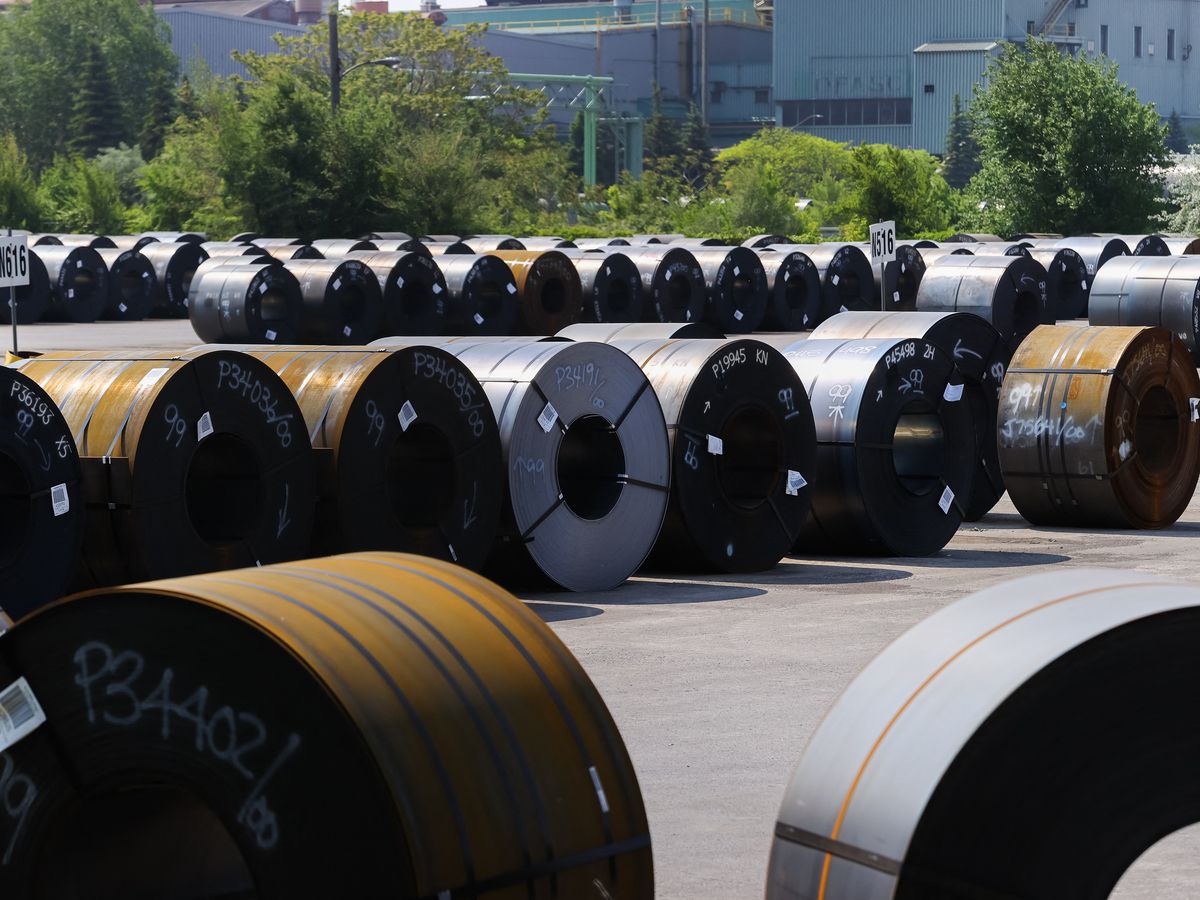
The prospective trade deal being negotiated by Ottawa and Washington would introduce a quota system for Canadian steel exports with a 25-per-cent tariff on metal shipments inside the quota and a 50-per-cent tariff on exports above the quota, according to three sources with knowledge of the negotiations.

Canada is also negotiating the terms of aluminum trade, with the aim of reducing tariffs. The U.S. faces a persistent structural supply deficit and high regional pricing premiums, driven heavily by steep Section 232 import tariffs (up to 50% on major partners like Canada) and global shipping disruptions, though recent moves to ease some tariff rates have caused record premiums to slightly pull back? High Section 232 tariffs on major suppliers like Canada forced buyers to absorb extra costs, inflating the regional U.S. Midwest Premium to historic highs. The U.S. relies on imports for roughly 80% of its primary aluminum needs.
U.S. President Donald Trump said on Friday that he has a “good relationship” with Prime Minister Mark Carney and he expects to close a deal.🙄Mr. Trump has threatened to impose a new 50-per-cent Trump tariff on an additional US$20-billion worth of Canadian exports at midnight if no agreement is reached.

The other major sector under discussion is autos. The Globe and Mail reported that the U.S. has agreed to lower Trump tariffs on Canadian automobiles to 15 per cent from 25 per cent. Still waiting on that final punchline.
 

no color

Electoral Member
May 20, 2007
353
101
43
1967 World's Fair
If Canada can afford to send $25 billion to some God forsaken country on the other side of the Atlantic Ocean, then Canada can sure as heck afford to absorb these new tariffs which only apply to 5% of the $380 billion dollar goods that Canada exports to the U.S. The tariffs for one year total less than the $25 billion that Canada threw down the tubes without approval from Parliament or Canadians.

In addition, maybe next time Quebec will think twice prior to removing U.S. alcohol from its shelves. Alberta and Saskatchewan had it right by keeping U.S. alcohol on its shelves. Quebeckers now buy their bourbon straight from the U.S. (by taking a 48 hour+ weekend trip across the border) as it’s no longer available in Quebec liquor stores.
 

Ron in Regina

"Voice of the West" Party
Apr 9, 2008
32,849
11,823
113
Regina, Saskatchewan
Blah blah blah…
Carney was speaking at a press conference on Saturday morning after suspending trade talks with U.S. President Donald Trump and then announcing steep retaliatory tariffs. Carney said the retaliatory measures would come into effect on the Tuesday after Labour Day.

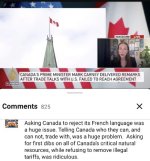
“We were attacked. You’re at war when you get attacked. We got attacked,” said Carney, in the West Block foyer on Parliament Hill. “We can’t control the storm that blows in from Washington.”

Carney itemized several flashpoints in the final week of negotiations with the U.S., including language on auto industry tariffs and “efforts to restrict our protections of our language, our culture, and in effect, our sovereignty.” Etc…
He also said the U.S. inserted language into the deal that seemed to restrict Canada’s ability to make other trade deals, which Carney said would “always be unacceptable to this government.” The prime minister also said that any deal with the U.S. would be unreliable???

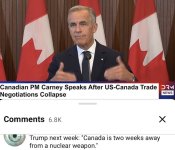
“Our government understood before many that America would transform all of its commercial relationships, that it would put a series of tariffs on its closest allies, and use economic integration as a weapon. We recognize that sometimes its signature was written in pencil,” said Carney.😳Elbows something sometimes.

Just minutes before a midnight deadline on Friday night, Carney said that Canada was withdrawing from the talks because “last-minute changes” to the agreement made by the U.S. “were unfair, uneconomic, and called into question the reliability of any deal.” (???)

“This is not good news” for the renegotiation of the Canada-U.S.-Mexico Agreement, Carney said in French.
Carney will also hold a cabinet meeting at 12:15 p.m. and a meeting with provincial premiers at 1:30 p.m. on Saturday, according to his itinerary. After the two sides broke off talks, the Americans blamed Canada for the breakdown in negotiations.

On Saturday morning, Greer said no new talks were planned and that the U.S. was moving ahead with plans to “respond to Canadian retaliation.”
 

Ron in Regina

"Voice of the West" Party
Apr 9, 2008
32,849
11,823
113
Regina, Saskatchewan
If Canada can afford to send $25 billion to some God forsaken country on the other side of the Atlantic Ocean, then Canada can sure as heck afford to absorb these new tariffs which only apply to 5% of the $380 billion dollar goods that Canada exports to the U.S. The tariffs for one year total less than the $25 billion that Canada threw down the tubes without approval from Parliament or Canadians.

In addition, maybe next time Quebec will think twice prior to removing U.S. alcohol from its shelves. Alberta and Saskatchewan had it right by keeping U.S. alcohol on its shelves. Quebeckers now buy their bourbon straight from the U.S. (by taking a 48 hour+ weekend trip across the border) as it’s no longer available in Quebec liquor stores.
So these take effect immediately, & Carney plans to react dollar for dollar (?) Sept 8th? We are not China, a fraction of the size of the US population and economy, and we can’t do this…not unless it’s done extremely strategically which none of this has been so far.
“The whole deal soured up when Lutnick got into the room and started relitigating,” said Jean Simard, CEO of the Aluminum Association of Canada. “This is all about Lutnick trying to relitigate things.”
Carney says part of U.S. demands were for Canada to impose tariffs on other countries and trying to “restrict our ability to have other trade deals.” He says that would make sense if you integrated markets and it was in the joint interest of both countries, “as opposed to being told to do something or being restricted from doing something else.”

He says it was a “power play” from the U.S. and Canadians “weren’t satisfied.”

“We’ll make our decisions about who we want to trade with and how, and including on how we work with the United States and other partners,” Carney says.
 

no color

Electoral Member
May 20, 2007
353
101
43
1967 World's Fair
usa has betrade us. :(
No. Canada betrayed the U.S. What did you expect the U.S. to do? Most Canadian provinces (with the exception of Alberta and Saskatchewan) pulled U.S. alcohol from it’s shelves. The U.S. has NOT pulled any Canadian products from its shelves. Then there’s the racist anti-constitutional French only hate laws in Quebec that violate Freedom of Expression rights that the U.S. has to deal with. If you ask me, Canada is getting off easy.
 

no color

Electoral Member
May 20, 2007
353
101
43
1967 World's Fair
Blah blah blah…
Carney was speaking at a press conference on Saturday morning after suspending trade talks with U.S. President Donald Trump and then announcing steep retaliatory tariffs. Carney said the retaliatory measures would come into effect on the Tuesday after Labour Day.

“We were attacked. You’re at war when you get attacked. We got attacked,” said Carney, in the West Block foyer on Parliament Hill. “We can’t control the storm that blows in from Washington.”

Carney itemized several flashpoints in the final week of negotiations with the U.S., including language on auto industry tariffs and “efforts to restrict our protections of our language, our culture, and in effect, our sovereignty.” Etc…
He also said the U.S. inserted language into the deal that seemed to restrict Canada’s ability to make other trade deals, which Carney said would “always be unacceptable to this government.” The prime minister also said that any deal with the U.S. would be unreliable???

“Our government understood before many that America would transform all of its commercial relationships, that it would put a series of tariffs on its closest allies, and use economic integration as a weapon. We recognize that sometimes its signature was written in pencil,” said Carney.😳Elbows something sometimes.

Just minutes before a midnight deadline on Friday night, Carney said that Canada was withdrawing from the talks because “last-minute changes” to the agreement made by the U.S. “were unfair, uneconomic, and called into question the reliability of any deal.” (???)

“This is not good news” for the renegotiation of the Canada-U.S.-Mexico Agreement, Carney said in French.
Carney will also hold a cabinet meeting at 12:15 p.m. and a meeting with provincial premiers at 1:30 p.m. on Saturday, according to his itinerary. After the two sides broke off talks, the Americans blamed Canada for the breakdown in negotiations.

On Saturday morning, Greer said no new talks were planned and that the U.S. was moving ahead with plans to “respond to Canadian retaliation.”
This is Carney’s personal war. Many of us have immediate family and friends in the U.S. Not to mention investment properties. I personally drive into the U.S. several times per week. Carney failed in his job, and his promises. He should simply resign.
 
  • Like
Reactions: 55Mercury

Ron in Regina

"Voice of the West" Party
Apr 9, 2008
32,849
11,823
113
Regina, Saskatchewan
The Trump administration has imposed trade arrangements on all trading partners that are worse than those that existed prior to 2025. Washington told countries to choose between being hit with higher tariffs, or even higher tariffs. It gave them a choice between Bad and Badder – and told them to pay a ransom if they wanted to be hit with merely Bad.

Since the 1965 Auto Pact, our two economies have been increasingly integrated. We make things together, with the automobile sector the best-known example. There are no purely American-made or Canadian-made cars; there are North American cars. The industry is more efficient and productive, and more internationally competitive, because of free trade. It’s win-win. That is not the Trump administration’s vision.
1787493142697.jpeg
The past month of Canada-U.S. negotiations were about how much more unfavourable of a trade relationship we could be forced to accept. The White House was pushing to see how much higher a tariff barrier Canada would agree to, relative to pre-2025, and what we’d concede to avoid even worse.
This is Carney’s personal war. Many of us have immediate family and friends in the U.S. Not to mention investment properties. I personally drive into the U.S. several times per week. Carney failed in his job, and his promises. He should simply resign.
I get it. A third+ of the 600+ contacts in my phone are Americans.
1787492750155.jpeg
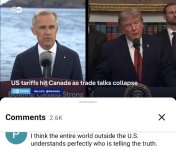
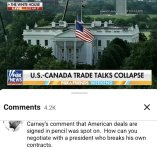
Both sides blamed the other for the breakdown in talks on Friday. Carney told Canadian journalists that the country was “at war” over trade with the US, after Trump “miscalculated” by escalating his tariff attack. Jamieson Greer, the US trade representative, has said the US was compelled to act after a year of retaliatory measures by Canada. He told Fox & Friends Weekend: “We’ve said enough and so we’ve taken countermeasures. Our interest is in protecting American workers and protecting American supply chains.” (?)
Carney, who previously served as the governor of the Bank of England, was elected as Canada’s prime minister last year after campaigning to lead what was a toxic political party in a fightback against Trump, who has previously suggested he wants to make Canada a 51st state with “economic force”. That said, the fact the Liberals benefit politically from conflict with Trump is notable, and eventually Carney will have to account for any prolonged economic pain that might result from this.

The fact that Canada was expected to make all these concessions while American tariffs remained in place is ludicrous. Not to mention that this little side deal already contravenes the existing Canada U.S. Mexico Agreement, which is somehow supposed to be renegotiated at some point.
Apparently, the plan/deal was to turn Canada into a Western version of Belarus, where it is nominally independent but controlled from a foreign capital. Incidentally, what the Americans seem to want Canada to give up is not much different from what would have to be conceded if we joined the European Union, where Ottawa would also be prevented from signing independent trade deals and expected to align its regulatory regime with other members.

Since Trump has returned to the White House, he has levied tariff after tariff against Canada, nearly all of which violate the Canada-U.S.-Mexico Agreement, or CUSMA. These include tariffs on so-called non-CUSMA compliant goods, but also on Canadian-made autos and Canadian steel and aluminum. Because Trump is also teriffing other countries to various degrees doesn’t make this either right or acceptable, and his complaints about Canada’s supply management system of quotas and tariffs on dairy, poultry and eggs are not unfounded. However, the existence of the system violates no agreement. It exists as it did when Trump negotiated CUSMA during his first term.
1787492115031.jpeg
Ottawa had been prepared to make concessions, dropping counter-tariffs on steel and aluminum provided the U.S. lower theirs to levels that would allow Canadian exports to be economic. Carney said he was prepared to encourage provinces to return U.S. alcohol to provincial liquor store shelves, and to take “administrative measures” to give more access to the dairy sector. The Americans then added language that would have limited Canada’s ability to strike new international trade deals.
1787491915375.jpeg
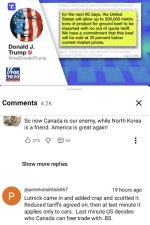
The pain will be felt on both sides of the border. The absurdity is that Trump is stoking the very inflationary pressures that are partly responsible for the surging bond yields that are so concerning to him. Such is his vexation that he suggested that he may instruct the U.S. military to intervene in the bond crisis, though even for this president an order to bomb Wall Street might be considered as an overreaction.
When the details of Canada’s retaliation are announced next week, Trump will also come under pressure from the impacted businesses and members of Congress. The American side is unlikely to be as united as the justifiably aggrieved Canadians.
1787492467016.jpeg
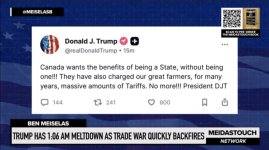
Conservative Leader Pierre Poilievre’s response suggests he realizes many Canadians see the Trump administration’s trade policy as an extortion racket aimed at getting paid for doing nothing. He urged Canadians to stand united and placed the blame for threatening jobs firmly on the U.S. side. That was in stark contrast to Alberta Premier Danielle Smith, who expressed her disappointment that the agreement had fallen apart and urged Ottawa to restart negotiations, without mentioning Trump.
1787493481226.jpeg
Carney noted that Canada supplies the U.S. with 95 percent of its natural gas imports, 85 percent of its electricity imports and 60 percent of its crude oil imports. “I don’t think they want us to stop sending any of that energy,” he said cryptically (?). The problem with that tacit threat is that following through would risk breaking up the country, on the eve of an Alberta referendum.
1787496283619.jpeg
California Governor Gavin Newsom likely spoke for all Democrats and many Republicans in a social media post that talked about the U.S.’s most critical trading partner. “Trump is hitting Canada with 50 percent tariffs. What the actual fuck are we doing?”
 

spaminator

Hall of Fame Member
Oct 26, 2009
40,694
4,059
113
No. Canada betrayed the U.S. What did you expect the U.S. to do? Most Canadian provinces (with the exception of Alberta and Saskatchewan) pulled U.S. alcohol from it’s shelves. The U.S. has NOT pulled any Canadian products from its shelves. Then there’s the racist anti-constitutional French only hate laws in Quebec that violate Freedom of Expression rights that the U.S. has to deal with. If you ask me, Canada is getting off easy.
i nominate you for white house press secretary. :(
 
  • Like
Reactions: Ron in Regina