The Trump administration has imposed trade arrangements on all trading partners that are worse than those that existed prior to 2025. Washington told countries to choose between being hit with higher tariffs, or even higher tariffs. It gave them a choice between
Bad and Badder – and told them to pay a ransom if they wanted to be hit with merely Bad.
Since the 1965 Auto Pact, our two economies have been increasingly integrated. We make things together, with the automobile sector the best-known example. There are no purely American-made or Canadian-made cars; there are North American cars. The industry is more efficient and productive, and more internationally competitive, because of free trade. It’s win-win. That is not the Trump administration’s vision.
The past month of Canada-U.S. negotiations were about how much more unfavourable of a trade relationship we could be forced to accept. The White House was pushing to see how much higher a tariff barrier Canada would agree to, relative to pre-2025, and what we’d concede to avoid even worse.
This is Carney’s personal war. Many of us have immediate family and friends in the U.S. Not to mention investment properties. I personally drive into the U.S. several times per week. Carney failed in his job, and his promises. He should simply resign.
I get it. A third+ of the 600+ contacts in my phone are Americans.
Both sides blamed the other for the breakdown in talks on Friday. Carney told Canadian journalists that the country was “at war” over trade with the US, after Trump “miscalculated” by escalating his tariff attack. Jamieson Greer, the US trade representative, has said the US was compelled to act after a year of
retaliatory measures by Canada. He told Fox & Friends Weekend: “We’ve said enough and so we’ve taken countermeasures. Our interest is in protecting American workers and protecting American supply chains.” (?)
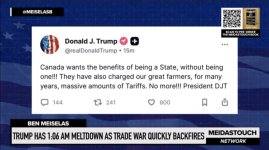
In his first comments since trade talks broke down, President Donald Trump said Canada "wants the benefits" of being a U.S. state "without being one." The president's brief post on his Truth Social platform early Sunday comes after new 50 per cent U.S. tariffs on a range of Canadian goods took...

apple.news
Carney, who previously served as the governor of the Bank of England,
was elected as Canada’s prime minister last year after campaigning to lead what was a toxic political party in a fightback against
Trump, who has previously suggested he wants to make Canada a 51st state with “economic force”. That said, the fact the Liberals benefit politically from conflict with Trump is notable, and eventually Carney will have to account for any prolonged economic pain that might result from this.
The fact that Canada was expected to make all these concessions while American tariffs remained in place is ludicrous. Not to mention that this little side deal already contravenes the existing Canada U.S. Mexico Agreement, which is somehow supposed to be renegotiated at some point.
The end of free trade is a tragedy the Liberals failed to prepare for
apple.news
Apparently,
the plan/deal was to turn Canada into a Western version of Belarus, where it is nominally independent but controlled from a foreign capital. Incidentally, what the Americans seem to want Canada to give up is not much different from what would have to be conceded if we joined the European Union, where Ottawa would also be prevented from signing independent trade deals and expected to align its regulatory regime with other members.
Since Trump has returned to the White House, he has levied tariff after tariff against Canada, nearly all of which violate the Canada-U.S.-Mexico Agreement, or CUSMA. These include tariffs on so-called non-CUSMA compliant goods, but also on Canadian-made autos and Canadian steel and aluminum. Because Trump is also teriffing other countries to various degrees doesn’t make this either right or acceptable, and his complaints about Canada’s supply management system of quotas and tariffs on dairy, poultry and eggs are not unfounded. However, the existence of the system violates no agreement. It exists as it did when Trump negotiated CUSMA during his first term.
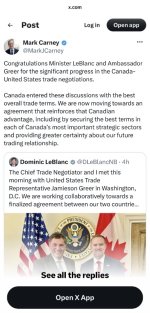
 Ottawa had been prepared to make concessions, dropping counter-tariffs on steel and aluminum provided the U.S. lower theirs to levels that would allow Canadian exports to be economic
. Carney said he was prepared to encourage provinces to return U.S. alcohol to provincial liquor store shelves, and to take “administrative measures” to give more access to the dairy sector.
The Americans then added language that would have limited Canada’s ability to strike new international trade deals.
The pain will be felt on both sides of the border. The absurdity is that Trump is stoking the very inflationary pressures that are partly responsible for the surging bond yields that are so concerning to him. Such is his vexation that he suggested that he may instruct the U.S. military to intervene in the bond crisis, though even for this president an order to bomb Wall Street might be considered as an overreaction.
The pain will be felt on both sides of the border
apple.news
When the details of Canada’s
retaliation are announced next week, Trump will also come under pressure from the impacted businesses and members of Congress. The American side is unlikely to be as united as the justifiably aggrieved Canadians.
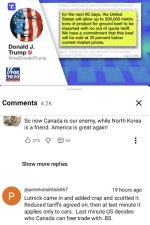
Conservative Leader Pierre Poilievre’s response suggests he realizes many Canadians see the Trump administration’s trade policy as an extortion racket aimed at getting paid for doing nothing. He urged Canadians to stand united and placed the blame for threatening jobs firmly on the U.S. side. That was in stark contrast to Alberta Premier Danielle Smith, who expressed her disappointment that the agreement had fallen apart and urged Ottawa to restart negotiations, without mentioning Trump.
Carney noted that Canada supplies the U.S. with 95 percent of its natural gas imports, 85 percent of its electricity imports and 60 percent of its crude oil imports. “I don’t think they want us to stop sending any of that energy,” he said cryptically (?). The problem with that tacit threat is that following through would risk breaking up the country, on the eve of an Alberta referendum.
California Governor Gavin Newsom likely spoke for all Democrats and many Republicans in a social media post that talked about the U.S.’s most critical trading partner. “Trump is hitting Canada with 50 percent tariffs. What the actual fuck are we doing?”



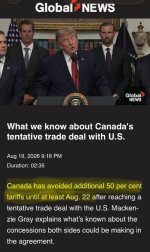


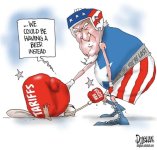

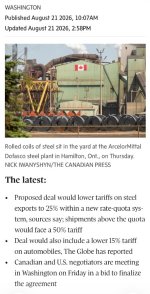
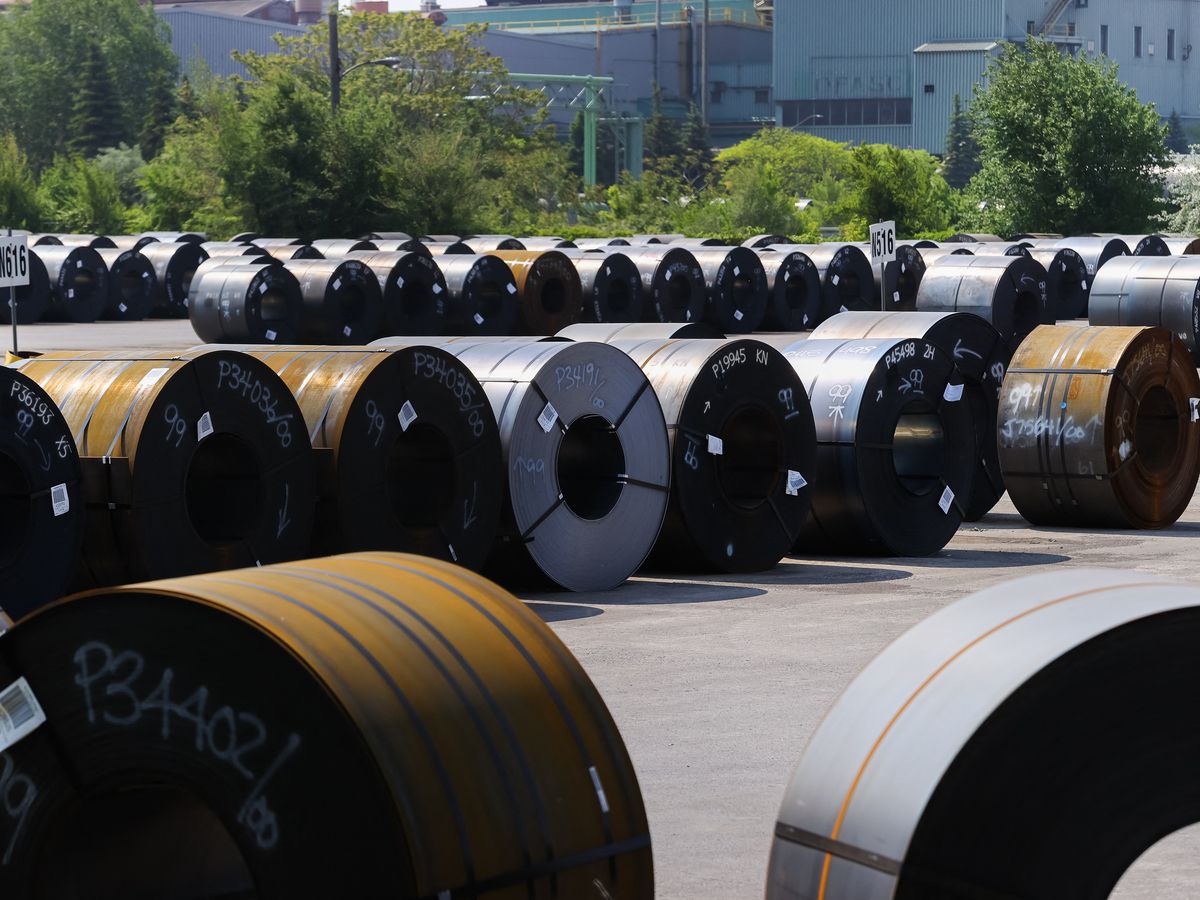
 Mr. Trump has threatened to impose a new 50-per-cent Trump tariff on an additional US$20-billion worth of Canadian exports at midnight if no agreement is reached.

 Elbows something sometimes.