Ethics commissioner's advice to Mark Carney about Tuscany will remain secret
While the Conflict of Interest Act allows the prime minister to seek guidance confidentially, it's only a matter of time before details leak out — like what happened with Trudeau's Aga Khan trip
Author of the article:Joe Warmington
Published Aug 11, 2026 • Last updated 15 hours ago • 4 minute read
Mark Carney
Prime Minister Mark Carney arrives for an availability at the Canadian Embassy in Washington on Tuesday, May 6, 2025. Photo by Adrian Wyld /THE CANADIAN PRESS FILES
Canadians do not know exactly where in Tuscany our prime minister is. Now comes word from the ethics commissioner that we are not entitled to know what advice Mark Carney was given before jetting to Italy.
“The Conflict of Interest Code for Members of the House of Commons and the Conflict of Interest Act require the Office to keep certain information confidential,” the Conflict of Interest and Ethics Commissioner’s director of communications, Melanie Rushworth, said.
Respectfully, she added that Carney did seek ethics commissioner Konrad von Finckenstein’s counsel.
“We can confirm that the Office of the Conflict of Interest and Ethics Commissioner was consulted prior to the Prime Minister’s current vacation in Italy,” Rushworth said.
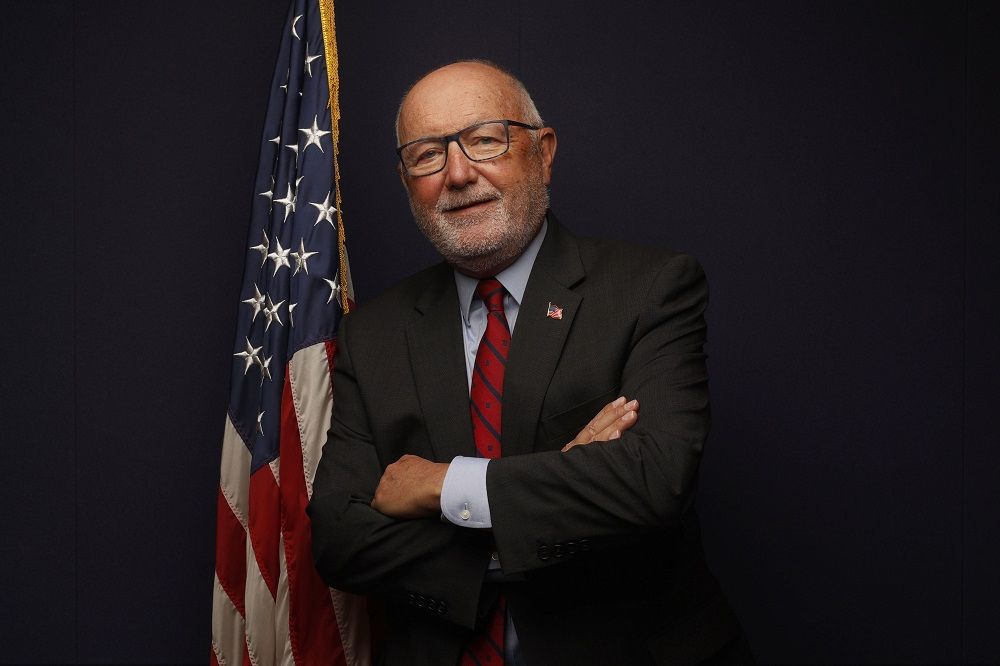
Ethics commissioner Konrad von Finckenstein.
Ethics commissioner Konrad von Finckenstein. POSTMEDIA FILES
But beyond those details was a wall of silence.
“We are unable to discuss the nature, scope, content, or outcome of any consultation involving an individual elected or appointed official. More generally, the commissioner’s office provides advice and guidance to elected and appointed officials regarding their obligations, but the office does not approve vacations.”
Under House of Commons conflict of interest rules, “the mandate of the Commissioner is twofold: to administer the Conflict of Interest Code for Members of the House of Commons and to administer the Conflict of Interest Act for public office holders.”
According to the Conflict of Interest Act, the commissioner “provides confidential advice to public office holders with respect to their obligations under the Conflict of Interest Act” and “provides confidential advice to the Prime Minister about the application of the Conflict of Interest Act. Additionally, the commissioner provides “confidential policy advice to the Prime Minister on conflict of interest and ethics issues in general.”
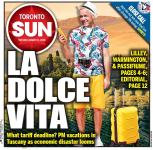
Toronto Sun front cover for Tuesday, Aug. 11.
Toronto Sun front cover for Tuesday, Aug. 11.
It’s in the vault.
While the commissioner keeps “confidential the advice he gives to the PM,” Duff Conacher, founder and coordinator of non-profit Democracy Watch, reminds that secrets in Ottawa are hard to keep, as previous prime minister Justin Trudeau learned in his 2016-17 Christmas break vacation fiasco to the Aga Khan’s Bell Island in the Bahamas.
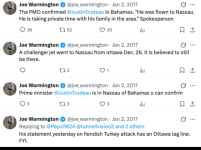
Joe Warmington tracked the PM’s Challenger jet to Nassau on social media in 2016-17.
Joe Warmington tracked the PM’s Challenger jet to Nassau on social media in 2016-17.
Reminds of Trudeau’s Aga Khan island vacation
This situation reminds of that one. For a refresher, Trudeau had taken off on vacation but did not tell anybody where. With help from sources, I was able to track his Challenger jet to Nassau in the Bahamas and those first social media posts helped break open what ended up being an even bigger story my Postmedia colleagues broke of a helicopter ride to the island — something that deservedly netted David Akin and Chris Selley a National Newspaper Award.
When the dust settled, it was ruled Trudeau had violated four sections of the conflict act.
No one has suggested Carney has violated the act here. The Tuscany trip was cleared by the ethics commissioner in advance. But, like Trudeau to the Aga Khan island, Conacher doubts the details of Carney’s Italian vacation will remain in darkness forever.
“The PMO will have to answer sooner or later. Paraphrasing the old saying, a cover-up would smell even worse than a violation of the COIA,” Conacher said.
Why Tuscany and who will he meet?
It’s unclear why Carney chose Tuscany, or if he plans to visit friends in the region like his billionaire former Brookfield colleague Bruce Flatt. But, Conacher said the PM will have to be careful about who he meets up with — from the private and public sectors. Any gift over $200 must be registered.
“If the president of Italy or someone in the Italian government is hosting and paying for Carney’s stay,” that would have to be registered as well, Conacher said.
It’s hard to speculate how von Finckenstein advised Carney, but Conacher added, “even if Carney pays the full costs of the trip, given that it would be difficult to determine exactly what that full cost is if someone is hosting him in a private villa, my opinion is that the host would definitely have provided a benefit worth more than $200 and so the hosting gift should be disclosed.”
Duff Conacher is co-founder of Democracy Watch. POSTMEDIA FILES.
Duff Conacher is co-founder of Democracy Watch. POSTMEDIA FILES.
There is a split on how people feel about this trip happening while Canada is in negotiations over trade with the United States and much of the country is facing wildfires and other problems. However you feel about it, one thing that is clear is that Prime Minister Carney this week seems to be off the grid and off the clock.
You only have to look at the PM’s X account to see his latest stock posts are about building affordable housing and the Canada Child Benefit. There are no selfie pics under the Tuscan sun like there was from the FIFA World Cup games.
“If Carney and the PMO and the Ethics Commissioner think they will get away with hiding who is hosting him, if anyone is, or where he is staying as Trudeau tried to do with his Aga Khan trip, they are only fooling themselves,” said Conacher, adding “someone will find out or it will be leaked by someone.”
At the moment, all we know about Carney’s whereabouts is that Canada’s jet landed in Grosseto, Italy.
For now.
The ethics commissioner says that we are not entitled to know what advice Mark Carney was given before jetting to Italy. Find out more.

torontosun.com




















 …so now what?