The Tarriff Hype.

Ron in Regina

"Voice of the West" Party
Apr 9, 2008
30,872
11,260
113
Regina, Saskatchewan
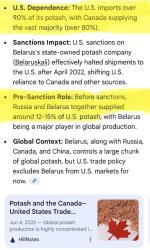
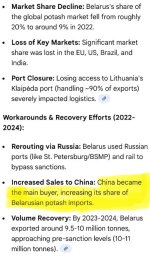
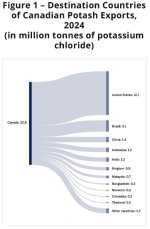
Now I’m assuming (I know, ass/u/ming) that the volume of potash imported from Russia to America of 11% in 2023 has decreased since that whole Ukraine invasion (I mean, I could be wrong here), and someone other that Belarus has been making up that shortfall? Rhymes with Zanada?
1765764803942.jpeg
1765764847387.jpeg
1765764865162.jpeg
1765764890262.jpeg
1765764914896.jpeg
The United States lifted sanctions on Belarusian potash exports on Saturday after Belarusian President Alexander Lukashenko freed 123 political prisoners, the largest release since diplomatic talks between Washington and Minsk began.
1765765170439.jpeg
1765765395207.jpeg
1765765858518.jpeg
1765765879095.jpeg
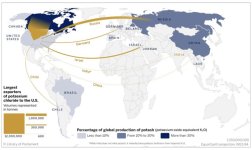
Canada supplies the vast majority of potash to the U.S., with recent data showing it accounts for over 80% to 87% of U.S. imports, primarily from Saskatchewan mines, a crucial source for American agriculture. The United States produces a very small percentage of its annual potash use domestically, typically around 2% to 10%, with recent data from 2023 and 2024 indicating a domestic production share closer to 2%.

America imports most of its potash because domestic reserves aren't enough to meet huge demand, Canadian potash is geographically close, cheaper to transport, and readily available via established infrastructure, unlike costly overseas options from Russia or Belarus which face political issues.

Developing new U.S. mines is time-consuming and expensive, and relying on other global suppliers introduces geopolitical risks and higher shipping costs…so maybe Trump can kickstart that before the 2026 planting season in…about 6-8 weeks or so?
 

Ron in Regina

"Voice of the West" Party
Apr 9, 2008
30,872
11,260
113
Regina, Saskatchewan
1766143706450.jpeg
Prime Minister Mark Carney says he does not expect that Canada and the U.S. will reach a near-term deal to end President Donald Trump’s tariffs on steel, aluminum, autos and other sectors, and that these negotiations will instead become part of a coming review of the pact that governs continental trade.
1766143782484.jpeg
Speaking to reporters in Ottawa on Thursday before signing an agreement with Ontario Premier Doug Ford to speed up approvals for infrastructure projects, Mr. Carney said the review of the United States-Mexico-Canada Agreement would absorb the talks on Mr. Trump’s punishing sectoral tariffs

The review of the deal, referred to as USMCA by the U.S. government and CUSMA by the Canadian government, is expected to happen next year, but an exact timeline has not been established.

This means that it could be another year, or more, before the countries reach an agreement to lift or reduce Mr. Trump’s levies, or not, prolonging the pain across several sectors of Canada’s economy.
 

pgs

Hall of Fame Member
Nov 29, 2008
28,818
8,262
113
B.C.
View attachment 32302
Prime Minister Mark Carney says he does not expect that Canada and the U.S. will reach a near-term deal to end President Donald Trump’s tariffs on steel, aluminum, autos and other sectors, and that these negotiations will instead become part of a coming review of the pact that governs continental trade.
View attachment 32303
Speaking to reporters in Ottawa on Thursday before signing an agreement with Ontario Premier Doug Ford to speed up approvals for infrastructure projects, Mr. Carney said the review of the United States-Mexico-Canada Agreement would absorb the talks on Mr. Trump’s punishing sectoral tariffs

The review of the deal, referred to as USMCA by the U.S. government and CUSMA by the Canadian government, is expected to happen next year, but an exact timeline has not been established.

This means that it could be another year, or more, before the countries reach an agreement to lift or reduce Mr. Trump’s levies, or not, prolonging the pain across several sectors of Canada’s economy.
It appears Carney was not really the best positioned to negotiate with the Donald . Who would have thought .
 

petros

The Central Scrutinizer
Nov 21, 2008
119,441
14,688
113
Low Earth Orbit
TIt appears Carney was not really the best positioned to negotiate with the Donald . Who would have thought .
Question. Which of the tariffs did Carney ask for?

Think about it. The short list of industries impacted are all energy intense. If they take a hit Canada wins on the Carbon Market.
 

pgs

Hall of Fame Member
Nov 29, 2008
28,818
8,262
113
B.C.
Question. Which of the tariffs did Carney ask for?

Think about it. The short list of industries impacted are all energy intense. If they take a hit Canada wins on the Carbon Market.
Wins what ?
 

Ron in Regina

"Voice of the West" Party
Apr 9, 2008
30,872
11,260
113
Regina, Saskatchewan
The Smoot-Hawley Tariff Act was active from its signing by President Herbert Hoover on June 17, 1930, and remained in effect, significantly impacting global trade through the early to mid-1930s, with its harsh effects leading to renegotiations and its eventual easing under President Franklin D. Roosevelt, with major trade shifts by the mid-1930s (around 1934).

Intended to bolster domestic employment and manufacturing, the tariffs instead deepened the Depression because the U.S.'s trading partners retaliated with tariffs of their own, leading to U.S. exports and global trade plummeting.
The process of opening world markets and expanding trade, initiated in the United States in 1934 and consistently pursued since the end of the Second World War, has played an important role in the development of American prosperity.

The U.S. shift towards free trade, beginning with the 1934 Reciprocal Trade Agreements Act(RTAA) and accelerating post-WWII through GATT/WTO, dramatically reduced global tariffs, boosted U.S. exports, encouraged competition, lowered consumer costs, and spurred American economic growth, making the U.S. a leading global economy by expanding markets and integrating it into a stable, prosperous world trade system.
1766937384141.jpeg
1766937568753.jpeg
1766937838081.jpeg
 

petros

The Central Scrutinizer
Nov 21, 2008
119,441
14,688
113
Low Earth Orbit
The Smoot-Hawley Tariff Act was active from its signing by President Herbert Hoover on June 17, 1930, and remained in effect, significantly impacting global trade through the early to mid-1930s, with its harsh effects leading to renegotiations and its eventual easing under President Franklin D. Roosevelt, with major trade shifts by the mid-1930s (around 1934).

Intended to bolster domestic employment and manufacturing, the tariffs instead deepened the Depression because the U.S.'s trading partners retaliated with tariffs of their own, leading to U.S. exports and global trade plummeting.
The process of opening world markets and expanding trade, initiated in the United States in 1934 and consistently pursued since the end of the Second World War, has played an important role in the development of American prosperity.

The U.S. shift towards free trade, beginning with the 1934 Reciprocal Trade Agreements Act(RTAA) and accelerating post-WWII through GATT/WTO, dramatically reduced global tariffs, boosted U.S. exports, encouraged competition, lowered consumer costs, and spurred American economic growth, making the U.S. a leading global economy by expanding markets and integrating it into a stable, prosperous world trade system.
View attachment 32461
View attachment 32462
View attachment 32463
You're old enough to remember the impact of tariffs Vs counter-tariffs.

I was pickled think when free trade came along. I didn't have to smuggle tools and auto parts from WA any longer.

Air tools had a 200% duty at the border so even with $0.69 cent dollar the savings made it highly lucrative to stuff a few Chicago Pneumatics 3/4' impact driver's under the back seat of my Lincoln Continental Town Car every couple weeks.
 
Last edited:
  • Like
Reactions: Ron in Regina

Ron in Regina

"Voice of the West" Party
Apr 9, 2008
30,872
11,260
113
Regina, Saskatchewan
You're old enough to remember the impact of tariffs Vs counter-tariffs.

I was pickled think when free trade came along. I didn't have to smuggle tools and auto parts from WA any longer.

Air tools had a 200% duty at the border so even with $0.69 cent dollar the savings made it highly lucrative to stuff a few Chicago Pneumatics 3/4' impact driver's under the back seat of my Lincoln Continental Town Car every couple weeks.
Knew a guy with a similar story from Eastern (centre of the Universe-ish) Canada, except it was marijuana he was smuggling up. They eventually busted him though for illegal parking.

He was thoroughly drunk, and he managed to park his Cadillac inside of his ex-wife’s living room. They frown on that, I guess.
 
  • Haha
Reactions: Dixie Cup

petros

The Central Scrutinizer
Nov 21, 2008
119,441
14,688
113
Low Earth Orbit
Knew a guy with a similar story from Eastern (centre of the Universe-ish) Canada, except it was marijuana he was smuggling up. They eventually busted him though for illegal parking.

He was thoroughly drunk, and he managed to park his Cadillac inside of his ex-wife’s living room. They frown on that, I guess.
I only got caught once but it was fireworks. Just a seizure, no penalty. I got lucky, normally a trip to Lummi Island Rez was "other goods".
 
  • Like
Reactions: Ron in Regina

Ron in Regina

"Voice of the West" Party
Apr 9, 2008
30,872
11,260
113
Regina, Saskatchewan
The United States lifted sanctions on Belarusian potash exports on Saturday after Belarusian President Alexander Lukashenko freed 123 political prisoners, the largest release since diplomatic talks between Washington and Minsk began.
Well, now for sure they don’t need Potash from Canada. Belarus on Tuesday released video of what it said was the deployment on its territory of the Russian nuclear-capable hypersonic Oreshnik missile system, a development that bolsters Moscow's ability to deliver missiles across Europe.

Moscow tested a conventionally armed Oreshnik – Russian for Hazel tree - against a target in Ukraine in November 2024. Putin boasts that it's impossible to intercept because of velocities reportedly exceeding Mach 10.

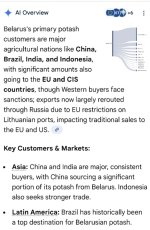
The top three potash-producing nations consistently include Canada, Russia, and Belarus, often followed by China, with Canada leading significantly, Russia and Belarus typically holding the second and third/fourth spots depending on the year and geopolitical factors affecting supply.

These countries, particularly Canada with its vast Saskatchewan reserves, dominate global production and exports, though supply chain issues and sanctions have sometimes shifted their market shares.
 

Ron in Regina

"Voice of the West" Party
Apr 9, 2008
30,872
11,260
113
Regina, Saskatchewan
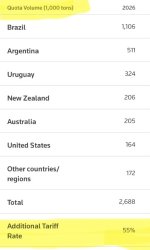
China will impose an added 55% tariff on beef imports that exceed quota levels from key suppliers including Brazil, Australia and the U.S. in a move to protect its domestic cattle industry.
1767313284986.jpeg
(As a weird side note, I’m seeing grass fed Australian beef on the shelves in Canada the last couple months, and maybe I’ve just never noticed it before, but it’s here now)

China's commerce ministry said on Wednesday the total import quota for 2026 for countries covered under its new "safeguard measures" is 2.7 million metric tons, roughly in line with the record 2.87 million tons it imported overall in 2024.

The new annual quota levels are lower than import levels for the first 11 months of 2025 for top supplier Brazil, and Australia.

"The increase in the amount of imported beef has seriously damaged China's domestic industry," the ministry said in announcing the measure following an investigation launched last December.

The measure takes effect on January 1 for three years, with the total quota set to increase annually.
 

petros

The Central Scrutinizer
Nov 21, 2008
119,441
14,688
113
Low Earth Orbit
China will impose an added 55% tariff on beef imports that exceed quota levels from key suppliers including Brazil, Australia and the U.S. in a move to protect its domestic cattle industry.
View attachment 32535
(As a weird side note, I’m seeing grass fed Australian beef on the shelves in Canada the last couple months, and maybe I’ve just never noticed it before, but it’s here now)
I'm see the the Aussie beast but only at Loblaws. I've seen Mexican at Sobeys last summer. Canadian beef fetches the big bucks so we rarely see AAA or Prime anymore.
 
  • Like
Reactions: Ron in Regina

Ron in Regina

"Voice of the West" Party
Apr 9, 2008
30,872
11,260
113
Regina, Saskatchewan
Big businesses will end up paying the most in tariffs because of the immense volume of goods they import. They have so far been in wait-and-see mode, viewing that as a better strategy than stirring up a feud with the temperamental president.

That phase of the tariff tussle appears to be ending. Costco, America’s 12th-largest publicly traded company by revenue and 15th-largest by number of employees, has filed suit at the U.S. Court of International Trade seeking refunds of the tariff money it has paid so far.

This suit confirms that American businesses pay American tariffs. If, as Trump believes, foreigners were paying them, there would be no reason for Costco to seek a refund. And Costco’s suit is one of many that will be filed as the thousands of American businesses robbed by the president seek their just recompense.

Costco says imported goods account for about one-third of its sales. The warehouse club is famous for its ruthlessness in cutting prices for its members. Obstacles to lower prices don’t normally include American customs officials running roughshod over the law.

Trump may lash out against Costco with one of his Truth Social tirades. But attacking a company that has mostly kept its prices low won’t go over well with inflation-weary voters. Nearly one-third of Americans shop at Costco, and they’re concentrated in the suburban areas so crucial to electoral success.
Big business is now acting on what small businesses felt instantly: Tariffs are taxes on Americans. The largest companies had enough money to absorb some of those costs for a while, but time is running out, and they don’t want to pass them on to their customers.
President Donald Trump's administration faces the possibility of having to refund more than $133.5 billion in tariffs to importers if the U.S. Supreme Court declares unlawful the duties he has imposed under the International Emergency Economic Powers Act, according to the U.S. Customs and Border Protection agency.

That is the total assessed through December 14, when the agency issued its most recent statistical update, on imports since the Republican president first imposed tariffs last February under the 1977 economic sanctions law meant to be used only during national emergencies.

The court, which in November heard arguments concerning the legality of Trump's IEEPA-based tariffs, is set to issue rulings in cases on Friday, but has not disclosed which ones. Online betting markets Kalshi and Polymarket give Trump a 30% and 23% chance of prevailing, respectively, versus around 40% on each platform prior to the arguments, when the justices signaled skepticism toward the tariffs.

It is also unclear whether the court would order refunds if it deems the duties illegal or leave that issue to lower courts or to the federal government to sort out.

Fentanyl-related tariffs were first imposed against goods from China on February 4 and on Canadian and Mexican goods that do not comply with a North American trade agreement on March 4.

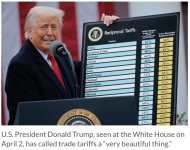
Trump's "reciprocal" duties on goods from countries from 10% to 50% were first imposed on April 5, with subsequent reductions in some cases as a result of trade negotiations. Additional punitive duties of 40% were imposed on goods from Brazil on August 6, while Indian goods were hit with an additional punitive 25% duty on August 27.
 

spaminator

Hall of Fame Member
Oct 26, 2009
39,665
3,695
113
New study questions viability of an all-Canadian car company
Industry study says startup costs could reach $20 billion

Author of the article:Norman De Bono
Published Jan 06, 2026 • Last updated 1 day ago • 4 minute read

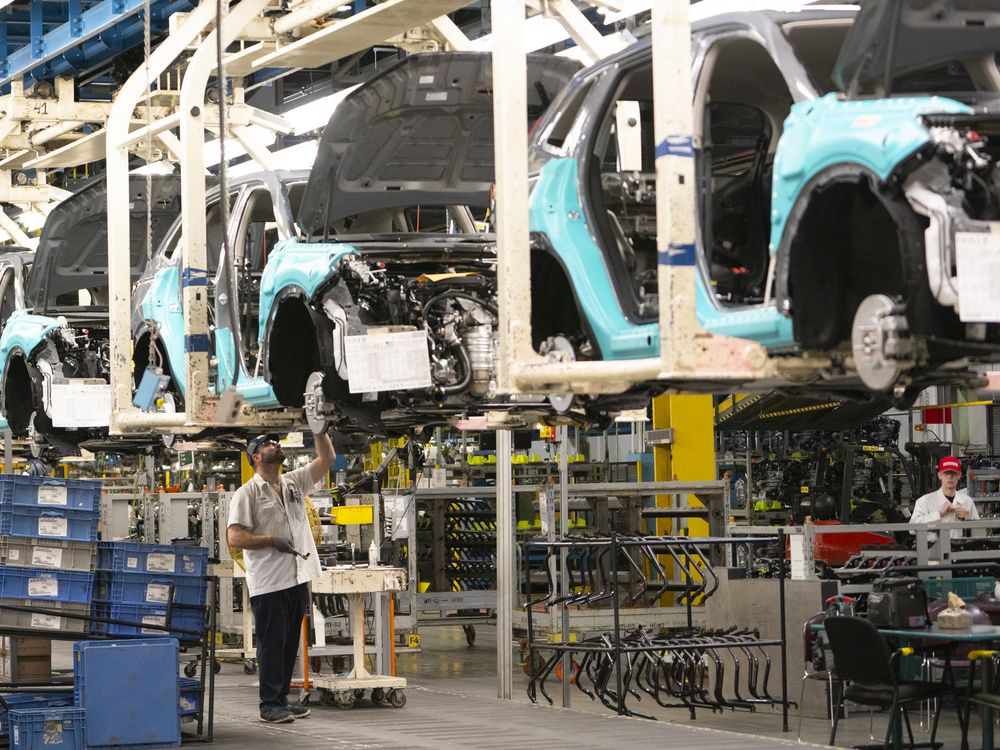
Workers assemble vehicles shortly before the line was shut down for an event at Honda of Canada Manufacturing Plant 2 in Alliston on April 25, 2024. (Peter Power/AFP via Getty Images)
Canada’s automotive industry is beginning to debate whether it’s time for an all-Canadian-made vehicle to reduce reliance on U.S.-based automakers, says an industry observer.


The London-based Trillium Network for Advanced Manufacturing released a study Tuesday examining the viability of creating an all-Canadian car company.


While Canada has the know-how and resources, the hurdles to making it happen may be too high, said Brendan Sweeney, Trillium’s chief executive and co-author of the report, Shifting Gears: The potential for a Canadian car company.

“We should have a conversation about whether to entertain the idea. We need to understand if it’s feasible, the investment that’s required and the likelihood of a return,” Sweeney said.

He believes, based on other countries creating national automakers, that it could cost as much as $20 billion to get off the ground. The largest hurdle may be finding a vehicle that will sell. While there were once opportunities for new vehicles such as minivans and sport utility vehicles that did not exist then, the sector is now saturated.
“The biggest challenge is coming up with the right idea that doesn’t exist, that people want,” Sweeney said. “We have all the stuff we need, but this report is meant to be part of the conversation, and it will continue throughout the year.”


The report notes Canada already has a vehicle-manufacturing sector that operates largely under the radar, producing buses, military vehicles and even the three-wheeled Can-Am Spyder, which is closer to a motorcycle than a car.

But producing a mass-market vehicle presents a higher bar.

“It’s likely that this much-discussed Canadian car company will remain elusive for the time being. Capital requirements in the billions serve as a barrier to entry and profitability. So does the monumental task of designing a vehicle that meets consumer needs and manufacturing it profitably,” the report states.

Still, Sweeney said the conversation is important and ongoing.

He expects discussions about a Canadian vehicle to be led by the parts sector, pointing to Magna and Linamar as global leaders with the capacity to drive the conversation.

The Automotive Parts Manufacturers’ Association previously created Project Arrow, an all-Canadian electric vehicle prototype that was shown at auto shows and in communities – including London in 2024 – to demonstrate that the components needed to build such a car exist in Canada.


Flavio Volpe
Flavio Volpe, head of the Automotive Parts Manufacturers’ Association, displays the Project Arrow concept vehicle at RBC Place in London on April 8, 2024. (Derek Ruttan/The London Free Press)
“This is an interesting inventory of Canadian vehicle innovations and achievements. All are great examples of the capabilities that exist in Canada. But they do not constitute the elusive ‘Canadian car company’ or come close to replacing the vehicle-assembly jobs lost over the past two decades,” the report states.

“Nor would they represent a robust market for Canadian-made automotive parts if U.S.-based automakers continue to scale back production in Canada.”

The report defines a Canadian car company as one that designs and assembles vehicles in Canada and sells them domestically and abroad. It would require investment in the billions and would likely need Canadian engineers currently working in the U.S. auto industry to return home, the report added.

For now, Sweeney said the priority for the automotive industry is renewing the Canada-U.S.-Mexico trade agreement, known as CUSMA, with talks ongoing.

“We’re making progress,” Sweeney said about the trade talks. “We’re holding out faith. We may never get back to the Auto Pact or even NAFTA, but there will be something, and we will go from there.”


The Auto Pact was an agreement between Canada and the United States that ensured U.S. automakers assembled vehicles in Canada in exchange for access to the Canadian market. NAFTA, the continent-wide trade agreement, allowed some goods to move back and forth without tariffs.

The conversation could become more urgent “if we get into a rough spot” in U.S. trade talks, Sweeney added.

“If we’re going to have this conversation, let’s make it based on good information,” he said. “This report is not the beginning or the end of the conversation – it is part of the conversation.”

As for domestic production, Canada built more than 2.3 million vehicles annually throughout the 1990s. At its peak in 1999, more than three million vehicles were produced, the report states.

The annual average rose to more than 2.5 million units in the 2000s as Toyota and Honda increased production. It then fell to 2.2 million units in the 2010s. In the first half of the 2020s, annual vehicle production averaged 1.3 million units.
In 2005, U.S.-based automakers assembled more than 74 per cent of vehicles made in Canada. Since 2020, Japan-based automakers have accounted for more than half of vehicles assembled domestically.
Recently, Turkey and Mexico announced plans to create national automakers, joining established European and Asian producers in smaller markets making the leap.

The report was posted Tuesday morning on the Trillium website and was co-authored by automotive writer Greg Keenan.

ndebono@postmedia.com
 

Dixie Cup

Senate Member
Sep 16, 2006
6,472
4,076
113
Edmonton
President Donald Trump's administration faces the possibility of having to refund more than $133.5 billion in tariffs to importers if the U.S. Supreme Court declares unlawful the duties he has imposed under the International Emergency Economic Powers Act, according to the U.S. Customs and Border Protection agency.

That is the total assessed through December 14, when the agency issued its most recent statistical update, on imports since the Republican president first imposed tariffs last February under the 1977 economic sanctions law meant to be used only during national emergencies.

The court, which in November heard arguments concerning the legality of Trump's IEEPA-based tariffs, is set to issue rulings in cases on Friday, but has not disclosed which ones. Online betting markets Kalshi and Polymarket give Trump a 30% and 23% chance of prevailing, respectively, versus around 40% on each platform prior to the arguments, when the justices signaled skepticism toward the tariffs.

It is also unclear whether the court would order refunds if it deems the duties illegal or leave that issue to lower courts or to the federal government to sort out.

Fentanyl-related tariffs were first imposed against goods from China on February 4 and on Canadian and Mexican goods that do not comply with a North American trade agreement on March 4.

Trump's "reciprocal" duties on goods from countries from 10% to 50% were first imposed on April 5, with subsequent reductions in some cases as a result of trade negotiations. Additional punitive duties of 40% were imposed on goods from Brazil on August 6, while Indian goods were hit with an additional punitive 25% duty on August 27.
So from what I understand, it's ok to tariff the hell out of the U.S. but not the other way around. Huh, who knew? That's what Trump is trying to fix & using tariffs as leverage. Oh well, it is what it is.