New study questions viability of an all-Canadian car company
Industry study says startup costs could reach $20 billion
Author of the article:Norman De Bono
Published Jan 06, 2026 • Last updated 1 day ago • 4 minute read
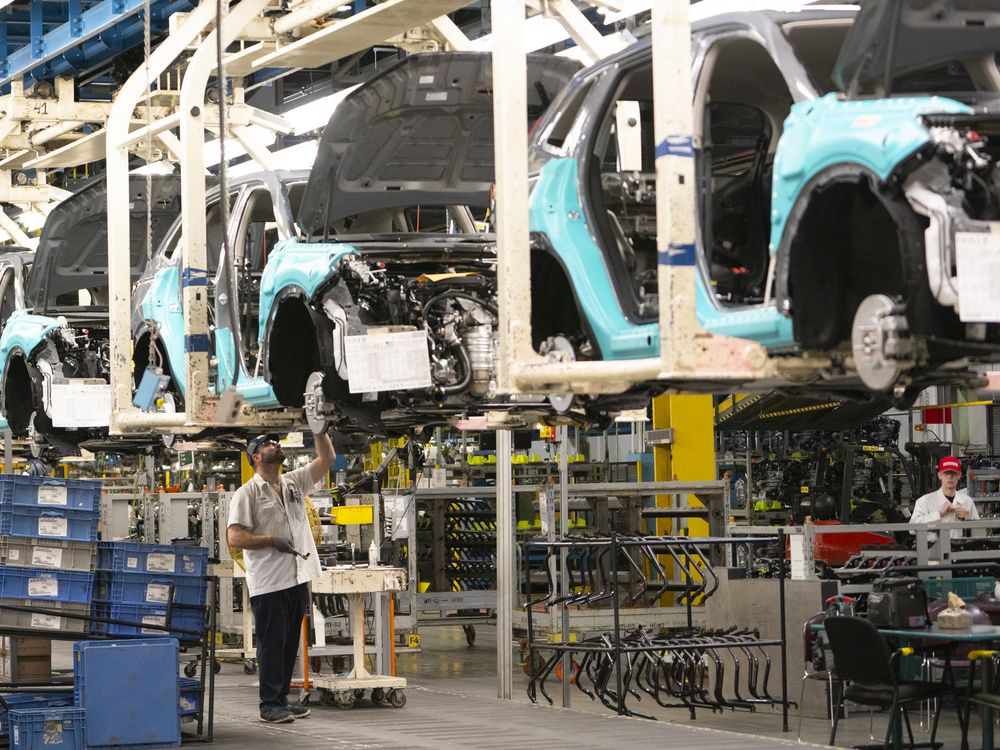
Workers assemble vehicles shortly before the line was shut down for an event at Honda of Canada Manufacturing Plant 2 in Alliston on April 25, 2024. (Peter Power/AFP via Getty Images)
Workers assemble vehicles shortly before the line was shut down for an event at Honda of Canada Manufacturing Plant 2 in Alliston on April 25, 2024. (Peter Power/AFP via Getty Images)
Canada’s automotive industry is beginning to debate whether it’s time for an all-Canadian-made vehicle to reduce reliance on U.S.-based automakers, says an industry observer.
The London-based Trillium Network for Advanced Manufacturing released a study Tuesday examining the viability of creating an all-Canadian car company.
While Canada has the know-how and resources, the hurdles to making it happen may be too high, said Brendan Sweeney, Trillium’s chief executive and co-author of the report, Shifting Gears: The potential for a Canadian car company.
“We should have a conversation about whether to entertain the idea. We need to understand if it’s feasible, the investment that’s required and the likelihood of a return,” Sweeney said.
He believes, based on other countries creating national automakers, that it could cost as much as $20 billion to get off the ground. The largest hurdle may be finding a vehicle that will sell. While there were once opportunities for new vehicles such as minivans and sport utility vehicles that did not exist then, the sector is now saturated.
“The biggest challenge is coming up with the right idea that doesn’t exist, that people want,” Sweeney said. “We have all the stuff we need, but this report is meant to be part of the conversation, and it will continue throughout the year.”
The report notes Canada already has a vehicle-manufacturing sector that operates largely under the radar, producing buses, military vehicles and even the three-wheeled Can-Am Spyder, which is closer to a motorcycle than a car.
But producing a mass-market vehicle presents a higher bar.
“It’s likely that this much-discussed Canadian car company will remain elusive for the time being. Capital requirements in the billions serve as a barrier to entry and profitability. So does the monumental task of designing a vehicle that meets consumer needs and manufacturing it profitably,” the report states.
Still, Sweeney said the conversation is important and ongoing.
He expects discussions about a Canadian vehicle to be led by the parts sector, pointing to Magna and Linamar as global leaders with the capacity to drive the conversation.
The Automotive Parts Manufacturers’ Association previously created Project Arrow, an all-Canadian electric vehicle prototype that was shown at auto shows and in communities – including London in 2024 – to demonstrate that the components needed to build such a car exist in Canada.
Flavio Volpe
Flavio Volpe, head of the Automotive Parts Manufacturers’ Association, displays the Project Arrow concept vehicle at RBC Place in London on April 8, 2024. (Derek Ruttan/The London Free Press)
“This is an interesting inventory of Canadian vehicle innovations and achievements. All are great examples of the capabilities that exist in Canada. But they do not constitute the elusive ‘Canadian car company’ or come close to replacing the vehicle-assembly jobs lost over the past two decades,” the report states.
“Nor would they represent a robust market for Canadian-made automotive parts if U.S.-based automakers continue to scale back production in Canada.”
The report defines a Canadian car company as one that designs and assembles vehicles in Canada and sells them domestically and abroad. It would require investment in the billions and would likely need Canadian engineers currently working in the U.S. auto industry to return home, the report added.
For now, Sweeney said the priority for the automotive industry is renewing the Canada-U.S.-Mexico trade agreement, known as CUSMA, with talks ongoing.
“We’re making progress,” Sweeney said about the trade talks. “We’re holding out faith. We may never get back to the Auto Pact or even NAFTA, but there will be something, and we will go from there.”
The Auto Pact was an agreement between Canada and the United States that ensured U.S. automakers assembled vehicles in Canada in exchange for access to the Canadian market. NAFTA, the continent-wide trade agreement, allowed some goods to move back and forth without tariffs.
The conversation could become more urgent “if we get into a rough spot” in U.S. trade talks, Sweeney added.
“If we’re going to have this conversation, let’s make it based on good information,” he said. “This report is not the beginning or the end of the conversation – it is part of the conversation.”
As for domestic production, Canada built more than 2.3 million vehicles annually throughout the 1990s. At its peak in 1999, more than three million vehicles were produced, the report states.
The annual average rose to more than 2.5 million units in the 2000s as Toyota and Honda increased production. It then fell to 2.2 million units in the 2010s. In the first half of the 2020s, annual vehicle production averaged 1.3 million units.
In 2005, U.S.-based automakers assembled more than 74 per cent of vehicles made in Canada. Since 2020, Japan-based automakers have accounted for more than half of vehicles assembled domestically.
Recently, Turkey and Mexico announced plans to create national automakers, joining established European and Asian producers in smaller markets making the leap.
The report was posted Tuesday morning on the Trillium website and was co-authored by automotive writer Greg Keenan.
ndebono@postmedia.com
Industry study says startup costs could reach $20 billion.

torontosun.com