(YouTube & Trump’s 100-Year Plan for Venezuela’s Oil | The Palki Sharma Show)
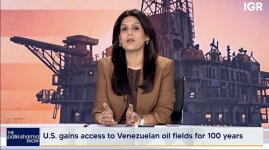
President Trump’s oil deal with Venezuela does not legally ban Venezuela from refining its own oil, but the agreement focuses
entirely on extracting and exporting crude oil through a U.S.-backed private venture to supply external markets.
U.S. President Donald Trump's oil deal with interim Venezuelan President Delcy Rodriguez is being rejected by the Venezuelan opposition, and by some in her own party. Venezuelan Canadians, some with long careers in the oil industry, say the deal is illegitimate and will be repudiated.

apple.news
Terms of the Agreement
- Sovereignty: Interim Venezuelan President Delcy Rodríguez stated that Venezuela officially retains ownership and sovereignty over its natural resources?
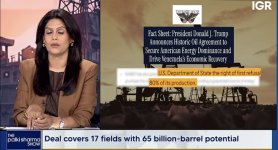
Concessions: The deal grants 100-year operating rights for 17 oil fields to North American Blue Energy Partners (NABEP), a private company.
U.S. Stake: The U.S. Pentagon holds a 35% equity stake in the venture and secures the right to buy 20% of the oil output at production cost so without profit.
The Reality of Refining
- Export Focus: The primary goal of the arrangement is to extract heavy crude oil and ship it to external refineries, particularly in the United States, to replenish the Strategic Petroleum Reserve and lower fuel costs.
Infrastructure Decay: Decades of neglect have left Venezuela’s local refining infrastructure [PDVSA] in a state of severe disrepair, meaning the country currently lacks the operational capacity to refine much of its own oil effectively.
The U.S. State Department secures the right of first refusal to buy the remaining 80% of the oil output, and any portion not claimed by the U.S. is sold commercially on the open market by North American Blue Energy Partners.
Handling the Remaining 80%
Right of First Refusal: The State Department has priority access to purchase or direct the rest of the oil produced by the venture before it goes elsewhere.
Open Market Sales: If the U.S. government declines to buy a portion of that 80%, the private operating company sells it at market rates.
Local Revenues: Sales of the remaining oil generate funds that support the agreed-upon tax and royalty payments toward Venezuelan infrastructure.
The terms of U.S. President Donald Trump's oil deal with Venezuela are highly similar in intent and structure to what his administration demanded from Canada before their trade talks collapsed.
Both situations reflect a consistent "America First" strategy focused on securing total or preferred access to vital foreign resource chains via ownership stakes, board control, and purchase mandates.
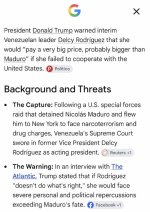
Delcy Rodríguez was installed as interim president on 5 January, two days after the president, Nicolás Maduro, was abducted by US special forces during a predawn raid on Caracas.
Trump warned Rodríguez, who was Maduro’s vice-president, she would face an even worse fate if she did not toe the US line.
“
We are very happy with the president-elect (?) that we have right now, the people that are running it," Trump said on Tuesday. (Rodriguez has not, in fact, been elected to the post.)
Since Maduro’s capture, Rodríguez has made a series of once unthinkable concessions to US officials who their nominally socialist political movement, Chavismo, had spent years denouncing as predatory imperialists bent on stealing Venezuela’s natural resources.

Neither U.S. President Donald Trump and U.S. Secretary of State Marco Rubio's social media posts, nor a White House statement, nor Rodriguez's speech clarified exactly how or when 17 Venezuelan oilfields would be rejuvenated and start producing the 65 billion barrels covered by Trump's "
biggest oil deal ever."

Under the current terms of the historic U.S.-Venezuela oil deal orchestrated by the Trump administration,
the domestic Venezuelan oil refining industry will not benefit in any meaningful capacity, as the agreement is fundamentally designed for extraction to supply U.S. refineries, for at least the next four generations of the Venezuelan population.
Energy secretary Chris Wright denies US seeks to ‘take’ country’s oil, saying deal is transformation of relations

www.theguardian.com
During intense trade talks, the Trump administration pushed for
a blanket Right of First Refusal (ROFR) and
exclusive access over Canada's highly coveted critical minerals and rare earth elements (including lithium, nickel, cobalt, and graphite).
This is structurally identical to the historic ‘deal’ Washington imposed on Venezuela following the capture of Nicolás Maduro. In Venezuela, the U.S. seized control of the country’s vast oil reserves by granting long-term concessions to a private operator,
locking in a right of first refusal on crude production and
securing veto power over board appointments…for the next 100 years.
Economic and mining experts noted that giving the U.S. a ROFR on Canadian soil was a "non-starter" and completely unworkable. It would have legally transformed sovereign Canadian territory into a de facto extraction zone for the Pentagon,
allowing Washington to unilaterally veto or divert mineral sales already under contract with other global allies.