Refugee/Migrant Crisis

spaminator

Hall of Fame Member
Oct 26, 2009
40,339
3,918
113
Sicko asylum seeker who filmed UK sexual assault earlier convicted of murder

Author of the article:Brad Hunter
Published Apr 24, 2026 • Last updated 1 day ago • 2 minute read

AUTEUR! AUTEUR! Karin Al-Danasurt, 20, was found guilty of four counts of rape as a secondary party. SUSSEX POLICE
AUTEUR! AUTEUR! Karin Al-Danasurt, 20, was found guilty of four counts of rape as a secondary party. Photo by SUSSEX POLICE
The UK appears to be taking a page out of Canadian immigration policy.


An asylum seeker who filmed a woman being gang raped on a beach had earlier been convicted of murder in Egypt, British prosecutors said.


According to UK media reports Karin Al-Danasurt, 20, was found guilty of four counts of rape as a secondary party. The Egyptian national encouraged and then filmed the horrific attack last October.

Al-Danasurt, along with Ibrahim Alshafe, 25, and Iranian Abdulla Ahmadi, 26, who were each found guilty of two counts of rape, were convicted after a trial in Hove Crown Court.

Will they be deported?
The three monsters crossed the English Channel by boat and were awaiting decisions on their asylum claims.

Prosecutors revealed that Al-Danasurt had been convicted of murder in his absence in Egypt, adding that the basis of his asylum claim was that he fled the country to “evade a lengthy custodial sentence.”

No, no, his legal eagle said. It was his BROTHER. A judge ruled to keep the murder conviction super secret. Al-Danasurt was previously given a caution for “criminal damage.”


An ‘appalling crime’
Sadly, court heard it was “not a foregone conclusion that these defendants will be deported”, adding “I am not the Home Office” when asked about reports to determine whether the rapists meet the threshold for extended sentences.

However, border security and asylum minister Alex Norris said: “Once sentencing has taken place, we will move to deport them off British soil.”

ASYLUM-SEEKING RAPISTS: Abdullah Ahmadi, Ibrahim Alshafe and Karin Al-Danasurt. (SUSSEX POLICE)
The trio had only been in the country for several months when they committed the gang rape. Alshafe’s asylum application had been refused on Oct. 3, but he told the court he did not know about the update to his case before going to Brighton that night. Convicted killer Al-Danasurt had been in the country about four years.

Under current law, most foreign nationals in British prisons can be considered for removal after serving 30% of their custodial sentence. They are then barred from ever returning to the UK.

‘People taking our country for a ride’
Norris added: “My thoughts are first and foremost with the victim of this appalling crime, and with all those who have been affected by it.


“What she endured is deeply disturbing, and I commend her bravery in coming forward and reporting these vile individuals. I share the public’s outrage in their horrendous actions.

“The perpetrators have now been rightly convicted, and justice has been delivered by the courts. Once sentencing has taken place, we will move to deport them off British soil.”

x
These nine men were convicted of being members of a sex grooming gang who raped vulnerable underage girls.
Kemi Badenoch, leader of the Conservative Party, told reporters: “There are people who are taking our country for a ride, are coming here trying to claim asylum, which is for genuine refugees, when really they come here to do harm to others. This is why it’s really important that we solve this small boats crisis, that’s why I’ve changed the Conservative Party policy.”

Foreign-born criminals, particularly Muslim rape gangs, have become an increasing problem in the UK. The predatory activities frequently target vulnerable white girls who are then gang-raped, hooked on drugs and forced into prostitution.

However, for years, authorities did not act because they worried arrests and trials might harm “social cohesion.”

bhunter@postmedia.com

@HunterTOSun
 

spaminator

Hall of Fame Member
Oct 26, 2009
40,339
3,918
113
'Gross mismanagement' and other cases of wrongdoing found at Immigration department, report says
In recent years, several departments have begun publishing misconduct and wrongdoing reports pointing to greater efforts of transparency and accountability. The reports also follow a renewed focus on values and ethics in recent years within the federal public service.

Author of the article:Matteo Cimellaro
Published May 18, 2026 • 3 minute read

OTTAWA - May 18, 2026-- C.D. Howe building in downtown Ottawa Monday. Photo for an Immigration Canada story. TONY CALDWELL, Postmedia.
OTTAWA - May 18, 2026-- C.D. Howe building in downtown Ottawa Monday. Photo for an Immigration Canada story. TONY CALDWELL, Postmedia. Photo by Tony Caldwell /Postmedia
An executive engaging in “gross mismanagement” by giving preferential treatment to a romantic partner, another executive attempting to hire a niece and an employee holding down another full-time job in the public service.


Those are among the cases of misconduct and wrongdoing found at Immigration, Citizenship and Refugee Canada (IRCC), which is the latest department to publish their report on misconduct and wrongdoing for the 2024-2025 fiscal year.


The cases ranged from the innocuous such as calling in sick to attend a conference, to blogging as a self-identified Canadian diplomat where they expressed political views and “discussed aspects of their work at the embassy, including private conversations with embassy staff and views on the country’s people and government.”

Some other founded cases include cases of racism, sexual harassment, claiming overtime not worked and an employees providing false references in a staffing process that led to an acting opportunity elsewhere in governments

In total, IRCC said it had 105 cases of misconduct and wrongdoing within the department leading to a handful of terminations.

There one founded case of fraud and financial misconduct at IRCC; 22 cases of harassment, violence and disrespectful behaviours; and eight breaches of values and ethics codes.


There were also 56 cases of administrative misconduct, 13 violations of the department’s directive on the use of networks and devices, two personnel security violations and three staffing complaints.

Three employees at IRCC lost their jobs, another was taken off of a staffing pool, while an executive voluntarily left the public service before disciplinary action could occur.

Dozens of other disciplinary measures at IRCC ranged from written reprimands to suspensions to forcing the recovery of funds to the federal government over time theft.

Ted Gallivan, deputy minister at IRCC, wrote at the beginning of the report that “some level” of wrongdoing will occur in an organization of more than 10,000 employees.

“Reporting such matters is essential, as we are committed to reviewing all allegations of perceived misconduct or wrongdoing through thorough review and investigation, and to taking administrative action when warranted,” Gallivan wrote.


In the report, Gallivan also says that IRCC established an ombuds office where employees can raise workplace concerns without fear of reprisal.

“The Ombuds Office supports employees in exploring options and navigating available resources to help resolve workplace issues,” Gallivan added.

IRCC could not be immediately reached for comment.

In recent years, several departments have released misconduct and wrongdoing reports, aiming to increase transparency and accountability within federal departments.

Over the past year, Environment and Climate Change Canada, the Department of Justice, Transport Canada and other federal departments have published their inaugural reports on misconduct and wrongdoing.

Other departments publish misconduct and wrongdoing reports for 2024-2025
Earlier this year, Global Affiars Canada published their report on misconduct and wrongdoing for the 2024-2025 fiscal year that saw 120 cases resulting in disciplinary or administrative measures.


Wrongdoing accounts at the department included an employee’s family member misuse a Crown-issued credit card, an employee using an employer credit card to buy personal plane tickets and sexual misconduct from an executive in one of Canada’s missions abroad.

Several employees at GAC were terminated due to wrongdoing.

At the Canada Border Services Agency (CBSA), there were 259 founded cases of misconduct resulting in four terminations and 14 employees leaving the agency.

Instances of wrongdoing at the agency include associating with a known drug traffickers, driving a CBSA vehicle while intoxicated and hiring family members or friends.

The report says that incident of misconduct and wrongdoing at CBSA occurred in around 1.52 per cent of employees at the CBSA.

At Transport Canada, there were 58 founded cases of misconduct and wrongdoing. The bulk of cases were breaches to the code of professional conduct, making up 53 of the founded cases.


Some founded cases led to a resignation, including an employee who conducted personal business during work hours and used Transport Canada to travel to the location where the business activity occurred.

The Canada Revenue Agency (CRA), Impact Assessment Agency of Canada (IAAC) and Crown-Indigenous Relations and Northern Affairs Canada (CIRNAC) are among other departments and agencies who published 2024-2025 misconduct and wrongdoing reports over the past several months.

The CRA had a total of 370 cases of founded misconduct including mishandling sensitive data.

Meanwhile, the IAAC had no cases of founded misconduct, and CIRNAC had only seven cases of founded misconduct, including submission of falsified medical documents to justify telework and misuse of a departmental travel card.
 
  • Like
Reactions: Taxslave2

spaminator

Hall of Fame Member
Oct 26, 2009
40,339
3,918
113
CBSA's most wanted list nabbed dozens of villains. Then Trudeau killed it
In 2015, Canada elected a very woke new sheriff. Virtue signalling trumped governance and safety


Author of the article:Brad Hunter
Published May 26, 2026 • Last updated 16 hours ago • 3 minute read

ENJOY YOUR STAY! Some of the accused in the Peel extortion sweep. PRPS
There are 17 of them accused in a widespread campaign of terror and extortion of South Asians in Brampton.


None of them are Canadians but we wouldn’t know that, would we?


Instead, cops, prosecutors, the Canada Border Services Agency, and others will serve up their usual po-faced approach and start scolding you for suggesting there is a problem of foreign criminals in this country.

If a triple killer from Burundi was standing beside us, we wouldn’t know because CBSA won’t release that information using the Berlin Wall of obfuscation: Our privacy laws.

It wasn’t always this way.

Peel police extortion accused.
List started with Harper, ended with Trudeau
In 2011, Prime Minister Stephen Harper’s government launched the CBSA Most Wanted page. Dozens of baddies were nabbed and given the boot. On a weekly basis the agency published releases claiming they had nabbed this killer or that rapist or this war criminal.

But in 2015, Canada elected a very woke new sheriff. Virtue signalling trumped governance and safety.

And in 2023, CBSA — taking orders from then Prime Minister Justin Trudeau — ever so quietly, secret squirrel like, took down the most wanted page. A flurry of nonsensical excuses followed.


“That was all Justin Trudeau,” one CBSA source told the Toronto Sun. “He thought it was mean and he thought it was racist. It was neither of those things. What it did do was raise public awareness and help us catch these people and deport them.”

The source added: “And now, when we flag them, the bureaucrats and the government will do everything in their power to block us. They do not want to upset certain demographics.”

Former prime ministers Justin Trudeau (left) and Stephen Harper are pictured ahead of King Charles’ speech from the Throne to open the first session of the 45th Parliament of Canada at the Senate of Canada, in Ottawa on May 27, 2025.
NOT LIKE THE OTHER: Former prime ministers Justin Trudeau (left) and Stephen Harper are pictured ahead of King Charles’ speech from the Throne to open the first session of the 45th Parliament of Canada at the Senate of Canada, in Ottawa on May 27, 2025. Photo by VICTORIA JONES/POOL /AFP via Getty Images
The list was never like the U.S. Immigration and Customs Enforcement (ICE) tactics. Instead, it featured high-risk foreign nationals and suspected war criminals, not Joe in the kitchen at the diner next door.

Dozens of bad guys were arrested and booted during the list’s run.

But Trudeau being Trudeau, listened to every sob story, every diaspora political group, every grievance industry stalwart. He weeped, he kneeled and vowed that he would personally will this feckless post-national state into woke conformity using his staggering magnetism, genius and all-around coolness.


Now, as anyone who hasn’t had their head buried in the sand knows, there are no longer hundreds of foreign-born criminals wandering the streets of Canada.

There are thousands.

Faizan Ali, wanted by cops, was allegedly confident enough to cross into the U.S. to smuggle guns. HPS
Sharing info can help stop crime
More recently, releasing wanted Pakistani national Faizan Ali’s photo and description might have saved a lot of heartache. Ali, 25, who lives in Hamilton, was pinched in New York State for allegedly trying to smuggle 89 guns into Canada.

The Toronto Sun later learned that Ali has been on the run from cops in Hamilton since 2024 in connection with the death of a motorcyclist. He was also facing an 11-year sentence for weapons and drug offences. He was released on bail and didn’t show up for the sentencing.

WHAT HAVE WE HERE? Cops in New York have thwarted a massive gun smuggling ring attempting to bring guns to Canada. NYSP
Normally, an 11-year-sentence should theoretically eliminate bail for a non-citizen. Well, you would be wrong. He is now the Americans’ problem and will likely find the judges and system much less empathetic.

Now, cops in Peel have swept the streets somewhat clean of the South Asian extortionist gangs. As my friend and colleague Joe Warmington reported Monday in the Sun, the gangs squeezed off more than 300 gunshots to show they meant business.

The accused are all from India, with some being alleged members of the For Brothers gang. One, Sukwinder Singh, is also wanted for an attempted murder in India.

But, always remember: Feelings and vibes are the ultimate in governance.

bhunter@postmedia.com

@HunterTOSun
 

spaminator

Hall of Fame Member
Oct 26, 2009
40,339
3,918
113
Refugee health program abuse is costing you, but Liberals ignore it
Vast majority in 'refugee' health program came to Canada as students or foreign workers and then claimed asylum.


Author of the article:Brian Lilley
Published May 26, 2026 • 3 minute read

The Nav Centre in Cornwall, Ont. awaits the next wave of refugees on Aug. 19, 2017.
The Nav Centre in Cornwall, Ont. awaits the next wave of refugees on Aug. 19, 2017. Photo by GEOFF ROBINS /GETTY IMAGES
See more Toronto Sun on Google — save as a Preferred Source


There are tens of thousands of people in Canada who are getting taxpayer-funded health benefits from a program for refugees despite having their refugee claim denied. That’s one of the big headlines from a new report by the Parliamentary Budget Officer.


Earlier this year, the PBO revealed that the cost of the Interim Federal Health Program, which covers refugee and asylum claimants, had risen from $60 million a year to close to $1 billion annually.

On Tuesday, in a follow-up report that broke down the program further, the PBO revealed that roughly 74,000 failed refugee claimants, “defined as individuals who made a claim for refugee protection in Canada and did not obtain protection,” were still accessing this gold-plated health plan despite being subject to a removal order — meaning they had been ordered deported from Canada.

“In addition, 27,759 failed claimants were in the wanted inventory, meaning they were subject to an enforceable removal order who failed to appear for removal proceedings and the CBSA is working to locate the foreign national,” the new report said.


This is nothing short of an abuse of the system caused by a system that incentivizes abuse.

Temporary program being abused by thousands
The IFHP is supposed to give stop-gap health coverage to refugee and asylum claimants until they qualify for provincial or territorial health benefits once their applications are approved. The problem with the IFHP is that it provides a level of health services that most Canadians don’t get from their own government health plans, including physiotherapy, eye care, dental services and more.

This is part of the incentive system for those looking to abuse the program.

Resettled refugees were on this program for an average of three months before transitioning to a provincial program. The PBO report found that for fiscal year 2024-25, the average duration of coverage for asylum claimants was roughly four years.

The people sitting in this system using up expensive health benefits aren’t even real refugees. They are mostly people who came to Canada as international students, on visitors’ visas or as temporary foreign workers and then claimed asylum.


“Since 2023, claimants with prior temporary resident approval have accounted for an average of 79 per cent of all claims, up from 52 per cent in the pre pandemic period,” the PBO report stated.

More than 74,000 rejected refugee claimants are still getting a gold-plated health program paid for by the federal government. TORONTO SUN GRAPHICS
Liberals took over a program that worked and failed to manage it properly
This program, which has only grown due to Liberal mismanagement of the program and the asylum/refugee program over the last decade, cost $822 million in 2024-25 and is expected to cost more than $1 billion this year. The Carney government has introduced co-payments for some services, such as prescription drugs.

That is expected to save some money for taxpayers going forward, but those savings could be easily wiped out due to the government not managing how many people are claiming asylum or the backlog in getting hearings processed.

Each one-month processing delay would add $72 to $92 million annually to the cost of the program.


Question about abuse dismissed by Liberals
In response to serious questions about this in the House of Commons on Tuesday, Liberal House Leader Steve MacKinnon tried to paint the Conservatives who were asking questions as heartless.

“Why are conservatives against providing health care to some of the most vulnerable people on this earth?” MacKinnon asked.

The most vulnerable people on earth come to Canada as visitors and then claim asylum? That’s what the PBO report said 79% of those in the program of late are doing.

The Liberals are simply trying to deflect away from their incompetence.

This program is being abused just like the asylum system is being abused, all due to Liberal mismanagement. They want to imply that you are an uncaring racist if you question their incompetence.

That’s a failure on their part.
health-program[1].jpg
 

Dixie Cup

Senate Member
Sep 16, 2006
6,665
4,208
113
Edmonton
Same thing here, only Trump killed it. He prefers race to crime as a deportation criterion.
I call unadulterated BULL SHIT!! Canada is an unmitigated disaster whereas the U.S. still has promise as long as the Democrats NEVER retain power. The Democrats have a LOT of "cleaning up" to do before they can ever retain power again. However, I'm sure that won't happen & the U.S. will go downhill JUST LIKE CANADA IS NOW. Good luck!!
 

Tecumsehsbones

Hall of Fame Member
Mar 18, 2013
61,680
10,300
113
Washington DC
I call unadulterated BULL SHIT!! Canada is an unmitigated disaster whereas the U.S. still has promise as long as the Democrats NEVER retain power. The Democrats have a LOT of "cleaning up" to do before they can ever retain power again. However, I'm sure that won't happen & the U.S. will go downhill JUST LIKE CANADA IS NOW. Good luck!!
Yawn. Yes, D-Cup, the Democrats are EEE-vil SOSHULISTS who want to D'STROY MURKA, and only one-party rule by the honest, righteous, morally-upright Republicans can save us from becoming Commiestan.

Whatthefuckever.
 

spaminator

Hall of Fame Member
Oct 26, 2009
40,339
3,918
113
U.S. Census Bureau says majority of U.S. will be non-white by 2050
West Virigina is the most least etnically diverse state with 89% of it population in 2020 being white people

Author of the article:Jane Stevenson
Published May 27, 2026 • Last updated 15 hours ago • 1 minute read

New York City
Central Park and midtown Manhattan are shown in this aerial view Wednesday, Aug. 29, 2007, in New York. A House of Commons committee will look into the Liberal government's recent purchase of a $9-million condo in Manhattan for its consul general to New York. Photo by Mark Lennihan /THE ASSOCIATED PRESS
See more Toronto Sun on Google — save as a Preferred Source


Non-whites will become the majority for the first time in the U.S. by 2050, including 16 states like New York, New Jersey and Connecticut, according to new census data.


The U.S. Census Bureau figures say this reflects demographic changes between 2040-2050 due to international and internal migration in addition to falling birthrates, reports the New York Post.

Back in 1980, the United States was 805 Caucasian
In 1980, the U.S. was 80% white, but that figure is expected to drop to 47% by 2050 and 44% by 2060.

In 2000, only California, Hawaii and New Mexico had less than a 50% white population.

There’s never been a majority white population in Hawaii, while in the 2000 U.S. Census, California’s population of whites was 46% and New Mexico’s was 45%.

The most recent census says by 2020 the white population in Maryland also dropped to 47%, 46% in Nevada and 40% in Texas.

By 2050, 10 more U.S. states will see white people become a minority including New York, where the white population will drop to 46%, New Jersey at 37%, Connecticut, 45%, Delaware, 47%, Florida, 39%, Georgia, 37%, Arizona, 43%, Illinois, 49%, Oklahoma, 49%, and Washington, 49%.

Whites will become a minority or close to a minority by 2060, says U.S. Census Bureau data
By 2060, whites will become a minority or close to a minority in 24 states among them Alaska, where whites will drop to 50%, Louisiana at 51%, Massachusetts, 46%, Minnesota, 51%, Mississippi, 51%, North Carolina ,49%, Rhode Island, 47%, and Virginia, 47%.

The data says West Virginia is the least ethnically diverse state where 89% of the population was white in 2020 and 30 years later that figure will only decrease to 86%.
 

Tecumsehsbones

Hall of Fame Member
Mar 18, 2013
61,680
10,300
113
Washington DC
U.S. Census Bureau says majority of U.S. will be non-white by 2050
West Virigina is the most least etnically diverse state with 89% of it population in 2020 being white people
And averaging three teeth per adult.
Non-whites will become the majority for the first time in the U.S. by 2050, including 16 states like New York, New Jersey and Connecticut, according to new census data.
Well, maybe "for the first time" since 1830 or so.
Back in 1980, the United States was 805 Caucasian
What were the other 200-some million?
 

spaminator

Hall of Fame Member
Oct 26, 2009
40,339
3,918
113
Mass immigration masks decade of Liberal economic mismanagement
Author of the article:Lorne Gunter
Published Jun 06, 2026 • Last updated 18 hours ago • 3 minute read

Prime Minister Mark Carney speaks during Question Period in the House of Commons on Parliament Hill in Ottawa June 3, 2026.
Prime Minister Mark Carney speaks during Question Period in the House of Commons on Parliament Hill in Ottawa June 3, 2026. Photo by Blair Gable /Postmedia
This Tuesday, after several days of dodging questions about the “technical” recession Canada is in (which is kind of like claiming a woman is “technically” pregnant), Prime Minister Mark Carney finally admitted the country’s economy was a bit patchy. The word he used is “bumpy.”


But Carney had an explanation. The recession wasn’t the culmination of 11 years of failed Liberal policy. No, no, no. It was the result of the caps his government had placed on out-of-control immigration.


The government has let in the equivalent of nine per cent of the population in four years.

“We see some weakness, in part because of clear decisions by the government,” to lower immigration targets, Carney explained.

He has that backwards.

Were it not for the addition of millions of new consumers, Canadians would have noticed the country’s pathetic economic performance three or four years ago and demanded more from the Liberal government to correct the slide.

Annual immigration of upwards of two million permanent residents, foreign students, temporary foreign workers and refugees didn’t drive economic growth, it masked a contraction of the economy.

Of course, as mass migration overcrowded our schools and emergency rooms and drove housing prices sky high, it hid data that shows Canada has been in what is called a “per capita recession” since at least 2022.


Gross domestic product (GDP) per Canadian has fallen every year for four years. Since per capita GDP is one of the most widely used barometers of a country’s standard of living, that means the average Canadian’s personal income has fallen behind inflation since roughly the end of the pandemic.


If you and your family feel you’re falling further and further behind, despite reports of positive growth in the economy, it’s not your imagination. Despite immigration creating the illusion of a growing economy, the average Canadian has seen their lifestyles fall due to immigration driven figures.

The government doesn’t have to bring in sensible, pro-growth policies. It can remain fixated on emissions caps, tanker bans, industrial carbon taxes, EV mandates, net-zero power grids, megaproject cancellations and other radical environmentalist polices that have driven away nearly $1 trillion in investments since the Liberals were re-elected in 2015.


So long as spending by immigrants is artificially papering over the underlying weaknesses in the economy, the government is not going to take the political flak it deserves, nor make the necessary changes to tax and economic policies.

Every new Canadian needs shelter, food and services. When buying what they need, their spending adds to overall GDP, but not necessarily to the country’s overall economic strength.

Take housing as an example: if accommodation for four million new people has to be found in a country of 41 million in as little as four years, of course GDP will rise, but so will rents and housing prices, to the point where now a majority of Canadians under 35 have given up hope of ever owning their own home.

Or look at student visas. The government issued hundreds of thousands of them, not just to university students, but to students studying six-month business certificates at career colleges. Until recently, those students were allowed to work 40 hours a week and obtain two-year extensions to their visas, mostly just by applying for one. Six months study; two-and-a-half years of work.


This scheme is one of the reasons youth unemployment is approaching 15 per cent.

Carney claimed his government has rolled back some of this immigration tide, and it has, but not enough to end our per capita recession.

Permanent resident targets have been reduced from 500,000 a year to 395,000.

Temporary resident caps — temporary workers and foreign students — are now set at five per cent of the country’s population. That’s still a staggering two million a year.

If the Carney government doesn’t want to keep Canada in a recession, technical or otherwise, it has to correct these policies.
 
  • Like
Reactions: Dixie Cup

spaminator

Hall of Fame Member
Oct 26, 2009
40,339
3,918
113
Judge orders reassessment of decision to deport Ottawa's Mohamed Harkat
The accused terrorist should be granted a judicial review of a federal government decision that he should not be allowed to stay in Canada, a judge ruled June 4.

Author of the article:Andrew Duffy
Published Jun 07, 2026 • Last updated 16 hours ago • 5 minute read

A December 2010 file photo of Mohamed Harkat at an Ottawa news conference.
A December 2010 file photo of Mohamed Harkat at an Ottawa news conference. THE OTTAWA CITIZEN/POSTMEDIA
A Federal Court judge has ruled that accused terrorist Mohamed Harkat should be granted a judicial review of a federal government decision that he should not be allowed to stay in Canada — more than two decades after the government first launched its bid to deport the Algerian-born refugee.


On June 4, Federal Court Judge John Norris sent that decision back to be reassessed by a different decision maker.


“Briefly, I am not persuaded that the process followed by the decision maker breached the requirements of procedural fairness, either at common law or stemming from Section 7 of the Charter,” Norris wrote in his judgment. “On the other hand, I have concluded that the delegate’s determination that the applicant should not be allowed to remain in Canada on the basis of the nature and severity of acts committed is unreasonable because a key finding by the delegate — that the applicant was complicit in acts of terrorism committed by Chechen extremists — is not reasonably supported by the delegate’s analysis of the record, including Justice (Simon) Noël’s findings supporting the reasonableness of the security certificate.”

The ruling by Norris came at the end of an eight-year judicial review conducted to determine whether an unnamed government official made a fair and reasonable decision in concluding that Harkat should be deported to Algeria despite his contention that he would be tortured or persecuted there.


The “minister’s delegate,” a senior official at Immigration, Refugees and Citizenship Canada, concluded Harkat posed a serious threat to Canada as a member of the al-Qaida network and was unlikely to be mistreated in Algeria.

Harkat, now 57, arrived in Canada in October 1995 and was later granted refugee status. He has been living in Ottawa, or in jail, for the past three decades.

First arrested in December 2002 on the strength of a security certificate that deemed him a terror suspect, Harkat has always denied any connection to terrorism.

He told the Federal Court he would be tortured or killed if returned to Algeria, the country from which he fled in 1990 as a university student opposed to its then military-backed government. After leaving Algeria, he spent five years in Pakistan.

The federal government said Harkat operated a guest house in Peshawar, Pakistan, for Chechen rebel leader Ibn Khattab and helped move mujahedeen fighters in and out of training camps in Afghanistan.


The minister’s delegate said Harkat, as a member of the Khattab group, was complicit in the terrorist acts of feared Chechen rebel leader Shamil Basayev, whom Khattab supported. Basayev was responsible for some of the bloodiest acts of the Chechen conflict.

The minister’s delegate also placed the Khattab and Basayev groups within the larger terror network — described as “a system of systems” — allied with terrorist kingpin Osama bin Laden.

Harkat’s lawyer, Barbara Jackman, said the government failed to establish any connection between Harkat’s work at the guest house and any specific crime. She said the government’s “hyperbolized” case against Harkat was built on speculation and guilt by association.

The minister’s delegate said that, although Harkat did not commit terrorist acts directly, he was “complicit” in the crimes of those he assisted in Pakistan.

Jackman said it was “irresponsible and perverse” to suggest Harkat committed acts so grave that he should be deported to a country where he could be tortured.


Jackman called Harkat an ordinary refugee who has lived peacefully in Canada for decades. He has built a family, home and community in Ottawa, she said, despite being mistreated by “overzealous” security officials.

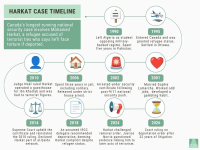
Mohamed Harkat case timeline
What happened in the Mohamed Harkat case? This chart traces every major development since 1990. (GRAPHIC: SOFIA MISENHEIMER / POSTMEDIA)
Harkat was arrested on Dec. 10, 2002, in the heated aftermath of the 9/11 terrorist attacks, when North American security agencies were under intense pressure to identify and neutralize al-Qaida “sleeper cells.”

He was taken into custody on the strength of a security certificate, a powerful and rarely used instrument of Canada’s immigration law. It allows the government to detain foreign-born terror suspects indefinitely and to present evidence in secret against them.

Harkat spent more than three years in jail, including a year in solitary confinement, and was under strict house arrest years after that.

Before his arrest, he worked as a pizza deliveryman and gas station attendant while also developing an expensive casino gambling habit. He married Sophie Lamarche, whom he met at the gas station, in January 2001.


In December 2010, Noël deemed Harkat a member of the terrorist network and linked him to several Islamic extremists, including Ibn Khattab, Canadian Ahmed Said Khadr, and Abu Zubaydah. Noël also found that Harkat offered assistance to two Islamic extremists who travelled to Canada.

The government’s case against Harkat was based on written summaries of 13 wiretapped phone conversations — the original tapes were destroyed — and at least two unnamed informants, one of whom failed a lie-detector test. Some parts of the government’s case remain secret.

An appeal court later overturned Noël’s ruling due to what it regarded as procedural unfairness.

In May 2014, however, the Supreme Court upheld the government’s security certificate regime and reinstated Noël’s decision that found Harkat to be an active member of the al-Qaida network.

In an affidavit filed in Federal Court, Harkat said he would be imperiled in Algeria by virtue of the media attention that had accompanied his case and by the terrorist label attached to him.


Harkat conceded that the Supreme Court had found him to be a member of a terrorist network, but insisted that he “cannot admit involvement in terrorist acts that I never committed.”

“I am not a threat to the security of any country, including Canada,” he insisted, “and I have not engaged in any acts of violence, much less a serious one, which would justify my return to Algeria.”

The Harkat case is one of Canada’s longest-running judicial matters.
1780910412430.png
 

Dixie Cup

Senate Member
Sep 16, 2006
6,665
4,208
113
Edmonton
Judge orders reassessment of decision to deport Ottawa's Mohamed Harkat
The accused terrorist should be granted a judicial review of a federal government decision that he should not be allowed to stay in Canada, a judge ruled June 4.

Author of the article:Andrew Duffy
Published Jun 07, 2026 • Last updated 16 hours ago • 5 minute read

A December 2010 file photo of Mohamed Harkat at an Ottawa news conference.
A December 2010 file photo of Mohamed Harkat at an Ottawa news conference. THE OTTAWA CITIZEN/POSTMEDIA
A Federal Court judge has ruled that accused terrorist Mohamed Harkat should be granted a judicial review of a federal government decision that he should not be allowed to stay in Canada — more than two decades after the government first launched its bid to deport the Algerian-born refugee.


On June 4, Federal Court Judge John Norris sent that decision back to be reassessed by a different decision maker.


“Briefly, I am not persuaded that the process followed by the decision maker breached the requirements of procedural fairness, either at common law or stemming from Section 7 of the Charter,” Norris wrote in his judgment. “On the other hand, I have concluded that the delegate’s determination that the applicant should not be allowed to remain in Canada on the basis of the nature and severity of acts committed is unreasonable because a key finding by the delegate — that the applicant was complicit in acts of terrorism committed by Chechen extremists — is not reasonably supported by the delegate’s analysis of the record, including Justice (Simon) Noël’s findings supporting the reasonableness of the security certificate.”

The ruling by Norris came at the end of an eight-year judicial review conducted to determine whether an unnamed government official made a fair and reasonable decision in concluding that Harkat should be deported to Algeria despite his contention that he would be tortured or persecuted there.


The “minister’s delegate,” a senior official at Immigration, Refugees and Citizenship Canada, concluded Harkat posed a serious threat to Canada as a member of the al-Qaida network and was unlikely to be mistreated in Algeria.

Harkat, now 57, arrived in Canada in October 1995 and was later granted refugee status. He has been living in Ottawa, or in jail, for the past three decades.

First arrested in December 2002 on the strength of a security certificate that deemed him a terror suspect, Harkat has always denied any connection to terrorism.

He told the Federal Court he would be tortured or killed if returned to Algeria, the country from which he fled in 1990 as a university student opposed to its then military-backed government. After leaving Algeria, he spent five years in Pakistan.

The federal government said Harkat operated a guest house in Peshawar, Pakistan, for Chechen rebel leader Ibn Khattab and helped move mujahedeen fighters in and out of training camps in Afghanistan.


The minister’s delegate said Harkat, as a member of the Khattab group, was complicit in the terrorist acts of feared Chechen rebel leader Shamil Basayev, whom Khattab supported. Basayev was responsible for some of the bloodiest acts of the Chechen conflict.

The minister’s delegate also placed the Khattab and Basayev groups within the larger terror network — described as “a system of systems” — allied with terrorist kingpin Osama bin Laden.

Harkat’s lawyer, Barbara Jackman, said the government failed to establish any connection between Harkat’s work at the guest house and any specific crime. She said the government’s “hyperbolized” case against Harkat was built on speculation and guilt by association.

The minister’s delegate said that, although Harkat did not commit terrorist acts directly, he was “complicit” in the crimes of those he assisted in Pakistan.

Jackman said it was “irresponsible and perverse” to suggest Harkat committed acts so grave that he should be deported to a country where he could be tortured.


Jackman called Harkat an ordinary refugee who has lived peacefully in Canada for decades. He has built a family, home and community in Ottawa, she said, despite being mistreated by “overzealous” security officials.

Mohamed Harkat case timeline
What happened in the Mohamed Harkat case? This chart traces every major development since 1990. (GRAPHIC: SOFIA MISENHEIMER / POSTMEDIA)
Harkat was arrested on Dec. 10, 2002, in the heated aftermath of the 9/11 terrorist attacks, when North American security agencies were under intense pressure to identify and neutralize al-Qaida “sleeper cells.”

He was taken into custody on the strength of a security certificate, a powerful and rarely used instrument of Canada’s immigration law. It allows the government to detain foreign-born terror suspects indefinitely and to present evidence in secret against them.

Harkat spent more than three years in jail, including a year in solitary confinement, and was under strict house arrest years after that.

Before his arrest, he worked as a pizza deliveryman and gas station attendant while also developing an expensive casino gambling habit. He married Sophie Lamarche, whom he met at the gas station, in January 2001.


In December 2010, Noël deemed Harkat a member of the terrorist network and linked him to several Islamic extremists, including Ibn Khattab, Canadian Ahmed Said Khadr, and Abu Zubaydah. Noël also found that Harkat offered assistance to two Islamic extremists who travelled to Canada.

The government’s case against Harkat was based on written summaries of 13 wiretapped phone conversations — the original tapes were destroyed — and at least two unnamed informants, one of whom failed a lie-detector test. Some parts of the government’s case remain secret.

An appeal court later overturned Noël’s ruling due to what it regarded as procedural unfairness.

In May 2014, however, the Supreme Court upheld the government’s security certificate regime and reinstated Noël’s decision that found Harkat to be an active member of the al-Qaida network.

In an affidavit filed in Federal Court, Harkat said he would be imperiled in Algeria by virtue of the media attention that had accompanied his case and by the terrorist label attached to him.


Harkat conceded that the Supreme Court had found him to be a member of a terrorist network, but insisted that he “cannot admit involvement in terrorist acts that I never committed.”

“I am not a threat to the security of any country, including Canada,” he insisted, “and I have not engaged in any acts of violence, much less a serious one, which would justify my return to Algeria.”

The Harkat case is one of Canada’s longest-running judicial matters.
View attachment 34673
Of course, he'd say that because he doesn't want to be deported. Having said that, has the government got the receipts that prove he's a terrorist? Why has this taken so long? How much has this cost the taxpayer?
 

petros

The Central Scrutinizer
Nov 21, 2008
120,815
14,981
113
Low Earth Orbit
Of course, he'd say that because he doesn't want to be deported. Having said that, has the government got the receipts that prove he's a terrorist? Why has this taken so long? How much has this cost the taxpayer?
No, actually. The Govt doesn't have the receipts. If he or others like him still want to fight against Chechens he'd be more than welcomed to join Azov International Brigade.