Omnibus Russia Ukraine crisis

Ron in Regina

"Voice of the West" Party
Apr 9, 2008
32,960
11,842
113
Regina, Saskatchewan
US has ran out of ATACMS.
Reuters reporting a gasoline shortage in Russia with many gas stations closed
Sweden's military will participate in the surveillance and protection of Finland's ‌territory with Gripen fighter jets and corvette warship, at least until the end of 2026, Finland's defence ⁠forces said on Friday.

The Swedish equipment strengthens air surveillance in particular, releasing the Finnish Defence Forces' own resources for repelling violations and incidents, if need be," Finland's military said ‌in ⁠a statement.
The initiative follows a request by Finland to Sweden, which has a 1,340-kilometre (833-mile) long eastern ⁠border with Russia, a spokesperson for the Swedish defence minister said.
 

Ron in Regina

"Voice of the West" Party
Apr 9, 2008
32,960
11,842
113
Regina, Saskatchewan
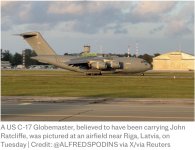
John Ratcliffe, the CIA director, flew to Moscow this week to warn Vladimir Putin against attacking any member of the alliance – something that increasingly appeals to the Russian president, according to recent intelligence reports. Bogged down in Ukraine, Moscow has escalated its hybrid attacks on the West.
1788061552595.jpeg
The most noteworthy previous visit of this kind, by William Burns, the CIA director under President Biden, in 2021, was not publicly acknowledged at the time. He told the Russian president that the United States had fully uncovered Russia’s plan to invade Ukraine — although this failed to deter Putin from going ahead and doing it anyway.

This summer alone, the Kremlin was suspected of having been behind explosions at arms factories in Italy and Bulgaria, an assassination plot against a German arms executive, and an attempted drone attack on a Ukrainian cargo plane at Leipzig airport, which failed only because a detonator malfunctioned.

In July, The Telegraph reported that the US had warned Poland about a potential incursion, which could come as early as the next few months. One source briefed on Mr Ratcliffe’s trip told Politico that the purpose was primarily to warn Moscow against “any escalatory action against the Baltic states”.

Latvia, Lithuania and Estonia make for potentially attractive targets, as former members of the Soviet Union that have come to symbolise the post-Cold War expansion of Western democracy. Geographically, they present the most exposed flank of the Nato alliance – bordering Russia and small enough to prevent “defence in depth”, in which armies retreat to a safe distance before launching counter-attacks.
1788061707569.jpeg
Debate about a potential Russian attack often focuses on Narva, a small Russian-speaking Estonian border town that is frequently in the crosshairs of Moscow’s propaganda machine. In recent months, Telegram accounts have launched calling for a “Narva People’s Republic” – an independent statelet for Estonia’s Russian minority. The language matches that used in the past to establish Moscow’s proxy forces in eastern Ukraine.

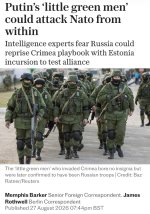
To raise the tension further, Moscow could stage a false-flag attack in which Estonia’s security forces are accused of killing or wounding Russian-heritage citizens. Then the Kremlin could use its toolkit from the 2014 invasion of Crimea, when “little green men” – supposedly Crimean residents taking action to defend the Russian-heritage population but later acknowledged to have been Moscow’s soldiers – took up arms.

Moscow could “potentially seize quite a small amount of territory on the border”, he said, just enough to test the willingness of Nato to trigger Article Five, which requires all members to come to the aid of the state under attack. Instead of targeting the entire city of Narva, say, the incursion could focus on a bridge, airstrip or electricity substation. If Nato failed to invoke Article Five, that’s an enormous blow to the credibility of the alliance and potentially a fatal one.
No country understands the dangers of being a neighbour of Russia more acutely than Estonia, which endured five decades of Soviet, then Nazi and then, again, Soviet occupation before regaining its independence in 1991. The nation has been reborn as an increasingly prosperous democracy with, since 2004, membership of both Nato and the EU.

From Estonia’s capital, Tallinn, where it could hardly be more necessary for intelligence officers to do incredible jobs. Russia is only 130 miles away – the border is a two-hour drive down what was known in Soviet times as the M11 highway. Vladimir Putin’s home city of St Petersburg, meanwhile, is four hours away.

If Putin were to seek a new target after – or perhaps during – his onslaught against Ukraine, then Estonia could be in his crosshairs, and there have been plenty of warnings recently about the possibility of a Russian attack on Nato. If the Russians were to strike across the border, then Britain, too, would be at war. Estonia is a Nato ally and 1,000 British troops lead a multinational battlegroup in the country, amounting to the Army’s biggest overseas deployment.

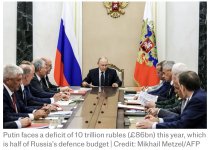
Kaupo Rosin, the director general of the Estonian Foreign Intelligence Service (EFIS) says, “The losses on the battlefield exceed the recruitment numbers,” he says. “The economy has taken a serious hit. One of the reasons is the Ukrainian long-range strikes against oil infrastructure, which is the main income for the Russian budget. There are huge financial problems already. The budget deficit has already exceeded the planned deficit for this year, and it will be, we assess, maybe around 10 trillion rubles [£86bn], which is half of the defence budget.”
1788062883661.jpegPutin would normally cover a deficit of that size without difficulty, except that sanctions have largely excluded Russia from the biggest financial markets, making it far harder and more expensive for the Kremlin to borrow. “The question is, ‘How do they mitigate that issue?’” asks Rosin. “Probably tax increases, asking oligarchs for contributions, and companies for contributions to the state budget, which, let’s say, creates an additional reason for internal discontent and internal pressure.”
Rosin continues: “We see that overall unhappiness levels with this war are increasing in all echelons of society, starting from normal people and throughout, up to the oligarchs. More and more people do not want this war. The question is: what impact does this have on his [Putin’s] decision-making? “I do not see a street revolution happening at this point,” says Rosin. “More important is what people who have access to money, weapons and information – what do they think? In these circles, there is no more talk about total victory. People are discussing different scenarios, and mainly how to end this [war] in a proper way.”

Rosin adds: “But I would say, if something changes in Russia, then it will happen in a very rapid manner and we will all be surprised. It will be an overnight thing, if it ever happens.”
Just how swiftly change could occur is shown by the sudden and abortive rebellion against Putin led by Yevgeny Prigozhin, the mercenary commander, in June 2023, when a column of mutineers advanced to within a 90-minute drive of the Kremlin.

If Putin decides to ignore the voices of caution and persevere with his onslaught against Ukraine, he will have to find a way of replacing his battlefield losses, which total about 500,000 Russian dead, according to GCHQ, the British intelligence service. His only option could be to order a mobilisation and press-gang hundreds of thousands more Russians into service.
Putin has always been viscerally reluctant to take this step, fearing both popular discontent and the economic consequences of depriving the workforce of masses of able-bodied males. But he was compelled to resort to a partial mobilisation in September 2022 after Ukraine’s successful counter-offensive against his invasion.

Since then, he has doggedly avoided any repetition. Yet there is now mounting speculation that Putin will order another mobilisation, perhaps next month, once Russia’s sham parliamentary election is out of the way.
 

Ron in Regina

"Voice of the West" Party
Apr 9, 2008
32,960
11,842
113
Regina, Saskatchewan
Russian Finance Minister Anton Siluanov was in the room Monday for the first day of the U.S.-hosted G20 talks. Treasury Secretary Scott Bessent also held a one-on-one meeting with Siluanov on the sidelines of the summit. Siluanov’s attendance, however, was opposed by European officials in Asheville on Monday, and the decision to include the Russian official in the meeting caused a stir in the planning of a group photo of participants.

ASHEVILLE, North Carolina — The Trump administration’s decision to bring Russia back into the fold at a gathering of the world’s leading economic officials is stirring fresh tensions with European allies who want to continue isolating Moscow over its war in Ukraine. “Secretary Bessent had a productive meeting with the Russian finance minister,” Erin Browne, Treasury’s undersecretary for international affairs, told POLITICO. Bessent “conveyed to him that the war needs to end, and we want to see a peaceful outcome,” she said.
A Treasury spokesperson said the two discussed “Trump’s plan for peace and economic growth.” Browne said Russia’s inclusion was a decision made by the White House. “We are following the White House’s protocol,” she said. Asked by reporters Monday about Russia’s inclusion in the gathering, Trump defended the decision. “We like getting along with everybody,” he told reporters. “One of the reasons that I’m so successful — that I get along with everybody.”
“We are ‌ramping up the economic pressure on Putin and leaving those aiding his illegal war with nowhere to hide," British finance minister John Healey said in a statement released as he attends his first G20 in North Carolina. European finance ministers and officials have bristled over the United States' move to invite Russia to participate in the summit ⁠as Moscow's war against Ukraine continues.

Britain had in May targeted Russia-linked cryptocurrency platforms, banks and financial networks that it said were used to bypass sanctions, freezing their ⁠assets and barring UK firms from processing payments and holding correspondent banking ties. The UK also announced new sanctions this month targeting Russian ships, banks and industrial companies.
European leaders and other member nations were frustrated by Trumps decision to invite Russia to this G20 meeting as have worked hard to isolate Russia economically and politically since the 2022 invasion of Ukraine.
 

Ron in Regina

"Voice of the West" Party
Apr 9, 2008
32,960
11,842
113
Regina, Saskatchewan
Horseshoes and hand grenades and Skud Missiles Russian Drones. Arrivals and departures at Chisinau airport were suspended for a time on Tuesday in connection with two Russian drones that entered Moldovan airspace. Several flights bound for the capital landed at airports outside Moldova or were forced into holding patterns, according to data from Flightradar24.

Zelenskiy attended the funeral of King Harald V of Norway on Wednesday, marching ⁠behind his coffin along with other heads of state in central Oslo. He left Norway soon after the funeral was over.
 

pgs

Hall of Fame Member
Nov 29, 2008
29,382
8,696
113
B.C.
Horseshoes and hand grenades and Skud Missiles Russian Drones. Arrivals and departures at Chisinau airport were suspended for a time on Tuesday in connection with two Russian drones that entered Moldovan airspace. Several flights bound for the capital landed at airports outside Moldova or were forced into holding patterns, according to data from Flightradar24.

Zelenskiy attended the funeral of King Harald V of Norway on Wednesday, marching ⁠behind his coffin along with other heads of state in central Oslo. He left Norway soon after the funeral was over.
Did anyone win yet ? Have we sent more money ? Who is getting rich ?
 

spaminator

Hall of Fame Member
Oct 26, 2009
40,769
4,076
113
Soaring diesel costs affect 'price of everything': Canadian analyst
Prices quietly spiked to an all-time high last week and they're 'staying high and remaining high,' says Dan McTeague

Author of the article:Gordon Anderson
Published Sep 09, 2026 • Last updated 1 day ago • 3 minute read
diesel
Last Wednesday, the price for a litre of diesel fuel reached an all-time high in Toronto at $2.43.9 per litre. Photo by POSTMEDIA NEWS /FILE

When diesel fuel prices spiked at an all-time high last Wednesday, no one seemed to take notice.


“It got very little attention and very little notice, and yet diesel fuel gets no respect,” gas price analyst and Canadians for Affordable Energy president Dan McTeague told the Toronto Sun. “I refer to (diesel fuel) as the Rodney Dangerfield of fuels. You need it for jets, trains, farm equipment, construction equipment and transport from point A to point B. Its use is so vast and so universal.”

Last Wednesday, diesel peaked at $2.43.9 a litre in Toronto.

“An all-time record,” McTeague said.

The average price of diesel on Sept. 9 was $2.36.9 per litre. McTeague says the price could push eight to 10 cents higher by the end of the week. A second all-time high could be registered by Friday.

McTeague says diesel prices could reach $245.9 in Toronto, the Greater Toronto Area, all of southern and central Ontario.

“The price of diesel is almost double what it was at this time last year,” he said. ‘What makes this even worse isn’t the fact that we are hitting all-time new highs, is that they are staying high and remaining high,” he said.


Diesel fuel may be out of sight and out of mind for residents who move about the city in gas-powered cars, electric cars or bicycles, but the increasing cost of diesel gets passed on to the consumer via higher prices for things like food and retail goods.

A CIty of Miramichi loader fuels up at a diesel pump during a winter storm.
A CIty of Miramichi loader fuels up at a diesel pump during a winter storm. Photo by Miramichi Leader archives
Powers the world
“Diesel fuel affects the price of everything,” McTeague said. “It is also not the season when diesel demand goes through the roof. It will start in a week or two when farmers start to harvest their crops, and that is when we see a larger movement in diesel. The season for diesel to go through the roof is usually September to April, not May to August.”

McTeague says diesel powers the economic engine of the world.

“It is the global economic work horse, and there is no way of getting around it,” he said. “The entire economy moves on diesel. All modes of heavy transportation and commercial transportation are done by diesel. You don’t run mining or forestry equipment, snowplows, garbage trucks, or rail on gasoline.”


McTeague said the war between Russia and Ukraine, and the ongoing conflict between the United States and Iran is “almost entirely the reason,” for higher prices at the pump.

“We are dealing with record prices for diesel and we are dealing with high prices for gasoline and some of the this is attributable to the war in Iran, but it has a lot more to do with geopolitics tensions, such as the war between Russia and Ukraine, disrupting a lot of supply that would normally come from the region.”


diesel 3
Smoke from an explosion rises following Russian missiles strike in Kyiv, Ukraine, early on September 8, 2026. Photo by (Photo by Sergei SUPINSKY / AFP via Getty Images)
Rising tensions
The former MP for the federal riding of Pickering-Scarborough East says the situation with Russia specifically is influencing prices in the wrong direction.

“Russia, which has traditionally been a major exporter of diesel for decades, has now found itself for the first time in a position where they can no longer export diesel, and in some cases importing it, because their facilities have been targeted in the war with Ukraine, not just refineries but vessels carrying these in the Black Sea, the Caspian Sea, all of these regions are therefore offline, but the world continues to use diesel,” he said.

McTeague said diesel production is 20% to 30% short of what the “world needs to meet everyday needs.”

“Diesel is scarce, it is precious, it is gold, it is platinum, call it what you want, but the price shock is real, and it is reflecting the two wars and reflecting high demand and low supply,” he said.

ganderson@postmedia.com