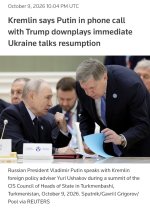
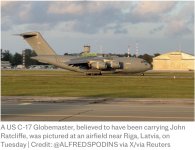
John Ratcliffe, the CIA director, flew to Moscow this week to
warn Vladimir Putin against attacking any member of the alliance – something that increasingly appeals to the Russian president, according to
recent intelligence reports. Bogged down in Ukraine, Moscow has
escalated its hybrid attacks on the West.
The most noteworthy previous visit of this kind, by William Burns, the CIA director under President Biden, in 2021, was not publicly acknowledged at the time. He told the Russian president that the United States had fully uncovered Russia’s plan to invade Ukraine — although this failed to deter Putin from going ahead and doing it anyway.
This summer alone, the Kremlin was suspected of having been behind explosions at arms factories in Italy and Bulgaria, an assassination plot against a German arms executive, and an attempted drone attack on a Ukrainian cargo plane at Leipzig airport, which failed only because a detonator malfunctioned.
In July, The Telegraph reported that the US had warned
Poland about a potential incursion, which could come as early as the next few months. One source briefed on Mr Ratcliffe’s trip told Politico that the purpose was primarily to warn Moscow against “any escalatory action against the Baltic states”.
Latvia, Lithuania and Estonia make for potentially attractive targets, as former members of the Soviet Union that have come to symbolise the post-Cold War expansion of Western democracy. Geographically, they present the most exposed flank of the Nato alliance – bordering Russia and small enough to prevent “defence in depth”, in which armies retreat to a safe distance before launching counter-attacks.
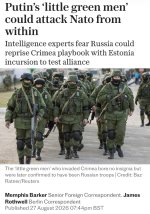
Debate about a potential Russian attack often focuses on Narva, a small Russian-speaking Estonian border town that is frequently in the crosshairs of Moscow’s propaganda machine. In recent months, Telegram accounts have launched calling for a “Narva People’s Republic” – an independent statelet for Estonia’s Russian minority. The language matches that used in the past to establish Moscow’s proxy forces in eastern Ukraine.
To raise the tension further, Moscow could stage a false-flag attack in which Estonia’s security forces are accused of killing or wounding Russian-heritage citizens. Then the Kremlin could use its toolkit from the 2014 invasion of Crimea, when “little green men” – supposedly Crimean residents taking action to defend the Russian-heritage population but later acknowledged to have been Moscow’s soldiers – took up arms.
Moscow could “potentially seize quite a small amount of territory on the border”, he said, just enough to test the willingness of Nato to trigger Article Five, which requires all members to come to the aid of the state under attack. Instead of targeting the entire city of Narva, say, the incursion could focus on a bridge, airstrip or electricity substation. If Nato failed to invoke Article Five, that’s an enormous blow to the credibility of the alliance and potentially a fatal one.
Intelligence experts fear Russia could reprise Crimea playbook with Estonia incursion to test alliance

apple.news
No country understands the dangers of being a neighbour of Russia more acutely than Estonia, which endured five decades of Soviet, then Nazi and then, again, Soviet occupation before regaining its independence in 1991. The nation has been reborn as an increasingly prosperous democracy with, since 2004, membership of both Nato and the EU.
From Estonia’s capital, Tallinn, where it could hardly be more necessary for intelligence officers to do incredible jobs. Russia is only 130 miles away – the border is a two-hour drive down what was known in Soviet times as the M11 highway. Vladimir Putin’s home city of St Petersburg, meanwhile, is four hours away.
If Putin were to seek a new target after – or perhaps during – his onslaught against Ukraine, then Estonia could be in his crosshairs, and there have been plenty of warnings recently about the possibility of a Russian attack on Nato. If the Russians were to strike across the border, then Britain, too, would be at war. Estonia is a Nato ally and
1,000 British troops lead a multinational battlegroup in the country, amounting to the Army’s biggest overseas deployment.
Kaupo Rosin, the director general of the Estonian Foreign Intelligence Service (EFIS) says, “The losses on the battlefield exceed the recruitment numbers,” he says. “The economy has taken a serious hit. One of the reasons is the Ukrainian long-range strikes against oil infrastructure, which is the main income for the Russian budget. There are huge financial problems already. The budget deficit has already exceeded the planned deficit for this year, and it will be, we assess, maybe around 10 trillion rubles [£86bn], which is half of the defence budget.”
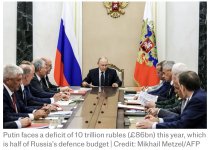
Putin would normally cover a deficit of that size without difficulty, except that sanctions have largely excluded Russia from the biggest financial markets, making it far harder and more expensive for the Kremlin to borrow. “The question is, ‘How do they mitigate that issue?’” asks Rosin. “Probably tax increases, asking oligarchs for contributions, and companies for contributions to the state budget, which, let’s say, creates an additional reason for internal discontent and internal pressure.”
Moscow is now losing more soldiers than it can recruit, while Ukrainian drone strikes are hitting deep inside Russian territory
apple.news
Rosin continues: “We see that overall unhappiness levels with this war are increasing in all echelons of society, starting from normal people and throughout, up to the oligarchs. More and more people do not want this war. The question is: what impact does this have on his [Putin’s] decision-making? “I do not see a street revolution happening at this point,” says Rosin. “More important is what people who have access to money, weapons and information – what do they think? In these circles, there is no more talk about total victory. People are discussing different scenarios, and mainly how to end this [war] in a proper way.”
Rosin adds: “But I would say, if something changes in Russia, then it will happen in a very rapid manner and we will all be surprised. It will be an overnight thing, if it ever happens.”
In his first interview with a British newspaper, Kaupo Rosin discusses Putin’s fractured inner circle and the looming threat against Nato
apple.news
Just how swiftly change could occur is shown by the sudden and abortive rebellion against Putin led by Yevgeny Prigozhin, the mercenary commander, in June 2023, when a column of mutineers advanced to within a 90-minute drive of the Kremlin.
If Putin decides to ignore the voices of caution and persevere with his onslaught against Ukraine, he will have to find a way of replacing his battlefield losses, which total about 500,000 Russian dead, according to GCHQ, the British intelligence service. His only option could be to order a mobilisation and press-gang hundreds of thousands more Russians into service.
Moscow recruits an estimated 1,000 people a day but western officials say it cannot keep up with casualty level
apple.news
Putin has always been viscerally reluctant to take this step, fearing both popular discontent and the economic consequences of depriving the workforce of masses of able-bodied males. But he was compelled to resort to a partial mobilisation in September 2022 after Ukraine’s successful counter-offensive against his invasion.
Since then, he has doggedly avoided any repetition. Yet there is now mounting speculation that Putin will order another mobilisation, perhaps next month, once Russia’s sham parliamentary election is out of the way.
CIA director John Ratcliffe’s visit to Moscow was meant to act as a warning to Putin, but was it enough to deter him from another invasion?
apple.news







 in these ongoing talks. The Hill has reached out to the White House for comment.
 Trump has repeatedly