If you change the wording of your question slightly, you can get a very different answer. Good example of that in the other thread.
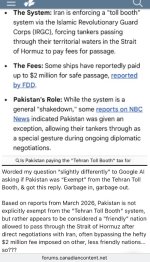
View attachment 33865
You asked two different questions and got two different answers. It's your garbage questions.
Let me try with "antisemitic" Grok.
Is Iran currently charging a transit fee through Strait of Hormuz to all nations?
No, Iran is not charging a uniform transit fee to all nations or vessels passing through the Strait of Hormuz
Reports from March 2026 (amid heightened regional tensions and conflict involving Iran) indicate that Iran has begun selectively and informally demanding payments—up to around $2 million per voyage—from some commercial vessels for "safe passage," while parliament is drafting legislation to formalize such tolls.b8a274
Key details from recent reporting:
The charges are applied on an ad hoc, case-by-case basis rather than systematically to every ship. Some vessels have reportedly paid (details on currency and exact mechanisms are unclear), but it's not a blanket policy enforced on all traffic.b1fbbd
Iran has distinguished between "friendly/non-hostile" nations (e.g., reports mention China, Russia, India, Pakistan, Iraq, and sometimes others) whose ships may pass with coordination, versus those linked to adversaries (e.g., tied to the US or Israel), which face restrictions or exclusion.dd2e67
Iranian lawmakers have described the fees as compensation for "security" or "war costs," framing it as an exercise of sovereignty. One parliament member (Alaeddin Boroujerdi) publicly referenced collecting ~$2 million from certain vessels as a show of strength. Parliament is working on a bill to legally recognize oversight of the strait and enable toll collection, potentially as part of a postwar arrangement.8baa8e
This occurs against a backdrop where Iran has disrupted or selectively controlled transit (including attacks on some vessels earlier in the conflict), drastically reducing overall traffic through the strait (which normally carries ~20-25% of global oil and LNG).53cda9
This practice has drawn strong criticism:
The Gulf Cooperation Council (GCC) has called it illegal and a violation of the UN Convention on the Law of the Sea, which generally guarantees freedom of navigation through international straits like Hormuz.06e941
Some Iranian officials have distanced themselves, labeling media claims as based on personal remarks rather than formal policy.f3d850
In short, while Iran is asserting greater control and extracting payments from select ships in an informal "toll-like" manner (and moving toward formalizing it), it is not a standardized fee charged equally to all nations or every vessel. The situation remains fluid, tied to ongoing regional conflict, and has contributed to higher shipping risks, rerouting considerations, and elevated oil prices.
Under international law, such unilateral fees on a critical chokepoint are highly contentious and not widely recognized as legitimate.
So...is that not what I've been saying all along? I can take that reply and add to it.
Do reports state which nations are currently exempt?
Yes, multiple reports from March 2026 explicitly identify certain nations whose vessels are treated as "friendly" or "non-hostile" and thus permitted safe passage through the Strait of Hormuz, often with coordination from Iranian authorities.
These countries are frequently described as exempt from the stricter restrictions or de facto blockade affecting others, though the application of any transit fees remains selective and ad hoc rather than uniformly waived.50ba4d
Core List of "Friendly" or Permitted Nations
Iranian Foreign Minister Abbas Araghchi and other officials have repeatedly named the following as examples of countries granted safe passage for their vessels:
China
Russia
India
Iraq
Pakistan
This list appears consistently across reports citing Araghchi's statements to state media and diplomatic channels.f7dc2d
Additional Nations Mentioned in Reports
Other countries have reportedly secured passage through bilateral talks or specific approvals, though they are mentioned less uniformly:
Malaysia
Bangladesh (noted in some statements as potentially included)
Egypt
South Korea
Japan (assurances reported for Japanese ships)
Turkey (at least one Turkish-owned ship cleared after coordination)
These appear to fall under the broader "non-hostile" category defined by Iran as vessels from countries that "neither participate in nor support acts of aggression against Iran" (primarily linked to the US and Israel).0fe3f1
Context on Fees vs. Passage
Passage is selectively allowed for these nations' vessels after coordination with Iranian authorities (e.g., providing details on crew, cargo, and route, sometimes routed close to Iranian waters for oversight). Some ships from these countries have transited successfully, including Indian LPG carriers and Pakistani tankers.
Fees (reportedly up to ~$2 million per voyage in some cases, occasionally in yuan) are described as applied on a case-by-case basis to certain vessels for "safe passage" or "security." It is not clear from reports that all ships from friendly nations are fully exempt from fees—some may still pay, while others appear to gain access primarily through diplomatic arrangements rather than direct payment. Lawmakers have framed fees as compensation for "war costs," but Iranian officials (including embassy statements) have sometimes downplayed or distanced themselves from blanket fee claims as personal remarks rather than formal policy.
Iran maintains that the strait is "open" only to non-hostile/non-enemy vessels and closed or restricted for adversaries (explicitly the US, Israel, and their direct supporters/allies). A vetting/registration system is reportedly in development, and parliament is drafting legislation to formalize oversight and potential tolls.d50cc7
Key Caveats from Reporting
The policy is fluid and not fully systematized — access often depends on direct negotiations, and traffic remains far below normal levels.
Some "friendly" nations (e.g., India) have publicly rejected the legitimacy of any fees under international law, emphasizing freedom of navigation.
The Gulf Cooperation Council and others have condemned the overall approach as illegal under the UN Convention on the Law of the Sea.
In summary, reports consistently highlight China, Russia, India, Iraq, and Pakistan as the primary "friendly" nations with permitted access, with a handful of others (Malaysia, Bangladesh, etc.) also benefiting in practice. However, even for these countries, passage requires Iranian coordination, and any fee exemptions are not explicitly guaranteed as a blanket rule—implementation appears pragmatic and selective amid the ongoing conflict. The situation continues to evolve rapidly.
BTW, not all AI is created equally and some are throttled.





 www.bbc.com


 toronto.citynews.ca





apple.news
 . Trump is full of shit and Iran holds the cards.

