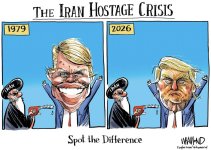
Iran War. . . USA Up 2-0 in the First Period

Ron in Regina

"Voice of the West" Party
Apr 9, 2008
33,020
11,857
113
Regina, Saskatchewan
Didn't bother or didn't like what you found?

Well as it turns out, one word answers the Palestine question with a big ol' YES.

Attacks on Israel will cease when Israel exits all of Palestine.

Go figure.
Haven’t looked yet. I take 3-4 minutes about every 60-90 minutes (I call it a cigarette break cuz…) and check this and the headlines and then back to work.

Trump on Monday said the U.S. is “open” to the concept of restarting negotiations between Washington and Tehran. High-level officials from both sides last convened for official peace talks in Switzerland in June.

“Iran has responded to Trump’s openness to negotiations by doubling down on its demands. “Don’t get distracted by the U.S. President’s mixed signals—from ‘no negotiations’ to ‘we’re ready to talk,’" said Mohsen Rezaei, Iran's recently-installed secretary of the Supreme National Security Council, on Monday. “No talks until Iran’s conditions are met. Period!”
So yeah, they’re totally in agreement or not or something something etc…
Attacks on Israel will cease when Israel exits all of Palestine.
Define all of Palestine. What does that mean? What does it mean to you? What does it mean to “Israel?” or to “Palestine?” Are the answers the same as each other?
 

petros

The Central Scrutinizer
Nov 21, 2008
121,263
15,105
113
Low Earth Orbit
Didn't bother or didn't like what you found?

Well as it turns out, one word answers the Palestine question with a big ol' YES.

Attacks on Israel will cease when Israel exits all of Palestine.

Go figure.
Now for the Saudis...

Do Saudi relations with Israel rely on Palestinian sovereignty?

Yes — Saudi Arabia's official position ties normalization with Israel directly to progress on Palestinian statehood, and that stance has held firm through 2026 despite heavy US pressure.

**The official line:** As recently as May 2026, a Saudi source told CNN that normalization requires a "clear and irreversible path" toward a Palestinian state — a position Riyadh has reaffirmed repeatedly even as President Trump pushed Saudi Arabia and other Muslim-majority nations to join the Abraham Accords. Saudi Foreign Minister Prince Faisal bin Farhan has put it plainly: recognition of Israel is tied to the establishment of a Palestinian state, and only once that's achieved can normalization talks proceed.

**Where this comes from:** This isn't new — it traces back to Saudi Arabia's 2002 Arab Peace Initiative, which conditioned full Arab normalization on Israeli withdrawal to 1967 borders and a Palestinian state with East Jerusalem as its capital. That framework still shapes official Saudi discourse today.

**The nuance — public position vs. private flexibility:** Some analysts and officials have long argued Crown Prince Mohammed bin Salman is more flexible in private than the public rhetoric suggests, and before October 7, 2023, he was reportedly less committed to a full two-state solution as a precondition. But the Gaza war hardened Riyadh's public stance considerably — it went from a soft preference to an explicit, repeated red line.

**Current dynamics:** Trump has continued pressing Saudi Arabia to normalize "immediately" alongside Qatar, Egypt, Jordan, Turkey, and Pakistan, especially after the 2026 Iran war. But Saudi sources have consistently pushed back, insisting the Palestinian statehood pathway isn't negotiable away. Some Israeli analysts (e.g., INSS) argue Saudi Arabia has actually been drifting further from normalization recently — using distance from Israel to shore up domestic legitimacy and regional leadership, rather than moving toward a deal.

So: yes, Palestinian sovereignty (or at least a credible, "irreversible" pathway toward it) is the stated Saudi precondition — though how firm that line truly is in private negotiations remains disputed.


Well how about that? I would have never suspected considering all I hear is Arabs hate Jews simply because they're Jews
 

petros

The Central Scrutinizer
Nov 21, 2008
121,263
15,105
113
Low Earth Orbit
Haven’t looked yet. I take 3-4 minutes about every 60-90 minutes (I call it a cigarette break cuz…) and check this and the headlines and then back to work.

Trump on Monday said the U.S. is “open” to the concept of restarting negotiations between Washington and Tehran. High-level officials from both sides last convened for official peace talks in Switzerland in June.

“Iran has responded to Trump’s openness to negotiations by doubling down on its demands. “Don’t get distracted by the U.S. President’s mixed signals—from ‘no negotiations’ to ‘we’re ready to talk,’" said Mohsen Rezaei, Iran's recently-installed secretary of the Supreme National Security Council, on Monday. “No talks until Iran’s conditions are met. Period!”
So yeah, they’re totally in agreement or not or something something etc…

Define all of Palestine. What does that mean? What does it mean to you? What does it mean to “Israel?” or to “Palestine?” Are the answers the same as each other?
Palestine is Gaza and West Bank. What do you think it means?

North, South East and West of the Pecos?
 

Ron in Regina

"Voice of the West" Party
Apr 9, 2008
33,020
11,857
113
Regina, Saskatchewan
Palestine is Gaza and West Bank. What do you think it means?

North, South East and West of the Pecos?
That’s in your mind. Others might think Palestine is Gaza and what’s now called the West Bank along with what’s currently called Israel in its entirety. Israel itself might think differently.

It’s a legitimate question and that’s why I asked it, as what and where Palestine starts and stops really hasn’t been agreed upon, and before you start going all 1967 (or a short snapshot from a very specific timeframe in I think a couple weeks of June in 1967 to be specific), it really hasn’t been finalized as to where it borders actually lay yet.

I think this came up because it was the Houthis saying they would start doing something or another if the Jews left whatever they consider as Palestine (?) or was it the Iranians? What do the Houthis or the IRGC consider as being Palestine? It could be very different than what you consider….& thus my question…

Israel captured the West Bank from Jordan and the Gaza Strip from Egypt during military conflict called the Six Day War among other names. These areas have remained under varying degrees of Israeli military control and occupation since then.

But…but there are other factors, predating the above, like the 1948 war, ceasefire lines (known as the Green Line) separated Israel from the West Bank (controlled by Jordan) and the Gaza Strip (controlled by Egypt), but those where ceasefire lines and not national (or international?) border lines.
 

petros

The Central Scrutinizer
Nov 21, 2008
121,263
15,105
113
Low Earth Orbit
That’s in your mind. Others might think Palestine is Gaza and what’s now called the West Bank along with what’s currently called Israel in its entirety. Israel itself might think differently.
Who would? You have Gemini, Grok, Claude ChatGT. Ask them. Zionism showed its ass and now an apple is $3.50 a fucking pound lb. For what? Who caused this?

It’s a legitimate question and that’s why I asked it, as what and where Palestine starts and stops really hasn’t been agreed upon, and before you start going all 1967 (or a short snapshot from a very specific timeframe in I think a couple weeks of June in 1967 to be specific), it really hasn’t been finalized as to where it borders actually layyett.
Thats for the world to decide now isnt it?

You do realize its 800,000,000 to 0.001125?

They think they're wrting Testement 4.0.
Are you hoping for an award for "Best Supporting Actor"?
I think this came up because it was the Houthis saying they would start doing something or another if the Jews left whatever they consider as Palestine (?) or was it the Iranians? What do the Houthis or the IRGC consider as being Palestine? It could be very different than what you consider….& thus my question…
The Jews or the US backed Zionist proxy with the their Isis bum buddies?
Israel captured the West Bank from Jordan and the Gaza Strip from Egypt during military conflict called the Six Day War among other names. These areas have remained under varying degrees of Israeli military control and occupation since then.
Jordan didnt want it? Egypt didnt want it? It was a great fucking big "oh well maybe next time" after Israel attacked Egypt for no fucking reason?
But…but there are other factors, predating the above, like the 1948 war, ceasefire lines (known as the Green Line) separated Israel from the West Bank (controlled by Jordan) and the Gaza Strip (controlled by Egypt), but those where ceasefire lines and not national (or international?) border lines.
What does that bullshit have to do with Zionists commiting genocide?
 

Ron in Regina

"Voice of the West" Party
Apr 9, 2008
33,020
11,857
113
Regina, Saskatchewan
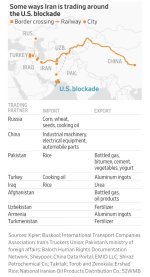
Ugh, yeah, ok, as hundreds of Iranian truck drivers are currently stuck at Iran’s border with Pakistan, unable to send their goods into Tehran’s neighbor. They say they are facing worsening bureaucratic hurdles and costs, many caused by their own government. The same thing is happening at Iran’s land borders with Turkey, Turkmenistan and Afghanistan, dealing Tehran a self-inflicted blow and throttling trade through its few remaining economic release valves, while its Ukraines fault that oil prices are high because they’re fighting back against Russia before the U.S. midterm election.
1789661455230.jpeg
Tons of stranded apricots have been spoiled because of the delays. Lucrative cargoes of iron ore, cement and bottled gas are stuck at entry points to the Pakistani and Afghan borders, truckers say.
1789658981522.jpeg
“Neither Iran is taking responsibility for the situation, nor is Pakistan allowing us to unload our cargo,” one driver says in a video posted by the Union of Truckers and Drivers Organizations Across Iran over the weekend.
In a sign of how vulnerable the alternative routes are, Iraq over the weekend temporarily closed cargo terminals at the Iran border after alleging Iran had used its territory to attack Saudi Arabia. On Sunday, trucks carrying Iranian onions bound for Iraq were forced to turn back as a result, according to Tehran’s Central Fruit and Vegetable Market.

One driver told Iran’s official news agency IRNA he was stuck for days at the Pakistan side of the border with meat destined for Iran, where prices are spiraling higher. At the border with Afghanistan, truckers also complain they have to wait for days before being able to export Iranian iron ore, according to Iran’s Truckers’ Union.
Meanwhile, at the border with Turkmenistan, the gateway to China, transporters complain of constraints tied to a lack of warehouses and of a proper registration process to bring goods by rail to China. One businessman complained it was increasingly difficult to bring in automotive spare parts from the Asian powerhouse.
 

Ron in Regina

"Voice of the West" Party
Apr 9, 2008
33,020
11,857
113
Regina, Saskatchewan
It’s a legitimate question and that’s why I asked it, as what and where Palestine starts and stops really hasn’t been agreed upon, and before you start going all 1967 (or a short snapshot from a very specific timeframe in I think a couple weeks of June in 1967 to be specific), it really hasn’t been finalized as to where it borders actually lay yet.
Thats for the world to decide now isnt it?
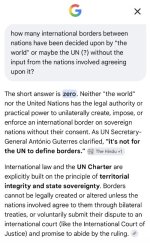
Is it? Is it really? Honest question. How many international borders for individual countries has “the world” decided upon just out’a curiosity?
1789663554332.jpeg
I’m not finding any examples, but I’m not looking very hard. I don’t have a vested interest in looking that hard. Anyway, your idea of where the borders of Palestine should be, & that of Palestinians, & that of Israelis, and that of their neighbours or non-neighbours, or “the world” or the UN or whatever could be very different than each other other. That’s what I was trying to get across above…& there’s many different snapshots in time that could be used as a basis…but it is what it is.
 
  • Like
Reactions: Taxslave2

Taxslave2

Senate Member
Aug 13, 2022
5,911
3,150
113
Is it? Is it really? Honest question. How many international borders for individual countries has “the world” decided upon just out’a curiosity?
View attachment 35692
I’m not finding any examples, but I’m not looking very hard. I don’t have a vested interest in looking that hard. Anyway, your idea of where the borders of Palestine should be, & that of Palestinians, & that of Israelis, and that of their neighbours or non-neighbours, or “the world” or the UN or whatever could be very different than each other other. That’s what I was trying to get across above…& there’s many different snapshots in time that could be used as a basis…but it is what it is.
It is quite simple. The border will be wherever the Jew haters decide it will be. Which could be a fluid location depending on PMS and TDS.
 

Ron in Regina

"Voice of the West" Party
Apr 9, 2008
33,020
11,857
113
Regina, Saskatchewan
It is quite simple. The border will be wherever the Jew haters decide it will be. Which could be a fluid location depending on PMS and TDS.
Palestine’s borders are not the done deal that some claim it to be because it was never agreed upon. If these borders are between Israel and what will become Palestine, then they would have to be agreed-upon by both Palestine & Israel.

Because major Israeli settlement blocs now house hundreds of thousands of people inside the West Bank, past negotiations have relied on the concept of "land swaps". Israel would likely annex small segments of the West Bank where major settlements sit, and in exchange, give an equivalent amount of land from within undisputed Israeli territory to the new Palestinian state…if…if these two nations managed to agree to this with each other.

The baseline for all modern peace frameworks (if in doubt of the definition of framework or frameworks, it can be googled) is the 1967 borders (often referred to as the Green Line or the 1949 Armistice Line), but it’s the baseline for a framework and not the end result of an negotiated and agreed-upon future border or borders between Israel and what will become Palestine someday. Anyway, this is getting away from the whole Iran war thing.
 

Ron in Regina

"Voice of the West" Party
Apr 9, 2008
33,020
11,857
113
Regina, Saskatchewan
Israel captured the West Bank from Jordan and the Gaza Strip from Egypt during military conflict called the Six Day War among other names. These areas have remained under varying degrees of Israeli military control and occupation since then.
Jordan didnt want it? Egypt didnt want it? It was a great fucking big "oh well maybe next time" after Israel attacked Egypt for no fucking reason?
…for no reason? Hmmmm…Egypt closed the Straits of Tiran to Israeli shipping, an act Israel had previously declared would be treated as a cause for war, and then in May 1967, Egyptian President Gamal Abdel Nasser ordered United Nations peacekeepers to leave the Sinai Peninsula for what no good reason?
Something something troops along the border something water and Syria starting in 1964, leading to Syrian positions in the Golan Heights frequently shelled Israeli farming communities below or no reason like that? Then the Soviet Union gave false intelligence to Egypt and Syria claiming that Israel was massing troops on the Syrian border for an invasion or something along those lines? This while the PLO was operating from Syria conducting raids into Israel, and Egypt had a mutual defence pact with Syria? That kinda nothing-like reason?

So for no good reason with Egypt and Syria and Jordan amassing hundreds of thousands of soldiers along multiple sides of Israel’s borders…& Israel already having warned Egypt about the Strait of Tiran, knowing that an attack was imminent on at least three fronts, for no good reason Israel preemptively attacked Egypt.

Once Jordan started shelling Israel, for no good reason they got it too, and with Syria already shelling Israeli farmers and having massed troops on its border with Israel, it got it too, for no good reason. Iraq and Saudi Arabia and Algeria and Kuwait and Sudan figured (for no good reason?) that they needed to also pile in/on…but again this is just getting further away from this current Iran kerfuffle.
 

Ron in Regina

"Voice of the West" Party
Apr 9, 2008
33,020
11,857
113
Regina, Saskatchewan
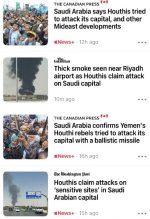
Turkish Foreign MinisterHakan Fidan said Saudi ‌Arabia may ⁠have military needs due to the ongoing Houthi attacks and Turkey was ready to help under a trilateral defence pact that also includes Pakistan. It was unclear what kind of support Turkey might provide but Fidan, in an interview with broadcaster NTV, said Saudi needs could include "some technical issues?”
 

petros

The Central Scrutinizer
Nov 21, 2008
121,263
15,105
113
Low Earth Orbit
Turkish Foreign MinisterHakan Fidan said Saudi ‌Arabia may ⁠have military needs due to the ongoing Houthi attacks and Turkey was ready to help under a trilateral defence pact that also includes Pakistan. It was unclear what kind of support Turkey might provide but Fidan, in an interview with broadcaster NTV, said Saudi needs could include "some technical issues?”
Theyre no joke. The Houthis are very capable, experienced, intelligent and well liked politically amongst the Northern Yemeni.

Wipe the Warner Brothers images you have of rural sheppards and farmers in mud huts shooting at the sky (Mexicans and Injuns in John Wayne movies).

Iran and Houthi N. Yemen have the Arab peninsula locked in with Israel a sitting duck with limited air defenses. If the US loses the already heavily damaged Navy jewel base in Bahrain its all over.

The Arabian Peninsula (also called Arabia or the Arab Peninsula) is the world’s largest peninsula, located in Southwest Asia at the junction of Africa and Asia.
Wikipedia
Key Facts
Area: Roughly 3.2 million km² (about 1.25 million square miles)—comparable in size to India.
Worldpopulationreview
Boundaries:
West/southwest: Red Sea
South: Gulf of Aden
Southeast: Arabian Sea
East/northeast: Gulf of Oman and Persian Gulf (also called the Arabian Gulf)
North: Merges with the Syrian Desert (no sharp natural boundary; political limits are usually taken as the northern borders of Saudi Arabia and Kuwait).
Britannica

Countries
The peninsula is primarily composed of these seven countries (politically recognized as the core Arabian Peninsula states):
Country
Notes
Saudi Arabia
Largest by far (~2/3 of the peninsula’s area)
Yemen
Southern portion
Oman
Southeastern coast
United Arab Emirates
Eastern Gulf coast
Kuwait
Northeast
Qatar
Peninsula projecting into the Persian Gulf
Bahrain
Island nation off the east coast
Geographically, small southern portions of Iraq and Jordan are sometimes included, but they are not usually counted in the political definition of the peninsula.
Wikipedia

Geography and Climate
The landscape is dominated by desert. Major features include:
Vast sand deserts, especially the Rubʿ al-Khali (Empty Quarter) in the south—one of the largest continuous sand deserts on Earth.
Central plateau (Najd).
Mountain ranges along the Red Sea coast (Hejaz and Asir), rising highest in Yemen.
Highest point: Jabal an-Nabi Shuʿayb in Yemen (~3,666 m / 12,030 ft).
Britannica

The climate is extremely arid (hyper-arid in much of the interior), with very low rainfall, extreme summer heat, and limited permanent rivers or lakes. Water comes mainly from aquifers, oases, and desalination in modern times.

Historical and Modern Significance
Birthplace of Islam: The Prophet Muhammad was born in Mecca; Medina is also in western Saudi Arabia. The peninsula was the center of the early Islamic caliphate in the 7th century.

Resources: Holds the world’s largest proven oil reserves (and major natural gas reserves). Petroleum and gas dominate the modern economies of most countries on the peninsula.
Population: Roughly 80–95 million people (estimates vary by source and year), with major cities including Riyadh, Jeddah, Dubai, Sanaa, Mecca, and Medina.

Wikipedia
The region remains geopolitically important due to its energy resources, strategic location (including key waterways like the Strait of Hormuz and Bab el-Mandeb), and role in global trade, religion, and politics.

Would you like more details on any specific aspect—geography, history, individual countries, oil economy, culture, or something else?

So, why do Houthis exist? I dont ave a clue. I want to know.

Maybe later
 
Last edited:

petros

The Central Scrutinizer
Nov 21, 2008
121,263
15,105
113
Low Earth Orbit
…for no reason? Hmmmm…Egypt closed the Straits of Tiran to Israeli shipping, an act Israel had previously declared would be treated as a cause for war, and then in May 1967, Egyptian President Gamal Abdel Nasser ordered United Nations peacekeepers to leave the Sinai Peninsula for what no good reason
Something something troops along the border something water and Syria starting in 1964, leading to Syrian positions in the Golan Heights frequently shelled Israeli farming communities below or no reason like that? Then the Soviet Union gave false intelligence to Egypt and Syria claiming that Israel was massing troops on the Syrian border for an invasion or something along those lines? This while the PLO was operating from Syria conducting raids into Israel, and Egypt had a mutual defence pact with Syria? That kinda nothing-like reaso
So for no good reason with Egypt and Syria and Jordan amassing hundreds of thousands of soldiers along multiple sides of Israel’s borders…& Israel already having warned Egypt about the Strait of Tiran, knowing that an attack was imminent on at least three fronts, for no good reason Israel preemptively attacked Egypt.

Once Jordan started shelling Israel, for no good reason they got it too, and with Syria already shelling Israeli farmers and having massed troops on its border with Israel, it got it too, for no good reason. Iraq and Saudi Arabia and Algeria and Kuwait and Sudan figured (for no good reason?) that they needed to also pile in/on…but again this is just getting further away from this current Iran kerfuffle.
The first three words say it all.


Israel’s opening attacks were preemptive (defensive in intent, according to the prevailing historical view among many scholars), not a response to an ongoing Arab invasion that day. Egypt and others initially claimed they had been attacked first or were responding to Israeli aggression; the historical record shows Israel fired the first shots of the full-scale war. Some later analyses debate whether Nasser intended an immediate offensive or was engaging in brinkmanship that spiraled out of control, but the combination of the blockade, troop concentrations, expulsion of UNEF, and alliance moves created a situation Israel regarded as existential.

Wikipedia
The war ended with Israel in control of the Sinai Peninsula and Gaza Strip (from Egypt), the West Bank and East Jerusalem (from Jordan), and the Golan Heights (from Syria). Sinai was later returned to Egypt under the 1979 peace treaty.

In short: Israel started the fighting with a preemptive strike, primarily because of Egypt’s military buildup, expulsion of UN forces, blockade of the Straits of Tiran, and the broader Arab military and rhetorical mobilization that followed false Soviet reports and years of border conflict.
 
  • Like
Reactions: Ron in Regina

Ron in Regina

"Voice of the West" Party
Apr 9, 2008
33,020
11,857
113
Regina, Saskatchewan
So, why do Houthis exist? I dont ave a clue. I want to know.
I’ve no idea either in all honesty so a quick peak. The movement started in the 1990s in northern Yemen's Saada province to protect Zaydi religious and cultural traditions. They felt threatened by the growing influence of state-funded Sunni Salafist preachers, so inter-Moslem interpretation conflicts like the Sunni’s and Shiites it would appear.
1789914520819.jpeg
During the 2011 Arab Spring, the Houthis joined protests against Saleh, later rejecting a Gulf-brokered political transition. They allied with military factions loyal to the former president, captured Sanaa in 2014, and fought a multi-year civil war against a Saudi-led coalition that intervened to back Yemen's internationally recognized government. Their core slogan—"God is great, death to America, death to Israel, a curse upon the Jews, victory to Islam"—reflects deep opposition to Western and Saudi influence in Yemeni and regional politics.

Nations like predominantly Sunni Saudi Arabia and predominantly Shia Iran have used sectarian identities to compete for dominance in proxy conflicts across the Middle East, such as in Iraq, Syria, and Yemen. Shiite Iran and Sunni Saudi Arabia are bitter rivals because they are locked in a struggle for geopolitical and religious dominance in the Middle East.

They are part of the Axis of Resistance—an Iranian-backed network that includes groups like Hezbollah and Hamas. While the US and allies view them as an Iranian proxy, experts note the Houthis also retain their own local ambitions and domestic base. The group is named after the al-Houthi family, starting with Hussein Badreddin al-Houthi, who founded the revivalist movement in the 1990s. His brother, Abdul-Malik al-Houthi, currently leads the group. Sunnis follow the traditions of the Prophet (the Sunnah) through scholarly consensus. Shias place religious authority in a line of divinely guided leaders called Imams and senior clerics.
1789914556556.jpeg
They belong to the Zaydi branch of Shia Islam, which makes up roughly one-third of Yemen's population. Zaydi Imams ruled northern Yemen for a thousand years until a republican revolution overthrew them in 1962. The conflict between Shia and Sunni Muslims began as a political disagreement over who should lead the Islamic community after the death of the Prophet Muhammad in 632 AD, so 1400 years later, here we are.
 

petros

The Central Scrutinizer
Nov 21, 2008
121,263
15,105
113
Low Earth Orbit
I’ve no idea either in all honesty so a quick peak. The movement started in the 1990s in northern Yemen's Saada province to protect Zaydi religious and cultural traditions. They felt threatened by the growing influence of state-funded Sunni Salafist preachers, so inter-Moslem interpretation conflicts like the Sunni’s and Shiites it would appear.
View attachment 35724
During the 2011 Arab Spring, the Houthis joined protests against Saleh, later rejecting a Gulf-brokered political transition. They allied with military factions loyal to the former president, captured Sanaa in 2014, and fought a multi-year civil war against a Saudi-led coalition that intervened to back Yemen's internationally recognized government. Their core slogan—"God is great, death to America, death to Israel, a curse upon the Jews, victory to Islam"—reflects deep opposition to Western and Saudi influence in Yemeni and regional politics.

Nations like predominantly Sunni Saudi Arabia and predominantly Shia Iran have used sectarian identities to compete for dominance in proxy conflicts across the Middle East, such as in Iraq, Syria, and Yemen. Shiite Iran and Sunni Saudi Arabia are bitter rivals because they are locked in a struggle for geopolitical and religious dominance in the Middle East.

They are part of the Axis of Resistance—an Iranian-backed network that includes groups like Hezbollah and Hamas. While the US and allies view them as an Iranian proxy, experts note the Houthis also retain their own local ambitions and domestic base. The group is named after the al-Houthi family, starting with Hussein Badreddin al-Houthi, who founded the revivalist movement in the 1990s. His brother, Abdul-Malik al-Houthi, currently leads the group. Sunnis follow the traditions of the Prophet (the Sunnah) through scholarly consensus. Shias place religious authority in a line of divinely guided leaders called Imams and senior clerics.
View attachment 35725
They belong to the Zaydi branch of Shia Islam, which makes up roughly one-third of Yemen's population. Zaydi Imams ruled northern Yemen for a thousand years until a republican revolution overthrew them in 1962. The conflict between Shia and Sunni Muslims began as a political disagreement over who should lead the Islamic community after the death of the Prophet Muhammad in 632 AD, so 1400 years later, here we are.
Irish
 

Ron in Regina

"Voice of the West" Party
Apr 9, 2008
33,020
11,857
113
Regina, Saskatchewan
Protestants and Catholics? In-fighting over scripture?
US President Donald Trump cut short a weekend at Camp David, a secluded presidential complex in rural Maryland, to return unexpectedly to the White House. The White House gave no explanation for the early return, which comes as a new threshold was crossed in the conflict between Saudi Arabia and the Houthis, who control a large part of Yemen and are fighting government forces backed by a coalition led by Riyadh.
Iran's military central command said on state media that any new attack would trigger sustained retaliation against US bases and interests, and that Washington's regional allies would be considered parties to the conflict. It did not elaborate on the information it said it had about a coming US attack.
Mohsen Rezaei, secretary of Iran’s Supreme National Security Council said Iran had seven conditions, including an end to the war on all fronts, the release of frozen Iranian assets and the lifting of the U.S. naval blockade on Iranian ports. He said Washington must implement Tehran’s conditions before negotiations begin.

Rezaei also warned that Iran was prepared for further military confrontation and said U.S. bases could face heavier strikes if Washington launched another attack. He said Tehran remained committed to its existing nuclear doctrine but was considering whether to withdraw from the Nuclear Non-Proliferation Treaty depending on U.S. actions.