The Tarriff Hype.

Ron in Regina

"Voice of the West" Party
Apr 9, 2008
33,037
11,860
113
Regina, Saskatchewan
The Wall Street Journal’s report, published Sunday, that Canada is pursuing “associate membership” in the European Union, and that the EU is “open to the idea,” was a fine piece of journalism with a lot of resources behind it. It cited officials, albeit mostly anonymous, “from a dozen different governments involved in … conversations” to back up the story.

Those dozen governments’ officials mentioned everything from “frictionless” trade in goods and services to allowing Canadians to work in Europe without a visa — and, presumably, vice versa. You might reasonably call such an agreement “associate membership,” though that’s not a category that currently exists. Helpfully for the Liberals, it could mean anything (or nothing?).
Last Saturday, a 5,000-word Wall Street Journal exclusive gave us a hint at what might be coming. The reporting claimed that the prime minister has spent months using his extensive European Rolodex and connections to push for deeper relations with the EU. According to the Journal, Carney even “suggested Canada take on a new title: Associate Member of the European Union.” Government sources challenged the story later in the day, saying the reporting “overstated” what is being discussed.
We cannot delude ourselves into thinking we will ever be able to entirely detach ourselves from America, as that’s never going to happen. It will likely remain our biggest trading partner and most important security partner, yet we must lessen our dependence on a much less reliable and volatile United States no matter who succeeds Donald Trump as president. A president who muses about annexation and slaps tariffs on his closest ally and biggest trading partner isn’t just an aberration, he is himself a symptom of an America that has changed.
1789594441284.jpeg
Republican Sen. Susan Collins of Maine — facing a re-election battle in November's midterms in a state highly dependent on cross-border trade — says it's unfortunate that Canada is turning toward the EU in response to U.S. President Donald Trump's tariffs. "That doesn't help rebuild the good relationship that we once had and that I want us to have again," Collins told CBC News correspondent Katie Simpson at the U.S. Capitol on Wednesday.

1789594404282.jpeg
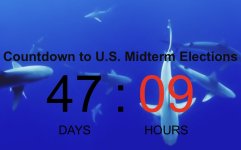
Collins's comments come amid growing signs of unease among some Republicans in the U.S. Congress over Trump's trade tactics toward Canada, particularly as the Nov. 3 midterm elections grow nearer. The Republicans hold narrow majorities in both the U.S. House of Representatives and the Senate and stand to lose control of Congress if the Democrats can flip a handful of districts or states, and the Senate is currently viewed as a tight toss-up or slight lean away from a Republican majority depending on the forecast.
1789593277518.jpeg
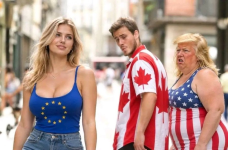
It used to be that the Democrats were the tariff/protectionist party, & the Republicans where the open for business party, but shit switches eventually like with Democrats and Jim Crow laws…& then trying to point the finger at the Republicans over those decades later, etc…
 

spaminator

Hall of Fame Member
Oct 26, 2009
40,818
4,090
113
Metrolinx hands out Lake Ontario-themed transit cards
The limited-edition release comes as Canadians continue to push back on the Trump administration’s claims to the body of water

Author of the article:Denette Wilford
Published Sep 16, 2026 • Last updated 14 hours ago • 2 minute read
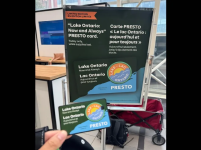
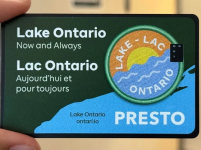
Limited-edition Lake Ontario Presto card from Metrolinx.
Limited-edition Lake Ontario Presto card from Metrolinx. Photo by Reddit

As Canadians continue to show their love for Lake Ontario, Metrolinx was also showing their appreciation for the smallest of the Great Lakes with a limited-edition keepsake.


About 1,000 Lake Ontario-themed Presto cards were handed out at Toronto’s Union Station on Tuesday morning to emphasize GO Transit and UP Express riders’ local pride.

The transit cards show a patch emblazoned with “Lake-Lac Ontario” along with a graphic of sun and water.

The card itself reads: “Lake Ontario, Now and Always,” as well as its French translation, “Lac Ontario, Aujourd’hui et pour toujours.”

Other limited edition Presto card. TORONTO SUN GRAPHIC
Other limited edition Presto cards. TORONTO SUN GRAPHIC
‘Now and always’ is the takeaway
Also on the card is blue representing the lake, with “Lake Ontario” and “Ontari’io,” on it, the latter which comes from the Wendat word that means “the lake is beautiful, the lake is big.”

The words on the Presto cards appear to be inspired by an X post from Prime Minister Mark Carney after U.S. President Donald Trump threatened to rename Lake Ontario to Lake America.


“The name is more than 400 years old, predating both the Confederation of Canada and the Declaration of Independence of the United States of America,” Carney wrote on Aug. 27, nearly a week after trade talks between the two nations collapsed.

“We know that America is changing. Their trading relationships, their foreign policies, their national monuments, their hydronyms,” the PM continued.

“Canadians also know that naming reality means calling it Lake Ontario – then, now and always.”

Lake Ontario
The “now and always” sentiment on the Presto cards, which were snapped up by Tuesday afternoon, according to Metrolinx, was also seen in signage at Union.

Promotion of the limited-edition Lake Ontario Presto card.
Promotion of the limited-edition Lake Ontario Presto card. (Reddit) Photo by Reddit
“We’re proud to operate bus and rail service along the shores of Lake Ontario, from Oshawa to Niagara,” Metrolinx said in a statement.

“Today’s customer engagement event and limited-edition PRESTO card giveaway celebrate the pride Ontarians and Canadians have in this iconic Great Lake and the name it has carried for generations — Lake Ontario, now and always.”


The limited-edition release comes as Canadians continue to push back on the Trump administration’s claims to the body of water, among other things.

Last month, Ontario Premier Doug Ford unveiled a massive blue sign on the shores of Lake Ontario, between Stoney Creek and Grimsby.

“Just in case President Trump or anyone else forgets, we’ve set up this sign to remind them it’s Lake Ontario now and forever.”
limited-prestocards[1].jpg1789633998571.png1789634399060.png
 

spaminator

Hall of Fame Member
Oct 26, 2009
40,818
4,090
113
Donald Trump says he could consider Canada-EU partnership a 'hostile act'
Threatens new tariffs after European Commission president says EU considering making Canada 'associate' member

Author of the article:Jordan Ercit
Published Sep 16, 2026 • Last updated 6 hours ago • 2 minute read
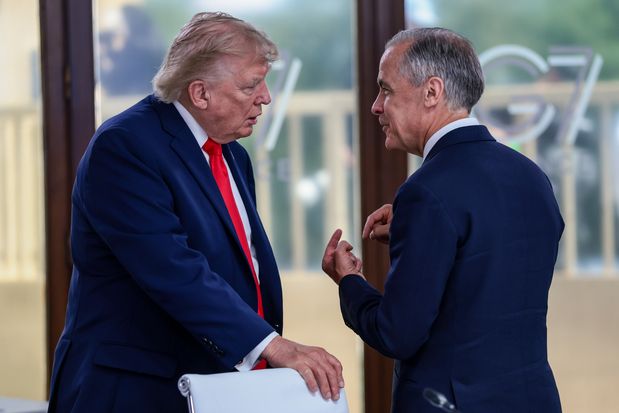
Trump and Carney
U.S. President Donald Trump speaks with Prime Minister Mark Carney at a working lunch with leaders of G7 and the Middle East, on June 16, 2026 in Evian-les-Bains, France. Photo by Evelyn Hockstein /GETTY IMAGES

U.S. President Donald Trump has threatened the European Union with a new round of “heavy tariffs” if its dealings with Canada are not to his liking.


The president made the threat in comments to reporters on Wednesday after European Commission President Ursula von der Leyen said they were considering making Canada an “associate member” of the EU during a State of the Union address earlier in the day in Strasbourg, France, that was attended by Prime Minister Mark Carney.

That prompted Trump to say that he could consider the move as a “hostile act” before qualifying the threat.

“If it’s a good intention, that’s fine,” he told reporters via CNN. “If it’s a bad intention, we’ll put very heavy tariffs on Europe, which is a possibility.”

European Commission President Ursula von der Leyen (left) shaking hands with Canada's PM Carney
This handout photograph taken and released by the European Union on September 16, 2026 shows European Commission President Ursula von der Leyen (left) shaking hands with Canada’s Prime Minister Mark Carney during her annual keynote address to the European Parliament in Strasbourg, France. Photo by Christophe Licoppe /Getty Images
Threat latest wrinkle in U.S. trade war
The possibility of Canada becoming an “associate” EU member was recently reported on by the Wall Street Journal, which prompted a denial from Carney over the weekend while he was here for the Toronto International Film Festival and the Canada Investment Summit.


The move is meant to draw Canada closer to Europe amid a trade war with the U.S. that has been ratcheted up in recent weeks with new tariffs and counter-tariffs being levied on billions of dollars’ worth of goods from both countries, Trump’s threat to correct the currency “imbalance” between the nations and the U.S. renaming Lake Ontario as “Lake America.”

Trump has also vowed to block Canadian aerospace firm Bombardier – which already has a manufacturing presence in the U.S. – from the American market unless they “build here,” signed an order on Wednesday to ban “Canadian-origin products” from government contracts and repeatedly made comments about Canada becoming the “51st state.”


EU partnership for ‘our common strength’
Von der Leyen, meanwhile, said the proposal to bring Canada closer to the EU was not meant as “a partnership against anyone else, but for our common strength.

“In short, we want to bring the relationship with Canada to the highest level possible,” she said in her address.

Meanwhile, Carney, the former head of the Bank of England, downplayed the EU speculation over the weekend in comments to the CBC at TIFF, adding “we’re not looking to become a member of the European Union.

“What we are looking (at) and will begin discussions for (is a) unique alliance with the European Union,” he said.
 

Ron in Regina

"Voice of the West" Party
Apr 9, 2008
33,037
11,860
113
Regina, Saskatchewan
U.S. President Donald Trump has threatened the European Union with a new round of “heavy tariffs” if its dealings with Canada are not to his liking.
Seriously? Canada currently isn’t the 51st state. The Canadian prime minister confirmed Canada’s interest in becoming the first ever “associate member” (whatever that means) of the union, an invitation extended the previous day by EU chief Ursula von der Leyen at the European Parliament in Strasbourg, France.
That prompted Trump to say that he could consider the move as a “hostile act” before qualifying the threat.

“If it’s a good intention, that’s fine,” he told reporters via CNN. “If it’s a bad intention, we’ll put very heavy tariffs on Europe, which is a possibility.”
While what that means remains to be seen, Carney used his speech to pitch Canada as a natural ally for the block of 27 European countries in the face of international upheaval — a “tremendous storm,” in his words — and the creation of the next world order.

He sold Canada as a reliable partner in the face of increasing trade violence and volatility by U.S. President Donald Trump. To hundreds of European lawmakers, he proposed Canadian energy and critical minerals in exchange for knocking down trade and travel barriers as well as deeper integration on tech, defence and artificial intelligence.
The move is meant to draw Canada closer to Europe amid a trade war with the U.S. that has been ratcheted up in recent weeks with new tariffs and counter-tariffs being levied on billions of dollars’ worth of goods from both countries, Trump’s threat to correct the currency “imbalance” between the nations and the U.S. renaming Lake Ontario as “Lake America.”
On Thursday, the prime minister set out to make it clear to Trump that the budding partnership with the E.U. was not intended as a hostile effort to supplant the U.S., a fear expressed by the American president Wednesday evening that came with a threat of significant trade retaliation.
Trump has also vowed to block Canadian aerospace firm Bombardier – which already has a manufacturing presence in the U.S. – from the American market unless they “build here,” signed an order on Wednesday to ban “Canadian-origin products” from government contracts and repeatedly made comments about Canada becoming the “51st state.”
On Thursday, the Canadian prime minister set out to make it clear to Trump that the budding partnership with the E.U. was not intended as a hostile effort to supplant the U.S., a fear expressed by the American president Wednesday evening that came with a threat of significant trade retaliation.
“I am not proposing a third bloc in order to become a great-power rival, only with better manners,” Carney said. Dozens of EU parliamentarians laughed and clapped in response.
“We do not seek power to dominate others. On the contrary, we are pursuing resilience, so no one, no one can control our open markets, impair our sovereignty, threaten our territorial integrity, or undermine our freedoms, our democracies, our rule of law.”
Meanwhile, Carney, the former head of the Bank of England, downplayed the EU speculation over the weekend in comments to the CBC at TIFF, adding “we’re not looking to become a member of the European Union.

“What we are looking (at) and will begin discussions for (is a) unique alliance with the European Union,” he said.
“We are not fair-weather allies. We do not pursue zero-sum deals,” Carney told hundreds of European lawmakers. “Our commitment to the rule of law and our unyielding defence of human dignity, individual freedom, and democracy share the same deep roots, the same unwavering dedication.”

Canada has loads of energy, including natural gas and hydrogen, and critical minerals that Europe will need for decades, he argued. On the flip side, Canada can contribute to Europe’s military procurement and development and would like to pool “sovereign compute power” to break away from foreign tech giant dependence.
 
  • Like
Reactions: Taxslave2

pgs

Hall of Fame Member
Nov 29, 2008
29,408
8,710
113
B.C.
ftr I also consider placing Canada under the auspices of an unelected body a hostile Act, and so should everyone who thinks democracy should mean something.
F the EU f the WEF and f the Prime Traitor
Anyone paying attention knew exactly who Carney is and who he represents prior to last election . Unfortunately not enough people pay attention. Elbows up .
 
  • Like
Reactions: Taxslave2

Ron in Regina

"Voice of the West" Party
Apr 9, 2008
33,037
11,860
113
Regina, Saskatchewan
ftr I also consider placing Canada under the auspices of an unelected body a hostile Act, and so should everyone who thinks democracy should mean something.
F the EU f the WEF and f the Prime Traitor
I’ve no idea what an “associate member” to the EU even means, & I don’t know if anybody else does either, but it’s not a member. I’ve no idea what Canada & the EU are or aren’t agreeing to.

The geography doesn’t change. Physically Canada is now and will always be connected to exactly one country (unless the US breaks into several smaller countries I guess?), and every other trading partner is at least an ocean away, so America will (probably) always remain our primary trade partner, but the %’ages can change (like Canada going from being America’s largest trading partner to its second largest trading partner recently).
The bigger question is, if America doesn’t need anything from Canada, then why is Trump threatening the EU for talking to Canada about this “associate member” status whatever that means (?) for a separate sovereign nation that’s supposed to be an ally to America talking about trade to the EU (a group of sovereign nations) that are also supposed to be an ally to America?
Neither Canada or the EU are US states or protectorates like North Dakota or Puerto Rico or Guam or whatever.
 
  • Like
Reactions: Taxslave2

Ron in Regina

"Voice of the West" Party
Apr 9, 2008
33,037
11,860
113
Regina, Saskatchewan
U.S. President Donald Trump says he is working on a “massive deal” to import potash from Belarus, an Eastern European dictatorship closely allied with Russia, in a bid to undercut Canada amid a continental trade war.

Mr. Trump announced the prospective deal in a social media post on Monday but provided no details on what exactly the agreement would entail, whether this was real or imaginary, how much potash it would involve or what the pricing would be.

“The United States is working on a massive Deal with respect to the purchase of Potash from Belarus. The pricing would be for substantially (as would the shipping I’m sure) less than we are currently paying to Canada, very good news for our Farmers and Ranchers,” he wrote on his Truth Social platform.

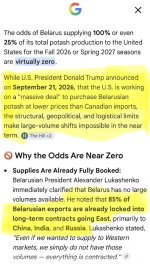
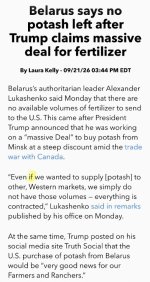
Belarusian President Alexander Lukashenko confirmed the deal but said Belarus doesn’t have much fertilizer to export to the U.S. because it is already destined for other markets.🤫“Even if we wanted to supply [potash] to other, Western markets, we simply do not have those volumes — everything is contracted,” a Monday press release from his office quoted him as saying.
Belarus, which has been ruled since 1994 by Alexander Lukashenko, has helped Russian President Vladimir Putin with his invasion of Ukraine. Mr. Lukashenko allowed Russian troops to use Belarusian territory to launch the February, 2022, attack against Kyiv. Belarus, like Russia, has been sanctioned by the U.S., the European Union and Canada over its role in the war against Ukraine, etc…

In March, Mr. Trump lifted sanctions on Belarusian potash companies after Minsk promised to release political prisoners. The deal was struck as Mr. Trump tried to push down fertilizer prices after Iran blockaded the Strait of Hormuz, cutting down the world’s supply of nitrogen from the Middle East for some reason.

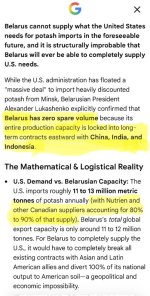
The largest export market for Belarus’s potash is China, which, according to figures from the U.S. Geological Survey, imported 29 per cent of Minsk’s product in 2024, and 40-45% of it in 2025, and is on track to absorb 75% of Belarus’s potash production for 2026🤔
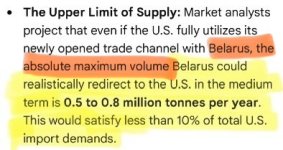
    • Belarusian Annual Production: Belarus produces roughly 6.0 to 6.4 million metric tons of potash (measured in K₂O / potassium oxide equivalent) per year. In terms of total physical weight (muriate of potash product), this amounts to roughly 11 to 12 million tonnes.
    • U.S. Annual Consumption: The United States has an apparent annual potash consumption of about 5.9 million metric tons (K₂O equivalent).
Because Belarus's total domestic output slightly outpaces total U.S. demand, a complete diversion of their supply would mathematically cover the entirety of America's annual potash needs, completely displacing the current ~80–85% reliance on imports from Canada, except…except America isn’t getting 100% of Belarus potash production when China alone is getting 75% of it.
1790024146830.jpeg
 

Ron in Regina

"Voice of the West" Party
Apr 9, 2008
33,037
11,860
113
Regina, Saskatchewan
Mr. Trump’s trade war with Canada has been repeatedly hamstrung by the fact that the United States depends heavily on its neighbour to the north for many goods, including potash. The U.S. imports much of the fertilizer from Saskatchewan and the President has granted it partial exemptions from his tariffs.
So he’s still zinging his own farmers and ranchers a tariff on Saskatchewan fertilizer with 6 weeks until the midterm elections. Also, Belarusian President Alexander Lukashenko, a close ally of Russia, said on September 11 that his country resumed selling potash to the United States following the lifting of US sanctions. Lukashenko said he wants Washington to return over $40 million that is "stuck" in the ‌US banking ⁠system, however.
1790026387096.jpeg
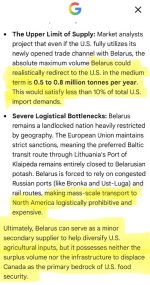
Belarus and Russia are major potash producers, but sanctions and the closing of a key port on Lithuania's Baltic coast have made those supplies expensive to ship to the US through Russia's Arctic.🙄 The US is still receiving potash exports from Russia, but the overwhelming majority of supply comes from nearby Canada.
Even if Lithuania opened its port of Klaipeda to Belarusian potash exports, the relatively low current value of potash makes it hard to justify exports through the ⁠Baltic and across the Atlantic Ocean. Oh well.
According to reporting from Reuters, potash from Belarus remains under EU sanctions, and the landlocked country has been barred from exporting via the Lithuanian port of Klaipeda since February 2022.🤫

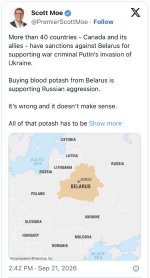
Saskatchewan Premier Scott Moe, whose province provides the U.S. with more than 86 per cent of its potash supply from Canada, said Trump’s tentative deal is “wrong and it doesn’t make sense.

More than 40 countries - Canada and its allies - have sanctions against Belarus for supporting war criminal Putin’s invasion of Ukraine. Buying blood potash from Belarus is supporting Russian aggression” he posted to X Monday afternoon.
1790026842964.jpeg
Does anyone believe Belarusian blood potash shipped through Russia is going to be more affordable, more sustainable or more ethical than potash shipped from Saskatchewan - right here in North America?
 

petros

The Central Scrutinizer
Nov 21, 2008
121,285
15,120
113
Low Earth Orbit
Mr. Trump’s trade war with Canada has been repeatedly hamstrung by the fact that the United States depends heavily on its neighbour to the north for many goods, including potash. The U.S. imports much of the fertilizer from Saskatchewan and the President has granted it partial exemptions from his tariffs.
So he’s still zinging his own farmers and ranchers a tariff on Saskatchewan fertilizer with 6 weeks until the midterm elections. Also, Belarusian President Alexander Lukashenko, a close ally of Russia, said on September 11 that his country resumed selling potash to the United States following the lifting of US sanctions. Lukashenko said he wants Washington to return over $40 million that is "stuck" in the ‌US banking ⁠system, however.
View attachment 35735
Belarus and Russia are major potash producers, but sanctions and the closing of a key port on Lithuania's Baltic coast have made those supplies expensive to ship to the US through Russia's Arctic.🙄 The US is still receiving potash exports from Russia, but the overwhelming majority of supply comes from nearby Canada.
Even if Lithuania opened its port of Klaipeda to Belarusian potash exports, the relatively low current value of potash makes it hard to justify exports through the ⁠Baltic and across the Atlantic Ocean. Oh well.
According to reporting from Reuters, potash from Belarus remains under EU sanctions, and the landlocked country has been barred from exporting via the Lithuanian port of Klaipeda since February 2022.🤫

Saskatchewan Premier Scott Moe, whose province provides the U.S. with more than 86 per cent of its potash supply from Canada, said Trump’s tentative deal is “wrong and it doesn’t make sense.

More than 40 countries - Canada and its allies - have sanctions against Belarus for supporting war criminal Putin’s invasion of Ukraine. Buying blood potash from Belarus is supporting Russian aggression” he posted to X Monday afternoon.
View attachment 35736
Does anyone believe Belarusian blood potash shipped through Russia is going to be more affordable, more sustainable or more ethical than potash shipped from Saskatchewan - right here in North America?
Delivery guarantees on demand aside, shipping will eat the tariff and the big players will continue to buy from SK.
 
  • Like
Reactions: Ron in Regina

Ron in Regina

"Voice of the West" Party
Apr 9, 2008
33,037
11,860
113
Regina, Saskatchewan
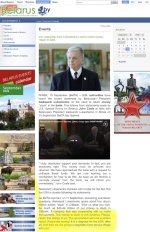
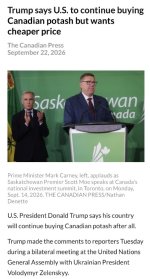
A day after Trump said he was working on a deal to buy cheaper potash from Belarus in a bid to lessen the United States' dependence on Canada. "Belarus has a lot of potash, and our farmers need good prices, and we want to get a lower price," Trump told reporters when asked about the proposed deal.

"We'll continue to go with Canada, but Belarus would like to sell it for a much lower price."…except…except Belarus ‘CAN’T’ sell it for a much lower price, and it doesn’t have the unspoken for potash to spare, and the shipping costs a real thing that exists.
1790124850681.jpeg
Belarus President Alexander Lukashenko has also said his country has limitations, saying it can't supply the United States with large volumes of potash. Canada is the world's largest producer of potash, a key component of fertilizers, and the United States is its biggest (but not only) customer. Asked about Trump's comments, Prime Minister Mark Carney told reporters at a separate news conference that Canada's potash is reliable and cost-effective.
1790124868164.jpeg
All of Canada's potash is produced in Saskatchewan. On Monday, Saskatchewan Premier Scott Moe condemned Trump's initial comments, saying Belarusian potash is unethical due to the country's involvement in Russia's invasion of Ukraine.
Mr. Trump announced the prospective deal in a social media post on Monday but provided no details on what exactly the agreement would entail, whether this was real or imaginary, how much potash it would involve or what the pricing would be.
Industry leaders and economists have also questioned how the United States could get cheaper potash from Belarus when Canada is much closer and has reliable supply-chain infrastructure.