


Hamas attacks Israel
- Thread starter Serryah
- Start date
You are using an out of date browser. It may not display this or other websites correctly.
You should upgrade or use an alternative browser.
You should upgrade or use an alternative browser.

So…is this Daniella Weiss representative of mainstream Israeli viewpoints, or is this like interviewing the KKK Grand Poobah and then condemning all Americans for that person’s viewpoint? Sorry, but the video is an hour long and I just don’t have it in me to sit through an hour of that at this point.Atoadaso....
1 Jewish life is worth...
You seem to forget that "Jew" is a blanket term that covers real and fake Jews. I doubt she represents Jewish Catholics, Khalihari Jews of Botswana or the uncontacted Jungle Jew tribes of Borneo.So…is this Daniella Weiss representative of mainstream Israeli viewpoints, or is this like interviewing the KKK Grand Poobah and then condemning all Americans for that person’s viewpoint? Sorry, but the video is an hour long and I just don’t have it in me to sit through an hour of that at this point.
It's JKK BTW
Daniella Weiss represents a hardline, religious-nationalist faction within Israel’s settler movement, not the views of most Israelis.
Weiss (born 1945) is a veteran activist long associated with Gush Emunim and, since around 2010, founder/leader of the Nachala movement. She has been involved for decades in establishing and expanding Jewish settlements and outposts in the West Bank (which she and supporters call Judea and Samaria). She served as mayor of the Kedumim settlement (1996–2007). She is often called the “godmother” of the settler movement by supporters.
Her core positions include:
- Aggressive expansion of settlements and outposts to permanently block a Palestinian state.
- Biblical/territorial maximalism (claims of Jewish rights over broad areas of the historic Land of Greater Israel).
- Especially since the October 7, 2023 Hamas attacks, open advocacy for resettling Gaza with Jews and removing its Palestinian population (“Arabs”), whom she has said “finished their chapter of history,” “lost the right” to remain, or will “disappear.” She has framed this as a practical and ideological necessity rather than abstract ambition.
- Dismissal or denial of settler violence against Palestinians in many interviews, prioritization of Jewish lives and security in stark terms, and rejection of international legal characterizations of settlements.
These views align with parts of the religious-Zionist and far-right spectrum (figures and parties like Bezalel Smotrich and Religious Zionism have overlapping goals on settlements and Gaza). Weiss has political access and has spoken at events with government ministers, and settlers overall have had outsized influence in recent coalitions. Canada and the UK have sanctioned her in connection with West Bank activities.
### Why this is not “most Israelis”
Israeli public opinion is diverse, polarized, and has hardened after October 7, but polling and political reality show clear limits:
- **West Bank settlements**: There is substantial support among Jewish Israelis for the existing settlement enterprise and for viewing many settlements as a security asset (roughly half of Jewish respondents in recent Pew data; higher among religious and right-leaning Jews). Most major Jewish parties tolerate or support the enterprise to varying degrees. Full annexation, deep outposts, or maximalist ideology do not command majority support, and a plurality has opposed specific large expansion budgets in some surveys. Secular and center/left Israelis are far more skeptical.
- **Gaza resettlement**: Clear majority opposition among both Jewish and Arab Israelis in available polls (e.g., Israel Democracy Institute data showing a majority of Jewish Israelis opposed; stronger opposition on the left and center, majority support mainly on the right). Support for rebuilding former Gush Katif-style communities has been a significant minority (around 26% overall in one 2025 poll, higher among coalition voters).
- Settlers themselves are a minority of Israel’s population (hundreds of thousands in the West Bank + East Jerusalem out of roughly 7 million Jewish Israelis). Within the settler population there is a spectrum—from quality-of-life/commuter communities nearer the Green Line to more ideological or messianic groups further out. Nachala-style unauthorized outpost activism is more radical even within settler circles.
- Broader Israeli society includes large secular, traditional, ultra-Orthodox, center, and left constituencies whose priorities (security, economy, hostages, governance, relations with the U.S. and Arab states) do not match Weiss’s full program. Israeli governments have repeatedly stopped short of her most maximalist goals for practical, diplomatic, and domestic reasons.
Public opinion has shifted rightward on Palestinian issues and security since October 7, with greater willingness to contemplate tough measures in Gaza and less faith in two-state solutions among many Jewish Israelis. That does not equate to endorsement of Weiss’s specific ideology, rhetoric, or methods. Commentators across the spectrum treat her as an influential activist from the extreme edge of the religious right, not a proxy for the median Israeli voter or even the broader right.
In short, she is a significant and persistent voice on the far right of the settler movement whose ideas have gained more visibility and some political proximity in recent years, but she does not speak for most Israelis.
Last edited:

The ISLAMISTS you dolt!! They're the rapists!! OMG I can't believe you! So Israel gets attacked & what, they're supposed to just not respond in any way? Tell themselves that the "killings" are to be accepted? They're fighting back to save their country.0
They don't occupy Palestine, Lebanon or Syria? They don't have partners who own newspapers, TV, radio and apps? Who does? Hamas?
Who does Canada occupy? First Nations that have more Rights than you or I?
Canada is destroying Rights, or are you destroying your own by being a fucking idiot?
Why would you coddled a rapist and blame the girl?
As for your spiel on Canada, I have no idea what you're talking about insofar as the topic we're speaking about. But you're right in that FN are beginning to have more rights than we do because apparently, we've "stolen" their land. Land that they travelled/roamed the country following the buffalo, so they didn't "own" any part of Canada at all. This is what is so frustrating to Canadians. YES, we've had a sordid history going against the FN but that was over 100 years ago. We've evolved but it seems our government insists on pursuing shit from back then instead of looking forward. The FN have so much going for them but they refuse to actually accept any responsibility for their communities since it's all "white man's fault" even today. What a bunch of B.S. JMHO
Last edited:
Why were Israelis attacked?The ISLAMISTS you dolt!! They're the rapists!! OMG I can't believe you! So Israel gets attacked & what, they're supposed to just not respond in any way? Tell themselves that the "killings" are to be accepted? They're fighting back to save their country.
For illegally occupying, dehumanizing and murdering people (Muzzies and Christian) in 3, yes 3 fucking nations for 59 years and beyond?
Yes 100%!!!
That makes them the rapist who got kicked in the balls, got a black eye or had an eye gouged out that you coddle.
Why on earth would you support Israel in illegally occupying, dehumanizing and murdering human beings (Christian and Muslim) who are simply fighting back against occupation, dehumanization and being murdered?
Are you a racist sick fuck? There are no viable excuses for occupation, dehumanization and murder. Only a racist sick fuck would try to justify being a racist sick fuck or support other racist sick fucks.
Ahhhhh, you ARE a racist sick fuck.As for your spiel on Canada, I have no idea what you're talking about insofar as the topic we're speaking about. But you're right in that FN are beginning to have more rights than we do because apparently, we've "stolen" their land. Land that they travelled/roamed the country following the buffalo, so they didn't "own" any part of Canada at all. This is what is so frustrating to Canadians. YES, we've had a sordid history going against the FN but that was over 100 years ago. We've evolved but it seems our government insists on pursuing shit from back then instead of looking forward. The FN have so much going for them but they refuse to actually accept any responsibility for their communities since it's all "white man's fault" even today. What a bunch of B.S. JMHO
Thanks!
I hope you are bestowed with the loss of rights and freedoms every racist sick fuck deserves to lose.
Rights and freedoms come with obligatory duties of upholding the rights and freedoms of everyone in Canada and the world.
Is racism in Israel systemic and problematic?
Yes, racism and ethnic discrimination exist in Israel, with clear systemic and institutional elements that are problematic for affected minorities—particularly Arab/Palestinian citizens (~21% of the population), Ethiopian Jews, and African migrants—though the picture is more complex than a simple binary of unique or all-encompassing racism.
Evidence of systemic patterns among Israeli citizens
Arab citizens of Israel face measurable disparities and discrimination across institutions:
Socioeconomic and service gaps: Arab localities rank overwhelmingly in the lowest socioeconomic clusters. Poverty rates for Arab families have been roughly double those of Jewish families (around 39% vs. ~16% in recent data). Education quality, infrastructure, and per-student funding show persistent gaps. Life expectancy is lower (several years for Arab men), with higher rates of certain diseases and neonatal mortality, linked in studies to segregation, poorer services, and socioeconomic factors.9df323
Employment and representation:
Arabs are underrepresented in the civil service (around 14–15% vs. 21% of the population, often in lower ranks) and heavily underrepresented in government companies. Affirmative action efforts exist but fall short.
Housing, land, and planning: Historical land policies, state control of most land, and planning restrictions contribute to housing shortages and demolitions concentrated in Arab areas. Many Arab towns are segregated; non-Jews face barriers in some Jewish localities and Jewish National Fund-related land.
Policing and enforcement:
Disproportionate complaints of police violence and over-policing affect Arabs and especially Ethiopian Israelis. Post-October 7, 2023, “incitement” cases have overwhelmingly targeted Arab citizens (reports of 90–96% of cases), while parallel Jewish expressions of racism or extreme rhetoric have seen far less enforcement.b372dc
Experienced racism:
Government tracking and surveys show Arabs and Ethiopians file a large share of racism complaints (often ~30–50% combined). High percentages of Arab and Ethiopian respondents report encountering institutional or social racism. Football stadium racism, social media hate, and everyday labeling are documented.99e126
Ethiopian Jews (Black Jews who immigrated under the Law of Return) face color-based racism: higher rates of police contact and violence complaints relative to population share, social exclusion, past blood donation controversies, and integration barriers despite formal equality. African asylum seekers (mostly Eritrean/Sudanese) have faced detention, deportation pressures, and public hostility framed around demographics and security.
The 2018 Basic Law:
Israel as the Nation-State of the Jewish People constitutionally prioritizes the Jewish character of the state, Jewish settlement, and the national home of the Jewish people. It downgraded Arabic’s status. Critics (including Arab parties, some Jewish liberals, UN committees, and rights groups) call it discriminatory and exclusionary; supporters and Israel’s High Court (which upheld it) argue it reflects Israel’s founding purpose as a Jewish state without negating individual rights under other Basic Laws or democratic institutions.4c170e
Israel’s government has acknowledged institutional racism (creating a dedicated unit initially focused on Ethiopians, later broadened) and tracks complaints, indicating recognition rather than total denial.
Occupied territories and the broader conflict
In the West Bank (including East Jerusalem) and regarding Gaza, numerous reports from UN bodies, Human Rights Watch, Amnesty, and others describe systematic differential treatment:
Separate legal regimes for Israelis and Palestinians, movement restrictions, settlement expansion, land/resource allocation, and residency policies. Some characterize this as apartheid or racial segregation under international definitions focused on domination.
Sick fuck Israel and its sick fuck supporters reject the label, arguing these are security measures in a territorial dispute and ongoing conflict involving terrorism, not racial ideology, and note that Arab citizens inside Israel proper have full formal political rights unlike classical apartheid.20492e
Security realities—suicide bombings, rocket attacks, the Second Intifada, and the October 7, 2023 Hamas massacre and subsequent war—shape attitudes, policing, and policy. Polls show significant portions of Jewish Israelis support differential rights or oppose Arab parties in coalitions; wartime polarization intensifies this. Arab citizens have voting rights, Knesset representation, Supreme Court access, and occasional coalition participation, which distinguishes Israel from non-democratic or fully segregationist systems.
Context and comparisons
Racism is not unique to Israel. Intra-Jewish tensions (Ashkenazi/Mizrahi, secular/Haredi), antisemitism among some Arabs, and hostility toward other groups also occur. Israel ranks poorly on some international racial-equality or preference surveys (alongside various Middle Eastern and Asian countries), but it is a democracy with free press, independent courts, and civil society that document and litigate these issues. Many multi-ethnic or conflict-affected societies show similar or worse institutional disparities.
Discrimination is real, documented in official data and independent reports, and harms social cohesion, minority outcomes, and Israel’s self-image as both Jewish and democratic. It is systemic in the sense of embedded disparities, land/housing rules, resource allocation, and selective enforcement, not merely isolated prejudice. At the same time, formal legal equality for citizens, political participation, and government anti-racism mechanisms differentiate it from total systems of racial hierarchy. The conflict context amplifies ethnic tensions without fully explaining domestic institutional gaps.
Last edited:
Which time, by whom?Why were Israelis attacked?
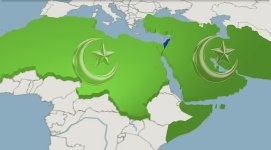
Anyway, Iran-backed Houthi forces in Yemen launched at least 12 fresh missile attacks on the Yemeni provinces of Hadramout and Marib on Friday, following drone and ballistic missiles launched at Saudi-led coalition and Yemeni government military sites, killing at least 30 soldiers in the country, on Thursday.

Saudi Arabia–Yemen relations - Wikipedia

Houthi–Saudi Arabian conflict - Wikipedia
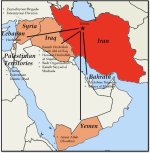
On Friday, a senior Saudi official, speaking on condition of anonymity, told Reuters that intelligence suggests the Houthis and Iraqi armed groups may launch new attacks under the supervision of Iran’s Islamic Revolutionary Guard Corps (IRGC), including on energy infrastructure, ports and airports.

Iran–Saudi Arabia proxy war - Wikipedia
The Iran-backed Houthis took control of Yemen’s capital Sanaa in 2014. Since then, they have been fighting the Saudi-backed, internationally recognised government located in the port city of Aden.
On July 13, hostilities escalated when Yemen’s government attacked Sanaa airport to prevent an Iranian aircraft from landing. The Yemeni government accused Iran of using flights to Yemen as cover to send equipment to the Houthis. The plane attempting to land in Sanaa was linked to Iran’s IRGC and had personnel, know-how, and military and dual-use equipment. The Houthis then launched missiles at Saudi Arabia, whose coalition backs the government.
Then on July 20, the Houthis imposed a maritime blockade on Saudi Arabia, disrupting oil shipments diverted to the Red Sea and also attacked Saudi state oil giant Aramco in the coastal cities of Jizan and Yanbu.
Multiple Saudi-flagged vessels and oil facilities have since been targeted by attacks. The Houthis’ Saree posted on X last week that the group had targeted the Saudi oil tanker, NCC Ghazal with ballistic missiles, forcing it to change course.
In 2023, following Israel’s attacks on Gaza in response to Hamas’s attack on Israel from Gaza, the Houthis also disrupted global shipping by attacking Israeli-linked ships transiting the Bab al-Mandeb Strait in protest over the war on Hamas in Gaza.
Houthi strikes in Yemen as Saudi Arabia braces for attacks: What we know — Al Jazeera
Tensions between the Houthis and Saudi Arabia have increased since the US-Israel war on Iran began.
The list was produced during meetings between Lebanon and Israel at the U.S. embassy in Rome this week, the latest round of talks on how to implement a June 26 deal that links Israel's progressive withdrawal of troops from Lebanon to the disarmament of Hezbollah, which would be "verified" by a third party.
Hezbollah is not a party to the agreement and has refused to give up its arsenal, which the vast majority of its massive military arsenal is obtained from Iran, which acts as its principal financial and structural patron. These weapons are systematically transferred into Lebanon via complex smuggling networks or produced locally with foreign assistance.
Lebanon, Israel agree shortlist of countries that could send troops to verify Hezbollah disarmament — Reuters
Lebanon and Israel have agreed a shortlist of countries that could send troops to verify the disarmament of Hezbollah under a U.S.-brokered agreement, a Lebanese official said on Friday, with the United States due to pick countries from the list.
Why? Why does it happen? Is it for shits and giggles? Nobody but Israel is allowed to retaliate, defend themselves or have the right to exist? They don't ilegally occupy anywhere? Israeli terrorism against Palestinians doesn't occur daily?Which time, by whom?
In the past year how many nations has Israel attacked? Only 6 and further expansions of occupations in Syria, Lebanon, West Bank and Gaza. Under international law are any of these legal? Are they justifiable? Do any of these 6 have a Right to exist or to defend themselves or retaliate or is that exclusive to Israel?
We're any justifiable or legal under international law?
The answer:
No clear consensus exists that any of these uses of force were unambiguously legal under international law; claims of self-defense are advanced in some cases and strongly contested in others. Legality turns on the UN Charter’s framework, and assessments remain polarized among states, scholars, and institutions.24cab4
Core legal rules
Article 2(4) of the UN Charter prohibits the threat or use of force against the territorial integrity or political independence of any state.
The two main exceptions are:
Authorization by the UN Security Council (none of the operations discussed received this).
The inherent right of individual or collective self-defense under Article 51 “if an armed attack occurs,” which must also satisfy customary requirements of necessity and proportionality.e2b2ec
Key points of contention include:
Whether an “armed attack” by non-state actors (Hamas, Hezbollah, Houthis) triggers self-defense against the territory of another state, and under what conditions (ICJ jurisprudence has generally required attribution or substantial involvement by the territorial state; some states accept a broader “unwilling or unable” doctrine).
The scope of anticipatory or preventive self-defense (the traditional Caroline standard requires an imminent threat that is “instant, overwhelming, leaving no choice of means, and no moment for deliberation”; pure prevention of future capabilities is widely rejected).
Once force is used, international humanitarian law (IHL/jus in bello—distinction, proportionality in attacks, precautions, etc.) applies independently of whether the initial resort to force was lawful.
There is no binding ICJ judgment in a contentious case definitively ruling these specific 2025–2026 operations lawful or unlawful. Advisory opinions address occupation obligations in the Palestinian territories but do not comprehensively settle the jus ad bellum questions for the wider regional strikes.
Assessments by target
Palestinian territories (Gaza/West Bank)
Israel invokes ongoing self-defense stemming from the 7 October 2023 Hamas attacks and continued rocket fire, hostage-holding, and threats. Many states and analysts accept that an armed attack occurred and that an initial right of self-defense arose. Debates center on whether the scale, duration, methods, and cumulative civilian harm remain necessary and proportionate, and on the application of occupation law (including duties to facilitate humanitarian relief). ICJ advisory opinions have addressed Israel’s obligations as occupying power regarding aid and related matters but have not issued a comprehensive finding that the entire campaign violates the Charter’s use-of-force rules. Positions remain sharply divided.724948
Lebanon (primarily Hezbollah)
Hezbollah’s post-October 2023 attacks provided a basis for Israeli claims of self-defense. Continued or expanded operations into 2026 raise questions of necessity and proportionality, particularly if viewed as linked to broader actions against Iran. Some analyses argue that if the Iran operations lack a solid self-defense foundation, secondary responses in Lebanon may also fail the necessity test.f9a8eb
Syria
Israel has conducted airstrikes, ground operations, and maintained presence in southern areas after the fall of the Assad regime, citing residual Iranian/proxy threats, weapons stockpiles, and protection of local communities (e.g., Druze). Legal commentary has generally found these difficult to justify under Article 51, as security interests or the desire to demilitarize a neighbor that has not itself launched an armed attack do not independently authorize force.278ec6
Yemen (Houthis)
Houthi missile and drone attacks on Israel and shipping supplied a self-defense claim for Israeli (and earlier U.S./UK) strikes. Similar non-state-actor and “unwilling or unable” issues apply.
Western states have often supported or conducted parallel actions on this basis.
Qatar (September 2025 Doha strike on Hamas leaders)
This is among the most contested.
Qatar was acting as a mediator and was not itself attacking Israel. Defenders invoke the ongoing conflict with Hamas, the status of the targets as part of the command structure, and variants of the “unwilling or unable” doctrine or universal jurisdiction against terrorists. Critics (including many international-law scholars) argue it violated Qatar’s sovereignty: Qatar was facilitating negotiations rather than demonstrably unwilling or unable to address a concrete imminent threat, and non-forcible alternatives existed. It is widely viewed as a strained application of self-defense.46999b
Iran (June 2025 “Twelve-Day War” and 2026 operations)
This is the most polarized case.
Supporting arguments: Iran’s direct 2024 missile/drone barrages against Israel, plus long-standing direction/support of proxies (Hamas, Hezbollah, Houthis) that attacked Israel, created an ongoing international armed conflict. Strikes aimed to degrade nuclear and missile capabilities that posed an existential threat, meeting necessity and proportionality within that context. Some also invoke anticipatory self-defense.19c508
Opposing arguments: At the moments of the major 2025 and 2026 strikes there was no ongoing or imminent armed attack by Iran itself that met the traditional threshold. Actions aimed at preventing future nuclear capability constitute unlawful preventive (not anticipatory) force and amount to aggression under Article 2(4). No Security Council authorization existed. UN Secretary-General statements and numerous scholars have described the strikes as lacking legal foundation.cbdb69
Overall picture
Claims of self-defense are strongest where Israel responded to actual attacks by Hamas, Hezbollah, or the Houthis (or to Iran’s direct 2024 strikes). They are weakest or most contested for broader preventive campaigns against Iran, the Qatar strike, and expansive actions in Syria. Even where a self-defense claim is plausible, IHL compliance (civilian harm, precautions, humanitarian access) is separately and intensively debated.
International law in this area is enforced primarily through state practice, political bodies, and eventual court proceedings rather than automatic adjudication. Different governments, legal scholars, and institutions reach opposing conclusions depending on how they weigh the facts of prior attacks, the imminence of threats, attribution of proxy actions, and the necessity/proportionality of the responses. No operation stands as clearly and uncontroversially lawful under the prevailing interpretations of the UN Charter.
My analogy of a rapist sustaining an injury during a rape doesn't make the rapist the victim in any way, shape or form stands firm.
Now what? Should they be held accountable under International Law or be given a pass because the rapist got a fat lip and think they are the fucking victim?Why? Why does it happen? Is it for shits and giggles? Nobody but Israel is allowed to retaliate, defend themselves or have the right to exist? They don't ilegally occupy anywhere? Israeli terrorism against Palestinians doesn't occur daily?
In the past year how many nations has Israel attacked? Only 6 and further expansions of occupations in Syria, Lebanon, West Bank and Gaza. Under international law are any of these legal? Are they justifiable? Do any of these 6 have a Right to exist or to defend themselves or retaliate or is that exclusive to Israel?
We're any justifiable or legal under international law?
The answer:
No clear consensus exists that any of these uses of force were unambiguously legal under international law; claims of self-defense are advanced in some cases and strongly contested in others. Legality turns on the UN Charter’s framework, and assessments remain polarized among states, scholars, and institutions.24cab4
Core legal rules
Article 2(4) of the UN Charter prohibits the threat or use of force against the territorial integrity or political independence of any state.
The two main exceptions are:
Authorization by the UN Security Council (none of the operations discussed received this).
The inherent right of individual or collective self-defense under Article 51 “if an armed attack occurs,” which must also satisfy customary requirements of necessity and proportionality.e2b2ec
Key points of contention include:
Whether an “armed attack” by non-state actors (Hamas, Hezbollah, Houthis) triggers self-defense against the territory of another state, and under what conditions (ICJ jurisprudence has generally required attribution or substantial involvement by the territorial state; some states accept a broader “unwilling or unable” doctrine).
The scope of anticipatory or preventive self-defense (the traditional Caroline standard requires an imminent threat that is “instant, overwhelming, leaving no choice of means, and no moment for deliberation”; pure prevention of future capabilities is widely rejected).
Once force is used, international humanitarian law (IHL/jus in bello—distinction, proportionality in attacks, precautions, etc.) applies independently of whether the initial resort to force was lawful.
There is no binding ICJ judgment in a contentious case definitively ruling these specific 2025–2026 operations lawful or unlawful. Advisory opinions address occupation obligations in the Palestinian territories but do not comprehensively settle the jus ad bellum questions for the wider regional strikes.
Assessments by target
Palestinian territories (Gaza/West Bank)
Israel invokes ongoing self-defense stemming from the 7 October 2023 Hamas attacks and continued rocket fire, hostage-holding, and threats. Many states and analysts accept that an armed attack occurred and that an initial right of self-defense arose. Debates center on whether the scale, duration, methods, and cumulative civilian harm remain necessary and proportionate, and on the application of occupation law (including duties to facilitate humanitarian relief). ICJ advisory opinions have addressed Israel’s obligations as occupying power regarding aid and related matters but have not issued a comprehensive finding that the entire campaign violates the Charter’s use-of-force rules. Positions remain sharply divided.724948
Lebanon (primarily Hezbollah)
Hezbollah’s post-October 2023 attacks provided a basis for Israeli claims of self-defense. Continued or expanded operations into 2026 raise questions of necessity and proportionality, particularly if viewed as linked to broader actions against Iran. Some analyses argue that if the Iran operations lack a solid self-defense foundation, secondary responses in Lebanon may also fail the necessity test.f9a8eb
Syria
Israel has conducted airstrikes, ground operations, and maintained presence in southern areas after the fall of the Assad regime, citing residual Iranian/proxy threats, weapons stockpiles, and protection of local communities (e.g., Druze). Legal commentary has generally found these difficult to justify under Article 51, as security interests or the desire to demilitarize a neighbor that has not itself launched an armed attack do not independently authorize force.278ec6
Yemen (Houthis)
Houthi missile and drone attacks on Israel and shipping supplied a self-defense claim for Israeli (and earlier U.S./UK) strikes. Similar non-state-actor and “unwilling or unable” issues apply.
Western states have often supported or conducted parallel actions on this basis.
Qatar (September 2025 Doha strike on Hamas leaders)
This is among the most contested.
Qatar was acting as a mediator and was not itself attacking Israel. Defenders invoke the ongoing conflict with Hamas, the status of the targets as part of the command structure, and variants of the “unwilling or unable” doctrine or universal jurisdiction against terrorists. Critics (including many international-law scholars) argue it violated Qatar’s sovereignty: Qatar was facilitating negotiations rather than demonstrably unwilling or unable to address a concrete imminent threat, and non-forcible alternatives existed. It is widely viewed as a strained application of self-defense.46999b
Iran (June 2025 “Twelve-Day War” and 2026 operations)
This is the most polarized case.
Supporting arguments: Iran’s direct 2024 missile/drone barrages against Israel, plus long-standing direction/support of proxies (Hamas, Hezbollah, Houthis) that attacked Israel, created an ongoing international armed conflict. Strikes aimed to degrade nuclear and missile capabilities that posed an existential threat, meeting necessity and proportionality within that context. Some also invoke anticipatory self-defense.19c508
Opposing arguments: At the moments of the major 2025 and 2026 strikes there was no ongoing or imminent armed attack by Iran itself that met the traditional threshold. Actions aimed at preventing future nuclear capability constitute unlawful preventive (not anticipatory) force and amount to aggression under Article 2(4). No Security Council authorization existed. UN Secretary-General statements and numerous scholars have described the strikes as lacking legal foundation.cbdb69
Overall picture
Claims of self-defense are strongest where Israel responded to actual attacks by Hamas, Hezbollah, or the Houthis (or to Iran’s direct 2024 strikes). They are weakest or most contested for broader preventive campaigns against Iran, the Qatar strike, and expansive actions in Syria. Even where a self-defense claim is plausible, IHL compliance (civilian harm, precautions, humanitarian access) is separately and intensively debated.
International law in this area is enforced primarily through state practice, political bodies, and eventual court proceedings rather than automatic adjudication. Different governments, legal scholars, and institutions reach opposing conclusions depending on how they weigh the facts of prior attacks, the imminence of threats, attribution of proxy actions, and the necessity/proportionality of the responses. No operation stands as clearly and uncontroversially lawful under the prevailing interpretations of the UN Charter.
All were illegal and unjustified. This is just the past 12 months.
My analogy of a rapist sustaining an injury during a rape doesn't make the rapist the victim in any way, shape or form stands firm.
What does the victim statement by the real victim say? What does the prosecutors Victim Impact Assessment say about her emotional state, mental health and long term recovery, PTSD reoccurring and intergenerational trauma?
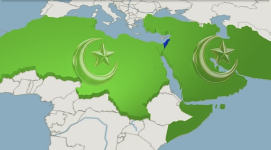
THIS???
Well, I've figured you out Petros. You're delusional & believe everything the "other side" says and you know is mis/disinformation but you put it out there anyway. I've already mentioned, that while Israel has it's issues, trying to survive is their major one & that's what they're doing. If everyone would leave them alone, there'd be peace in the M.E. but that's not what the muzzie's want - they want TOTAL ANIALATION of Israel to start & then Europe & the West afterwards. Do you not read & listen to what those "muzzies" say & do?Why? Why does it happen? Is it for shits and giggles? Nobody but Israel is allowed to retaliate, defend themselves or have the right to exist? They don't ilegally occupy anywhere? Israeli terrorism against Palestinians doesn't occur daily?
In the past year how many nations has Israel attacked? Only 6 and further expansions of occupations in Syria, Lebanon, West Bank and Gaza. Under international law are any of these legal? Are they justifiable? Do any of these 6 have a Right to exist or to defend themselves or retaliate or is that exclusive to Israel?
We're any justifiable or legal under international law?
The answer:
No clear consensus exists that any of these uses of force were unambiguously legal under international law; claims of self-defense are advanced in some cases and strongly contested in others. Legality turns on the UN Charter’s framework, and assessments remain polarized among states, scholars, and institutions.24cab4
Core legal rules
Article 2(4) of the UN Charter prohibits the threat or use of force against the territorial integrity or political independence of any state.
The two main exceptions are:
Authorization by the UN Security Council (none of the operations discussed received this).
The inherent right of individual or collective self-defense under Article 51 “if an armed attack occurs,” which must also satisfy customary requirements of necessity and proportionality.e2b2ec
Key points of contention include:
Whether an “armed attack” by non-state actors (Hamas, Hezbollah, Houthis) triggers self-defense against the territory of another state, and under what conditions (ICJ jurisprudence has generally required attribution or substantial involvement by the territorial state; some states accept a broader “unwilling or unable” doctrine).
The scope of anticipatory or preventive self-defense (the traditional Caroline standard requires an imminent threat that is “instant, overwhelming, leaving no choice of means, and no moment for deliberation”; pure prevention of future capabilities is widely rejected).
Once force is used, international humanitarian law (IHL/jus in bello—distinction, proportionality in attacks, precautions, etc.) applies independently of whether the initial resort to force was lawful.
There is no binding ICJ judgment in a contentious case definitively ruling these specific 2025–2026 operations lawful or unlawful. Advisory opinions address occupation obligations in the Palestinian territories but do not comprehensively settle the jus ad bellum questions for the wider regional strikes.
Assessments by target
Palestinian territories (Gaza/West Bank)
Israel invokes ongoing self-defense stemming from the 7 October 2023 Hamas attacks and continued rocket fire, hostage-holding, and threats. Many states and analysts accept that an armed attack occurred and that an initial right of self-defense arose. Debates center on whether the scale, duration, methods, and cumulative civilian harm remain necessary and proportionate, and on the application of occupation law (including duties to facilitate humanitarian relief). ICJ advisory opinions have addressed Israel’s obligations as occupying power regarding aid and related matters but have not issued a comprehensive finding that the entire campaign violates the Charter’s use-of-force rules. Positions remain sharply divided.724948
Lebanon (primarily Hezbollah)
Hezbollah’s post-October 2023 attacks provided a basis for Israeli claims of self-defense. Continued or expanded operations into 2026 raise questions of necessity and proportionality, particularly if viewed as linked to broader actions against Iran. Some analyses argue that if the Iran operations lack a solid self-defense foundation, secondary responses in Lebanon may also fail the necessity test.f9a8eb
Syria
Israel has conducted airstrikes, ground operations, and maintained presence in southern areas after the fall of the Assad regime, citing residual Iranian/proxy threats, weapons stockpiles, and protection of local communities (e.g., Druze). Legal commentary has generally found these difficult to justify under Article 51, as security interests or the desire to demilitarize a neighbor that has not itself launched an armed attack do not independently authorize force.278ec6
Yemen (Houthis)
Houthi missile and drone attacks on Israel and shipping supplied a self-defense claim for Israeli (and earlier U.S./UK) strikes. Similar non-state-actor and “unwilling or unable” issues apply.
Western states have often supported or conducted parallel actions on this basis.
Qatar (September 2025 Doha strike on Hamas leaders)
This is among the most contested.
Qatar was acting as a mediator and was not itself attacking Israel. Defenders invoke the ongoing conflict with Hamas, the status of the targets as part of the command structure, and variants of the “unwilling or unable” doctrine or universal jurisdiction against terrorists. Critics (including many international-law scholars) argue it violated Qatar’s sovereignty: Qatar was facilitating negotiations rather than demonstrably unwilling or unable to address a concrete imminent threat, and non-forcible alternatives existed. It is widely viewed as a strained application of self-defense.46999b
Iran (June 2025 “Twelve-Day War” and 2026 operations)
This is the most polarized case.
Supporting arguments: Iran’s direct 2024 missile/drone barrages against Israel, plus long-standing direction/support of proxies (Hamas, Hezbollah, Houthis) that attacked Israel, created an ongoing international armed conflict. Strikes aimed to degrade nuclear and missile capabilities that posed an existential threat, meeting necessity and proportionality within that context. Some also invoke anticipatory self-defense.19c508
Opposing arguments: At the moments of the major 2025 and 2026 strikes there was no ongoing or imminent armed attack by Iran itself that met the traditional threshold. Actions aimed at preventing future nuclear capability constitute unlawful preventive (not anticipatory) force and amount to aggression under Article 2(4). No Security Council authorization existed. UN Secretary-General statements and numerous scholars have described the strikes as lacking legal foundation.cbdb69
Overall picture
Claims of self-defense are strongest where Israel responded to actual attacks by Hamas, Hezbollah, or the Houthis (or to Iran’s direct 2024 strikes). They are weakest or most contested for broader preventive campaigns against Iran, the Qatar strike, and expansive actions in Syria. Even where a self-defense claim is plausible, IHL compliance (civilian harm, precautions, humanitarian access) is separately and intensively debated.
International law in this area is enforced primarily through state practice, political bodies, and eventual court proceedings rather than automatic adjudication. Different governments, legal scholars, and institutions reach opposing conclusions depending on how they weigh the facts of prior attacks, the imminence of threats, attribution of proxy actions, and the necessity/proportionality of the responses. No operation stands as clearly and uncontroversially lawful under the prevailing interpretations of the UN Charter.
My analogy of a rapist sustaining an injury during a rape doesn't make the rapist the victim in any way, shape or form stands firm.

As a sick fuck racist who had no idea Gaza and Palestine have existed long before Hebrews ever became Israelites who wandered the levant in circles you have zero credibility.Well, I've figured you out Petros. You're delusional & believe everything the "other side" says and you know is mis/disinformation but you put it out there anyway. I've already mentioned, that while Israel has it's issues, trying to survive is their major one & that's what they're doing. If everyone would leave them alone, there'd be peace in the M.E. but that's not what the muzzie's want - they want TOTAL ANIALATION of Israel to start & then Europe & the West afterwards. Do you not read & listen to what those "muzzies" say & do?
You dont link to anything, you dont read what is linked, all you do is attack the messenger. You're just a sick fuck racist ignorant cunt who is being used and you simply cant admit you're an ignorant sick fuck racist cunt and being used by people who hate you.
Do you have anything to confirm your statements as factual?
Bring facts to the table instead of repeating the same tired bullshit nobody but a handful of sick fuck racist morons believe and repeat over and over and over even when its proven false time and time again.
Prove this bullshit about wanting to kill all Jews, take over Europe, Botswana and eventually Walla Walla Washington.
Saying it doesn’t make it true PROVE IT.
Just prove your sick fuck racist bullshit for once. Why is that so hard to do?
OMG all you need to do is GOOGLE IT! Why are you so belligerent? You know most of what you say & quote are B.S. propaganda that I guess you believe. Sad really as you're not the only one in Canada who refuses to see where this world is going. But perhaps that's not it. It's likely just to "rile" some people up right?As a sick fuck racist who had no idea Gaza and Palestine have existed long before Hebrews ever became Israelites who wandered the levant in circles you have zero credibility.
You dont link to anything, you dont read what is linked, all you do is attack the messenger. You're just a sick fuck racist ignorant cunt who is being used and you simply cant admit you're an ignorant sick fuck racist cunt and being used by people who hate you.
Do you have anything to confirm your statements as factual?
Bring facts to the table instead of repeating the same tired bullshit nobody but a handful of sick fuck racist morons believe and repeat over and over and over even when its proven false time and time again.
Prove this bullshit about wanting to kill all Jews, take over Europe, Botswana and eventually Walla Walla Washington.
Saying it doesn’t make it true PROVE IT.
Just prove your sick fuck racist bullshit for once. Why is that so hard to do?
OMG all you need to do is GOOGLE IT! Why are you so belligerent? You know most of what you say & quote are B.S. propaganda that I guess you believe. Sad really as you're not the only one in Canada who refuses to see where this world is going. But perhaps that's not it. It's likely just to "rile" some people up right?
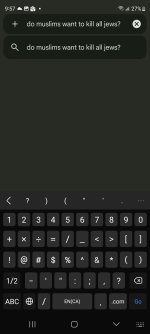
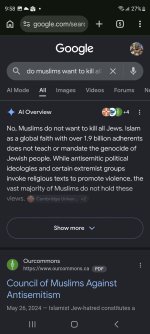
You must have a different "low class" version of Google.
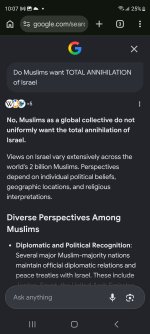
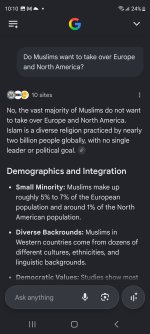
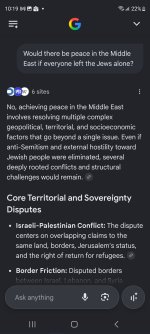
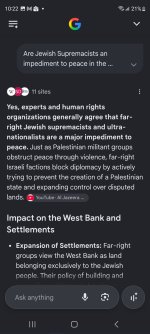
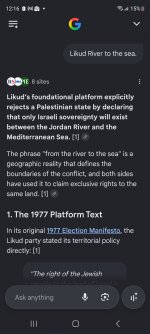
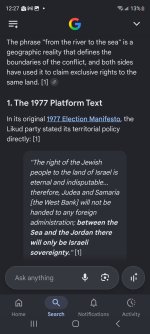
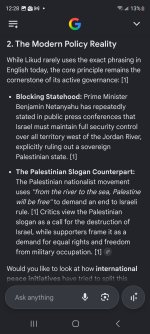
The original Likud Party "River to the Sea" that directly calls for ethnic cleansing of West Bank and Gaza.

muzzies everywhere, in all directions, as far as the eye can see, and beyond. based on what petros posted, i'm glad i don't have to worry about all the terrorists that live here in canadastan. thanks, bruh.
muzzies everywhere, in all directions, as far as the eye can see, and beyond. based on what petros posted, i'm glad i don't have to worry about all the terrorists that live here in canadastan. thanks, bruh.

What if, in the Middle East, you narrow your search parameters, just out of curiosity? Using some of the characters listed here?
You must have a different "low class" version of Google.
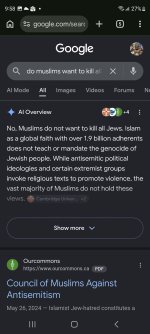
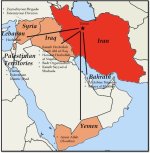
Reflecting the topic of the thread itself?
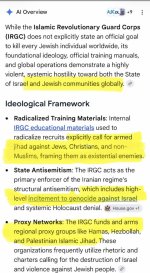
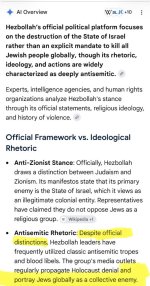
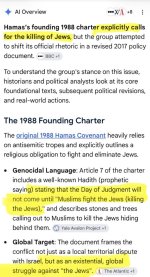
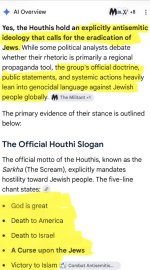
The AI will answer the question you give it, using whatever vagaries or biases are in your question, right? Narrowing the parameter helps to eliminate confusion that might be unintentionally involved by setting up the argument that because not all Muslims everywhere want to see the elimination of Jews, then it’s a non-issue or even a falsehood that there are organized armed and funded (by the ruling Iranian gov’t) groups in the Middle East that do wish to this this happen.
Approximately 85% of all Shia Muslims globally belong to the Twelver (Ithna Ashari) branch, making it by far the largest community within Shia Islam. For the Twelvers of Iran, Muhammad ibn Hasan — better known as Muhammad al-Mahdi — is the twelfth and final imam (other Shias, such as the Fivers and Seveners, believe the Imamate ends with the fifth and seventh imams, respectively).
Born in 868, al-Mahdi is believed to have gone into a state of “occultation” in 874 — meaning Allah miraculously caused him to “disappear.” Still alive, the 1,155 year-old Muhammad al-Mahdi is patiently biding his time to return and usher in the takeover of the Muslim — and eventually entire — world. Mahdism—the messianic belief in the return of the Twelfth Imam, Muhammad al-Mahdi—is a foundational pillar of the official ideology and institutional indoctrination programs of Iran's Islamic Revolutionary Guard Corps (IRGC).
Something something hooves and horns, but this and the training and ideological indoctrination materials used by Iran's Islamic Revolutionary Guard Corps (IRGC) explicitly promote violent antisemitism, delegitimize Jewish faith, and feature rhetoric calling for actions against Jews and Zionists globally…but this could just be another coincidence… when keeping the search parameters narrowed to the Middle East, etc…right?