


What taxes do you prefer?
- Thread starter Machjo
- Start date
You are using an out of date browser. It may not display this or other websites correctly.
You should upgrade or use an alternative browser.
You should upgrade or use an alternative browser.
The thing everyone is missing here is that income tax is not the biggest problem. The real problem is multiple levels of government and even public utilities have been given the right to tax with zero oversite other than the ballot box.In the Vancouver area the public transit corp gets to tax gas so that people that drive are forced to finance transportation for those that don't. Except for those that live close to the boarder who skip across to buy cheap gas.
Better go check the stats.
Who's stats are those? The ones that say that dirt poor people who's incomes are below the taxable threshold all have hoards of gold buried in the back yard?
Mine is not a minority view. If you want civilization to come apart, just marginalize and exclude the poor from everything.
I support a witch tax.
I can smell the garlic on you, from here.

How is a VAT user-pay? For example, if I go for a hair cut, I might be contributing to the extraction of metals from the ground to build scissors and clippers and to the consumption of hydro power for those clippers. but that forms a fraction of the money I pay for my hair cut. The vast majority of it is just going towards the barber's profit.
If I fill my car up with that for the same amount of money, nearly 100% of it goes towards the extraction of the resource from the ground and will contribute to adding to traffic on the roads and to urban pollution. Why should the haircut and the gas be charged the same tax?
With a tax on non-renewable resources, then I'd pay barely no tax on the innocuous haircut and a high tax on the gas. Is that not more fair?
Better go read up on VATs. The readers digest version is if you don't buy a product/service you pay no tax.

Better go read up on VATs. The readers digest version is if you don't buy a product/service you pay no tax.
Let's look at the GST for example. Would you not agree that the GST applies indiscriminately whether you pay for a haircut or for gas? How is that fair when we consider the social or environmental impact of each? Logic would suggest that they should not be subjected to the same tax.
You think hair products are good for the environment?
Why? Are you mining crude Brylcream at Fort Mac?
You think hair products are good for the environment?
Not necessarily. But instead of taxing the haircut itself, why not tax the specific product.
to take an example, in Mexico they'd introduced a sugar tax if I remember correctly. The problem though is that this sugar tax is not charged on sugar only but also on sugary drinks. Should the drink containing less sugar be taxed as much as the one containing more sugar? The solution would be to not tax the drinks at all and instead to just increase the tax on sugar producers at the source. This means that a beverage producer would have to pay more for the sugar he buys to make his beverage. This creates a direct incentive for him to either reduce the quantity of sugar in the drink or pass the extra cost down to the consumer in the price of the drink itself, not through a separate tax.
By taxing the drink itself, we eliminate the incentive to reduce the sugar content since the drink will be taxed the same way past a certain minimum sugar content regardless of how much sugar is added beyond that.
So instead of taxing the hair cut, why not tax steel? The steel producer would then have to include the tax in his overhead costs and so pass it down to the scissor manufacturer in the cost of the steel. The scissor manufacturer would be paying that tax indirectly through the cost of the steel it uses to manufacture the scissors and then pass that cost down to the barber who buys the scissors. This gives the barber an incentive to care for his scissors. The longer the scissors last, the less tax he pays.
The same can apply to other hair products. That way, the barber would have a direct incentive to cut back on more expensive products and so indirectly pay less tax. The less tax he indirectly pays, the less he needs to pass down to his client who wants to get a hair cut.
In the case of a VAT like the GST or HST, no such incentive exists since no matter how responsible the barber is, he'll pay the same tax anyway?
So let's introduce a tax on non-renewable resources and a sin tax, raise the taxes as high at the market can bear, and then scrap the GST, HST, QST, and other VATs.
Skin whitening creme in Metro Van.
If there's a harmful product in that, then tax that, not the hair cut itself.
Unfortunately, the GST is totally nonsensically indiscriminate in its application and therefore eliminates any incentive to promote responsible spending habits.
Last edited:
Goods AND services. A haircut is a service.
But that's the point. Why tax a service that minimally impacts society, the environment, the consumer's health, or the health of any person around him?
The point of the tax is to fund government services and infrastructure. But if we can encourage people to take responsibility for their own actions, then the government won't need as much revenue to begin with. A person can avoid the gas tax by moving closer to work. Though this costs the government revenue, it also reduces the need for the government to spend so much on building more highways. Though smoking or drinking less might cut into government revenues, it also reduces the need for the government to spend so much on health care. The point is that the tax needs to be relevant. How is taxing a friggin hair cut relevant to any government service or infrastructure? How does my getting a hair cut impose any additional cost on the government?
If I buy gas, I polute, contribute to traffic, etc. If I smoke, I harm my health, etc. So I get paying taxes in those cases. But how am I harming the state, the government, the environment, society, or anything or anyone else by getting a friggin hair cut?
If you want to tax the steel that the barber uses through the scissors, I get that, and I'll pay for it indirectly through the extra overhead cost to the barber for example, But how does the service itself harm society? Do we not want to encourage such clean industries? Why discourage them?
Minimal impacts? Any idea what sort of chemicals a salon uses?
Toxic Chemicals in Salons Linked to Adverse Health Effects, Including Cancer - EcoWatch
Toxic Chemicals in Salons Linked to Adverse Health Effects, Including Cancer - EcoWatch
Minimal impacts? Any idea what sort of chemicals a salon uses?
Toxic Chemicals in Salons Linked to Adverse Health Effects, Including Cancer - EcoWatch
That green hair die that is so popular now is made from spent uranium fuel rods.
It's radium that glows.
So do pregnant women but we don't make them into fuel rods, either.
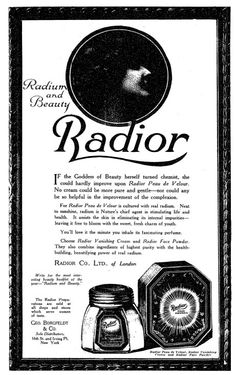
We don't make radium into fuel rods either.So do pregnant women but we don't make them into fuel rods, either.
We don't make radium into fuel rods either.
Just clock faces ...
Minimal impacts? Any idea what sort of chemicals a salon uses?
Toxic Chemicals in Salons Linked to Adverse Health Effects, Including Cancer - EcoWatch
Right. So tax the manufacturer of the chemical, not the barber. That way, any company that wants to add that chemical to its product will need to think about the extra cost of doing so. It could either cut the chemical out to keep costs down or pass the tax down indirectly through the base cost of the product.
The barber would then be free to choose to buy a less expensive product that cuts that chemical out or pay more for a product that includes it. If the barber opts for the more expensive product, he would then need to pass that cost on to the consumer in the base cost of the hair cut. The barber who opts out could then pass the savings on to the consumer through a less expensive hair cut. But how does indiscriminately taxing the hair cut itself independently of the chemicals used create any incentive for the barber to cut back on harmful chemicals if he has no way to avoid the tax and if he must pay the same tax regardless?
Let's look at the taxi driver for example. Imagine a taxi driver who decides to build an ingenious solar-powered taxi that he can also plug into his solar-powered house after every shift. How would charging the GST/HST/QST indiscriminately promote more responsible practices? Now imagine scrapping taxes on taxi rides but raising a tax on non-renewable resources. This would mean that the taxi driver who buys gas will then need to pay more for gas and pass the cost down to the rider as an overhead cost, whereas the driver of the solar-powered taxi would pay no GST at all. Again, why should they be taxed the same when one accepts more socially responsible practices and the other doesn't?
You have to tax the end user.
Why tax the end user directly? That is the most blunt instrument available in the tax repertoire. By taxing the end user directly, we're taxing both good and bad products. By taxing the manufacturer or extractor directly instead, it becomes a more precisely targeted tax targeting undesirable products and services while leaving the rest alone.
No worries. The tax will be passed on to the end consumer anyway, but more precisely to the degree that it's consumed.