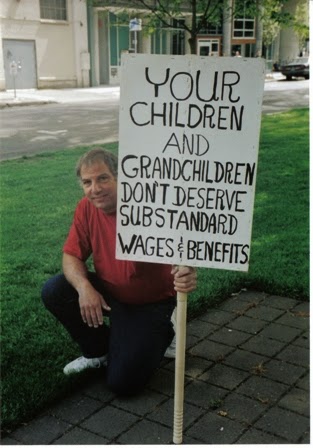
Trudeau BSs' Big Time On CETA. Says It Will Help The EU

Machjo

Hall of Fame Member
Oct 19, 2004
17,878
61
48
Ottawa, ON
Also, free trade does not necessarily need to come at the sacrifice of justice. Why could a country not have free traide and raise taxes on the rich and retrain laid off workers for new jobs too?

They don't have to be mutually exclusive.

In fact, the economies of scale gained from free trade could even mean that the rich can better afford to pay higher taxes than before. Some might even just naturally gravitate to a higher tax bracket as a result of free trade. The extra money in taxes could then help those who are hardest hit.

When Trudeau Jr said CETA would benefit the EU, he was right to have said that. Why else should the EU sign it? If CETA benefitted only Canada, then we'd have no deal. So it must necessarily either benefit all parties concerned, benefit the least advantaged party, or at least the trading partners overall. It if benefits only one of the wealthier members and hurts the rest and hurts the partners overall, then why would the EU sign it just to benefit Canada?
 

tay

Hall of Fame Member
May 20, 2012
11,548
1
36
NAFTA's Biggest Winner? Mexico

Now it you believe in the redistribution of wealth, how can you morally opose free trade?

Maybe we could have argued that the free movement of labour should have complemented it so that people could go to the manufacturers as easily as the manufacturers could go to the workers. For example, had NAFTA accompanied the free movement of labout, Caterpillar workers could have been free to follow Caterpillar south had they wanted to. Instead, the corporatio was free to leave Canada to access another labour market. But the workers weren't free to follow the company south to access the job market.

I see that as problematic.

I think the problem is that many ultranationalists like to ask whether free trade will benefit their country rather than ask whether it will benefit all of the participating countries overall, a far more legitimate question if we include the welfare not only of Canadians but of our fellow man.


There's our difference. I am Canadian and I care about Canada and putting Canada first.......


Machjo

Hall of Fame Member
Oct 19, 2004
17,878
61
48
Ottawa, ON
There's our difference. I am Canadian and I care about Canada and putting Canada first.......


Then we'll have to agree to disagree.

Though far from being a socialist, I still believe in an at least moderate redistribution of wealth.
 

Danbones

Hall of Fame Member
Sep 23, 2015
24,505
2,198
113
Any one who can't see that these completely integrated treaties totally abrogate national governments and only will benefit the small handful of corporate elite at the top of the food chain is not worth reading or arguing with

they obviously haven't been paying attention to whats already happened

The future: wait till the robots arrive full on
 

Machjo

Hall of Fame Member
Oct 19, 2004
17,878
61
48
Ottawa, ON
Any one who can't see that these completely integrated treaties totally abrogate national governments and only will benefit the small handful of corporate elite at the top of the food chain is not worth reading or arguing with

they obviously haven't been paying attention to whats already happened

The future: wait till the robots arrive full on

NAFTA helped to build the Mexican middle class.

If you want to introduce more progressive taxes, carbon tax, etc. those are separate matters.
 

tay

Hall of Fame Member
May 20, 2012
11,548
1
36
We live in the Age of Misplaced Faith. A stunning example of what this means for ordinary people is CETA . Murray Dobbin writes (link is external):

The federal government makes its own "reality" by crafting "facts" to fit its policy objectives -- no matter how outrageous they are when put to the test. Three numbers stand out in the talking points of federal governments under both Harper and Trudeau: that CETA will increase GDP by $12 billion, that it will create 80,000 jobs and that the newly created wealth will boost income by $1,000 per family.

But economist Jim Stanford debunked these numbers long ago -- pointing out in 2012 (link is external) that the federal trade department simply took the $12-billion figure (itself a highly dubious figure) "[a]nd divided it by the number of families in Canada. That assumes that every additional dollar of GDP translates directly into family income. In fact, higher GDP never fully trickles down into income..." The money that does find its way into income goes mostly to the wealthy.

The $12-billion figure came from a study commissioned by Canada and carried out by three EU economists. Stanford pointed out that the model used made some outrageous assumptions:

"[c]onstant full employment (so no one can be unemployed due to imports), balanced trade (so a country's total output cannot be undermined by a trade deficit), no international capital flows (so companies cannot shift investment abroad), and no impact from fluctuating exchange rates."Stanford called the study "outrageous."

He was being far too polite. It was outright fraud.

Anyone paying even cursory attention to the Canadian economy knows that not one of these assumptions holds. We haven't had full employment for decades, we have been experiencing trade deficits for years, NAFTA resulted in the shifting of billions of investment dollars to Mexico and China, and our exchange rate has been all over the map.

A recent study from Tufts University took a long look at CETA and arrived at these conclusions:


  • "CETA will lead to a reduction of the labour income share. Competitive pressures exerted by CETA on firms and transferred onto workers will raise the share of national income accruing to capital and symmetrically reduce the share of national income accruing to labour.

  • By 2023, workers will have foregone average annual earnings increases of €1776 in Canada and between €316 and €1331 in the EU depending on the country.

  • CETA will lead to net losses of government revenue. Competitive pressures exerted by CETA on governments by international investors and shrinking policy space for supporting domestic … production and investment will reduce government revenue and expenditure.

  • CETA will lead to job losses. By 2023, about 230,000 jobs will be lost in CETA countries, 200,000 of them in the EU, and 80,000 more in the rest of the world [the study projects a loss of 23,000 Canadian jobs due to CETA in the first seven years].

  • CETA will lead to net losses in terms of GDP. [D]emand shortfalls nurtured by higher unemployment will also hurt productivity and cause cumulative losses amounting to 0.96 per cent of national income in Canada..."

Mr. Trudeau lambasted Mr. Harper for his misplaced faith. It was the pot calling the kettle black.
 

tay

Hall of Fame Member
May 20, 2012
11,548
1
36
BRUSSELS (Reuters) - An EU-Canada free trade deal will destroy jobs in Europe and should be rejected, a committee of the European Parliament concluded on Thursday.

The European Union and Canada signed CETA in October, but only after hesitation in Austria other countries and opposition from a region of Belgium.

CETA needs backing from the European Parliament and that vote is expected in February.

The employment committee voted 27-24 for a motion saying the 751-seat parliament should not give its approval to the deal, saying studies showed it could lead to 204,000 EU job losses.

Parliament's trade committee is the lead body responsible for CETA, but before it holds a vote in January, other committees are allowed to offer their opinions. The environment and foreign affairs committees are also expected to give a view, with the latter expected to be in favour.

CETA has struggled to secure approval in Europe some two years after the two sides reached a deal.

Even after the European Parliament vote, CETA would only enter force provisionally, most likely in the form of import tariff removal, as it needs approval from the EU's 28 member states and Belgium's regions.

Supporters say CETA will increase Canadian-EU trade by 20 percent and boost the EU economy by 12 billion euros ($13 billion) a year and Canada's by C$12 billion ($9 billion).

The main focus of protests against CETA is the system to protect foreign company's investments against state intervention. Critics say its arbitration panels to rule on disputes allow multinational companies to dictate public policy, such as on environmental standards.

European Parliament committee says reject EU-Canada trade deal | Reuters
 

tay

Hall of Fame Member
May 20, 2012
11,548
1
36
EU lawmakers today voted for the European Parliament to push ahead with a trade deal that could encourage Canadian tar sand oil imports and make it easier for energy companies to sue governments when environmental policies threaten their profits.

The UK’s international trade minister, Liam Fox, last year circumvented parliament to approve the Comprehensive Economic and Trade Agreement (CETA) between the EU and Canada. The deal now has to be approved by European policymakers.

MEPs in the committee charged with overseeing environmental regulation today voted 40 to 24 for the European Parliament to back the deal, Reuters reports. A final decision is expected in February.

Writing in The Ecologist ahead of the vote, Mark Dearn from campaign group War on Want said the deal had already “put rocket boosters under runaway climate change by bringing high-polluting tar sands oil into Europe”.

Reacting to the vote, he told DeSmog UK:

“The committee's decision on CETA is an utter disgrace. It flies in the face of a wealth of evidence showing CETA to be bad news for the environment, food and health - not least that the EU sacrificed its own climate change legislation to appease the tar sands demands of Big Oil companies and the Canadian and US governments.”

Campaigners are also concerned that the deal will make it easier for companies to sue governments that use environmental regulations to try and move their economies away from fossil fuels.

A mechanism called investor-state dispute settlements is included in the deal, and could allow companies to sue countries that ban tar sands oil. Companies have used the mechanism in Canada to oppose fracking moratoriums, and in Germany to protest the closure of nuclear power plants.

The Canadian government has also objected to EU chemical regulations on over 20 occasions between 2003 and 2011, EnergyDesk has previously revealed, leading to concerns that companies could use CETA to undermine those rules.

http://desmog.uk/2017/01/12/meps-vote-pursue-tar-sands-friendly-trade-deal-canada
 

Machjo

Hall of Fame Member
Oct 19, 2004
17,878
61
48
Ottawa, ON
If CETA does not prohibit any federal or provincial government in Canada from imposing a non-renewable-resource tax on its extraction companies, then I don't see how CETA harms the environment.

Are you suggesting that CETA ought to force Canada to impose such a tax on its extraction companies? I'm just trying to understand your logic, Tay.
 

tay

Hall of Fame Member
May 20, 2012
11,548
1
36
If CETA does not prohibit any federal or provincial government in Canada from imposing a non-renewable-resource tax on its extraction companies, then I don't see how CETA harms the environment.

Are you suggesting that CETA ought to force Canada to impose such a tax on its extraction companies? I'm just trying to understand your logic, Tay.
Please read the posts. I'll be patient with you because I appreciate English is not your first language.

The ISDS is the problem regarding the environment............


The EU-Canada free trade deal received backing from a committee of the European Parliament and Germany's top court on Thursday, increasing its chances of entering force later this year.

Even after the European Parliament vote, CETA would only enter force provisionally. But this provisional application is expected to bring well over 90 per cent of the deal into force, with the exception of controversial reforms to the investor-state dispute settlement (ISDS) system.

The ISDS clauses were rewritten a year ago to introduce a new investment arbitration court system that the EU hopes may one day be adopted internationally.

Canadian officials joined EU proponents for talks in Geneva last month toward establishing a multilateral investment court that, if implemented, could supersede the clauses that were highly contentious prior to CETA's signing last October.

Critics of the deal, who have organized anti-trade deal protests in several European countries that drew thousands to the streets, maintain that even the revised investment court provisions allow multinational companies to dictate public policy, such as on environmental standards.

Campaign group Transport & Environment said lawmakers had missed a vital opportunity to red-flag CETA over a flawed investment tribunal system and toothless environmental provisions.

video

Canada-EU trade agreement clears two more hurdles in Europe - Politics - CBC News
 

tay

Hall of Fame Member
May 20, 2012
11,548
1
36
A planned EU-Canada free trade deal moved closer to reality on Tuesday after a key committee advised the European Parliament to give its backing after months of protests and heated debate.

The EU-Canada Comprehensive Economic and Trade Agreement (CETA) is seen as a test of Europe's ability to forge future trade accords and as a counterweight to anticipated protectionism under new U.S. President Donald Trump.

Foreign Affairs Minister Chrystia Freeland told reporters at the cabinet retreat in Calgary that this was "an important moment for Canada."

"It's more than just a free trade treaty with Canada. It's a statement about how we relate with the rest of the world," said Sorin Moisa, CETA co-ordinator for the centre-left Socialists and Democrats Group, whose members have been divided over the pact.

"We want to shape rather than withdraw from the world, and all the more so after Trump," he told Reuters in an interview.

CETA still needs approval from the European Parliament to enter into force and lawmakers in its international trade committee voted 25-15 urging it to do so. The full parliament is due to give its verdict in mid-February.

In a debate on Monday, committee members backing the accord repeatedly warned of the threat of greater protectionism under Trump, who has withdrawn from the TPP and plans to renegotiate the NAFTA with Canada and Mexico.

EU trade commissioner Cecilia Malmstrom told lawmakers Canada was a welcome partner in uncertain and difficult times.
"We have an important friend and ally who seems to be at least partly disengaging from the international scene, promoting less trade, more protectionism," she said of the United States.

David Martin, a Scottish Labour member of the European Parliament, issued a press release declaring that "when it comes to trade, we're choosing Trudeau over Trump."

"We rejected protectionism," he said in an interview with CBC News. "We have a different view of how we handle globalization.

"We have criticisms — and frankly, some of our criticisms are exactly the same as President Trump. But we've come to a completely opposite conclusion," Martin said.

European Parliament's trade committee endorses Canada's free trade deal - Politics - CBC News
 

taxslave

Hall of Fame Member
Nov 25, 2008
36,362
4,341
113
Vancouver Island
EU lawmakers today voted for the European Parliament to push ahead with a trade deal that could encourage Canadian tar sand oil imports and make it easier for energy companies to sue governments when environmental policies threaten their profits.

The UK’s international trade minister, Liam Fox, last year circumvented parliament to approve the Comprehensive Economic and Trade Agreement (CETA) between the EU and Canada. The deal now has to be approved by European policymakers.

MEPs in the committee charged with overseeing environmental regulation today voted 40 to 24 for the European Parliament to back the deal, Reuters reports. A final decision is expected in February.

Writing in The Ecologist ahead of the vote, Mark Dearn from campaign group War on Want said the deal had already “put rocket boosters under runaway climate change by bringing high-polluting tar sands oil into Europe”.

Reacting to the vote, he told DeSmog UK:

“The committee's decision on CETA is an utter disgrace. It flies in the face of a wealth of evidence showing CETA to be bad news for the environment, food and health - not least that the EU sacrificed its own climate change legislation to appease the tar sands demands of Big Oil companies and the Canadian and US governments.”

Campaigners are also concerned that the deal will make it easier for companies to sue governments that use environmental regulations to try and move their economies away from fossil fuels.

A mechanism called investor-state dispute settlements is included in the deal, and could allow companies to sue countries that ban tar sands oil. Companies have used the mechanism in Canada to oppose fracking moratoriums, and in Germany to protest the closure of nuclear power plants.

The Canadian government has also objected to EU chemical regulations on over 20 occasions between 2003 and 2011, EnergyDesk has previously revealed, leading to concerns that companies could use CETA to undermine those rules.

http://desmog.uk/2017/01/12/meps-vote-pursue-tar-sands-friendly-trade-deal-canada

That is good news. Where is the problem?
 

taxslave

Hall of Fame Member
Nov 25, 2008
36,362
4,341
113
Vancouver Island
EU lawmakers today voted for the European Parliament to push ahead with a trade deal that could encourage Canadian tar sand oil imports and make it easier for energy companies to sue governments when environmental policies threaten their profits.

The UK’s international trade minister, Liam Fox, last year circumvented parliament to approve the Comprehensive Economic and Trade Agreement (CETA) between the EU and Canada. The deal now has to be approved by European policymakers.

MEPs in the committee charged with overseeing environmental regulation today voted 40 to 24 for the European Parliament to back the deal, Reuters reports. A final decision is expected in February.

Writing in The Ecologist ahead of the vote, Mark Dearn from campaign group War on Want said the deal had already “put rocket boosters under runaway climate change by bringing high-polluting tar sands oil into Europe”.

Reacting to the vote, he told DeSmog UK:

“The committee's decision on CETA is an utter disgrace. It flies in the face of a wealth of evidence showing CETA to be bad news for the environment, food and health - not least that the EU sacrificed its own climate change legislation to appease the tar sands demands of Big Oil companies and the Canadian and US governments.”

Campaigners are also concerned that the deal will make it easier for companies to sue governments that use environmental regulations to try and move their economies away from fossil fuels.

A mechanism called investor-state dispute settlements is included in the deal, and could allow companies to sue countries that ban tar sands oil. Companies have used the mechanism in Canada to oppose fracking moratoriums, and in Germany to protest the closure of nuclear power plants.

The Canadian government has also objected to EU chemical regulations on over 20 occasions between 2003 and 2011, EnergyDesk has previously revealed, leading to concerns that companies could use CETA to undermine those rules.

http://desmog.uk/2017/01/12/meps-vote-pursue-tar-sands-friendly-trade-deal-canada
From desmog canada no less. A group of worthless NIMBYs that want to destroy our oil industry. And the rest of the economy with it. Meaning this is mostly garbage coming from the extreme left.

There's our difference. I am Canadian and I care about Canada and putting Canada first.......


If you actually cared about Canada you would be pushing for a really big pipeline to the East coast so we could export oil to Europe.
 

tay

Hall of Fame Member
May 20, 2012
11,548
1
36
European Green Leaders write to Justin Trudeau ahead of CETA vote in European Parliament

https://www.eureporter.co/economy/2...au-ahead-of-ceta-vote-in-european-parliament/


Dear Right Honourable Justin Trudeau,

It is a pleasure to welcome you to the heart of European democracy – the European Parliament. The relations between the European Union and Canada enjoy the distinction of being among the very best between any transatlantic partners.

There can be little doubt of the utmost respect we have for your country and your government and we wholeheartedly recognise the importance of strengthening relations with Canada, especially as we also experience some ominous developments in the transatlantic space.

Indeed, we appreciate a lot what your government has done for refugees and for the advancement of diversity and women´s rights.

We believe we should and we can cooperate to shape globalization in a way that will eradicate poverty, solve the climate crisis, pursue innovation and inclusion and safeguard our democracies.

But all of this won’t make us vote in favor of CETA.

CETA is a deal that in its development mirrors some important changes regarding our trade relations.

Negotiation at first were not transparent. The European Commission mandate for negotiations was indeed published very late, only in December 2015. Only more recently did the public get a chance to be involved more deeply.

We assume you agree that we have to balance the interest of citizens, consumers, entrepreneurs and workers. We also assume you agree that if negotiations were to start all over again, we might both contribute to a trajectory that looks more ambitiously at finding such a balance.

Obviously, we cannot do the CETA negotiations all over again, so we can but state that the agreement is plagued with considerable faults that could have been avoided if things were done differently from the beginning.

As European Greens, are we going to say yes to CETA because there is no other option? No! We want to clearly state that some old thinking on trade needs to be eradicated still.

In particular the privileges international investors are enjoying thanks to the investors protection rules are unjustified and we cannot support them. We are also deeply concerned about the so-called “ratchet” and “standstill” clauses which for the first time establish that privatizations are irreversible while the public sector is still open for privatization.

We clearly do not share the assumption that markets always work better than the public sector. Experience is on our side here.

So we stick to a NO vote because we want to send a signal: more progress must be made!

We know that on some issues Canada might have been willing to opt for an improvement of the existing text, for instance with regard to the enforcement of workers’ rights and environmental commitments. The European Commission did, in our eyes, miss out on some opportunities.

With CETA being a mixed Treaty, it will have to be ratified by all 28 member states, provided it is not ruled incompatible with EU law by the European Court of Justice. For as long as this ratification process has not been completed, the investment protection rules will not apply. That might give both sides, Canada and the EU, some time to reconsider how to build a fair investment protection system that is not tilted towards big corporations, but also enables workers or defendants of the environmental concerns to take corporations to task. We count on you.

We say yes to trade with Canada and yes to an open world. We hope that your country and the EU will be able to team up effectively in the future to build a free and fair multilateral global trading environment that opposes both protectionist nationalism and corporate privilege.

With the expression of our great respect, we remain,

Sincerely yours,


Monica Frassoni
Ska Keller
Reinhard Bütikofer
 

Danbones

Hall of Fame Member
Sep 23, 2015
24,505
2,198
113
if le pen gets in in France in a couple months she plans to default back to the franc
lol
the eu and the US are titanics, like global warming, communism, and free trade

the lil pot ate oh is doing us in for globalism and WW.dictatorship
 

Remington1

Council Member
Jan 30, 2016
1,469
1
36
It's not Canada's responsibility to enrich Mexico or anybody else. It should be our responsibility to enrich Canadians and make sure there is a future for our children. Canada should have continued to help poorer countries monetarily, but not by outsourcing our jobs, and resources. With the mass distribution of wealth that NAFTA has afforded Mexico, why are the citizens still running across borders at night? Why is there still such poverty? Who is actually getting rich? I suspect the same people as in Canada, and it ain't the poor.