Easy for him to say. He spends more of OPM on airline food every month than a pensioner is expected to live on for an entire year. Maybe if we cut his pay to $1.00 a year he would have a better understanding of money.Then Canadian Prime Minister Mark Carney has sort of but not really inserted himself into Tuesday’s U.S. midterm elections, saying he’s prepared to outwait the Trump administration and sign a new trade deal with the next American president, if necessary.

Omnibus : 2022 Midterm Elections
- Thread starter B00Mer
- Start date
You are using an out of date browser. It may not display this or other websites correctly.
You should upgrade or use an alternative browser.
You should upgrade or use an alternative browser.


If we did that, he would be justified in collecting his salary Trump-style with insider connections on policy so that he can make $1 billion a year, etc…. or like Trudeau, who somehow made something like $400 million while in office during COVID-19. Don’t get me wrong and I’m not justifying political financial excess whatsoever & and it definitely needs to be reeled in.Easy for him to say. He spends more of OPM on airline food every month than a pensioner is expected to live on for an entire year. Maybe if we cut his pay to $1.00 a year he would have a better understanding of money.

The real estate bubble popped. Housing prices and rentals are plummeting in Vancouver. Im starting to see property management companies offering $1000 move in bonus and last month of a one year lease free.View attachment 36106
If we did that, he would be justified in collecting his salary Trump-style with insider connections on policy so that he can make $1 billion a year, etc…. or like Trudeau, who somehow made something like $400 million while in office during COVID-19. Don’t get me wrong and I’m not justifying political financial excess whatsoever & and it definitely needs to be reeled in.
By January they'll be offering trips to Mexico ontop of move in and last month free.
Jackass Trudeau made his $400m in real estate fueled by 5 million more immigrants than the system could handle.
I bet he has already ditched the properties and moved onto data.

Look at the relationship between King Carney’s Brookfield and federal government contracts and subsidies . It makes Trudeau’s grift chump change .View attachment 36106
If we did that, he would be justified in collecting his salary Trump-style with insider connections on policy so that he can make $1 billion a year, etc…. or like Trudeau, who somehow made something like $400 million while in office during COVID-19. Don’t get me wrong and I’m not justifying political financial excess whatsoever & and it definitely needs to be reeled in.
You have to look at Carneys Brookfield & the ties to Trump’s son-in-law & 666 5th Ave and the Qatari….before Carney became the Prime Minister of Canada…& how that tangled web leads to Trump & Carney’s slap fest and the gift of Qatar Force One, & Jared Kushner, being one of the two mediators floating around the Middle East on Trump’s behalf. There’s a rabbit hole if you want to crawl down one.Look at the relationship between King Carney’s Brookfield and federal government contracts and subsidies . It makes Trudeau’s grift chump change .
 T
In August 2018, Brookfield Asset Management rescued Jared Kushner’s family skyscraper at 666 Fifth Avenue in Manhattan by signing a 99-year lease and paying approximately $1.1 billion to $1.2 billion in rent upfront. This cash infusion allowed the Kushner Companies to pay off a massive, looming debt burden on the struggling property.
The bailout drew intense scrutiny because the Qatar Investment Authority (QIA)—Qatar's sovereign wealth fund—was a major investor in Brookfield Property Partners, the fund utilized for the transaction.
Critics and congressional investigators (such as Senator Ron Wyden) raised serious conflict-of-interest and ethics concerns. Just months prior in 2017, Jared Kushner had pushed a foreign policy stance aligned with a Saudi- and UAE-led blockade against Qatar. Reports later surfaced that Kushner’s family had directly pitched Qatari officials for funding to save the tower before the deal was quietly routed through Brookfield.
Brookfield initially maintained that no Qatar-linked entity was behind the deal, a claim challenged by lawmakers and investigative reports pointing to QIA's substantial stake in the financing mechanism.
The financial entanglement between the Kushners, Qatari-backed capital, and subsequent ventures (such as Jared Kushner's later private equity firm, Affinity Partners, which also received significant Qatari backing) has remained a focal point for ethics watchdogs and congressional inquiries.

Timeline on Jared Kushner, Qatar, 666 Fifth Avenue, and White House Policy
A comprehensive account of Jared Kushner, 666 Fifth Avenue, and White House support for the blockade of Qatar after the Qataris rejected Kushner Companies.
 www.justsecurity.org
Well that’s great but doesn’t explain the relationship between King Carney , the Liberal Party , the Government of Canada and Brookfield it makes Paul Martin and Canada Steamship Lines look like child’s play .You have to look at Carneys Brookfield & the ties to Trump’s son-in-law & 666 5th Ave and the Qatari….before Carney became the Prime Minister of Canada…& how that tangled web leads to Trump & Carney’s slap fest and the gift of Qatar Force One, & Jared Kushner, being one of the two mediators floating around the Middle East on Trump’s behalf. There’s a rabbit hole if you want to crawl down one.View attachment 36110T
In August 2018, Brookfield Asset Management rescued Jared Kushner’s family skyscraper at 666 Fifth Avenue in Manhattan by signing a 99-year lease and paying approximately $1.1 billion to $1.2 billion in rent upfront. This cash infusion allowed the Kushner Companies to pay off a massive, looming debt burden on the struggling property.
The bailout drew intense scrutiny because the Qatar Investment Authority (QIA)—Qatar's sovereign wealth fund—was a major investor in Brookfield Property Partners, the fund utilized for the transaction.
Critics and congressional investigators (such as Senator Ron Wyden) raised serious conflict-of-interest and ethics concerns. Just months prior in 2017, Jared Kushner had pushed a foreign policy stance aligned with a Saudi- and UAE-led blockade against Qatar. Reports later surfaced that Kushner’s family had directly pitched Qatari officials for funding to save the tower before the deal was quietly routed through Brookfield.
Brookfield initially maintained that no Qatar-linked entity was behind the deal, a claim challenged by lawmakers and investigative reports pointing to QIA's substantial stake in the financing mechanism.
The financial entanglement between the Kushners, Qatari-backed capital, and subsequent ventures (such as Jared Kushner's later private equity firm, Affinity Partners, which also received significant Qatari backing) has remained a focal point for ethics watchdogs and congressional inquiries.
Timeline on Jared Kushner, Qatar, 666 Fifth Avenue, and White House Policy
A comprehensive account of Jared Kushner, 666 Fifth Avenue, and White House support for the blockade of Qatar after the Qataris rejected Kushner Companies.

Yes soon it will all be over except for the crying and skullduggery.
As the 2026 US midterm elections take place tomorrow, November 3, 2026, political analysts, legal experts, and government institutions have outlined several anticipated challenges regarding the voting process, the acceptance of results, and the subsequent power dynamics between Congress and the White House.Yes soon it will all be over except for the crying and skullduggery.
Because evaluating potential political conflict or "skulduggery" involves differing perspectives, the primary concerns and expectations attributed to major tracking organizations, legal analyses, and political reports are detailed below.
1. Legal Challenges and Post-Election Litigation
According to non-partisan legal and election tracking organizations like the Brennan Center for Justice and Democracy Docket, a high volume of post-election litigation is expected from both political parties.
- Pre-election rules: Legal battles have already been established concerning mail-in ballot deadlines, signature verification rules, and voter roll maintenance.
- Canvassing and certification: Experts anticipate localized disputes during the county- and state-level certification processes, mirroring patterns seen in recent election cycles where some local officials may hesitate or delay signing off on narrow results.
Public statements from party leadership indicate contrasting approaches to how the election outcomes will be received:
- The Democratic Perspective: Democratic leaders and groups like the Democratic National Committee (DNC) have stated concerns that certain Republican candidates may preemptively declare victory or refuse to concede close races, particularly in key swing districts or Senate battlegrounds, citing unverified claims of irregularities.
- The Republican Perspective: Republican leaders and groups like the Republican National Committee (RNC) emphasize their focus on "election integrity" initiatives, deploying thousands of poll watchers and legal monitors to ensure strict adherence to state election laws, which they argue is necessary to ensure public trust in the final tally.
The aftermath of the midterms will directly dictate the level of legislative gridlock or cooperation between the legislative branch and the executive branch (the Oval Office):
- Divided Government Dynamics: Political forecasting models (such as those from Cook Political Report and Inside Elections) suggest that if control of either the House of Representatives or the Senate flips parties, the Oval Office will face intense oversight, a wave of committee investigations, and potential gridlock on judicial appointments and federal budget appropriations.
- The Seating Process: While intense political maneuvering and rhetoric are anticipated during the counting and certification phases throughout November and December 2026, constitutional experts note that the Electoral Count Reform Act and established federal statutes provide strict legal mechanisms governing how newly elected members are certified and seated when the new Congress convenes in January 2027.
Why , he would spout Democrat taking points for the most part . That said I believe he is a capitalist and would not like the direction the current Democrat hierarchy.As the 2026 US midterm elections take place tomorrow, November 3, 2026, political analysts, legal experts, and government institutions have outlined several anticipated challenges regarding the voting process, the acceptance of results, and the subsequent power dynamics between Congress and the White House.
Because evaluating potential political conflict or "skulduggery" involves differing perspectives, the primary concerns and expectations attributed to major tracking organizations, legal analyses, and political reports are detailed below.
1. Legal Challenges and Post-Election Litigation
According to non-partisan legal and election tracking organizations like the Brennan Center for Justice and Democracy Docket, a high volume of post-election litigation is expected from both political parties.
2. Rhetoric and Acceptance of Results
- Pre-election rules: Legal battles have already been established concerning mail-in ballot deadlines, signature verification rules, and voter roll maintenance.
- Canvassing and certification: Experts anticipate localized disputes during the county- and state-level certification processes, mirroring patterns seen in recent election cycles where some local officials may hesitate or delay signing off on narrow results.
Public statements from party leadership indicate contrasting approaches to how the election outcomes will be received:
3. The Congressional Power Shift and the Oval Office
- The Democratic Perspective: Democratic leaders and groups like the Democratic National Committee (DNC) have stated concerns that certain Republican candidates may preemptively declare victory or refuse to concede close races, particularly in key swing districts or Senate battlegrounds, citing unverified claims of irregularities.
- The Republican Perspective: Republican leaders and groups like the Republican National Committee (RNC) emphasize their focus on "election integrity" initiatives, deploying thousands of poll watchers and legal monitors to ensure strict adherence to state election laws, which they argue is necessary to ensure public trust in the final tally.
The aftermath of the midterms will directly dictate the level of legislative gridlock or cooperation between the legislative branch and the executive branch (the Oval Office):
It would’ve been very interesting to have Tec’s opinion and insight on this.
- Divided Government Dynamics: Political forecasting models (such as those from Cook Political Report and Inside Elections) suggest that if control of either the House of Representatives or the Senate flips parties, the Oval Office will face intense oversight, a wave of committee investigations, and potential gridlock on judicial appointments and federal budget appropriations.
- The Seating Process: While intense political maneuvering and rhetoric are anticipated during the counting and certification phases throughout November and December 2026, constitutional experts note that the Electoral Count Reform Act and established federal statutes provide strict legal mechanisms governing how newly elected members are certified and seated when the new Congress convenes in January 2027.
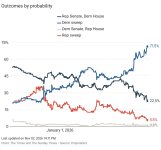
Recent US political history is littered with examples where public opinion polls, even ones just days before an election, were off the mark. Trump outperformed predictions on his way to White House victories in 2016 and 2024. His narrow defeat in 2020 came after most surveys indicated a more comfortable win for Democrat Joe Biden.
Earlier this year, polls suggested Democrat Abdul El-Sayed was poised for a double-digit win in Michigan's Democratic Senate primary. Instead it was 1%. In Wisconsin's Democratic primary for governor, the candidate that had a polling lead that approached 20 points lost by a fraction of a percent.
This sounds so familiar, and according to Clifford Young, president of Ipsos Public Affairs, which conducts political and market research surveys, polling has become difficult in recent years because it's harder to reach Americans as they abandon their land lines and screen their calls. And many of those who pollsters do contact have become less willing to participate.
Senior officials, including deputy chief of staff Stephen Miller and budget director Russell Vought, have been working with the White House Counsel’s Office since April to identify executive actions on immigration, tariffs, housing costs and federal spending that Trump could pursue without congressional approval, said the three people, who spoke on the condition of anonymity. White House counsel Will Scharf and his team also are looking at “what Trump can legally do on his own, where he could push the limits of his authority and how to defend those decisions in court,” the White House official said.
The planning underscores a paradox of Tuesday’s midterm elections: Capturing control of Congress would, in theory, give Democrats the power to investigate Trump, block legislation and constrain his spending priorities. But Trump would retain broad executive authority over trade, foreign policy and the federal bureaucracy that he has already used aggressively during his second term.
Among the executive actions under consideration are new tariffs on imports of critical minerals and wind turbines, tighter rules on visas for international students and temporary foreign workers, and measures aimed at somehow lowering housing and construction costs, the White House official said.
Trump has already tested the reach of presidential power since returning to office in January 2025, using executive authority to impose sweeping tariffs, intensify immigration enforcement, shrink the federal workforce, and pursue foreign-policy goals including the war against Iran without Congress’ approval or new laws.
“President Trump in the last two years has basically ignored Congress and tried to do as much as possible through executive orders and executive power,” said Nathan Gonzales, editor at Inside Elections, which provides nonpartisan political analysis. “I think he will only continue if there are Democratic majorities.” In a New York Post tabloid podcast, the U.S. president previewed his post-midterms playbook, saying he’d liberally hand out pardons for allies making Congressional investigations and hearings into Trump administration officials’ conduct -- past and present, irrelevant.
Trump floats pardons, teases vetoes as he faces possible split government — CTV News
U.S. President Donald Trump floated pardons for allies and teased vetoes on Democratic legislation Monday, a day before elections that could see his Republican Party lose control of Congress.

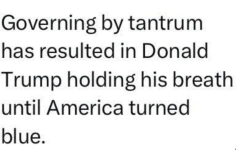
It’s gonna be turmoil, and America’s turmoil, ripples out globally far beyond their own borders.Cross your fingers and hold your breath.
International politicians react to Democrats winning US midterms — Reuters
Governments and politicians around the world reacted to the Democrats winning the US midterm elections, a result that could have major implications for global trade, security and energy prices.
"I did the right thing," he said in his interview with the Wall Street Journal. "I would have done it again."Clearly the American people are saying no to war. But the bought and paid for politicians will only pay them lip service while not playing along.
Trump acknowledges role of Iran war in Democratic sweep in midterm elections — Reuters
President Donald Trump acknowledged on Wednesday that the US-Israeli war on Iran played a role in his party's sweeping defeat in the midterm elections, as Democrats won control of the House of Representatives and the Senate.
In interviews as the results came in, Trump vowed to wield his veto pen to force Democrats to compromise. He distanced himself from the results and cast blame on other Republicans. He also declined to name his preferred successor and left open the possibility of a competitive primary in 2028.
“I don’t like to consider it a defeat for me, I wasn’t on the ballot,” he said on Fox News, after campaigning for two months telling his supporters at least 41 times to “pretend I’m on the ballot.” Apparently they did.
 In a late-night phone interview with Fox News, Trump said he didn’t consider the elections to be a personal defeat. Voters, he said, “didn’t like the candidates.”
“If I was, we would have won,” Trump added.
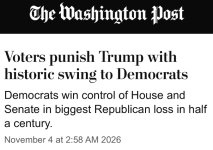
Voters punish Trump with historic swing to Democrats — The Washington Post
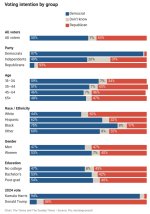
Across major demographic groups and geographies, voters shifted toward the Democrats.
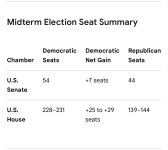
House Minority Leader Hakeem Jeffries, D-N.Y., is now poised to become the first Black speaker of the House, succeeding Republican Mike Johnson when the new Congress convenes in January. Jeffries, who has led House Democrats since 2023, must first be elected speaker by the incoming House.
Despite the results, Senate Majority Leader John Thune wrote on X that “Senate Republicans will not stand idly by as the far-left, socialist wing of the Democrat Party attempts to unwind everything we’ve done.” He said they will work with Trump “to stop the worst impulses of Democrat extremism.”

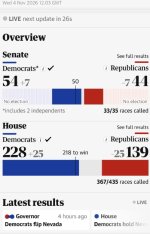
Democrats win U.S. Senate, ending Republican dominance by harnessing voters’ frustration with Trump
Democrats won control of both chambers of Congress, delivering a decisive rebuke of Republican governance in Washington and ushering in a new era of congressional resistance to President Donald Trump.
Even outside of that war, Trump still attacked everybody with tariffs, which in the American citizens pay for…& it’s messed up the whole global economy with respect of predictability or some aspect of it.Had he not decided to suck Bibi's dick the Republicans probably would have won.
Alas, 'twas not the case.
Even outside of the Iran war, Trump’s shenanigans with Putin are more than notable with respect to the war in Ukraine.
Even outside of the Iran war, Trump’s globetrotting son-in-law and golf buddy expanding Trump‘s personal finances by billions as people struggle to pay their bills.
Even outside of the Iran war, the bat shit, crazy stuff that happened with respect to Venezuela and Cuba and Greenland and Denmark and the European Union all still happened.

Venezuela was the turning point for me.
Hi, I'm Don, and i'm a recovering magatard. lol
Hi, I'm Don, and i'm a recovering magatard. lol
From the outside, looking in, I think of all the rhetoric surrounding the whole drain the swamp thing…& Trump and his family and friends are the swamp…but just watching what’s happening in Cuba since he cut off all or damn near all oil imports to that nation, it’s beyond beyond.Venezuela was the turning point for me.
Hi, I'm Don, and i'm a recovering magatard. lol
Donald Trump reacted to his defeat in the midterms by paying an unlikely tribute to the “good job” done by his opponents. Yet the president who suddenly posed as a model of humility is unlikely to be the same president whom the world will have to deal with now that American voters have delivered their verdict. On the contrary, Trump after this election will probably be even more vengeful and wayward on the global stage than before.
Opinion: Defeated at home, Trump will wreak havoc on the world stage — The Telegraph
After his midterm drubbing, the US president is set to double down on foreign policy – risking chaos from Iran to Ukraine
But his presidential dominance of foreign policy, as well as his status as commander-in-chief of the mightiest armed forces in the world, will remain unchanged in all respects save one. Anything that requires Congressional approval, like repealing sanctions legislation on Russia, will almost certainly become impossible.