


It's July 1940, 10 months into World War II.
Britain has just sustained Nazi Germany's first major defeat in the War, that of Germany's failure to destroy Britain's air defence and its failure to force Britain out of the war by forcing a surrender (the Nazis couldn't have been that clever if they thought Britain would surrender).
So it comes up with another idea to try and defeat the British - send over the Luftaffe to gain air superiority and then invade Britain to prevent it from fighting back.
Thus began the Battle of Britain. From the 10th July 1940 to the 31st October 1940 the RAF, with its Spitfires and Hurricanes, took on the Luftwaffe in the skies above Britain, the world's first major air battle. During the battle, almost 2000 RAF aircraft fought doggedly again over 4000 Luftwaffe aircraft and, against the odds, the RAF prevailed. It was a Great British Victory.
Although the Americans disagree. The Americans have a history of trying to take credit for other people success and glories, and this is the latest example.
They say the British should thank the Americans for their victory, even though the US wasn't even in the war during the Battle of Britain.
Tin Palucka, a US science writer, claims that it was an American superfuel which the RAF used which gave our brave fighters the edge over the villainous Luftwaffe.
But Palucka is wrong about the superfuel. It was actually the BRITISH themselves who invented the fuel, though the Yanks were merely the first to use it.
Amongst the factors which actually allowed the RAF to win was the superior manoeuvrability of the RAF planes compared to the Luftwaffe ones - and the British never-say-die attitude.
Revealed: RAF fighter planes 'used super-fast fuel from the U.S. to win the Battle of Britain'
By Rebecca Camber
13th May 2009
Daily Mail

For years we have believed it was the brave young men of the RAF Fighter Command and their two superb aircraft, the sturdy Hurricane and the elegant Spitfire, that won the Battle of Britain.
It appears we have been mistaken. It was, apparently, an American superfuel that gave our fighters the edge over the Germans.
In fact, according to a U.S. science writer, the RAF may have been shot out of the sky without it.
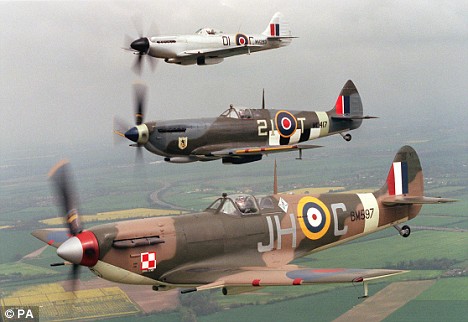
Great British icons: RAF Spitfires such as these, above, were more manoeuvrable than planes of the Luftwaffe
It is a suggestion almost certain to start a dogfight with historians and veterans - indeed almost anybody who knows anything about the Battle of Britain.
And it follows an unfortunate pattern of our allies across the Atlantic trying to rewrite war history.
Tim Palucka contends that the fuel gave our planes superior altitude, manoeuvrability and rate of climb, enabling them to dodge the Luftwaffe.
THE BATTLE
Combatants
RAF VS Luftwaffe
Commanders
RAF - Hugh Dowding
Luftwaffe - Hermann Goring
Battle strength
RAF - 1,963 aircraft
Luftwaffe - 4,074
Casualties and losses
RAF - 544 killed, 1,547 aircraft destroyed
Luftwaffe - 2,500 killed, 1,887 aircraft destroyed
There were almost 60,000 civilian casualties
Writing in the journal Invention And Technology, he suggests that the 100-octane fuel developed in the U.S. just in time for battle replaced a 87-octane version previously used by the planes, giving British pilots a crucial edge.
The Royal Society of Chemistry is now inviting experts to challenge the claim, amid reports from military experts that the story has been 'corrupted' to give the impression America was instrumental in the battle, when in fact it was BRITISH engineers that came up with the formula.
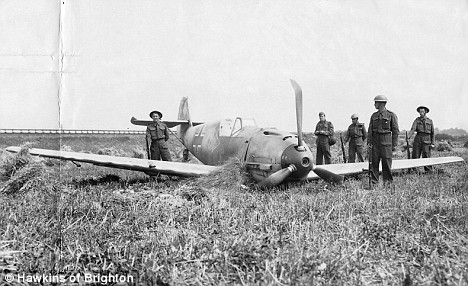
The enemy: British soldiers guard a Luftwaffe fighter plane that went down in southern England during the Battle of Britain, 1940
According to aviation defence expert Michael Gething the fuel was pioneered by RAF Air Commodore Rod Banks in the 1930s.
Known as 'Rod's cocktail', the fuel was first tested in the 1931 Schneider Trophy seaplane races. In 1937 Banks urged the RAF to use the 100-octane fuel even if the supply was limited, but it was the U.S. Army Air Corp that took on its mass production.
Mr Gething said: 'This reeks of a corruption of a story that is true and pre-dates the Battle of Britain.'
By contrast, Mr Palucka says the fuel was invented by Eugene Houdry, a Frenchman who settled in the U.S. He said he developed a catalyst to convert useless crude oil into high octane fuel, revealing his 'cracking' process at a Chicago chemicals conference in 1938.
Enlarge
Mr Palucka wrote: 'Luftwaffe pilots couldn't believe they were facing the same planes they had fought successfully over France a few months before.'
The fuel is credited with increasing the Spitfire's speed by up to 34mph. But historians say it was only one of a number of factors that helped Britain win.

The battle rages in the skies above London
Bill Bond, of the Battle of Britain Historical Society, said: 'If this played such a vital part why didn't we hear this story 70 years ago?
'High octane fuel certainly helped us in the Battle of Britain but it was the design of our Spitfires and Hurricanes that was critical as they were more manoeuvrable than the Messerschmitt 109.'
A spokesman for the Royal Society of Chemistry, Brian Emsley said of Mr Palucka's claim: 'If it's refutable we want it to be refuted.'
READERS' COMMENTS
Cant be American fuel - we didn't shoot up our own side.
- Tally Ho!, London
************************
And how would we have won at Agincourt if the American's hadn't invented the long bow? How would we have defeated the Spanish armada without American designed ships? And where would Wellington have been if Americans hadn't invented the horse? ...sorry...I've had too much coffee....
- Karen, Midlands England
************************
I would think it was the British fighter pilots prowess that clinched it
- Rapture, Ireland
**********************
The victory of the RAF in the Battle of Britain was surely down to the design of the planes and the skill, determination and courage of the pilots, together with all the efforts put in by the ground crew, WAAFs, mechanics and so on, who kept the planes flying, and told the crews where the enemy planes were. I suspect the Americans just can't face the fact that the vast majority of them were late for WWII, just as they had been for WWI: many Americans, including their ambassador (Joe Kennedy) wanted nothing to do with WWII, preferring to wait and see whether GB could beat the Axis on their own: Churchill had to work like mad to get any official assistance from that side of the Atlantic.
- Helen, Kent
**************************
Why are we surprised? Tom Cruise was planning a film about the Battle of Britain where all the RAF would be portrayed as effete cowards and the battle was won by clean living American heroes.
The US have denigrated the British military over and over again, mostly recently regarding our performance in Helmand.
It rather sticks in the throat
- Andy, York, England
*****************************
The Yanks' Mustangs were powered by Rolls Royce British designed Merlin engines !
- Expatriate, Hamburg, Germany
***************************
what a load of tosh!
of course we would have used the highest octane fuel we could get our hands on, and as stated 100 octane fuel was pioneered by the british.
All the americans did was sell us some they'd made - sure we were grateful for it, but they made a profit while we got bombed.
- Amar Staphalik, Birmingham
****************************
The yanks should stick to film making rather than come into wars at the last minute. 1914/18. The Germans were finished had no more reserves when the yanks walked in. 1939/45 the Russians had beaten the Germans ,again before the yanks came in. Just say it as it is.
- Royal, Trowbridge
****************************************
We have seen how the Americans try to hijack British history for themselves, but this is ridiculous. And why have they waited 70 years to announce the fact?
At this rate, it won't be long before they tell us that they won the battle of Culloden in 1746!
- Cy, Reading England
dailymail.co.uk
Britain has just sustained Nazi Germany's first major defeat in the War, that of Germany's failure to destroy Britain's air defence and its failure to force Britain out of the war by forcing a surrender (the Nazis couldn't have been that clever if they thought Britain would surrender).
So it comes up with another idea to try and defeat the British - send over the Luftaffe to gain air superiority and then invade Britain to prevent it from fighting back.
Thus began the Battle of Britain. From the 10th July 1940 to the 31st October 1940 the RAF, with its Spitfires and Hurricanes, took on the Luftwaffe in the skies above Britain, the world's first major air battle. During the battle, almost 2000 RAF aircraft fought doggedly again over 4000 Luftwaffe aircraft and, against the odds, the RAF prevailed. It was a Great British Victory.
Although the Americans disagree. The Americans have a history of trying to take credit for other people success and glories, and this is the latest example.
They say the British should thank the Americans for their victory, even though the US wasn't even in the war during the Battle of Britain.
Tin Palucka, a US science writer, claims that it was an American superfuel which the RAF used which gave our brave fighters the edge over the villainous Luftwaffe.
But Palucka is wrong about the superfuel. It was actually the BRITISH themselves who invented the fuel, though the Yanks were merely the first to use it.
Amongst the factors which actually allowed the RAF to win was the superior manoeuvrability of the RAF planes compared to the Luftwaffe ones - and the British never-say-die attitude.
Revealed: RAF fighter planes 'used super-fast fuel from the U.S. to win the Battle of Britain'
By Rebecca Camber
13th May 2009
Daily Mail
For years we have believed it was the brave young men of the RAF Fighter Command and their two superb aircraft, the sturdy Hurricane and the elegant Spitfire, that won the Battle of Britain.
It appears we have been mistaken. It was, apparently, an American superfuel that gave our fighters the edge over the Germans.
In fact, according to a U.S. science writer, the RAF may have been shot out of the sky without it.
Great British icons: RAF Spitfires such as these, above, were more manoeuvrable than planes of the Luftwaffe
It is a suggestion almost certain to start a dogfight with historians and veterans - indeed almost anybody who knows anything about the Battle of Britain.
And it follows an unfortunate pattern of our allies across the Atlantic trying to rewrite war history.
Tim Palucka contends that the fuel gave our planes superior altitude, manoeuvrability and rate of climb, enabling them to dodge the Luftwaffe.
THE BATTLE
Combatants
RAF VS Luftwaffe
Commanders
RAF - Hugh Dowding
Luftwaffe - Hermann Goring
Battle strength
RAF - 1,963 aircraft
Luftwaffe - 4,074
Casualties and losses
RAF - 544 killed, 1,547 aircraft destroyed
Luftwaffe - 2,500 killed, 1,887 aircraft destroyed
There were almost 60,000 civilian casualties
Writing in the journal Invention And Technology, he suggests that the 100-octane fuel developed in the U.S. just in time for battle replaced a 87-octane version previously used by the planes, giving British pilots a crucial edge.
The Royal Society of Chemistry is now inviting experts to challenge the claim, amid reports from military experts that the story has been 'corrupted' to give the impression America was instrumental in the battle, when in fact it was BRITISH engineers that came up with the formula.
The enemy: British soldiers guard a Luftwaffe fighter plane that went down in southern England during the Battle of Britain, 1940
According to aviation defence expert Michael Gething the fuel was pioneered by RAF Air Commodore Rod Banks in the 1930s.
Known as 'Rod's cocktail', the fuel was first tested in the 1931 Schneider Trophy seaplane races. In 1937 Banks urged the RAF to use the 100-octane fuel even if the supply was limited, but it was the U.S. Army Air Corp that took on its mass production.
Mr Gething said: 'This reeks of a corruption of a story that is true and pre-dates the Battle of Britain.'
By contrast, Mr Palucka says the fuel was invented by Eugene Houdry, a Frenchman who settled in the U.S. He said he developed a catalyst to convert useless crude oil into high octane fuel, revealing his 'cracking' process at a Chicago chemicals conference in 1938.
Enlarge
Mr Palucka wrote: 'Luftwaffe pilots couldn't believe they were facing the same planes they had fought successfully over France a few months before.'
The fuel is credited with increasing the Spitfire's speed by up to 34mph. But historians say it was only one of a number of factors that helped Britain win.
The battle rages in the skies above London
Bill Bond, of the Battle of Britain Historical Society, said: 'If this played such a vital part why didn't we hear this story 70 years ago?
'High octane fuel certainly helped us in the Battle of Britain but it was the design of our Spitfires and Hurricanes that was critical as they were more manoeuvrable than the Messerschmitt 109.'
A spokesman for the Royal Society of Chemistry, Brian Emsley said of Mr Palucka's claim: 'If it's refutable we want it to be refuted.'
READERS' COMMENTS
Cant be American fuel - we didn't shoot up our own side.
- Tally Ho!, London
************************
And how would we have won at Agincourt if the American's hadn't invented the long bow? How would we have defeated the Spanish armada without American designed ships? And where would Wellington have been if Americans hadn't invented the horse? ...sorry...I've had too much coffee....
- Karen, Midlands England
************************
I would think it was the British fighter pilots prowess that clinched it
- Rapture, Ireland
**********************
The victory of the RAF in the Battle of Britain was surely down to the design of the planes and the skill, determination and courage of the pilots, together with all the efforts put in by the ground crew, WAAFs, mechanics and so on, who kept the planes flying, and told the crews where the enemy planes were. I suspect the Americans just can't face the fact that the vast majority of them were late for WWII, just as they had been for WWI: many Americans, including their ambassador (Joe Kennedy) wanted nothing to do with WWII, preferring to wait and see whether GB could beat the Axis on their own: Churchill had to work like mad to get any official assistance from that side of the Atlantic.
- Helen, Kent
**************************
Why are we surprised? Tom Cruise was planning a film about the Battle of Britain where all the RAF would be portrayed as effete cowards and the battle was won by clean living American heroes.
The US have denigrated the British military over and over again, mostly recently regarding our performance in Helmand.
It rather sticks in the throat
- Andy, York, England
*****************************
The Yanks' Mustangs were powered by Rolls Royce British designed Merlin engines !
- Expatriate, Hamburg, Germany
***************************
what a load of tosh!
of course we would have used the highest octane fuel we could get our hands on, and as stated 100 octane fuel was pioneered by the british.
All the americans did was sell us some they'd made - sure we were grateful for it, but they made a profit while we got bombed.
- Amar Staphalik, Birmingham
****************************
The yanks should stick to film making rather than come into wars at the last minute. 1914/18. The Germans were finished had no more reserves when the yanks walked in. 1939/45 the Russians had beaten the Germans ,again before the yanks came in. Just say it as it is.
- Royal, Trowbridge
****************************************
We have seen how the Americans try to hijack British history for themselves, but this is ridiculous. And why have they waited 70 years to announce the fact?
At this rate, it won't be long before they tell us that they won the battle of Culloden in 1746!
- Cy, Reading England
dailymail.co.uk
Last edited:


