Liberals now pulling away from Cons into majority territory

mentalfloss

Prickly Curmudgeon Smiter
Jun 28, 2010
39,817
471
83
Albertaoilmagazine.com says the definition of a subsidy shouldn't include what they don't like.

Shocking.


Meanwhile,

Energy subsidies are measures that keep prices for consumers below market levels or for producers above market levels, or reduce costs for consumers and producers. Energy subsidies may be direct cash transfers to producers, consumers, or related bodies, as well as indirect support mechanisms, such as tax exemptions and rebates, price controls, trade restrictions, and limits on market access. They may also include energy conservation subsidies. The development of today's major modern energy industries have all relied on substantial subsidy support.

Energy subsidies - Wikipedia, the free encyclopedia
 

captain morgan

Hall of Fame Member
Mar 28, 2009
28,429
148
63
A Mouse Once Bit My Sister
No.

The author's of the article point to outside, third party sources like Youri Chassin, author of a recent Montreal Economic Institute (MEI) report called 'Is the Canadian Oil Industry Subsidized?'... He calls the IMF numbers definitions and numbers “dubious.”... But then again, the IMF likes to hire leadership that gets knee deep into scandals and graft that result in investigations, 3 in the last 10 years I understand
 

mentalfloss

Prickly Curmudgeon Smiter
Jun 28, 2010
39,817
471
83
The price-gap approach

The IEA estimates subsidies to fossil fuels that are consumed directly by end-users or consumed as inputs to electricity generation. The price-gap approach, the most commonly applied methodology for quantifying consumption subsidies, is used for this analysis. It compares average end-user prices paid by consumers with reference prices that correspond to the full cost of supply. The price gap is the amount by which an end-use price falls short of the reference price and its existence indicates the presence of a subsidy. In a given economy..

IEA - Methodology for Calculating Subsidies


So what methodology does the IMF use?


Subsidies for petroleum products are calculated for 176 countries using the price gap approach drawing on data compiled by IMF staff, the OECD, and Deutsche Gesellschaft für Internationale Zusammenarbeit (GIZ) for 2000–2011. Consumer subsidies are estimated for gasoline, diesel, and kerosene. Producer subsidies to refineries to cover inefficient operations are not estimated due to the lack of data. Therefore, our estimated petroleum product subsidies capture only consumer subsidies and should be seen as a lower bound. See Appendix I for details.

http://www.imf.org/external/np/pp/eng/2013/012813.pdf


That dubious methodology that everyone uses lol


captain morgan

Hall of Fame Member
Mar 28, 2009
28,429
148
63
A Mouse Once Bit My Sister
So what methodology does the IMF use?

Subsidies for petroleum products are calculated for 176 countries using the price gap approach drawing on data compiled by IMF staff, the OECD, and Deutsche Gesellschaft für Internationale Zusammenarbeit (GIZ) for 2000–2011. Consumer subsidies are estimated for gasoline, diesel, and kerosene. Producer subsidies to refineries to cover inefficient operations are not estimated due to the lack of data. Therefore, our estimated petroleum product subsidies capture only consumer subsidies and should be seen as a lower bound. See Appendix I for details.

Ummm... The IMF counts car accidents and traffic congestion as subsidies to the O&G sector.... But thanks for coming out all the same.


mentalfloss

Prickly Curmudgeon Smiter
Jun 28, 2010
39,817
471
83
And what percentage of their number is based on those figures you clearly take umbrage with?
 

captain morgan

Hall of Fame Member
Mar 28, 2009
28,429
148
63
A Mouse Once Bit My Sister
Any amount is too high.

Fact is, their argument was that weak to begin with that they made the leap to generate the optics of legitimacy.

What I really get a kick out of is how the IMF doesn't piss and moan that the tire mfg companies are being hugely subsidized because of the traffic congestion and auto accidents.

... EVen you should be able to see the ludicrous nature of this logic
 

taxslave

Hall of Fame Member
Nov 25, 2008
36,362
4,342
113
Vancouver Island
The price-gap approach

The IEA estimates subsidies to fossil fuels that are consumed directly by end-users or consumed as inputs to electricity generation. The price-gap approach, the most commonly applied methodology for quantifying consumption subsidies, is used for this analysis. It compares average end-user prices paid by consumers with reference prices that correspond to the full cost of supply. The price gap is the amount by which an end-use price falls short of the reference price and its existence indicates the presence of a subsidy. In a given economy..

IEA - Methodology for Calculating Subsidies


So what methodology does the IMF use?


Subsidies for petroleum products are calculated for 176 countries using the price gap approach drawing on data compiled by IMF staff, the OECD, and Deutsche Gesellschaft für Internationale Zusammenarbeit (GIZ) for 2000–2011. Consumer subsidies are estimated for gasoline, diesel, and kerosene. Producer subsidies to refineries to cover inefficient operations are not estimated due to the lack of data. Therefore, our estimated petroleum product subsidies capture only consumer subsidies and should be seen as a lower bound. See Appendix I for details.

http://www.imf.org/external/np/pp/eng/2013/012813.pdf


That dubious methodology that everyone uses lol

I see your source is estimating subsidies ti consumers for oil and gas. What exactly do they base their estimates on? Might it just be the number reqxuired to make the total they claim?
 

captain morgan

Hall of Fame Member
Mar 28, 2009
28,429
148
63
A Mouse Once Bit My Sister
Couldn't find the figure I see?

That's a shame.

Here is another report which confirms $400 billion per year in fossil fuel subsidies.

Dat taxpayer supported free market.

http://www.iea.org/media/weowebsite/factsheets/factsheets.pdf

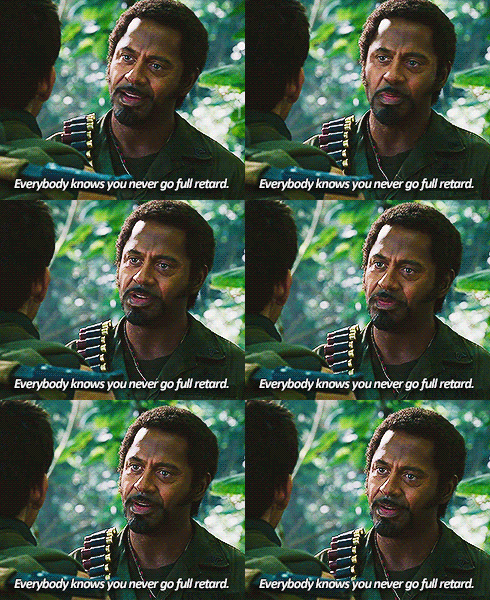
You're going full retard again MF.... Please see gif below for valuable advice


I see your source is estimating subsidies ti consumers for oil and gas. What exactly do they base their estimates on? Might it just be the number reqxuired to make the total they claim?


What Flossy hasn't factored into his account (nor the IMF apparently) are the combined resource taxes on top of the royalty structure that is in place.

Changes the numbers dramatically in addition to the optics.... IMF and Flossy can't have that now, can they?
 

Colpy

Hall of Fame Member
Nov 5, 2005
21,887
848
113
71
Saint John, N.B.
Lol Colpy.


What’s behind the Tories’ obsession with Justin Trudeau?

On Aug. 19, Michelle Rempel, a junior minister in the Stephen Harper government who won her Calgary Centre-North riding in 2011 by 20,000 votes, posted a video of Liberal Leader Justin Trudeau on her Facebook page.

“Many of you ask me why I sought to serve as an MP. Part of this role includes standing up for Canadian values and speaking out against terrorist acts, injustice, oppression and violence wrought by terrorist groups such as ISIS and Hamas on innocents,” she wrote. “For me, I think this is why the attached video is so blind-rage-inducing for me.”

The video came from Ezra Levant’s nightly Sun News TV show. It showed the Liberal leader speaking to reporters in Edmonton as the party’s MPs gathered for an end-of-summer caucus retreat. “The biggest threat to global security,” Trudeau said in response to a reporter’s question, “is the kind of violence and misunderstandings and wars that come out of resource depletion—concerns of lack of hope for generations growing up in a world that is getting smaller and seemingly less and less fair.”

Seeing this clip, Rempel was fit to bust a gasket. “This man . . .  spews a diatribe of non sequiturs and platitudes,” she told her Facebook followers. “I ask you to imagine this man at the helm of our nation while serious international conflicts arise. How would he position our country? What would the consequences to our nation be? To the international community?” she asked, calling Trudeau’s answer “so mind-bogglingly ridiculous, I have to post it.”

Justin Trudeau is the fifth Liberal leader the Harper Conservative government has faced, if you count Bill Graham in 2006 and Bob Rae in 2011-12. He fronts the smallest caucus of any of them, having banished Liberal senators from the party’s weekly meetings at the beginning of this year. He is not even the Opposition leader—that job belongs to the scrappy and dogged Tom Mulcair, whose NDP caucus has 2½ MPs for every Liberal in the Commons.

Yet, there is plainly something about Trudeau that gets under Conservatives’ skins. The Liberals haven’t elected an MP in Alberta since 2004. But the Conservatives’ official Twitter account marked his visit to Edmonton for the Liberals’ annual caucus retreat by urging supporters to “sign your name if you want to keep Alberta blue.” The tweet was illustrated with an image of an all-blue map of Alberta. It left the uncomfortable impression that Conservatives are worried their party’s bastion could actually topple. Before Trudeau’s closing news conference in Edmonton, the Prime Minister’s Office sent reporters 360 words of talking points attributed to MPs Chris Warkentin and Jacques Gourde. “From the economy, to our security, to First Nations accountability and Canada’s role on the world stage—Justin Trudeau and his team have consistently demonstrated one truth,” the release said. “They lack the judgment to lead.”


Christinne Muschi/Reuters

On Aug. 19, Michelle Rempel, a junior minister in the Stephen Harper government who won her Calgary Centre-North riding in 2011 by 20,000 votes, posted a video of Liberal Leader Justin Trudeau on her Facebook page.

“Many of you ask me why I sought to serve as an MP. Part of this role includes standing up for Canadian values and speaking out against terrorist acts, injustice, oppression and violence wrought by terrorist groups such as ISIS and Hamas on innocents,” she wrote. “For me, I think this is why the attached video is so blind-rage-inducing for me.”

The video came from Ezra Levant’s nightly Sun News TV show. It showed the Liberal leader speaking to reporters in Edmonton as the party’s MPs gathered for an end-of-summer caucus retreat. “The biggest threat to global security,” Trudeau said in response to a reporter’s question, “is the kind of violence and misunderstandings and wars that come out of resource depletion—concerns of lack of hope for generations growing up in a world that is getting smaller and seemingly less and less fair.”

Seeing this clip, Rempel was fit to bust a gasket. “This man . . .  spews a diatribe of non sequiturs and platitudes,” she told her Facebook followers. “I ask you to imagine this man at the helm of our nation while serious international conflicts arise. How would he position our country? What would the consequences to our nation be? To the international community?” she asked, calling Trudeau’s answer “so mind-bogglingly ridiculous, I have to post it.”

Justin Trudeau is the fifth Liberal leader the Harper Conservative government has faced, if you count Bill Graham in 2006 and Bob Rae in 2011-12. He fronts the smallest caucus of any of them, having banished Liberal senators from the party’s weekly meetings at the beginning of this year. He is not even the Opposition leader—that job belongs to the scrappy and dogged Tom Mulcair, whose NDP caucus has 2½ MPs for every Liberal in the Commons.

Yet, there is plainly something about Trudeau that gets under Conservatives’ skins. The Liberals haven’t elected an MP in Alberta since 2004. But the Conservatives’ official Twitter account marked his visit to Edmonton for the Liberals’ annual caucus retreat by urging supporters to “sign your name if you want to keep Alberta blue.” The tweet was illustrated with an image of an all-blue map of Alberta. It left the uncomfortable impression that Conservatives are worried their party’s bastion could actually topple. Before Trudeau’s closing news conference in Edmonton, the Prime Minister’s Office sent reporters 360 words of talking points attributed to MPs Chris Warkentin and Jacques Gourde. “From the economy, to our security, to First Nations accountability and Canada’s role on the world stage—Justin Trudeau and his team have consistently demonstrated one truth,” the release said. “They lack the judgment to lead.”

Related: The Interview: Justin Trudeau’s game plan

As is usually the case, the tone comes from the top. At Harper’s annual Calgary Stampede barbecue, he mentioned Trudeau by name 11 times, and Mulcair not at all. “He has nothing—absolutely nothing—of substance to offer,” the Prime Minister said of Trudeau. The Conservatives have spent more than a million dollars running radio ads against Trudeau’s plans for marijuana legalization in the past year. And the next election is still a year away.

There are at least three reasons for the preoccupation. First, the Trudeau Liberals are demonstrably and persistently popular among voters. Second, to Conservatives, he comes off as an incorrigible featherweight. Finally, and perhaps more important, there’s that last name of his—Trudeau, a reminder of ancient battles the Conservatives thought they’d put behind them. It’s as if a government led by Robin Hood suddenly found itself confronting a party led by the fresh-faced young Sheriff of Nottingham, Jr.

First, the polls. On his website ThreeHundredEight.com, analyst Éric Grenier finds that the Trudeau Liberals have now led all other parties in national polls for 16 consecutive months. New polls this week from Abacus Data and Ipsos Reid, not firms usually accused of having a soft spot for the Liberals, showed that party increasing its lead over the Conservatives to six and seven points, respectively.

Polls, of course, are for dogs, but the Conservatives have also been underperforming at the ballot box. University of Calgary political scientist Paul Fairie keeps track of parties’ vote share in by-elections and compares them to their share of the popular vote in full-scale federal elections. The Harper Conservatives increased their vote share in by-elections after the 2006 and 2008 elections. But, since 2011, their luck has run out: Conservatives’ share of the vote in recent by-elections is 11.8 percentage points lower than in the 2011 election. That’s worse than the Liberals’ performance under Pierre Trudeau and John Turner before they lost the 1984 election, and worse than the Liberals did in by-elections under Paul Martin before they lost in 2006.

Simply put, the Conservatives are in real trouble in public opinion, and the trouble looks like Justin Trudeau.

Which brings us to the second point: Did it have to be Justin Trudeau? He has two bachelor’s degrees, in literature from McGill University and in education from the University of British Columbia. He had no particular record of intellectual or private sector achievement before he arrived in Parliament in 2008. “A lot of our MPs have a hard time taking seriously the notion that someone like Justin could run a G7 government,” a senior Conservative said in an email, speaking on condition of anonymity.

“That is because most Tory MPs come from very practical, real-world career backgrounds in small business (Joe Preston), policing (Rick Norlock), or farming (Gerry Ritz), to name a few. Others have track records of governing (John Baird) or legislating (Jason Kenney). They have painstakingly built their reputations and livelihoods over decades of work.”

This Conservative acknowledged “grudging respect” for Jean Chrétien’s and Paul Martin’s achievements, before adding that in Trudeau, Conservatives see “a frivolous head-in-the-clouds dreamer who thinks that ‘budgets balance themselves,’ that terrorists are just ‘feeling excluded’ and that million-dollar chiefs [of First Nations communities] just need more money to spend on themselves in secret.”

In the same breath—well, the same email—this Conservative insisted there is nothing personal in his party’s attitude toward Trudeau. The Conservatives ran plenty of ads against Stéphane Dion and Michael Ignatieff in their time—even against Bob Rae, when he was the party’s caretaker leader after it was nearly shattered in the 2011 election. And the Liberals were never shy about attacking Preston Manning and Stockwell Day, this source said. “Rough-and-tumble treatment of leaders is nothing new. What is new is the amazing success of the Liberal team in convincing the media that normal political criticism is unprecedented and inhumane when directed at their leader.”

But perhaps it’s possible to argue for a broad and inclusive definition of partisan rough-and-tumble while marvelling at the extent to which Trudeau plainly drives Conservatives up the wall—in a way Martin, Dion and Ignatieff never did. With them, it was business. With him, it’s—well, it’s family, isn’t it? Because Justin Trudeau is, of course, the second person with that surname to provoke something approaching a cultural response from Conservatives.

“The faithful of the party have a horrible memory of the name of Trudeau that translates into exasperation,” another long-standing Conservative said. “Pierre Trudeau and his years in Ottawa are largely the reason why our party”—the Reform Party and, then, eventually, the modern Harper-led Conservative party—“came into being.”

In areas of the country where Pierre Trudeau was often wildly popular during his nearly 20-year political career—especially, but not only, Ontario and the western half of Montreal—it’s simply impossible to fathom the extent to which the former prime minister was loathed elsewhere. His economic policy was a beggar-thy-neighbour forced transfer of wealth from the Prairies to the skyscrapers of Toronto and Montreal. His language policy reserved the best jobs for disproportionately French Canadian bilinguals. His foreign policy could be summed up as appeasement.

But perhaps the best summary of this view of Pierre Trudeau—and certainly one of the most vehement—was written by Stephen Harper. On Oct. 5, 2000, two days after Justin Trudeau delivered a much-noticed speech at his father’s funeral, the National Post published an essay about the former PM by Harper, who was then the president of the National Citizens’ Coalition.

Harper wrote that he had passed the elder Trudeau in the street a year earlier and been struck by “a tired out, little old man” who had once “provoked both the loves and hatreds of my political passion.” The loves came first for Harper, he wrote, the hatreds as he matured. He called Trudeau “a distant leader who neither understood, nor cared to understand, a group of people over whom his actions had immense impact,” a man who “flail[ed] from one pet policy objective to another,” whose government “created huge deficits, a mammoth national debt, high taxes, bloated bureaucracy, rising unemployment, record inflation, curtailed trade and declining competitiveness.”

So far, Harper’s essay could be read as a scathing attack on Pierre Trudeau’s skill or engagement as an administrator. But he closed by contesting Trudeau’s morality. “Mr. Trudeau . . .  was also a member of the ‘greatest generation,’ the one that defeated the Nazis in war and resolutely stood down the Soviets in the decades that followed,” Harper wrote. “In those battles, however, the ones that truly defined his century, Mr. Trudeau took a pass.”

In recent interviews and in a speech in May to supporters of an Ottawa monument to victims of Communism, Harper has made it clear he still sees the history of the West in the 20th century as an epic conflict between good and evil, with evil abetted by those who “took a pass.” That’s why the bland complacency of Justin Trudeau’s comments on global security issues so reliably provoke the outrage of the Prime Minister and his strongest supporters.

After the Boston Marathon bombing of 2013, Trudeau told Peter Mansbridge, “There is no question that this happened because there is someone who feels completely excluded.” The remarks Michelle Rempel immortalized on Facebook, to the effect that ISIS is wreaking havoc in the Middle East because of “resource depletion,” were of a similar sort.

One of the big questions of politics in the year before the next federal election, then, is whether Conservatives can get more Canadians to share their disdain for Trudeau. So far, if 16 months of polls are any indication, they’ve had little luck.

The second Conservative who spoke for this story says he’s sanguine about results so far. “The reality about political advertising is it doesn’t need to work while it’s running. What it needs to do is accurately predict behaviour by your opponent that will reinforce the message that you are delivering.” In other words, it doesn’t matter whether voters think Trudeau is “in over his head,” as Conservative ads say, right now. What matters is whether Trudeau’s future words and actions fit that frame. The Conservative strategy amounts to a million-dollar bet that Trudeau will keep sounding like a global hug-a-thug with no idea how grown-up things work, and that Canadians will start to notice.

This is what happened to strong challengers who failed to break through in recent provincial elections in British Columbia, Alberta and Ontario. In each case, an incumbent government was in serious trouble in pre-election polls. In each case, voters chose to stick with the incumbent anyway. “Even though Canadians have an affinity for [Trudeau], even though Canadians like him in a way they don’t like Harper, even though they have an affinity for the family name, when you dig below that, they are not necessarily ready to give him the keys to the kingdom,” this Conservative said. “They’re not ready to concede that he’s got the gravitas to do what needs to be done.”

Through it all, Trudeau professes to be too busy focusing on Canadians to worry when the government focuses on him. He will need his insouciance. The stakes are so high, the echoes of history so insistent, that the Conservatives will continue to treat him as something more than just another opponent. The last few times they took a Liberal apart, it was business. This time, it’s personal.

What’s behind the Tories’ obsession with Justin Trudeau


Justin Trudeau is polling well.......

And he is an idiot that will do serious and enduring damage to the nation if elected.

He is Obama Light, if such a thing is even possible.

His answer to the serious question about the greatest threats to national security reveal a vacuity that simply boggles the mind.....one wonders how he could attract the attention of anyone serious.

“The biggest threat to global security,” Trudeau said in response to a reporter’s question, “is the kind of violence and misunderstandings and wars that come out of resource depletion—concerns of lack of hope for generations growing up in a world that is getting smaller and seemingly less and less fair.”

Meanwhile, Canadians are butchering and crucifying their way across Syria and Iraq with ISIS...........and may well be coming home some day.

The Russians are trying to re-create the Soviet Empire with an invasion of Ukraine, threats against Estonia, airspace violations in Finland, and a DIRECT THREAT to Canada's arctic by Putin.

Putin likens Ukraine's forces to Nazis and threatens standoff in the Arctic | World news | theguardian.com

AND THIS ****ING IDIOT GOES ON ABOUT RESOURCE DEPLETION AND "UNFAIRNESS"???? It is simply beyond belief.

Justin Trudeau leaves us foaming at the mouth for one simple reason: We love Canada.

Justin Trudeau would be a complete disaster as PM. He MIGHT even succeed in doing more damage than his father, if that is even possible.
 

Locutus

Adorable Deplorable
Jun 18, 2007
32,230
47
48
67
he has the 'dreamy vote' at the moment...more of a wet dream but they'll not give the spaz keys to the kingdom...not to worry.
 

mentalfloss

Prickly Curmudgeon Smiter
Jun 28, 2010
39,817
471
83
Basically reaffirming the rejection of curmudgeonism.

Voters may be saying 'enough is enough' to Harper's Tories

For lack of a better term, let's call it "voter fatigue." Voter fatigue is what sets in when the public simply grows tired of the politicians who are running their lives. They may not be especially angry at the people in power. It's more a matter of being weary -- and bored -- of hearing the same self-serving arguments, the same empty platitudes, the same threadbare rationalizations over and over from the same political mouths.

That's when voters start telling one another (and they tell pollsters, too) that "enough is enough." I think we are at that point in federal politics today. As I read the opinion polls, people are not so much outraged by Stephen Harper and the Conservatives as they are tired of them. Some of this was reflected in the Angus Reid Global survey mentioned in last week’s column. Asked to describe Harper in one word, 26 per cent of the 1,502 Canadians polled chose "boring" while 37 per cent said "arrogant."

These responses have less to do with the merits of the government's policies than they do with the tone that the administration projects. Are they sensitive to the people's concerns? Do they put the public interest ahead of their own political interest? Are they compassionate when compassion is called for, as with Canada's veterans? Or do they treat the vets as just another special interest group to be shoved aside? Do they really care about the treatment of Aboriginals? Are they really interested in protecting the environment?

The Harper government does not fare well when faced with questions like these. It comes across as being more concerned with its own well-being than with the interests of the population as a whole. After 8½ years in power, it has lost sight of why it wanted to get elected in the first place.

We have been there before. To cite one example, it happened to Progressive Conservative Brian Mulroney at the same stage in his reign. He was elected in 1984 and re-elected in 1988. By 1992, the public had had enough. He might have weathered the controversies over free trade and the goods and services tax, but it was the Mulroney style (remember "Lyin' Brian"?), the arrogance and the sense of entitlement of a party that had been in power too long that did them in. As the opinion polls cratered, Mulroney took his leave but it was too late; the Tories were annihilated in 1993 under the leadership of Kim Campbell. Thus began the Jean Chrétien Liberal era.

I am not suggesting a catastrophe of such magnitude awaits the Harper (or post-Harper) Conservatives in 2015. But when the public takes it into its head that enough is enough, it will take more than a portfolio of shiny new polities, a major retooling of the cabinet, or maybe even a new leader, to right the ship.

At the moment, the Tory ship is sinking, and has been for the past year. An EKOS poll this month put the Harper party 13 points behind the Liberals (25.6 per cent to 38.7) and barely ahead of the New Democrats (23.4 per cent). A Forum Research poll had it closer -- a nine point lead for the Liberals (41-32).

Either way, the numbers suggest a Liberal government. The Liberals are talking about winning 170 seats, enough for a bare majority of the 338 seats in the enlarged House of Commons. They aren't there yet and may not get there; the NDP has no intention of rolling over. If the Liberals do form a government, it won't be because they dazzled the country with irresistible policies or because Justin Trudeau set the woods afire with his personal magnetism.

If they win, it will because the Harper Tories got old, out of touch and took the keys to 24 Sussex for granted. It will be because voters, having concluded "enough is enough," made the next short step to "time for a change."

Cambridge resident Geoffrey Stevens, an author and former Ottawa columnist and managing editor of the Globe and Mail, teaches political science at Wilfrid Laurier University and the University of Guelph. His column appears on Mondays in Waterloo Region Record and Guelph Mercury. He welcomes comments at geoffstevens[at]sympatico.ca


Voters may be saying 'enough is enough' to Harper's Tories | rabble.ca
 

#juan

Hall of Fame Member
Aug 30, 2005
18,326
119
63
Harper has lunch often with Mulroney. Is Harper headed down the same road as Mulroney? From a majority down to a couple seats....Yeah, I ca see that happening......And I can see why the Cons are worried.
 

Colpy

Hall of Fame Member
Nov 5, 2005
21,887
848
113
71
Saint John, N.B.
If Trudeau is Obama lite I'd vote for him for sure.

We know.

That is the problem.

Obama is in the process of losing every single gain the west has made in 40 years. He is the WORST President in at least 150 years. By far.

Harper has lunch often with Mulroney. Is Harper headed down the same road as Mulroney? From a majority down to a couple seats....Yeah, I ca see that happening......And I can see why the Cons are worried.

You guys keep conveniently forgetting that it was the REFORM PARTY that destroyed Mulroney......not the Liberals.

There is no Reform to split the conservative vote.

Basically reaffirming the rejection of curmudgeonism.

Voters may be saying 'enough is enough' to Harper's Tories

For lack of a better term, let's call it "voter fatigue." Voter fatigue is what sets in when the public simply grows tired of the politicians who are running their lives. They may not be especially angry at the people in power. It's more a matter of being weary -- and bored -- of hearing the same self-serving arguments, the same empty platitudes, the same threadbare rationalizations over and over from the same political mouths.

That's when voters start telling one another (and they tell pollsters, too) that "enough is enough." I think we are at that point in federal politics today. As I read the opinion polls, people are not so much outraged by Stephen Harper and the Conservatives as they are tired of them. Some of this was reflected in the Angus Reid Global survey mentioned in last week’s column. Asked to describe Harper in one word, 26 per cent of the 1,502 Canadians polled chose "boring" while 37 per cent said "arrogant."

These responses have less to do with the merits of the government's policies than they do with the tone that the administration projects. Are they sensitive to the people's concerns? Do they put the public interest ahead of their own political interest? Are they compassionate when compassion is called for, as with Canada's veterans? Or do they treat the vets as just another special interest group to be shoved aside? Do they really care about the treatment of Aboriginals? Are they really interested in protecting the environment?

The Harper government does not fare well when faced with questions like these. It comes across as being more concerned with its own well-being than with the interests of the population as a whole. After 8½ years in power, it has lost sight of why it wanted to get elected in the first place.

We have been there before. To cite one example, it happened to Progressive Conservative Brian Mulroney at the same stage in his reign. He was elected in 1984 and re-elected in 1988. By 1992, the public had had enough. He might have weathered the controversies over free trade and the goods and services tax, but it was the Mulroney style (remember "Lyin' Brian"?), the arrogance and the sense of entitlement of a party that had been in power too long that did them in. As the opinion polls cratered, Mulroney took his leave but it was too late; the Tories were annihilated in 1993 under the leadership of Kim Campbell. Thus began the Jean Chrétien Liberal era.

I am not suggesting a catastrophe of such magnitude awaits the Harper (or post-Harper) Conservatives in 2015. But when the public takes it into its head that enough is enough, it will take more than a portfolio of shiny new polities, a major retooling of the cabinet, or maybe even a new leader, to right the ship.

At the moment, the Tory ship is sinking, and has been for the past year. An EKOS poll this month put the Harper party 13 points behind the Liberals (25.6 per cent to 38.7) and barely ahead of the New Democrats (23.4 per cent). A Forum Research poll had it closer -- a nine point lead for the Liberals (41-32).

Either way, the numbers suggest a Liberal government. The Liberals are talking about winning 170 seats, enough for a bare majority of the 338 seats in the enlarged House of Commons. They aren't there yet and may not get there; the NDP has no intention of rolling over. If the Liberals do form a government, it won't be because they dazzled the country with irresistible policies or because Justin Trudeau set the woods afire with his personal magnetism.

If they win, it will because the Harper Tories got old, out of touch and took the keys to 24 Sussex for granted. It will be because voters, having concluded "enough is enough," made the next short step to "time for a change."

Cambridge resident Geoffrey Stevens, an author and former Ottawa columnist and managing editor of the Globe and Mail, teaches political science at Wilfrid Laurier University and the University of Guelph. His column appears on Mondays in Waterloo Region Record and Guelph Mercury. He welcomes comments at geoffstevens[at]sympatico.ca


Voters may be saying 'enough is enough' to Harper's Tories | rabble.ca

The Rabble?? Really?? lol

Anyway, as I asked before....how were Dion and Ignatieff polling a year before the election??

I still have faith in the Canadian voter.
 

JLM

Hall of Fame Member
Nov 27, 2008
75,301
548
113
Vernon, B.C.
Obama is in the process of losing every single gain the west has made in 40 years. He is the WORST President in at least 150 years. By far.


Now, now, Colpy, don't get carried away. Over the past 150 years I'd guess he'd be about average! -:)