Is It Time To Cut The Cost Of Post-Secondary Education Programs?

Liberalman

Senate Member
Mar 18, 2007
5,623
36
48
Toronto
Is It Time To Cut The Cost Of Post-Secondary Education Programs?

Getting a degree in university is becoming an expensive proposition where if nothing is done will be an institution for the rich.

Governments have a belief that post-secondary education will save our economic lives and is a good job creator.

The early half of the 1900s grade six education was the norm and would get you by because companies would train the rest of the way to their standards.

American presidential candidate Mitt Romney in the course of his first television debate said that a person should think twice before they make a commitment a degree program at university because of the major financial burdens suffered by graduates in the coming years and for the people that do not graduate at minimum wage jobs they will have no hope. Mitt does not look like he will help the post educational system.

Universities should consider cutting their non-essential subjects to ones that directly relates to the degrees that the student is trying to get, which would bring down the cost of learning.

This country should bring back streamlining for students because of most people wanting to go to universities the trades are suffering to the point that this country has to import their labour from other countries.

What do you think is it time to change the university curriculum and get education more affordable or just have it for the rich?

Think about this when the Iron Curtain was lifted from Russia and the eastern block countries and those citizens moved to other places around the world they got the good jobs because they had access to free university education like our aboriginals and this is why the students protested in Montreal because of better education brings in better job opportunities.
.
.
 

Machjo

Hall of Fame Member
Oct 19, 2004
17,878
61
48
Ottawa, ON
Is It Time To Cut The Cost Of Post-Secondary Education Programs?

Getting a degree in university is becoming an expensive proposition where if nothing is done will be an institution for the rich.

Governments have a belief that post-secondary education will save our economic lives and is a good job creator.

The early half of the 1900s grade six education was the norm and would get you by because companies would train the rest of the way to their standards.

American presidential candidate Mitt Romney in the course of his first television debate said that a person should think twice before they make a commitment a degree program at university because of the major financial burdens suffered by graduates in the coming years and for the people that do not graduate at minimum wage jobs they will have no hope. Mitt does not look like he will help the post educational system.

Universities should consider cutting their non-essential subjects to ones that directly relates to the degrees that the student is trying to get, which would bring down the cost of learning.

This country should bring back streamlining for students because of most people wanting to go to universities the trades are suffering to the point that this country has to import their labour from other countries.

What do you think is it time to change the university curriculum and get education more affordable or just have it for the rich?

Think about this when the Iron Curtain was lifted from Russia and the eastern block countries and those citizens moved to other places around the world they got the good jobs because they had access to free university education like our aboriginals and this is why the students protested in Montreal because of better education brings in better job opportunities.
.
.


A few points to make here:

1. If it's going to be subsidized less than 100%, then it ought not be subsidized at all, the idea being that otherwise we're merely subsidizing it for those who could afford it already. So, if we are going to subsidize partway, we might say for instance that the X number of years is free, the rest not subsidized at all.

2. We have to determine, before we subsidize it, if it's a necessity for all to get post-secondary. One thing I could see would be to fund year-round schooling for the 5-15-year-old age range, thus ensuring they have more knowledge by the end of highschool. this would also ensure they're ready for the world right when they leave, with post-secondary being an unsubsidized option for those who want it.

3. Another option could be some kind of Peace Corps whereby they can serve the community in exchange for post-secondary.

Either way though, we need to consider costs.
 

taxslave

Hall of Fame Member
Nov 25, 2008
36,362
4,340
113
Vancouver Island
There are several things that need to be looked at to cut costs. A means test to see who really needs subsidized education. What courses are subsidized? How may classes of Medieval history majors do we need? How many French literature majors?
 

The Old Medic

Council Member
May 16, 2010
1,330
2
38
The World
Any society that does not emphasize education for its youth, and does not make education available, is on a downhill slope.

BUT, that education should include technical subjects, and not just degrees. It should only put the best, and the brightest into regular colleges, and the rest into technical schools.
 

gerryh

Time Out
Nov 21, 2004
25,756
295
83
. It should only put the best, and the brightest into regular colleges, and the rest into technical schools.


Really? The implication here is that the "dumbies" go into the trades. You really don't have a clue, do you?
 

WLDB

Senate Member
Jun 24, 2011
6,182
0
36
Ottawa
Really? The implication here is that the "dumbies" go into the trades. You really don't have a clue, do you?

Yeah I wouldnt want an idiot wiring my house or installing elevators. They have to be smart.

One of the ideas I have liked is making graduates pay back what they can afford based on a percentage of their income. That way if they dont get particularly good jobs right off the bat they wont be crippled with massive payments and interest rates. It'll mean it may take longer for some to pay it back, but they'll be able to do it without having their credit destroyed and going bankrupt. I believe Obama is in favour of such a measure and some other countries already have it.
 

Machjo

Hall of Fame Member
Oct 19, 2004
17,878
61
48
Ottawa, ON
Yeah I wouldnt want an idiot wiring my house or installing elevators. They have to be smart.

One of the ideas I have liked is making graduates pay back what they can afford based on a percentage of their income. That way if they dont get particularly good jobs right off the bat they wont be crippled with massive payments and interest rates. It'll mean it may take longer for some to pay it back, but they'll be able to do it without having their credit destroyed and going bankrupt. I believe Obama is in favour of such a measure and some other countries already have it.

Might be an option, though my concern is that it therefore does not give an incentive to learn something that can be applied to the workforce. In the case of some kind of peace corps, the government would pay for training specifically in skills it needs, you then serve it for X years, and then that's it. You have training, work experiecne, and you're good to go.
 

taxslave

Hall of Fame Member
Nov 25, 2008
36,362
4,340
113
Vancouver Island
Any society that does not emphasize education for its youth, and does not make education available, is on a downhill slope.

BUT, that education should include technical subjects, and not just degrees. It should only put the best, and the brightest into regular colleges, and the rest into technical schools.

You are somewhat behind the times. TO be a mechanic at anyplace other than crappy tire you will need a B average in school or you will not be able to follow the technology. Same goes for most trades other than perhaps rodbusters.

Yeah I wouldnt want an idiot wiring my house or installing elevators. They have to be smart.

One of the ideas I have liked is making graduates pay back what they can afford based on a percentage of their income. That way if they dont get particularly good jobs right off the bat they wont be crippled with massive payments and interest rates. It'll mean it may take longer for some to pay it back, but they'll be able to do it without having their credit destroyed and going bankrupt. I believe Obama is in favour of such a measure and some other countries already have it.

Why should there be any interest charged on student loans?
 

wulfie68

Council Member
Mar 29, 2009
2,014
24
38
Calgary, AB
First off, I do think the cost of education is too high but I have not seen any ideas as to how to make it more affordable. I firmly believe that teachers contribute more to our society than most accountants and lawyers but their earning potential is far lower. Liberalman mentions "streamlining for students" but I have no idea what he means. There has been a lot of discussion in both Canada and the US of the cost of post secondary education and what needs to be done to alleviate the costs associated but there aren't a whole lot of solutions that I have seen or heard.

I agree with the sentiment Old Medic expressed, in that if we don't educate our youth, we are doomed to decline. I don't agree with funneling "the smartest" into universities either: I think interest plays a large part in how successful a student will be, and not everyone (and not all the "best and brightest) is interested in course areas that are the exclusive domain of universities.

I firmly believe that part of the issue is societal, and that it is being pushed by our corporate culture: companies are willing to train employees to fulfill some of their needs but its hard for them to justify some of the less quantifiable expenditures on things like R & D, where there are no timelines or guarantees of a return on investment. That in turn, carries through to the rest of our outlook on education: we're looking at rates of return and time to pay out. Comments were made earlier about eliminating liberal arts courses (i.e. French Literature and Medieval History) and while I do see limited use for most arts programs, they still have their place and I don't think the savings realized by eliminating those types of programs would be all that substantial.
 

WLDB

Senate Member
Jun 24, 2011
6,182
0
36
Ottawa
Why should there be any interest charged on student loans?

I dont know of many interest free loans. All of mine have interest on them. I can apply for interest relief but that'll only delay the interest by a year or two. It may be different in other provinces. I haven't looked into that.

In the case of some kind of peace corps, the government would pay for training specifically in skills it needs, you then serve it for X years, and then that's it. You have training, work experiecne, and you're good to go.

I'd be in favour of something like that.
 

JLM

Hall of Fame Member
Nov 27, 2008
75,301
548
113
Vernon, B.C.
Why should there be any interest charged on student loans?

So the people putting up the money will continue putting it there and not somewhere else?

Is It Time To Cut The Cost Of Post-Secondary Education Programs?

Getting a degree in university is becoming an expensive proposition where if nothing is done will be an institution for the rich.

Governments have a belief that post-secondary education will save our economic lives and is a good job creator.

The early half of the 1900s grade six education was the norm and would get you by because companies would train the rest of the way to their standards.

American presidential candidate Mitt Romney in the course of his first television debate said that a person should think twice before they make a commitment a degree program at university because of the major financial burdens suffered by graduates in the coming years and for the people that do not graduate at minimum wage jobs they will have no hope. Mitt does not look like he will help the post educational system.

Universities should consider cutting their non-essential subjects to ones that directly relates to the degrees that the student is trying to get, which would bring down the cost of learning.

This country should bring back streamlining for students because of most people wanting to go to universities the trades are suffering to the point that this country has to import their labour from other countries.

What do you think is it time to change the university curriculum and get education more affordable or just have it for the rich?

Think about this when the Iron Curtain was lifted from Russia and the eastern block countries and those citizens moved to other places around the world they got the good jobs because they had access to free university education like our aboriginals and this is why the students protested in Montreal because of better education brings in better job opportunities.
.
.


No use even talking about the early years of the 20th century, a mechanic could perform most of his work with a screw driver and a crescent wrench and a doctor could perform most of his with a stethoscope and thread and needle. I don't see a hope in Hell of education getting cheaper as the disciplines become more complicated, those who teach them are going to have to be more sophisticated and I doubt if they are willing to work for a dime. I'm a great believer in the person who benefits most from the education pays the biggest slice of the shot.


Tonington

Hall of Fame Member
Oct 27, 2006
15,441
150
63


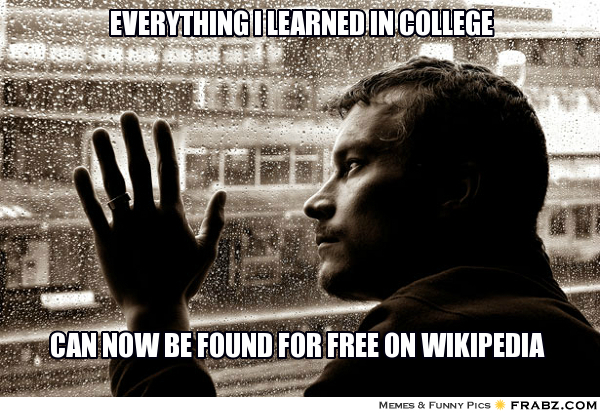
Not entirely true. But, all of the material could be found on the internet with a decent library subscription to journals and other academic publishing.
 

JLM

Hall of Fame Member
Nov 27, 2008
75,301
548
113
Vernon, B.C.


Not entirely true. But, all of the material could be found on the internet with a decent library subscription to journals and other academic publishing.

That would be true if everything we learned was through the medium of sight, which indeed is probably the most significant medium but not the only one. There are times when you need someone else watching. I personally find it easier to learn when you show me than when you tell me.

I think Wikipedia is fine for the layman, but for technical "in depth", I'm not sure!
 

Tonington

Hall of Fame Member
Oct 27, 2006
15,441
150
63
That would be true if everything we learned was through the medium of sight, which indeed is probably the most significant medium but not the only one. There are times when you need someone else watching. I personally find it easier to learn when you show me than when you tell me.

I think Wikipedia is fine for the layman, but for technical "in depth", I'm not sure!

What's true is that the educational material and tools out there exist to help make delivery of education more efficient and at significantly lower costs. Of course Wikipedia is not a sufficient tool for educating a highly trained workforce. The point is that education can be made available to many people at a cheaper cost if we use a different educational model.

Lots of people learn by watching someone who is trained and a subject matter expert. That can be done now too. There are many higher education institutions that are even offering course material for free online. You can watch a video online of how to switch parts on your car if you've never seen it or done it yourself.

It just requires a bit of ingenuity.
 

taxslave

Hall of Fame Member
Nov 25, 2008
36,362
4,340
113
Vancouver Island
What's true is that the educational material and tools out there exist to help make delivery of education more efficient and at significantly lower costs. Of course Wikipedia is not a sufficient tool for educating a highly trained workforce. The point is that education can be made available to many people at a cheaper cost if we use a different educational model.

Lots of people learn by watching someone who is trained and a subject matter expert. That can be done now too. There are many higher education institutions that are even offering course material for free online. You can watch a video online of how to switch parts on your car if you've never seen it or done it yourself.

It just requires a bit of ingenuity.

Swapping parts is the easy part. Knowing what to change takes education, experience and a few thousand dollars worth of test equipment.