Analysis: Oilsands poisoning groundwater

pgs

Hall of Fame Member
Nov 29, 2008
28,984
8,396
113
B.C.
Alternative energy sources. It's just that basic. Societies reliance on oil has been highlighted as a problem since the OPEC embargo in the '70's and if you are familiar with the The Hubbert peak theory (also known as peak oil), it has been known for quite some time. It posits that future petroleum production (whether for individual oil wells, entire oil fields, whole countries, or worldwide production) will eventually peak and then decline at a similar rate to the rate of increase before the peak as these reserves are exhausted. It also suggests a method to calculate the timing of this peak, based on past production rates, the observed peak of past discovery rates, and proven oil reserves. The peak of oil discoveries was in 1965, and oil production per year has surpassed oil discoveries every year since 1980.

So if we have known that source oil (being non-renewable) is decling, why hasn't there been a massive effort towards, wind, solar, water (tides), etc. Because as one poster pointed out "we are lemmings"

We twend to wait until the last possible moment to look up and exclaim, s--t, what do we do now?

Huge gov't incentive to alternative sources would seem to be the immediate answer in order to reduce our dependance 10 yrs down the road
I think we better think about getting horses.
LoL:lol:
 

Said1

Hubba Hubba
Apr 18, 2005
5,338
70
48
53
Das Kapital
Alternative energy sources. It's just that basic. Societies reliance on oil has been highlighted as a problem since the OPEC embargo in the '70's and if you are familiar with the The Hubbert peak theory (also known as peak oil), it has been known for quite some time. It posits that future petroleum production (whether for individual oil wells, entire oil fields, whole countries, or worldwide production) will eventually peak and then decline at a similar rate to the rate of increase before the peak as these reserves are exhausted. It also suggests a method to calculate the timing of this peak, based on past production rates, the observed peak of past discovery rates, and proven oil reserves. The peak of oil discoveries was in 1965, and oil production per year has surpassed oil discoveries every year since 1980.

So if we have known that source oil (being non-renewable) is decling, why hasn't there been a massive effort towards, wind, solar, water (tides), etc. Because as one poster pointed out "we are lemmings"

We twend to wait until the last possible moment to look up and exclaim, s--t, what do we do now?

Huge gov't incentive to alternative sources would seem to be the immediate answer in order to reduce our dependance 10 yrs down the road

Yes, I am familiar with Hubbert's and in particular, Duncan's Olduvai theory. Like the Mathusians, people are always claiming their theorys do not account for social and technological change. I think they did include those factors in the correct way as overall consuption has increased and production has decreased as explained in their theorys, with the same consequences. Duncan also predicted a depression not unlike the 30's for this time period AND I just heard on the news that Canada is officially in a recession. Talk about prophecy. 8O
 
Last edited:

Said1

Hubba Hubba
Apr 18, 2005
5,338
70
48
53
Das Kapital
I don't believe it has to come down to deindustrialization, but rather hang onto all existing development, companies and jobs for the oil sands, but stop making the problem worse by expanding for the time being until the existing companies and development can be retro-fitted in a way that can secure the environment around the oil sands and assure the safety and health of those who work there.

Once everything is optimized and made as safe as possible for humans and nature alike.... then goto town and haul all the oil you want.

But of course I would rather us just stop using fossil fuels altogether, but I am also realistic and know that's a long stretch.

With all due respect, I agree. IHO.

Honestly, I know very little about the process and even less about any type of risk assessment studies that might have been done prior to developing the tars sands for extraction. Just the fact that oil prices have reached the point where extraction is profitable is worrisome enough for me. But I'm just weee lemming, how am I supposed to know from facts!
 

Praxius

Mass'Debater
Dec 18, 2007
10,677
161
63
Halifax, NS & Melbourne, VIC
With all due respect, I agree. IHO.

Honestly, I know very little about the process and even less about any type of risk assessment studies that might have been done prior to developing the tars sands for extraction. Just the fact that oil prices have reached the point where extraction is profitable is worrisome enough for me. But I'm just weee lemming, how am I supposed to know from facts!

By simply asking, it's your right to know that sort of information. The government and those who represent you and whom you voted for (Or at least voted to have a say) have a duty to ensure that you and everybody else's health is not being affected. They should get that information for you and/or get an independant researcher into the whole matter to get down to the truth.

If your health is as risk, then more digging is required and I would be seeking out the names of those who approved such projects with such disregard for the health of those surrounding, as well as the environment.

If I couldn't get this information in the normal ways, then I would seek out this information through the "Request for Access to Information" process or whatever you call it and get the information this way.

Then of course make this information public through the media or by other means such at the internet....... then attempt to gather as many people as you can to launch a class action lawsuit against the government or the company or both.

Get some people jailed, get things fixed to the way they should be.

The best weapon against corruption is the truth.
 

Stretch

House Member
Feb 16, 2003
3,924
19
38
Australia
for the life of me , I cant figer out how this is a surprise.....oil, sand,.... underneath it all is water......what the hell was the expected outcome??
 

barney

Electoral Member
Aug 1, 2007
336
9
18
If your health is as risk, then more digging is required

Don't you mean more 'drilling' is required? ;-) (Sorry, couldn't resist...I know, LAME)

As to a less-childish answer to your serious statement:

The best weapon against corruption is the truth.

Of course. And common sense, or rationality, or logic, or whatever you want to call it leads to the truth (also known as, 'the facts'). The reason why these very important issues are not dealt with (or at least not dealt with adequately), isn't because people are unable to get the facts, it's because people (i.e. your fellow Canadians) don't want to accept the truth. This is all-too-frequently reflected by who they vote for; why would you expect someone who represents political interests that promote money-making over responsible government to suddenly about-turn and wade into oily waters that even socially-responsible types fear to swim in?

Until you deal with the me-generation's faults, dealing with problems like whether or not to proceed with activities which are clearly harmful to the environment and the population, will be an endlessly frustrating governmental nightmare.
 

Lester

Council Member
Sep 28, 2007
1,062
12
38
65
Ardrossan, Alberta
Ok so, - the heavy metals and other contaminants that are LEFT over(TAILINGS) from the extraction process, this waste is pumped into the tailings pond(s),which is supposed to be enviromentally isolated and somewhat leak proof. Apparently this is not the case as the tailings have leaking into the aquifers and river system by the millions of litres per year. I do not know how this problem can be solved short of shutting them down or insisting that all new plants have to be constructed Insitu(steam injected, no mining)
 

karrie

OogedyBoogedy
Jan 6, 2007
27,780
285
83
bliss
Ok so, - the heavy metals and other contaminants that are LEFT over(TAILINGS) from the extraction process, this waste is pumped into the tailings pond(s),which is supposed to be enviromentally isolated and somewhat leak proof. Apparently this is not the case as the tailings have leaking into the aquifers and river system by the millions of litres per year. I do not know how this problem can be solved short of shutting them down or insisting that all new plants have to be constructed Insitu(steam injected, no mining)

I don't see how in situ is any less risky for the water table though. With in situ drilling the steam extraction will still leave behind tailings, just deeper within the soil, where they can't possibly be contained, and have less distance to have to leech through (thus less soil to filter them) before hitting the water table. It's the exact same process, just one requires digging, one doesn't.
 

Vanni Fucci

Senate Member
Dec 26, 2004
5,239
17
38
8th Circle, 7th Bolgia
the-brights.net
Ok so, - the heavy metals and other contaminants that are LEFT over(TAILINGS) from the extraction process, this waste is pumped into the tailings pond(s),which is supposed to be enviromentally isolated and somewhat leak proof. Apparently this is not the case as the tailings have leaking into the aquifers and river system by the millions of litres per year. I do not know how this problem can be solved short of shutting them down or insisting that all new plants have to be constructed Insitu(steam injected, no mining)

Would proper containment tanks be outside the realm of possibility?

Truth is I don't know enough about the process, to know whether this is possible or not, and I don't really feel like reading up on it...
 

Lester

Council Member
Sep 28, 2007
1,062
12
38
65
Ardrossan, Alberta
I don't see how in situ is any less risky for the water table though. With in situ drilling the steam extraction will still leave behind tailings, just deeper within the soil, where they can't possibly be contained, and have less distance to have to leech through (thus less soil to filter them) before hitting the water table. It's the exact same process, just one requires digging, one doesn't.
It's not necessarily the extraction from the ground that causes the problem, it's the chemicals and processes used to extract the oil from the sand. When they do mine extraction, they dig it all up and send it by trucks to the extraction plant. The trucks dump it into huge hoppers and conveyors take it from there. It's run through a bath of steam, super hot water, and an assortment of caustic chemicals to allow the bitumen(raw synthetic crude) to float to the top. this raw bitumen is processed into a purer form. It's the crap(oil ,chemicals, and water) thats left over from that process that goes into the tailings pond. When they extract oil insitu, they have an inlet steam and an outlet Bitumen- Steam is Injected deep into the ground and the oil is sucked out, kind of like a slurpie on a hot day. No chemicals are needed with insitu as far as I know, it's not nearly as efficient as mining but far cleaner and it takes the environment less time to recover.
 

Lester

Council Member
Sep 28, 2007
1,062
12
38
65
Ardrossan, Alberta
Would proper containment tanks be outside the realm of possibility?

Truth is I don't know enough about the process, to know whether this is possible or not, and I don't really feel like reading up on it...
Presently the area of the tailings ponds is 137 sq km 10 ft deep- they are pretty much liquid dumps. somebody here had a good idea why don't they clean up the water as much as they can and re-use it. For the life of me, I can't see why they don't either.
 

mt_pockets1000

Council Member
Jun 22, 2006
1,292
29
48
Edmonton
Lester, you are correct in your understanding of the insitu process. Right now I'm working on connecting electric submersible pumps for multiple wellpads at the Long Lake site (Opti/Nexen). This would be the production side of the process. Each wellpad has up to 13 producing wellheads. The pumps suck the bitumen out of the ground after the steam process liquifies the molasses-like bitumen into a manageable viscosity. The sand sinks to the bottom of the natural reservoir leaving a cleaner product to be pumped out of the ground. This site is operating at approximately 75% capacity and very clean. The heat from the steam used to liquify the bitumen is reused back at the co-generation plant to help power the site.

One of the disadvantages of the steam injection process of insitu is the vast amounts of water required to carry out the procedure. It's taxing the local water sources in the area. I've heard talk of building a pipeline to bring water in from other sources but we'll see how far that idea goes.

As far as what is happening underground when the steam is injected, it makes sense if a thick, syrupy material is suddenly liquified it is going to migrate through cracks and fissures into areas it wouldn't normally go. And that could mean straight into wellwater, lakes and rivers.

As far as the open pit sites go, I've been to the Syncrude site and those tarponds are a disturbing sight to behold. The oily surface, the scarecrows, the cannons all combine to create a surreal scene. Kinda reminds me of those space movies where a distant planet is being mined and nobody lives there for any length of time, except for the grunts who are condemned there for life. You can't wait to jump in your spaceship and head back to earth.
 

Vanni Fucci

Senate Member
Dec 26, 2004
5,239
17
38
8th Circle, 7th Bolgia
the-brights.net
Presently the area of the tailings ponds is 137 sq km 10 ft deep- they are pretty much liquid dumps. somebody here had a good idea why don't they clean up the water as much as they can and re-use it. For the life of me, I can't see why they don't either.

Ok, well if my math is correct, [and it's very likely that it's not, because I suck at math], it would take 112,614,000 x 500,000 litre storage tanks to contain all that water...maybe it's not such a viable solution after all...
 

Lester

Council Member
Sep 28, 2007
1,062
12
38
65
Ardrossan, Alberta
The line between them just got blurrier- but tit seems that the major problem is leakage from the tailings - It must be a Syncrude and Suncor problem as they have been there longest and have the largest tailings ponds.
 

Praxius

Mass'Debater
Dec 18, 2007
10,677
161
63
Halifax, NS & Melbourne, VIC
Presently the area of the tailings ponds is 137 sq km 10 ft deep- they are pretty much liquid dumps. somebody here had a good idea why don't they clean up the water as much as they can and re-use it. For the life of me, I can't see why they don't either.

Liquid Dumps are some of the worst things on the planet and take forever to get rid of... Take here in Nova Scotia for example:

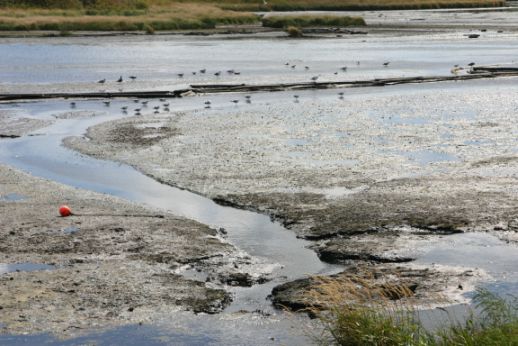
Sydney Tar Ponds:

Herring gulls resting on a mud flat in the South Pond of the Sydney Tar Ponds, September 2004.

Or Boat Harbour, Pictou Landing. (Can't find any picutres for some odd reason) But A guy in my grade 3 class went and did a science thing for school and did it all on Boat Harbour. He took a stone the size of a softball and lobbed it into the middle of the place and it just wedged itself on the surface and stayed there amongst the sludge.....

When a stone doesn't sink, there's something wrong.