



Fearless Tennessee Mom Delivers An AMAZING Speech
Fearless Tennessee Mom Delivers An AMAZING Speech
 www.youtube.com
But it's all about the kids, right?
www.youtube.com

A gay in Grade 6 eh? Sounds like bullshit to me. Effeminate yes. Gay no. She is pushing him.Fearless Tennessee Mom Delivers An AMAZING Speech
Fearless Tennessee Mom Delivers An AMAZING Speech
But it's all about the kids, right?

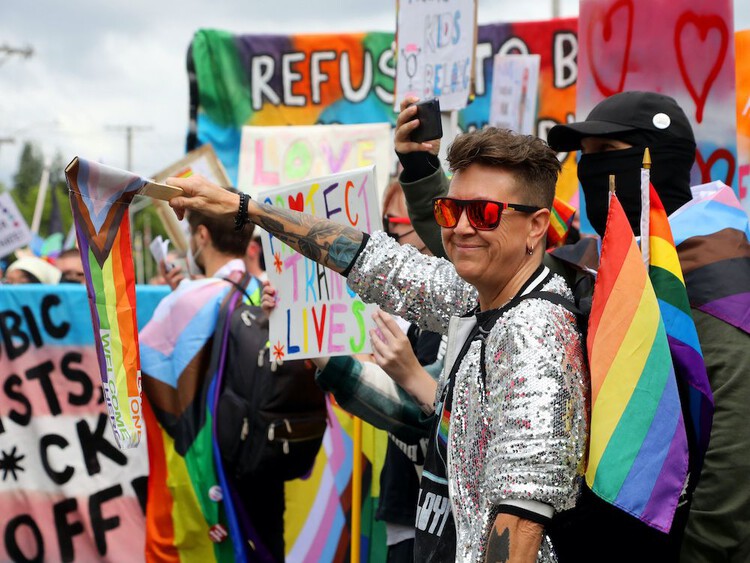
Allan Stratton: The left’s social contract is broken. Here’s how to fix it — National Post
A relentless focus on dubious forms of ‘oppression’ is alienating traditional leftists. Saving the movement means returning to liberal rootsapple.news
Om Namo Narayanaya!Can't comment on that article itself, as it's behind a paywall.
However.
The comments aren't and... wow. This one took the cake.
"I'm glad Stratton deliberately separates the LGB and T agendas. They are not in fact premised on the same interests or beliefs. The T agenda is based on a heteronormative gender identity perspective, whereby if a boy exhibits feminine characteristics and/or behaviors or a girl exhibits masculine characteristics and/or behaviors, it's assumed by many who believe in T orthodoxy that these children have been assigned an incorrect gender at birth and should therefore transition to reflect their correct gender. And many T activists assist that others comply with this perspective. Most members of the LGB community simply don't accept this construct, viewing human sexuality in a much more flexible fashion."
... Uh huh...
Obviously this person has bought into the GLB Alliance bullshit.
Because no, this ISN'T what trans people believe (and fyi, "Trans" can cover a large umbrella of people, not just specifically FtM or MtF trans people).
This idea that the GLB community is stepping away from the Trans and rest of the "community", is, sadly, semi-correct though. Because there are extremists out there doing just that, and advocating for it. Some of it is based on the idea that "Everyone else" is gender based while GLB is more focused on sexuality, the other part is that there are GLB who, as I said, bout into the idea that somehow Trans et al are "Bad" for the GLB community.
And yet I don't see any support for those who are trans, but fall under GLB as well. Because someone can be Trans, but also be G, L, OR B at the same time.
Since it is "Sexuality" and not "Gender", after all.
In any event; no. As part of those under the T umbrella, no, this ISN'T what the "T agenda" is about. At it's basic level, those under the T umbrella just want to live their lives being who they are without fear from people, and being labelled as "pedophiles" and "Groomers". They just want to live without being asked "Do you have X body part?" They just want to live without having to worry that someone wants them eradicated just for simply being who they are.
The T agenda? To not just survive, but fucking LIVE.
Sorry. It’s not for me for whatever reason and I’m not subscribed to Nation Post. Here you go:Can't comment on that article itself, as it's behind a paywall.

Sorry. It’s not for me for whatever reason and I’m not subscribed to Nation Post. Here you go:
Toronto is one of the most tolerant, multicultural cities in the world. And yet, according to many of its progressive journalists, academics, and politicians, it’s actually a den of systemic racism, sexism, homophobia and transphobia. Unless you’re a straight white man, daily life is supposedly an exhausting and dangerous struggle. If you live in the United States, the UK, Australia, or elsewhere in Canada, I’m guessing you’ve been told similar things about your own society.
I’m a gay man for whom these reports bear no relationship to the real world. Certainly, hate-crime statistics show a sharp increase in physical and verbal abuse against specific demographics, including my own. And there are even rare incidents of murder and arson. But to suggest that minorities live under constant threat from a bigoted majority is apocalyptic nonsense. This is especially true of Canada, an especially open, diverse, and welcoming country. Western nations, more generally, are incontrovertibly the most tolerant on the planet.
My heretical view (among fellow progressives, at least) may be due to my “positionality” (this being a faddishly woke jargon term that most English speakers would call “perspective”). The Holocaust and the internment of Japanese North Americans ended a mere six years before I was born. The pass system that turned Canadian Indigenous reservations into open-air prison camps was still in force. The United States was segregated by Jim Crow and redlining. Cross burnings and lynchings went unpunished. Marital rape was legal. Spousal abuse and unequal pay were commonplace. Gay sex and cross-dressing were criminalized, with outed individuals losing their jobs and children. “Fag bashing” was treated as public entertainment.
In the relatively few decades since, western governments have implemented universal civil and human rights protections for racial and sexual minorities. The speed and depth of this transformation has been so remarkable that it seems inconceivable that we ever lived as we once did. Has any other culture critiqued its failings and set about reforming itself so quickly?
This is not to suggest that everything is sunshine and lollipops. Human nature has not been repealed. Police departments without effective civilian oversight, for instance, continue to invite corruption and abuse. Nonetheless, we now have the tools to press for accountability, such as human rights tribunals and whistleblower protections.
It’s also important to acknowledge that while the relative increase in reported hate crimes may seem shocking, that rise is based on a remarkably low baseline. For instance, 2021 saw a 65 per cent increase in incidents (over 50 per cent of these comprising verbal slurs) targeting Canada’s LGB and T communities. But that still represents just 423 cases in a country of 40-million people. That’s hardly a “tsunami of hate.” The number is infinitesimal compared to the 114,132 domestic assaults and 34,242 sexual assaults recorded against women.
In all honesty, I’ve only read the first three or four or five paragraphs myself. Thought those were an interesting perspective, and I was outside for all of two minutes having a quick cigarette…. So I copy and pasted the link and went back to work.Thanks Ron, will read it, but tbh by the comments I am not hopeful of common sense in this.

Wait. . . he's less than three days old and he's already seen a lot?Now I’ve read through it. Still an interesting perspective coming from a gay guy who’s close to 70hrs old
The above and this seem to fit together:Allan Stratton: The left’s social contract is broken. Here’s how to fix it — National Post
A relentless focus on dubious forms of ‘oppression’ is alienating traditional leftists. Saving the movement means returning to liberal roots
The above and this seem to fit together:
Michael Higgins: School principal's death is a stain on the conscience of this nation — National Post
It's time to stand up against the woke zealots who destroyed Richard Bilksztoapple.news
Are you still not seeing yourself in those articles? They are both about you and people like you.Another paywall but found the story about Bilkszto elsewhere.
First, that he was driven - yes, driven - to suicide is appalling, disgusting and absolutely the result of bullying. The irony is that those now crying about this, some of them would otherwise shout "Suck it up", "move on" and "get over it" if it were someone that didn't fit with their ideology (aka "the left"). After all, he was only bullied, just verbally abused, it's not like it was a big deal.
Right?
That's what is being told to kids, despite people - on the left - saying "no this isn't right"...
It's sad that it seems to only matter to some when it's someone they can throw support behind, instead of it being someone that deserved support because they're human.
Second - I hope the lawsuit goes through and this garbage person running that so called "program" is held accountable in some way.
Yep, firmly against that group and the woman leading the training given at the time. More specifically, fuck her and her self-righteous horse she rode in on.
Canada has racism problems, but it is NOT at the extent of the US and I don't think it's any more "neglectful" about it's history in regards to black people as the US is. It's certainly not LESS.
And if the comments reported that the woman said to Bilkszto are true, she IS part of the problem when it comes to racesim these days.
So yeah, fuck her and her "program" for pushing this man to have his career forcefully ended, and his life ended.
