Trudeau Has Buried Us In Debt

spaminator

Hall of Fame Member
Oct 26, 2009
41,142
4,186
113
Beware Carney’s borrowing bomb
Money the government borrows eventually has to be paid back, with interest, no matter how the government classifies it

Author of the article:postmedia News
Published Nov 12, 2026 • Last updated 14 hours ago • 2 minute read
Carney 2026 budget 1
Prime Minister Mark Carney and Finance Minister Francois-Philippe Champagne meet before tabling the federal budget on Parliament Hill in Ottawa on Nov. 5, 2026. Photo by Blair Gable /Postmedia Network
Because of the way Prime Minister Mark Carney is spending our money, taxpayers have a lot more to worry about than the size of the federal deficit.


The even bigger concern is the rate of federal borrowing.


In its latest budget, the Liberals are pouring hundreds of billions of borrowed taxpayer dollars into crown corporations and other so-called arm’s length agencies to finance government programs.

These costs don’t appear in the federal books as part of the deficit.

Under what’s known as accrual accounting, this spending is classified as investments, rather than liabilities, even though it’s all being financed by government debt.


Adds to debt
Unless these investments return profits above the cost of financing them, they add to the debt, which taxpayers are responsible for paying.

Parliamentary budget officer Annette Ryan warned that federal borrowing of this type is growing at more than double the rate of federal deficits over the next five years – $732.9 billion compared to $333.3 billion.


“This obscures the realities of cash debt and raises questions about whether the current fiscal framework provides a complete and transparent picture of Canada’s fiscal sustainability,” Ryan wrote.

“Cash outlays drive borrowing, which … increase market debt and public debt charges, independent of how they are recorded.”


Borrowed money must be paid back with interest
There is no free lunch. Money the government borrows eventually has to be paid back, with interest, no matter how the government classifies it.

A previous PBO report warned that the feds misclassified $94 billion of operating expenses as capital investments, rendering meaningless the PM’s boast that he will balance the operating budget next year.

In fact, Ryan wrote: “A balanced operating budget should not be interpreted as a balanced fiscal position. By design, it includes debt-financed capital spending, meaning borrowing and debt can continue to grow while the target is being achieved.”

Kevin Lynch, a former federal deputy finance minister, warned in a Globe and Mail column that the Carney government has already spent its entire revenue windfall from high oil prices and inflation on new government programs rather than reducing deficits.

It’s also gambling that there will be no major global economic shocks over the next five years.

“Canadians had better hope the budget’s two big bets pay off,” Lynch concludes, because taxpayers will be on the hook whatever happens.
 
  • Angry
Reactions: Taxslave2

spaminator

Hall of Fame Member
Oct 26, 2009
41,142
4,186
113
Government added $131M last year to Phoenix overpayments it doesn't expect to recover
Auditor general found total amount of outstanding overpayments to public servants had grown to $295 million

Author of the article:Ben Andrews
Published Nov 12, 2026 • 2 minute read
Auditor General Karen Hogan is warning the government that pay errors under Phoenix could carry over the replacement software if the backlog isn't addressed.
Auditor General Karen Hogan is warning the government that pay errors under Phoenix could carry over the replacement software if the backlog isn't addressed. Photo by HYUNGCHEOL PARK /Postmedia
The government added $131 million last fiscal year to the total amount of outstanding overpayments made to public servants that may never be recovered, according to an analysis by Canada’s auditor general.


The commentary by Auditor General Karen Hogan, released Monday, Nov. 9, responded to figures included in the government’s audited financial statements for last year, which were released last Friday, Nov. 6.


According to the analysis, the government estimated that $295 million in outstanding overpayments — a common issue under the beleaguered Phoenix pay system — “may never be recovered” and had been recorded by the government as an allowance for “doubtful accounts.”

That total is an increase of $131 million over the previous year.

The government is legally required to begin recovery of an overpayment within six years, a window of time called the “limitation period.” After that point, the government cannot force public servants to repay the money without their agreement.

The auditor general warned that a backlog of potential overpayments means some have already exceeded or are approaching six years in the system.

Errors could carry over to Phoenix replacement
The extensive backlog of unresolved pay errors has long been an issue.


The problem-plagued Phoenix pay system was launched in 2016 after being initially introduced in 2009. Issues related to Phoenix began to appear almost immediately after its implementation and continue more than a decade later, leading to errors on employees’ paycheques and a backlog of transactions, including those for public servants extending contracts or acting positions, taking leave or making changes to personal information.

As of March 31, the federal pay centre had a backlog of 181,649 transactions, including 110,867 that were older than one year. Some 8 per cent of those transactions were older than six years, according to an auditor general analysis of government figures.

In this week’s commentary, the auditor general said federal departments and agencies must focus on recovering outstanding overpayments.

“These issues should be address before organizations transition to Dayforce so that long-standing problems are not carried over to the new system,” the auditor general’s analysis said.


In a March report, the auditor general previously warned that pay errors could carry over to the government’s new $4.2-billion human resources software, Dayforce, if they aren’t addressed before launch.

In addition to the backlog, the audit found the Treasury Board had made “slow progress” in simplifying and standardizing pay rules and processes — a key lesson the government identified out of its experience with Phoenix to help avoid costly and complex system customizations.

The government still expects to recover $137 million in outstanding overpayments from federal employees.
 
  • Angry
Reactions: Taxslave2

Dixie Cup

Senate Member
Sep 16, 2006
6,830
4,285
113
Edmonton
Government added $131M last year to Phoenix overpayments it doesn't expect to recover
Auditor general found total amount of outstanding overpayments to public servants had grown to $295 million

Author of the article:Ben Andrews
Published Nov 12, 2026 • 2 minute read
Auditor General Karen Hogan is warning the government that pay errors under Phoenix could carry over the replacement software if the backlog isn't addressed.
Auditor General Karen Hogan is warning the government that pay errors under Phoenix could carry over the replacement software if the backlog isn't addressed. Photo by HYUNGCHEOL PARK /Postmedia
The government added $131 million last fiscal year to the total amount of outstanding overpayments made to public servants that may never be recovered, according to an analysis by Canada’s auditor general.


The commentary by Auditor General Karen Hogan, released Monday, Nov. 9, responded to figures included in the government’s audited financial statements for last year, which were released last Friday, Nov. 6.


According to the analysis, the government estimated that $295 million in outstanding overpayments — a common issue under the beleaguered Phoenix pay system — “may never be recovered” and had been recorded by the government as an allowance for “doubtful accounts.”

That total is an increase of $131 million over the previous year.

The government is legally required to begin recovery of an overpayment within six years, a window of time called the “limitation period.” After that point, the government cannot force public servants to repay the money without their agreement.

The auditor general warned that a backlog of potential overpayments means some have already exceeded or are approaching six years in the system.

Errors could carry over to Phoenix replacement
The extensive backlog of unresolved pay errors has long been an issue.


The problem-plagued Phoenix pay system was launched in 2016 after being initially introduced in 2009. Issues related to Phoenix began to appear almost immediately after its implementation and continue more than a decade later, leading to errors on employees’ paycheques and a backlog of transactions, including those for public servants extending contracts or acting positions, taking leave or making changes to personal information.

As of March 31, the federal pay centre had a backlog of 181,649 transactions, including 110,867 that were older than one year. Some 8 per cent of those transactions were older than six years, according to an auditor general analysis of government figures.

In this week’s commentary, the auditor general said federal departments and agencies must focus on recovering outstanding overpayments.

“These issues should be address before organizations transition to Dayforce so that long-standing problems are not carried over to the new system,” the auditor general’s analysis said.


In a March report, the auditor general previously warned that pay errors could carry over to the government’s new $4.2-billion human resources software, Dayforce, if they aren’t addressed before launch.

In addition to the backlog, the audit found the Treasury Board had made “slow progress” in simplifying and standardizing pay rules and processes — a key lesson the government identified out of its experience with Phoenix to help avoid costly and complex system customizations.

The government still expects to recover $137 million in outstanding overpayments from federal employees.
You can't rely on an incompetent government which is what Canada has. We'll never "recover" the over payments because there's likely nothing happening to even TRY to collect. The corruption is endemic.
 

bob the dog

Council Member
Aug 14, 2020
2,154
1,458
113
You can't rely on an incompetent government which is what Canada has. We'll never "recover" the over payments because there's likely nothing happening to even TRY to collect. The corruption is endemic.
Transitioned from "For the People" to just "For the Administration".

It's at an epidemic level with the highest priority to not let anyone find out what is going on. Carry on, appear important. Take a sabbatical. Prorogue the government. None of which has anything to do with a normal persons life other than it costs them money. If it wasn't for paying taxes a person could get by on very little.

Just like prisons need prisoners and schools need students, governments need tax payers. Those people are happy how it is. Sad part is they don't know what to do with the money and think accumulation is the idea. Much of it headed to the next generation is what I see.
 
  • Like
Reactions: Taxslave2

Taxslave2

Senate Member
Aug 13, 2022
6,031
3,199
113
Government added $131M last year to Phoenix overpayments it doesn't expect to recover
Auditor general found total amount of outstanding overpayments to public servants had grown to $295 million

Author of the article:Ben Andrews
Published Nov 12, 2026 • 2 minute read
Auditor General Karen Hogan is warning the government that pay errors under Phoenix could carry over the replacement software if the backlog isn't addressed.
Auditor General Karen Hogan is warning the government that pay errors under Phoenix could carry over the replacement software if the backlog isn't addressed. Photo by HYUNGCHEOL PARK /Postmedia
The government added $131 million last fiscal year to the total amount of outstanding overpayments made to public servants that may never be recovered, according to an analysis by Canada’s auditor general.


The commentary by Auditor General Karen Hogan, released Monday, Nov. 9, responded to figures included in the government’s audited financial statements for last year, which were released last Friday, Nov. 6.


According to the analysis, the government estimated that $295 million in outstanding overpayments — a common issue under the beleaguered Phoenix pay system — “may never be recovered” and had been recorded by the government as an allowance for “doubtful accounts.”

That total is an increase of $131 million over the previous year.

The government is legally required to begin recovery of an overpayment within six years, a window of time called the “limitation period.” After that point, the government cannot force public servants to repay the money without their agreement.

The auditor general warned that a backlog of potential overpayments means some have already exceeded or are approaching six years in the system.

Errors could carry over to Phoenix replacement
The extensive backlog of unresolved pay errors has long been an issue.


The problem-plagued Phoenix pay system was launched in 2016 after being initially introduced in 2009. Issues related to Phoenix began to appear almost immediately after its implementation and continue more than a decade later, leading to errors on employees’ paycheques and a backlog of transactions, including those for public servants extending contracts or acting positions, taking leave or making changes to personal information.

As of March 31, the federal pay centre had a backlog of 181,649 transactions, including 110,867 that were older than one year. Some 8 per cent of those transactions were older than six years, according to an auditor general analysis of government figures.

In this week’s commentary, the auditor general said federal departments and agencies must focus on recovering outstanding overpayments.

“These issues should be address before organizations transition to Dayforce so that long-standing problems are not carried over to the new system,” the auditor general’s analysis said.


In a March report, the auditor general previously warned that pay errors could carry over to the government’s new $4.2-billion human resources software, Dayforce, if they aren’t addressed before launch.

In addition to the backlog, the audit found the Treasury Board had made “slow progress” in simplifying and standardizing pay rules and processes — a key lesson the government identified out of its experience with Phoenix to help avoid costly and complex system customizations.

The government still expects to recover $137 million in outstanding overpayments from federal employees.
The only thing the Phoenix system has going for it is that it is unreliable in both official languages.
 

spaminator

Hall of Fame Member
Oct 26, 2009
41,142
4,186
113
Amid hiring freeze, city division’s $14G catering spend exposed
City hall’s 40-person emergency management division also spent more than $15,000 on 'miscellaneous materials' between January and mid-September, figures show

Author of the article:Justin Holmes
Published Nov 16, 2026 • Last updated 23 hours ago • 4 minute read
Joanna Beaven-Desjardins
Joanna Beaven-Desjardins, seen in 2015 while with the Toronto Police Service, is executive director of city hall’s emergency management division. Photo by Veronica Henri/Toronto Sun files

The City of Toronto’s emergency management division has racked up tens of thousands of dollars in expenses just this calendar year on categories of spending that include catering and “miscellaneous materials.”


The Toronto Sun acquired a list of spending by the division on purchases worth $250 or more via a freedom-of-information request. The expenses aren’t itemized, so the Sun only knows the totals spent by category, such as $51,591.54 for computer software.

That’s despite the fact the Sun specifically requested invoices and receipts for the division’s large expenditures.

Some of the totals appear large for a city hall outfit that numbers only 40 or so people.

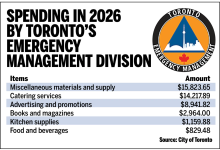
Emergency management spent $14,217.89 on catering services, $1,159.88 on kitchen supplies and $829.48 on food and beverage, the list shows.

Another $15,823.65 went toward “miscellaneous materials and supplies” and $5,578 on “other office material,” while $2,964 was spent on books and magazines.


Despite the division’s relatively low profile in the city, it spent $8,941.82 on advertising and promotions.

The figures only cover spending between Jan. 1 and Sept. 14, when the numbers were requested by the Sun. That period notably covers the World Cup, which was a high-profile moment for city hall, and emergency management in particular.

In an emailed statement, the city defended its spending practices but provided no details on what had been bought or why.

Olivia Chow at city hall
Toronto Mayor Olivia Chow enters city hall on Tuesday, Oct. 27, 2026. Chow ignored a request for comment from the Sun about the emergency management division’s spending. Photo by Ernest Doroszuk/Toronto Sun
Mayor silent
These figures are being made public just weeks after an election campaign that saw Mayor Olivia Chow repeatedly insist that city hall doesn’t need a line-by-line audit.

They also come as city hall began a hiring freeze at the start of this month. The city confirmed in a statement it is “pausing most recruitments,” with notable exceptions including front-line paramedic and firefighter roles.

Chow’s office ignored a request for comment from the Sun about the spending.

The revelation also follows a handful of headline-making controversies for Joanna Beaven-Desjardins, the executive director of the city’s emergency management division.


As the Sun has reported, Beaven-Desjardins was in the Rogers Centre for work only six times between 2024 and 2025: the dates of four Taylor Swift concerts and games 6 and 7 of the 2025 World Series.

She has also been accused of communicating with subordinates on the messaging app Signal in violation of city policy. The Sun is seeking records that could confirm if Beaven-Desjardins used Signal or other messaging apps not sanctioned by city hall.

The City of Toronto has refused to provide those records, and the Sun is pursuing an appeal of that decision.

Many of the biggest totals come in categories associated with office tech, such as computer hardware and software, telecom services, network equipment, computer and printer supplies and contracted services for office equipment.

While most of those categories involve five-figure outlays, city hall emphasized that for the emergency management division, which co-ordinates communication during the city’s major events and crisis responses, spending on technology can be equivalent to spending on safety.


Toronto's Emergency Management Division spending. TORONTO SUN GRAPHIC
Toronto’s Emergency Management Division spending in 2026. TORONTO SUN GRAPHIC
Eats ‘quite extravagant’: Source
“These expenses support the City of Toronto’s emergency management planning and response activities, including when the Toronto emergency operations centre is activated to co-ordinate incident response across city divisions, agencies and corporations,” Trevor Hyland, a director for the division, said in a brief emailed statement.

“All expenses are funded through Toronto city council-approved operating budgets and comply with the city’s expense policies and procedures.”

Despite questions from the Sun — including what “miscellaneous material” would cover, and whether or not the division even does advertising — the city provided nothing further.

A source at city hall, who the Sun has agreed to not identify to protect him from reprisals by top bureaucrats, said the catering outlay by emergency management was apparently “quite extravagant.”

However, a leading company in Toronto’s catering industry told the Sun that $14,000 for a 40-people division is not necessarily excessive. It could indicate city hall was regularly buying lunch for division staff, or that emergency management hosted a few events with people outside of the division invited.


Still, the city hall source insisted the spending was unusual, saying the division’s staff typically bring lunch or dinner from home.

That source did agree with the city’s point on the importance of tech to the division. However, he also said he believed that TVs and video boards had been bought for emergency management specifically for World Cup operations, and those expenses perhaps weren’t necessary.

“There’s a difference between having what you need to do the job and buying things because they look impressive,” he said.

The city was also asked about the allegation, but its response did not directly address the matter.

Another $15,148.88 was spent on external training and development, and $6,606.64 on registration for conferences or seminars.

jholmes@postmedia.com
1794912952382.png