The Tarriff Hype.

Ron in Regina

"Voice of the West" Party
Apr 9, 2008
31,780
11,537
113
Regina, Saskatchewan
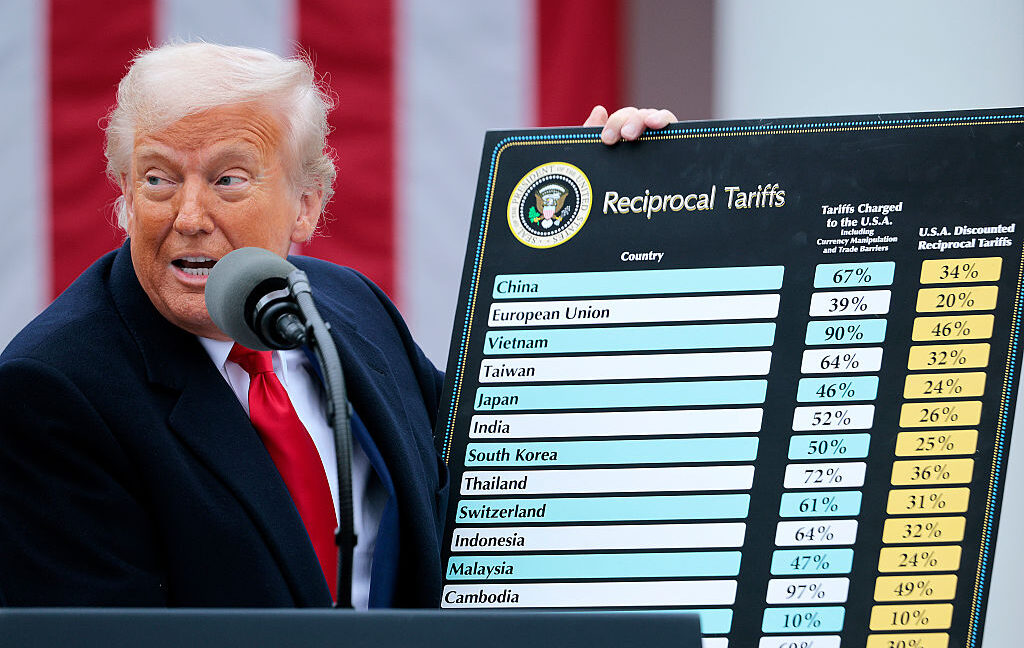
Unfortunately, Trump’s decision to create a whole new set of tariffs will be bad for both the US economy and the world economy. When one cuts through Trump’s delusional poppycock about how great his new tariffs will be, it becomes clear that his new 15% across-the-board tariff will hurt consumers, corporations, factories, US trading partners and Trump’s beloved stock market. While Trump says “tariffs” is “the most beautiful word”, economists, business executives and consumers give Trump’s tariffs a thumbs down.

A huge 64% of Americans disapprove of Trump’s handling of tariffs, according to a new ABC News/WashingtonPost/Ipsos poll.
 
  • Like
Reactions: Taxslave2

Ron in Regina

"Voice of the West" Party
Apr 9, 2008
31,780
11,537
113
Regina, Saskatchewan
WASHINGTON, D.C. — Expect more tariffs. That’s the rub from the 2026 U.S. Trade Policy Agenda, which U.S. Trade Representative Jamieson Greer delivered to Congress this week. It lays out plans for U.S. President Donald Trump’s trade dealings this year, signalling that the Supreme Court ruling against his International Emergency Economic Powers Act (IEEPA) tariffs has not deterred the “tariff man.”

“President Trump continues to flip the script on forty years of non-reciprocal trade practices …,” said Greer. So how does this differ from 2025’s agenda, and what does it mean for U.S. trading partners like Canada?

This year’s trade agenda also pivots from making a case for tariffs as a legitimate foreign policy tool toward them as the central pillar of U.S. geopolitical and economic strategy. The trade deficit is now a “national emergency,” justifying higher tariffs, demands for bilateral deals, and expanded government intervention, etc…
 

petros

The Central Scrutinizer
Nov 21, 2008
120,126
14,844
113
Low Earth Orbit
WASHINGTON, D.C. — Expect more tariffs. That’s the rub from the 2026 U.S. Trade Policy Agenda, which U.S. Trade Representative Jamieson Greer delivered to Congress this week. It lays out plans for U.S. President Donald Trump’s trade dealings this year, signalling that the Supreme Court ruling against his International Emergency Economic Powers Act (IEEPA) tariffs has not deterred the “tariff man.”

“President Trump continues to flip the script on forty years of non-reciprocal trade practices …,” said Greer. So how does this differ from 2025’s agenda, and what does it mean for U.S. trading partners like Canada?

This year’s trade agenda also pivots from making a case for tariffs as a legitimate foreign policy tool toward them as the central pillar of U.S. geopolitical and economic strategy. The trade deficit is now a “national emergency,” justifying higher tariffs, demands for bilateral deals, and expanded government intervention, etc…
America is dying.
 
  • Sad
Reactions: TheShadow

Ron in Regina

"Voice of the West" Party
Apr 9, 2008
31,780
11,537
113
Regina, Saskatchewan
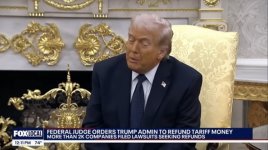
Anyway, back on the subject of tariffs, Congressional Democrats are asking companies to pass along expected tariff refunds to American customers, but the wait for money “could” drag out as the Trump administration is indicating it wants to delay or entirely block the “complex and time-consuming” process.
1772883443898.jpeg
Some companies have already pledged to pass along any refunds. Shipping company FedEx released a statement last month saying, “Our intent is straightforward: if refunds are issued to FedEx, we will issue refunds to the shippers and consumers who originally bore those charges.”

Other companies that have promised to pass along any refunds including game maker Cards Against Humanity and sex toy company Dame Products. There’s a Tariff Dildo of consequences joke in here somewhere…

A group of small businesses sued the Trump administration, claiming its use of the 1977 International Emergency Economic Powers Act to impose global reciprocal tariffs was an overstep of presidential powers. A divided Supreme Court agreed in a decision released last month but it sent the question of refunds back to the lower court to decide.

The Court of International Trade has now quickly ordered the refunds after a hearing in Manhattan on Wednesday. “You have to do it now,” Judge Richard Eaton told a government lawyer.

Judge Eaton denied a Justice Department request to pause his order to give the administration time to fight it. “There are no merits,” Judge Eaton told the government of its case. An appeals court could still agree to give the pause while the government tries to lay out its case.
Judge Eaton scheduled a Friday hearing to deal with the status of the suits that have been filed and duties involving companies that have not filed suit. “We don’t want people who are due a refund to have to file suit,” the judge added. “We want to work out a method by which those importers can make a claim for duties that were unlawfully applied.”

It has been two weeks since the Supreme Court blocked Donald Trump’s emergency tariffs, but an estimated 300,000 US businesses still have no idea if or when they will receive refunds.

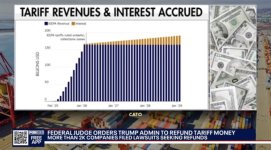
Economists have estimated that more than $175 billion was unlawfully collected, and the US could end up owing substantially more than that the longer the refund process is dragged out, since the US must pay back daily interest on the funds. According to the Cato Institute, a libertarian think tank, a conservative estimate showed that “$700 million in interest is added to the final bill every month that the government delays tariff refunds, or around $23 million per day.”
1772884617623.jpeg
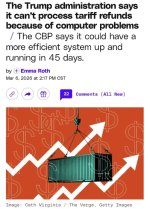
More than 2,000 companies, including well-known names like Costco (COST) and FedEx (FDX), have filed lawsuits seeking refunds for the illegal tariffs they paid. On Friday, the US Customs agency said it is preparing a process for importers to electronically file and receive tariff refunds, and that the system will be ready in the next 45 days.
(YouTube & Trump tariffs: Customs and Border Protection tells judge it can't comply with refund order)
1772882965924.jpeg
While the refund process gets ironed out, President Trump has moved forward with imposing new 10% tariffs that could rise to 15% as soon as "sometime this week," according to Treasury Secretary Scott Bessent. However, a group of states is seeking to challenge these duties in court, arguing that Trump lacks the power to reinstate tariffs under Section 122.
(YouTube & 24 states file lawsuit against Trump administration over tariffs)
 

Ron in Regina

"Voice of the West" Party
Apr 9, 2008
31,780
11,537
113
Regina, Saskatchewan
Malaysia has declared its trade deal with the United States—the Agreement on Reciprocal Trade (ART)—null and void as of March 15, 2026, following a U.S. Supreme Court ruling striking down reciprocal tariffs.
(YouTube & Johari confirms Malaysia-US trade deal nullified)

The decision makes Malaysia the first country to abandon a trade deal under this U.S. tariff strategy.
Key Details:
  • Cause: A February 20, 2026, U.S. Supreme Court decision invalidated reciprocal tariffs imposed under the International Emergency Economic Powers Act (IEEPA), which were central to the deal.
  • Context: The deal, signed in October 2025, involved Malaysia lowering tariffs and providing market access in exchange for avoiding a 19%–24% tariff, which was initially up to 47%.
  • Result: Malaysia, under Prime Minister Anwar Ibrahim, halted ratification following domestic pressure and the removal of the tariff, making the agreed concessions no longer beneficial.
  • Global Impact: This move might encourage other nations to reconsider similar U.S. agreements, potentially setting back Washington's trade policy.
(YouTube & First Country WALKS OUT - Malaysia Tears Up Trump Deal, Trade Leverage Collapses)
 

petros

The Central Scrutinizer
Nov 21, 2008
120,126
14,844
113
Low Earth Orbit
Malaysia has declared its trade deal with the United States—the Agreement on Reciprocal Trade (ART)—null and void as of March 15, 2026, following a U.S. Supreme Court ruling striking down reciprocal tariffs.
(YouTube & Johari confirms Malaysia-US trade deal nullified)

The decision makes Malaysia the first country to abandon a trade deal under this U.S. tariff strategy.
Key Details:
  • Cause: A February 20, 2026, U.S. Supreme Court decision invalidated reciprocal tariffs imposed under the International Emergency Economic Powers Act (IEEPA), which were central to the deal.
  • Context: The deal, signed in October 2025, involved Malaysia lowering tariffs and providing market access in exchange for avoiding a 19%–24% tariff, which was initially up to 47%.
  • Result: Malaysia, under Prime Minister Anwar Ibrahim, halted ratification following domestic pressure and the removal of the tariff, making the agreed concessions no longer beneficial.
  • Global Impact: This move might encourage other nations to reconsider similar U.S. agreements, potentially setting back Washington's trade policy.
(YouTube & First Country WALKS OUT - Malaysia Tears Up Trump Deal, Trade Leverage Collapses)
Muzzies canceling on Trump?
 

Ron in Regina

"Voice of the West" Party
Apr 9, 2008
31,780
11,537
113
Regina, Saskatchewan

Ron in Regina

"Voice of the West" Party
Apr 9, 2008
31,780
11,537
113
Regina, Saskatchewan
Last week, the United States Trade Representative (USTR) launched investigations into 60 economies under Section 301(b) of the U.S. Trade Act of 1974 to determine whether they have failed to impose or enforce bans on imports produced with forced labour. But critics in the Washington beltway say the 301 probes are basically a “show trial” and that the verdict is sure to go against trading partners such as Canada.

Canada and Mexico, two of America’s biggest trading partners, are being grouped together with China and dozens of other countries for these investigations. The probes will examine whether Ottawa’s forced-labour rules and framework, including the 2023 Fighting Against Forced Labour and Child Labour in Supply Chains Act, are sufficient for screening goods produced by child or forced labour.

The inclusion of Canada “was unbelievably shocking to me,” said Clark Packard, research fellow at CATO’s Herbert A. Stiefel Center for Trade Policy Studies.

“This poisons the well in terms of any USMCA negotiation,” Packard added, referring to the renegotiation of the U.S.-Mexico-Canada trade agreement scheduled for July.

Section 301 gives the U.S. trade representative power to unilaterally restrict imports or suspend trade agreements over trade practices it considers unjustifiable, unreasonable or discriminatory, or that burden domestic commerce.

Investigations under the section, which follow a formalized process of consultations and hearings, usually take around 12 months to complete. But U.S. trade officials have already said they expect the probes to be completed within five months so that new tariffs can replace the time-limited Section 122 duties.

Those were the duties imposed by President Donald Trump after his use of global tariffs under the International Emergency Economic Powers Act (IEEPA) were ruled invalid by the U.S. Supreme Court in February. However, the Section 122 duties, which give the president temporary tariff power to address a severe balance-of-payments shortage or currency crisis, are only good for five months.

This means the conclusion of the 301 investigation into Canada could coincide with this summer’s USMCA review.

So, is this really about Canada using forced labour?

This question drew laughs from Washington trade watchers.
“This has nothing to do with forced labour,” said Inu Manak, senior fellow for international trade at the Council on Foreign Relations.

She explained that these and the other probes recently launched by the administration also under Section 301 — looking at allegations of structural overcapacity and excessive production of major products like autos, steel and semiconductors — are part of an effort to rebuild the IEEPA tariff wall as comprehensively as possible, covering more than 70 countries.

Packard agreed. “It’s an egregious claim,” he said. “I think the United States is just grasping at straws and doing anything it can to make the case for tariffs on all these countries.”

He thinks the administration is constructing a pretext to defend the tariffs it’s already planning by alleging multiple violations, as it anticipates the inevitable legal challenges.

Forced labour is a serious issue and worth addressing, said Andrew Hale, fellow at Advancing American Freedom, a conservative advocacy group. But by declaring that the 301 probes will take just five months, he said the administration is not following the right process and thus “doing this in bad faith.”

“They’re just trying to replicate what they lost with IEEPA,” he said.

The critics also pointed to the hypocrisy of the probes, given that plenty of textiles made in factories in China categorized as using forced Uyghur labour are sold in the U.S. and worn by Americans. Packard noted that U.S. prisons also use labour practices that mirror the administration’s forced-labour critiques.

Still, the allegations have been filed, and Canada is very likely to be found in violation.

“Section 301 allows the U.S. government to be basically a detective, a prosecutor, and a judge and jury,” said Packard, calling it a “show trial.”

“We know the USTR is going to come back with affirmative answers … the fix is in.”

The resulting tariff level, however, is anyone’s guess. The statute allows Trump to place any percentage of tariff he chooses for as long as he likes, against all or some Canadian products.
1773834219096.jpeg
Packard and Manak assume the U.S. administration will keep USMCA-compliant goods exempted, as it did when using the IEEPA and Section 122 tariffs, but there are no guarantees. Placing high tariffs on all goods would obviously undermine the trade deal.

That would be hugely problematic for both Canada and the United States, given their high level of trade integration.

“I don’t think he’s going to go that far,”👀Manak said, noting how disruptive that would be to U.S. manufacturing? “But I think (the U.S. will) threaten it to get other concessions from Canada.”

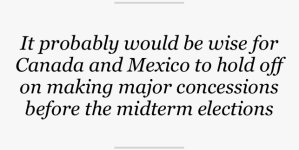
The timing will be key for both Trump and Ottawa. If U.S. inflation rises as a result of tariffs and the current war with Iran, affordability issues may be key to the U.S. midterm elections in November. In fact, many already predict that Republicans are facing a sound defeat, at least in the House. This could change the political dynamic, leaving Trump a lame duck with an antagonistic Congress that slows him down.

That is why Manak advises Ottawa to be patient when renegotiations begin this summer. The talks could go on well past November.