The Tarriff Hype.

Tecumsehsbones

Hall of Fame Member
Mar 18, 2013
61,249
9,974
113
Washington DC

Taxslave2

Senate Member
Aug 13, 2022
5,304
2,931
113
“Volatility and creating uncertainty are Trump’s primary modus operandi. That’s how he operates. He tries to get you off foot and says one thing one day, and then changes his position the next day.” FLIP

Following the two countries’ (China & Canada) agreement, Trump told reporters at the White House that “it’s OK. That’s what he should be doing.” FLOP

”However, on Saturday, Trump took to Truth Social to say that if Canada becomes a “drop-off port” for China to send goods into the U.S., “China will eat Canada alive, completely devour it, including the destruction of their businesses, social fabric and general way of life.” FLIP
View attachment 32957
Too late. China already owns many leftwing politicians in Canada.
 

Taxslave2

Senate Member
Aug 13, 2022
5,304
2,931
113
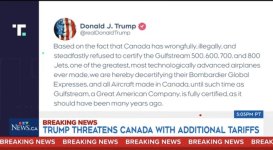
(YouTube & Trump threatens to decertify Canadian aircrafts despite receiving all regularity approvals)
Hmmm there are a lot of US registered trucks run through BC to Alaska. It would be just too bad if they didn't meet our new safety standards. And require a Pakistani speaking guide. Also, a lot of marine traffic through BC's inside passage. Will they meet the new Marine certification requirements? THe new $1billion non refundable environmental cleanup deposit per trip.
 

pgs

Hall of Fame Member
Nov 29, 2008
28,911
8,329
113
B.C.
Hmmm there are a lot of US registered trucks run through BC to Alaska. It would be just too bad if they didn't meet our new safety standards. And require a Pakistani speaking guide. Also, a lot of marine traffic through BC's inside passage. Will they meet the new Marine certification requirements? THe new $1billion non refundable environmental cleanup deposit per trip.
A Pakistani speaking guide , too funny .
 
  • Like
Reactions: Taxslave2

spaminator

Hall of Fame Member
Oct 26, 2009
39,809
3,740
113
Playing to Davos and domestic audience, Mark Carney recklessly provoked Donald Trump
Referring to the U.S. president as a hegemon is not a helpful tactic in dealing with a formidable political powerhouse who is notorious for striking out when triggered

Author of the article:Joe Oliver
Published Jan 31, 2026 • Last updated 1 day ago • 3 minute read

Mark Carney and Donald Trump
Prime Minister Mark Carney, left, and U.S. President Donald Trump during a world leaders' summit on ending the Gaza war on Oct. 13, 2025 in Sharm El-Sheikh, Egypt. Photo by Evan Vucci - Pool /Getty Images
Prime Minister Mark Carney recklessly provoked President Donald Trump, with the predictable result of a hyperbolic overreaction — a 100% tariff threatened on all goods and services exported to the United States — which, taken at face value, would have a devastating impact on Canada’s economy.


Although we should not accept his threats at face value (take him seriously, but not literally), it was irresponsible for Carney to have indulged his ego for domestic political purposes.


The U.S. itself has a trade relationship with China of about $650 billion, including $460 billion in imports, so Trump would be hard-pressed to say Canada cannot trade with China. Also, Trump’s initial reaction to Canada’s deal was to say it was a good thing.

Trade with China
Since Canada/U.S. trade totals about $910 billion, a 100% tariff would have a ruinous impact on Canada, push the country into a recession or even a depression, kill millions of jobs, cause the dollar to plummet, bolster inflation, exacerbate capital flight and compromise national security.

But the overarching constraint on Trump is that a prohibitive tariff would also significantly damage the U.S. economy, impact affordability, crush supply chains, raise unemployment and damage America’s reputation as a reliable trading partner.


CUSMA negotiations
It will not happen, but Canada’s bargaining position has been compromised going into the crucial CUSMA free trade negotiations later this year and a lower punishing tariff could be imposed instead.

Carney irresponsibly goaded the president with an ill-advised communications strategy. He exaggerated the significance of the trade deal with China, calling it a strategic partnership and saying that the “old relationship” with the U.S., based on deep economic and military integration, is “over.” He was indulging in political hyperbole. Although characterized as a “landmark” trade deal, it was, in fact a narrow exchange.

A much broader agreement with China, approaching a free trade agreement, would have compromised Canadian national security and sovereignty. After all, prior to the 2025 election, Carney called China Canada’s “biggest security threat.”

In the context of the China deal, Carney dubiously alleged that China is a more predictable partner than the U.S. That gratuitous insult was sure to irritate the Americans. U.S. Commerce Secretary Howard Lutnick dismissed it as “political noise.”

Carney must have been gratified that his speech at Davos during the World Economic Forum received a standing ovation from the elitists committed to a liberal rules-based international order. He was also playing to a domestic audience, over three-quarters of whom hold a negative opinion of Trump and feel empowered when politicians talk back to bullying.

Referring to Trump as a hegemon (without explicitly naming him) is not a helpful tactic in dealing with a formidable political powerhouse who is notorious for striking out when triggered. Carney’s comments about encouraging middle powers to coalesce against the more powerful, aside from being unrealistic, seemed designed to incite a trading partner, rather than persuade him to negotiate in good faith.


Rumours of snap election
There are rumours that Carney will call a snap election to get his coveted majority in Parliament. If that is the motivation for his communications strategy, it is a cynical ploy that jeopardizes the national interest at a moment of exceptional jeopardy. Furthermore, it could boomerang if trade talks are put in limbo and the Canadian economy is damaged even further from heightened uncertainty.

If Canadians believe that the competent financial manager they thought they elected is not delivering on his campaign promise to negotiate effectively with the U.S. president, his analytical approach, reassuring words and elbows-up-again posture will wear thin. Then they might conclude he is yet another Liberal emperor who has no clothes.

— Joe Oliver was the Minister of Natural Resources and Finance in the Harper government
 
  • Like
Reactions: Taxslave2

Ron in Regina

"Voice of the West" Party
Apr 9, 2008
31,255
11,357
113
Regina, Saskatchewan
Trump to remove 25% punitive tariff on India, US official says

India will buy oil from US and potentially Venezuela

Modi says India grateful for new 18% tariff rate

U.S. President Donald Trump on Monday said he had agreed on a trade deal with India that slashes U.S. tariffs on Indian goods to 18% from 50% in exchange for India lowering trade barriers, stopping its purchases of Russian oil and buying oil instead from the U.S. and potentially Venezuela (so US Adjacent).

"Out of friendship and respect for Prime Minister Modi and, as per his request, effective immediately, we agreed to a Trade Deal between the United States and India, whereby the United States will charge a reduced Reciprocal Tariff, lowering it from 25% to 18%," Trump said in a social media post following a call with Indian Prime Minister Narendra Modi.

A White House official told Reuters that the U.S. was rescinding a punitive, 25% duty on all imports from India over its purchases of Russian oil that had stacked on top of a 25% "reciprocal" tariff rate.
 

spaminator

Hall of Fame Member
Oct 26, 2009
39,809
3,740
113
Fake Canadian shops promote closing sale as items ship from China
AI used to create slick websites and curate social media presence while advertising steep discounts to scam customers

Author of the article:Spiro Papuckoski
Published Feb 01, 2026 • Last updated 1 day ago • 4 minute read

This photo was used on a purported Montreal clothing boutique when in fact it is an image created by artificial intelligence.
This photo was used on a purported Montreal clothing boutique when in fact it is an image created by artificial intelligence. Photo by Juliette & Lea Montreal
The advertisement displayed while scrolling through social media seemed innocuous at first glance.


The mother and daughter behind a chic Montreal boutique announce they are closing after running the business since 2008.


“With heavy hearts, Juliette & Lea Montreal is closing its doors,” the ad, displayed on Meta-owned Threads, reads.

“After years of passion and dedication, this marks the end of a beautiful chapter.”

An advertisement promoted on Threads announces a Montreal boutique’s closing sale offering deep discounts.
An advertisement promoted on Threads announces a Montreal boutique’s closing sale offering deep discounts. Photo by Screengrab /Threads
The ad contains photos of cozy women’s sweaters with an image of a black cat.

“To say thank you, our Closure sale is now live,” the ad continues. “These are the final pieces — once sold out, they will never return. This is your last chance to be part of our story.”

The link to the store’s website offers discounts of up to an astounding 80% off from their inventory of women’s coats, clothing, shoes, bags and accessories.

The site also lists testimonials from women in Toronto, Vancouver, Edmonton and Calgary who praise the boutique for its quality merchandise and great service.

Things seem fishy after the number of items in stock remain static after selecting different sizes and colours. In addition, the site offers free shipping on all orders from within the United Kingdom while product pages advertise free UPS shipping in Canada.


The storefront for fashion boutique Juliette & Lea Montreal, which doesn't exist.
The storefront for fashion boutique Juliette & Lea Montreal, which doesn’t exist. Photo by Juliette & Lea Montreal
In addition, nowhere does the website list a physical address despite an image of its storefront at the bottom of product pages. Only store hours and an email contact are provided as well as their payment and return policies. An internet search also doesn’t turn up a street address.

An email asking for the store’s location is answered with an automated message from Juliette & Lea’s help desk and a promise to respond within 24 hours. An answer several days later confirms there is no actual store.

“We do not have an upfront store, but you are welcome to check out our collection [online],” an email from Michelle in customer care reads.

However, comments from customers on the social media post explain what is really going on: the store doesn’t sell their products in Canada. In fact, all purchases ship from China.

“Same tops from another store claiming to be from Ottawa,” one person wrote in response. “I bought figuring they were in my city. Two weeks later they just started their trip from China.”


Another called it a scam after his wife made a purchase from the site and it shipped from China. It wasn’t what she ordered, the man said, adding the store didn’t respond to her attempts to contact them.


Carl Boutet, a Montreal retail strategist and faculty lecturer at McGill University, says the rise of artificial intelligence allows foreign fraudsters to quickly create professional websites with authentic brand stories and images that can easily fool the most seasoned online shopper, especially those who want to buy Canadian.

“That’s what scary about this,” Boutet said. “You basically have ChatGPT tell you what would be a good way to engage potential customers in Montreal, what kind of story tends to resonate the best, and so on. They can take a couple of minutes and have this up and running and look very legitimate on ecommerce platforms.”

Boutet, who has more than 25 years experience in the retail world, also advises executives on their commercial and digital strategies through his Montreal-based company Studio RX.


His message to consumers is to always take the extra steps to verify that the business is real.

“The closest thing you get to Juliette & Lea in Montreal is a daycare service,” he said, referring to Juliette, Lea et Cie. There is also a shop in the city selling sweets called Juliette & Chocolat.

“It’s interesting that they used names that sound semi-familiar,” he said.

These images are seen on a purported Montreal clothing boutique when in fact they were created by artificial intelligence.
These images are seen on a purported Montreal clothing boutique when in fact they were created by artificial intelligence. Photo by Juliette & Lea Montreal
On the store’s website, Juliette is described as a single mother who “transformed her passion into a boutique.” Her daughter Lea was eight years old when the shop opened and grew up with an “appreciation for craftmanship and style.”

The story continued with Lea graduating from the city’s LaSalle College in 2023. She has now set her fashion sights for Milan while her mother is ready to retire.

On the store’s Instagram account, there are fewer than 500 followers. The posts only date back to early December, including an image of the shop’s interior created by AI. Young women are seen modelling clothing while there are no images or videos of the shop’s actual owners.


An image of the purported fashion boutique shared to Instagram.
An image of the purported fashion boutique shared to Instagram. Photo by Juliette & Lea Montreal /Instagram
Boutet said shoppers should always take a few minutes to confirm a brand’s background before putting in credit card information to complete a purchase.

“Even more so if it’s a brand you don’t know,” he said. “And even if it’s a brand you do know. Pay a little extra attention to the website address that’s coming up.”

Boutet said he saw the same ad in late January offering discounts on handbags, but questioned its authenticity because he follows the retail industry closely and had never heard of the shop, especially being a Montreal resident.

He shared his findings on LinkedIn, calling it “a synthetic retail brand, generated using AI storytelling, reviews, imagery, even the emotional cues, designed to trigger trust.”

The best way for brands to show their authenticity is to grow organically and show a human face behind their products.

“It’s getting scary out there,” he said. “And it makes it tougher for legitimate businesses. I feel for the legitimate brands that are starting out, which you wouldn’t know them either because they are literally getting off the ground and you might be more doubtful.”

Boutet adds that there is a trend for upstarts to not be as technically savvy or polished.

“Most start with community where you have people around your brand that believe in what you are trying to do and want to support it and engage with those people, and then find more people that share those same values,” he said.

But in the age of AI, the aura of authenticity can easily scam consumers who are not too careful into making an impulse purchase.

1770129110356.pngJulietteAndLea-Threads-advertisement-Jan29[1].jpg1770129741337.png1770129211949.png
 

Attachments

  • 1770129410248.png
    1770129410248.png
    478 KB · Views: 0

Ron in Regina

"Voice of the West" Party
Apr 9, 2008
31,255
11,357
113
Regina, Saskatchewan
…at the White House where he announced a US$12-billion tariff relief fund for American farmers, who have been facing rising costs for agricultural inputs like seed and fertilizer amid Trump’s global trade war…& the irony would be that this $12-billion tariffs relief fund would come from the very pockets of these farmers and others that have had to pay Trumps tariffs.
The chair of the U.S. Senate's agriculture committee warned on Tuesday that farmers were suffering heavy losses, while more than two dozen former industry leaders sounded the alarm about the risk of a "widespread collapse of American agriculture" ahead of a $12 billion government bailout expected to reach growers this month…& why this month…being February?
“A lot of (fertilizer) does come in from Canada, and so we’ll end up putting very severe tariffs on that that Americans would have to pay, if we have to, because that’s the way you want to bolster here,” Trump said.
For three years, the costs of seed, fertilizer and other farm inputs rose, while plentiful grain supplies limited profits for farmers, economists said. Then, President Donald Trump returned to office last year, sparking trade disputes that disrupted U.S. crop exports and immigration crackdowns that increased labor costs and left some farms with crops rotting in fields.
Many U.S. farmers rely on Canadian potash fertilizer from Saskatchewan in order to add potassium to their soils. Over 90 per cent of Canadian fertilizer is exported, and the U.S. market accounts for well over half of that, according to Fertilizer Canada.
Many farmers are now bracing to potentially lose money for a fourth consecutive year. Tough credit conditions are forcing those with limited cash flows to make decisions about what acres to plant and how much fertilizer to buy, economists said.
America supplies about 1/50th of its own potash fertilizer needs…so yeah, I guess. U.S. President Donald Trump said Monday he may impose “very severe tariffs” on fertilizer from Canada “if we have to” (?) in order to bolster domestic production.
Now I’m assuming (I know, ass/u/ming) that the volume of potash imported from Russia to America of 11% in 2023 has decreased since that whole Ukraine invasion (I mean, I could be wrong here), and someone other that Belarus has been making up that shortfall? Rhymes with Zanada?
Farmers will begin receiving funds on February 28, according to Rollins. Meanwhile, applications for funds will open in the coming weeks so that farmers “will know exactly what that number looks like”.

Trump said the money for the scheme will come from tariff revenues.🤔
  • Regional Timing: Southern U.S. planting begins March–May, while central/northern regions start April–June.
  • Key Crops: Corn and soybeans are generally planted in the spring (April–June), while winter wheat is planted in the fall.
  • Factors: Planting begins as the ground thaws and after the danger of the last frost has passed.
  • Early Starts: Cold-hardy crops like spinach, radish, and peas can be sown directly in early spring, often in March.
 

petros

The Central Scrutinizer
Nov 21, 2008
119,623
14,735
113
Low Earth Orbit
The chair of the U.S. Senate's agriculture committee warned on Tuesday that farmers were suffering heavy losses, while more than two dozen former industry leaders sounded the alarm about the risk of a "widespread collapse of American agriculture" ahead of a $12 billion government bailout expected to reach growers this month…& why this month…being February?

For three years, the costs of seed, fertilizer and other farm inputs rose, while plentiful grain supplies limited profits for farmers, economists said. Then, President Donald Trump returned to office last year, sparking trade disputes that disrupted U.S. crop exports and immigration crackdowns that increased labor costs and left some farms with crops rotting in fields.

Many farmers are now bracing to potentially lose money for a fourth consecutive year. Tough credit conditions are forcing those with limited cash flows to make decisions about what acres to plant and how much fertilizer to buy, economists said.


Farmers will begin receiving funds on February 28, according to Rollins. Meanwhile, applications for funds will open in the coming weeks so that farmers “will know exactly what that number looks like”.

Trump said the money for the scheme will come from tariff revenues.🤔
  • Regional Timing: Southern U.S. planting begins March–May, while central/northern regions start April–June.
  • Key Crops: Corn and soybeans are generally planted in the spring (April–June), while winter wheat is planted in the fall.
  • Factors: Planting begins as the ground thaws and after the danger of the last frost has passed.
  • Early Starts: Cold-hardy crops like spinach, radish, and peas can be sown directly in early spring, often in March.
Corporate Farms
 

Ron in Regina

"Voice of the West" Party
Apr 9, 2008
31,255
11,357
113
Regina, Saskatchewan
The numbers are in and the message is clear: free trade is dead and it’s never looked healthier.
1770424609882.jpeg
It’s dead in that the United States, which led the creation of a Western-dominated trade regime after the Second World War and then spread it globally after the fall of Soviet communism, has decisively turned its back on trade in a quest to bring manufacturing jobs back home. After decades of rapid expansion, which lifted global economic growth rates and living standards and raised billions of people out of poverty, world trade growth has begun slowing.

Although its volume grew by some 7 per cent last year, most of that took place in the middle of the year as importers frontloaded shipments to get ahead of U.S. President Donald Trump’s tariffs. By the end of 2025, growth in goods trade was approaching zero.

It appears that Mr. Trump’s determination to remake the global trading order to the U.S.’s advantage is bearing fruit. Rather than fight his trade war, the U.S.’s trading partners, especially its closest allies, mostly responded to his tariffs by backing down and signing trade deals in which Washington got most of what it demanded. Cue a stream of triumphal tweets from the White House.

But peer closely at the data and you’ll see that beneath that shrill surface, a very different story is unfolding. Choosing not to retaliate was a sensible option, since the main victims would have been the consumers and businesses of the retaliating country – as is the case in the U.S., where recent studies have shown that American businesses and consumers are bearing almost the full expense of tariffs.

However, while most other countries played nice with Mr. Trump, they also began talking among themselves to diversify their markets. The result of this reorientation was becoming apparent by the middle of last year. As container traffic into and out of U.S. ports declined, elsewhere it surged, with exports from the Far East setting new records. Meanwhile imports into Africa, Europe and the Middle East have risen especially sharply.

John McCown, a trade specialist at the Center for Maritime Strategy who monitors global container traffic, reported that by year-end U.S. inbound traffic had dropped 6.4 per cent over the previous year. But in the rest of the world, trade remains resilient. It’s growing particularly strongly in developing countries, where governments are forming new trade pacts to secure the framework of the World Trade Organization (which Mr. Trump hates). As a result of these developments, in most of the world the U.S. has been declining as a principal trade partner.

Equally, just as most countries didn’t respond (something something elbows) to U.S. tariffs by launching trade wars of their own, they also chose not to “weaponize” their dollar holdings to punish the U.S. Nevertheless, here as well, organically, the world began slowly shifting out of U.S. assets, not by selling off what they had but by simply buying less of it, especially Treasury paper. And since U.S. debt is continually rising, that excess of supply over demand is now driving down bond prices, sending interest rates higher.

This helps to explain the decline in the exchange rate of the U.S. dollar and the rise in the price of gold. As their trade with the U.S. falls, other countries not only have fewer U.S. dollars from export sales, but they also need fewer U.S. dollars for import payments. Factor in the growing risk premium being attached to U.S. debt amid the Trump administration’s volatility, and fund managers around the world have been slowly diversifying their holdings away from their previous heavy reliance on U.S. assets.

Add it all up, and world economic growth will slow as the U.S. engine sputters and its contribution to trade declines. However, it won’t stop, and ultimately the U.S. economy will suffer the most harm.

(Although some manufacturing may relocate to get behind tariff barriers, its higher costs will make U.S. companies less globally competitive. As a result, American consumers will pay higher prices)

Meanwhile trade volatility may increase as a uniform currency regime based on the dollar gives way to a multiplicity of payment systems. But so far, countries are showing a willingness to work together to improvise solutions. For instance, some analysts detect indications that the Chinese leadership is showing increased sensitivity to the strains put on its trade relations by a weak yuan, and is slowly allowing it to rise in value. At the same time, talk about creating a digital euro that could substitute for the dollar in international payments seems to be finally gaining traction.

In short, as the U.S. is saying no to the global trade regime, the rest of the world is working to shore it up. Therefore, Canada isn’t setting off alone into an unfriendly world. It’s joining (with Liberal two steps forward and one step back baby steps) an exodus from a land that wants to go it alone.
 

Ron in Regina

"Voice of the West" Party
Apr 9, 2008
31,255
11,357
113
Regina, Saskatchewan
Although its volume grew by some 7 per cent last year, most of that took place in the middle of the year as importers frontloaded shipments to get ahead of U.S. President Donald Trump’s tariffs. By the end of 2025, growth in goods trade was approaching zero.
In five speeches on the economy since December, Trump asserted that inflation had been beaten or was way down almost 20 times and said prices were falling almost 30 times, assertions at odds with economic data and voters' daily experiences. Much of the remaining time was spent on grievances and other issues, including immigration, whether Somalia was a country, and attacks on opponents.
But peer closely at the data and you’ll see that beneath that shrill surface, a very different story is unfolding. Choosing not to retaliate was a sensible option, since the main victims would have been the consumers and businesses of the retaliating country – as is the case in the U.S., where recent studies have shown that American businesses and consumers are bearing almost the full expense of tariffs.
Taken together, the speeches portray a president struggling to reconcile his central claim — that he has fixed the cost-of-living crisis — with inflation near 3% over the past year and voters’ lived experience of paying more for grocery staples. The price of ground beef, for example, is up 18% since Trump took office a year ago, while ground coffee prices are up 29%.
Nevertheless, here as well, organically, the world began slowly shifting out of U.S. assets, not by selling off what they had but by simply buying less of it, especially Treasury paper. And since U.S. debt is continually rising, that excess of supply over demand is now driving down bond prices, sending interest rates higher.
Trump has repeatedly stressed that much work remains to clean up the economic mess he says his Democratic predecessor, Joe Biden, left him, Desai added. The Reuters analysis found that Trump - when not declaring inflation beaten - devoted nearly half his speaking time to grievances and other issues.
As their trade with the U.S. falls, other countries not only have fewer U.S. dollars from export sales, but they also need fewer U.S. dollars for import payments. Factor in the growing risk premium being attached to U.S. debt amid the Trump administration’s volatility, and fund managers around the world have been slowly diversifying their holdings away from their previous heavy reliance on U.S. assets.
In about five hours of speaking time, he spent roughly two hours straying into about 20 topics unrelated to prices, the Reuters review found. When he veered off message, his top issue was illegal immigration, which he spent a total of about 30 to 40 minutes talking about.
Add it all up, and world economic growth will slow as the U.S. engine sputters and its contribution to trade declines. However, it won’t stop, and ultimately the U.S. economy will suffer the most harm.

(Although some manufacturing may relocate to get behind tariff barriers, its higher costs will make U.S. companies less globally competitive. As a result, American consumers will pay higher prices)
"Inflation is stopped. Incomes are up. Prices are down," Trump said in an Iowa speech on January 27.

Only twice in the five speeches did Trump acknowledge that prices are still too high, but he blamed them on Biden. Trump was elected in 2024 because of voter unhappiness with Biden's handling of inflation - which spiked to over 9% in 2022 - and illegal immigration.

Democrats caused prices "to be too high," Trump told a rally in Pennsylvania on December 9. "But now they're coming down."

In the same speech he called the term "affordability" a Democratic "hoax". After a public backlash, he has ceased saying that in more recent speeches. In four of the speeches Trump repeatedly and haphazardly switches topics, often when he is in the middle of talking about the economy, the Reuters review found.

Doug Heye, a Republican strategist, said voters want to hear what Trump is doing to lower costs. "But they have no memory of what Trump says about economic issues because of the volume of his own rhetoric."

One source familiar with the White House's thinking said Trump was likely to use his State of the Union address on February 24 as the kickoff for more intense domestic travel to amplify his message on affordability.
Some 35% of Americans approve of Trump's overall handling of the economy, according to a January 25 Reuters/Ipsos poll, up slightly from 33% in December. But it is well below his initial 42% rating on the issue when he first took office a year ago.