


Do what's best for YOUR country, whoever you are.It doesn't affect the U.S. as much as other countries so I say, stay out of it & let others do the work or suffer the consequences. It's about time anyway.
Do what's best for YOUR country, whoever you are.It doesn't affect the U.S. as much as other countries so I say, stay out of it & let others do the work or suffer the consequences. It's about time anyway.

Cuba Free?Cuban President Miguel Díaz-Canel insisted that he’s not “stepping down” in an interview with NBC News’ “Meet the Press” moderator Kristen Welker in Havana on Thursday.
Díaz-Canel bristled when Welker asked if he would be “willing to step down to save your country” during his first interview with a U.S. broadcast network.
“In Cuba, the people who are in leadership positions are not elected by the U.S. government, and they don’t have a mandate from the U.S. government. We have a free sovereign state, a free state. We have self-determination and independence, and we are not subjected to the designs of the United States,” Díaz-Canel said.
The Cuban president’s response comes as the Trump administration has been ratcheting up pressure on the communist country and calling for a change in its government, with President Donald Trump calling Cuba a “failing nation” and saying last month, it may be “a friendly takeover, it may not be a friendly takeover.”
Díaz-Canel took issue with being asked if he would step down, asking, “Do you ask that question to Trump?” and whether the question was “coming from the State Department of the U.S.”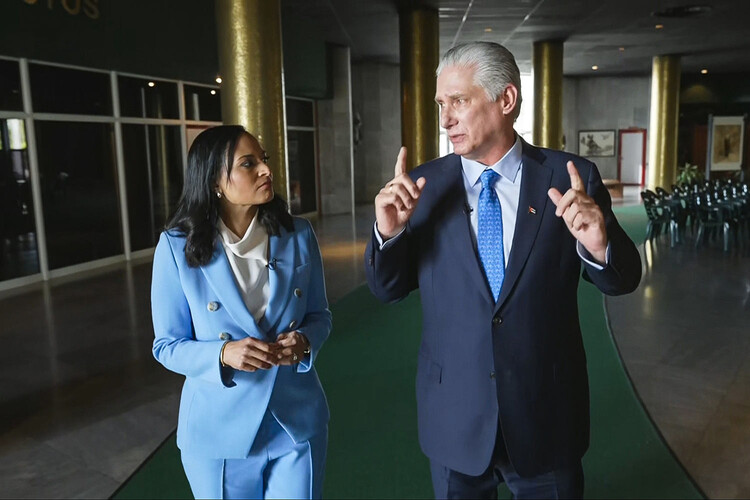
Cuba's president says he's 'not stepping down' under U.S. pressure — NBC News
In his first interview with a U.S. broadcast network, Miguel Díaz-Canel told "Meet the Press" moderator Kristen Welker that in Cuba, leaders aren't "elected" by the U.S.apple.news

Would Cuba be “more” free (?) if Trump takes it over (for America) and dictates its policies from DC?Cuba Free?

Cuba Free?
Define "free".Would Cuba be “more” free (?) if Trump takes it over (for America) and dictates its policies from DC?
Unconstrained? Independent? Autonomous?Define "free".

Most thinking people would .Unconstrained? Independent? Autonomous?
Many Cubans seek a future that is neither the current repressive government nor a return to pre-1959 levels of American influence, favouring instead a functional, sovereign, and free nation…of their own.
I’m Cuban American. For the sake of both countries, Trump’s siege must end | Danny Valdes
Marco Rubio, the secretary of state, crushes our people and calls it freedom. We want engagement, not escalationwww.theguardian.com
(YouTube & What would American intervention in Cuba look like?)
And medical tourism.Cuba'd probably be best off building another batch of glitzy tourist hotels, bringing back the hookers and gambling, and focussing law enforcement on keeping people safe instead of policing their morals.
Many Cubans seek a future that is neither the current repressive government nor a return to pre-1959 levels of American influence, favouring instead a functional, sovereign, and free nation…of their own.
Cuba'd probably be best off building another batch of glitzy tourist hotels, bringing back the hookers and gambling, and focussing law enforcement on keeping people safe instead of policing their morals.
Will Trump allow this (any of this) though? Marco Rubio’s parents did flee Cuba in early 1956 (during the regime of Fulgencio Batista), so roughly two and a half years before Fidel Castro took power in 1959, so that communist regime needs to be toppled, etc…And medical tourism.
 )
)

So do you expect the Americans to install another strong man ?Will Trump allow this (any of this) though? Marco Rubio’s parents did flee Cuba in early 1956 (during the regime of Fulgencio Batista), so roughly two and a half years before Fidel Castro took power in 1959, so that communist regime needs to be toppled, etc…
(The Batista regime (1952–1959) was a corrupt, authoritarian dictatorship in Cuba led by Fulgencio Batista, who seized power via a military coup. Characterized by high inequality, close ties to the American Mafia, and reliance on brutal repression by secret police, the regime was overthrown by Fidel Castro's revolution in 1959
As a high-ranking U.S. official, Rubio has positioned himself as a leading voice advocating for regime change in Cuba, believing that the economic system in Cuba cannot improve without the complete removal of the current leadership. The last time the United States did this, they played a critical role in supporting and facilitating the rise of Fulgencio Batista in Cuba, particularly in the 1930s…the guy in power when Marco’s parents fled the island nation.
While not directly staging his coups, the U.S. government, through diplomats and aid, helped solidify his power to ensure a stable, anti-communist, and pro-American leadership.
Back in power and receiving financial, military and logistical support from the United States government, Batista suspended the 1940 Constitution and revoked most political liberties, including the right to strike. He then aligned with the wealthiest landowners who owned the largest sugar plantations, and presided over a stagnating economy that widened the gap between rich and poor Cubans.
Eventually, it reached the point where most of the sugar industry was in U.S. hands, and foreigners owned 70% of the arable land. Batista's repressive government then began to systematically profit from the exploitation of Cuba's commercial interests, by negotiating lucrative relationships both with the American Mafia, who controlled the drug, gambling, and prostitution businesses in Havana, and with large U.S.-based multinational companies who were awarded lucrative contracts.
To quell the growing discontent amongst the populace—which was subsequently displayed through frequent student riots and demonstrations—Batista established tighter censorship of the media, while also utilizing his Bureau for the Repression of Communist Activities secret police to carry out wide-scale violence, torture and public executions.
While exact numbers are unclear, estimates of the death toll attributed to Batista range from hundreds to up to 20,000 victims. Batista's efforts to quell the unrest proved not only ineffective, but his tactics were the catalyst to even wider resistance against his regime.
Thus enters Fidel Castro and Che Guevara, founders of the 26th of July Movement, began a revolution that saw a combination of peaceful protests and guerrilla warfare in both rural and urban areas of Cuba between 1956 and 1958. After almost two years of fighting, rebel forces led by Guevara defeated Batista's forces at the Battle of Santa Clara on New Year's Eve, 1958, effectively collapsing the regime.
Fulgencio Batista - Wikipedia
en.wikipedia.org
Who do you think they’re going to install, assuming they install someone soon & not in another 3/4’s of a century? Someone cuddly that’ll get eaten alive? Someone with Cuban best interests at heart? Someone who’s strong against the Cubans, but soft towards American (specific Americans anyway) interests?So do you expect the Americans to install another strong man ?
AOCWho do you think they’re going to install, assuming they install someone soon & not in another 3/4’s of a century? Someone cuddly that’ll get eaten alive? Someone with Cuban best interests at heart? Someone who’s strong against the Cubans, but soft towards American (specific Americans anyway) interests?
I think if they do anything , it will be to set up some kind of elections and allow the Cuban people to control their destiny . But what do I know .Who do you think they’re going to install, assuming they install someone soon & not in another 3/4’s of a century? Someone cuddly that’ll get eaten alive? Someone with Cuban best interests at heart? Someone who’s strong against the Cubans, but soft towards American (specific Americans anyway) interests?
Like what was done in Venezuela?I think if they do anything , it will be to set up some kind of elections and allow the Cuban people to control their destiny . But what do I know .
Maybe , they left the infrastructure intact .Like what was done in Venezuela?
And the regime.Maybe , they left the infrastructure intact .
Bingo. Of all the illusions vast numbers of Americans hold (and there are many), the one they most cling to is that in every country with a Dear Leader we don't like, there's a homegrown Thomas Jefferson who will emerge just as soon as we knock off the big dawg, and lead his country to peace, justice, and applying for statehood.And the regime.
Cool Puerto Rico , Panama , Haiti , Columbia and all the other broke countries to help create Pax Americana . Hail Trump .Bingo. Of all the illusions vast numbers of Americans hold (and there are many), the one they most cling to is that in every country with a Dear Leader we don't like, there's a homegrown Thomas Jefferson who will emerge just as soon as we knock off the big dawg, and lead his country to peace, justice, and applying for statehood.

