


Stunning images of sun's surface hailed as 'major step forward' for science
National Solar Observatory captures images of 'solar landscape unlike any that had been seen before'
Author of the article:Jane Stevenson
Published Aug 06, 2026 • 2 minute read
The sun's surface
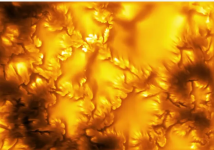
The most detailed images of the sun's surface yet were taken by the National Science Foundation's Daniel K. Inouye Solar Telescope Photo by NSF/NSO/AURA/MPS
“A solar landscape unlike any that had been seen before.”
That was how the U.S. National Science Foundation’s National Solar Observatory described the most detailed images taken of the sun’s surface.
The images of the sun’s surface or photosphere were captured by the Daniel K. Inouye Solar Telescope — the world’s most powerful solar telescope — on the island of Maui in Hawaii.
The findings were published Wednesday in the journal Nature.
When scientists saw the results of the telescope’s capabilities, they realized they’d snapped photos of the sun’s bright outer shell at higher resolution than ever before with tiny swirling patterns like small whirlpools showing up in the images.
The U.S National
The U.S. National Science Foundation Daniel K. Inouye Solar Telescope, built and managed by the NSF National Solar Observatory, in Maui (NSF-NSO-AURA) Photo by NSF/NSO/AURA
Solar landscape unlike anything else
The images “reveal a solar landscape unlike any that had been seen before, uncovering small-scale and dynamic swirls everywhere at the edges of magnetic areas,” the NSF’s National Solar Observatory said in an Wednesday news release.
The ripples on the sun’s surface are caused by a well-known phenomenon called the Kelvin-Helmholtz instability (KHI).
“An effect caused by fluid motion, KHI occurs when two fluids slide past each other at different velocities creating a ‘shear’ at the interface — causing small disturbances to grow into striking wave-like or spiraling vortices that look like breaking ocean waves, “ said the news release.
”Since its original formulation by Lord Kelvin and Hermann von Helmholtz around 1870, KHI has been observed and investigated across many areas of physics, including fluid dynamics, meteorology, oceanography, heliosphysics, and astrophysics. The instability is observed at a variety of scales from small lake and ocean waves (in windy conditions) and cloud formations on Earth, to the atmospheres of gas giants like Jupiter and Saturn.”
‘Major step forward’ for solar science
Dr. David Boboltz, deputy director at the National Solar Observatory, said the discovery, “backed up by analysis of numerical simulations, is a major step forward in our understanding of the dynamics and evolution of solar and stellar plasma and will serve as a basis for future discoveries.”
Researchers suggest that KHI might be a key reason why the Sun’s outer atmosphere gets so hot and why magnetic energy builds up and fuels solar flares and eruptions that can send bursts of energy toward Earth, affecting satellites, power grids and other technology.
“We believe that the discovery of Kelvin-Helmholtz instability in the solar photosphere, backed up by analysis of numerical simulations, is a major step forward in our understanding of the dynamics and evolution of solar and stellar plasma and will serve as a basis for future discoveries,” said Boboltz in a statement.
The next phase of analysis includes using computer programs that can automatically spot and study these swirling patterns aided by the high resolution data from the Inouye Solar Telescope.

 torontosun.com
National Solar Observatory captures images of 'solar landscape unlike any that had been seen before'
Author of the article:Jane Stevenson
Published Aug 06, 2026 • 2 minute read
The sun's surface
The most detailed images of the sun's surface yet were taken by the National Science Foundation's Daniel K. Inouye Solar Telescope Photo by NSF/NSO/AURA/MPS
“A solar landscape unlike any that had been seen before.”
That was how the U.S. National Science Foundation’s National Solar Observatory described the most detailed images taken of the sun’s surface.
The images of the sun’s surface or photosphere were captured by the Daniel K. Inouye Solar Telescope — the world’s most powerful solar telescope — on the island of Maui in Hawaii.
The findings were published Wednesday in the journal Nature.
When scientists saw the results of the telescope’s capabilities, they realized they’d snapped photos of the sun’s bright outer shell at higher resolution than ever before with tiny swirling patterns like small whirlpools showing up in the images.
The U.S National
The U.S. National Science Foundation Daniel K. Inouye Solar Telescope, built and managed by the NSF National Solar Observatory, in Maui (NSF-NSO-AURA) Photo by NSF/NSO/AURA
Solar landscape unlike anything else
The images “reveal a solar landscape unlike any that had been seen before, uncovering small-scale and dynamic swirls everywhere at the edges of magnetic areas,” the NSF’s National Solar Observatory said in an Wednesday news release.
The ripples on the sun’s surface are caused by a well-known phenomenon called the Kelvin-Helmholtz instability (KHI).
“An effect caused by fluid motion, KHI occurs when two fluids slide past each other at different velocities creating a ‘shear’ at the interface — causing small disturbances to grow into striking wave-like or spiraling vortices that look like breaking ocean waves, “ said the news release.
”Since its original formulation by Lord Kelvin and Hermann von Helmholtz around 1870, KHI has been observed and investigated across many areas of physics, including fluid dynamics, meteorology, oceanography, heliosphysics, and astrophysics. The instability is observed at a variety of scales from small lake and ocean waves (in windy conditions) and cloud formations on Earth, to the atmospheres of gas giants like Jupiter and Saturn.”
‘Major step forward’ for solar science
Dr. David Boboltz, deputy director at the National Solar Observatory, said the discovery, “backed up by analysis of numerical simulations, is a major step forward in our understanding of the dynamics and evolution of solar and stellar plasma and will serve as a basis for future discoveries.”
Researchers suggest that KHI might be a key reason why the Sun’s outer atmosphere gets so hot and why magnetic energy builds up and fuels solar flares and eruptions that can send bursts of energy toward Earth, affecting satellites, power grids and other technology.
“We believe that the discovery of Kelvin-Helmholtz instability in the solar photosphere, backed up by analysis of numerical simulations, is a major step forward in our understanding of the dynamics and evolution of solar and stellar plasma and will serve as a basis for future discoveries,” said Boboltz in a statement.
The next phase of analysis includes using computer programs that can automatically spot and study these swirling patterns aided by the high resolution data from the Inouye Solar Telescope.
Stunning images of sun's surface hailed as 'major step forward' for science
The US National Science Foundation’s National Solar Observatory has captured the most detailed images taken of the sun's surface. Read more.


![a927f31a865e6cb02b9772bb23b9c9a6a94dc4a8-e1787245079412[1].jpg](https://forums.canadiancontent.net/data/attachments/33/33681-9305f2022a0f59672a155aac94e22e2e.jpg "a927f31a865e6cb02b9772bb23b9c9a6a94dc4a8-e1787245079412[1].jpg")

