Science & Environment

spaminator

Hall of Fame Member
Oct 26, 2009
40,741
4,064
113
Oldest human brain cells grown in lab 'recorded passage of time'
They discovered that the brain organoids continued to change and mature over the years, despite never having been inside an embryo, let alone a body.

Author of the article:AFP
AFP
Daniel Lawler
Published Aug 19, 2026 • 2 minute read
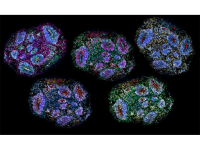
Close-up images of different human brain organoids that Harvard researchers grew in a lab for a record seven years.
Close-up images of different human brain organoids that Harvard researchers grew in a lab for a record seven years. Photo by Noelia ANTON-BOLANOS, Irene FARAVELLI /Springer Nature/AFP

Paris (France) (AFP) — Peppercorn-sized clumps of human brain cells grown in a lab for a record seven years aged similarly to those inside our heads, suggesting they “recorded the passage of time,” scientists said Wednesday.


These tiny clumps called organoids are grown from stem cells by scientists around the world in the hopes of uncovering the mysteries of our brain — and to test new medicine without having to use animals such as mice.

Normally these organoids live for a few months, meaning they can only offer a window into the earliest stages of human brains, which take nearly 20 years to fully develop.

So a US-led team of researchers grew some for around seven years, making them the “oldest ever”, Paola Arlotta, the senior author of a new study describing the experiment, told AFP.

They discovered that the brain organoids continued to change and mature over the years, despite never having been inside an embryo, let alone a body.

“The brain can continue to develop outside the context of a person for this unprecedented amount of time,” explained Arlotta, a Harvard University professor.


The scientists hope this will help shed light on how a range of disorders such as autism and schizophrenia first emerge and then progress later in life.

The study, published in the journal Nature, said the organoids “recorded the passage of time and retain a memory of the developmental steps already performed”.

Scientists hope brain organoids can reveal information about our mysterious brains — and help test new drugs. (HO/Muotri Lab/AFP/File)
This does not mean organoids have memories like we tend to think of them — such as recalling something from childhood — but simply that their past is “engraved” on a cellular level, Arlotta emphasized.

Organoids are “biological models” or “avatars” for human brain cells that are far less complex and do not receive sensory input, she added.

Scientists widely agree that organoids are not capable of consciousness or other higher-order brain functions.

– Experiment ‘warped time’ –
The researchers analyzed their ageing organoids with three different kinds of recently developed genetic “clocks” that can roughly determine the biological age of cells.


They all showed that the organoids changed over time in similar ways to normal brain cells.

To further confirm their theory, the scientists carried out what Arlotta described as a “crazy experiment”.

They mixed cells that had been developing for a year together with others that were only two weeks old, creating a “chimera”.

The young cells behaved as normal.

But the older cells “jumped ahead a whole chunk of development” and started making neurons that normally take around four months, Arlotta said.

This effectively “warped time” for brain development, which was “super cool”, she added.

In the future, it could be possible to use this technique to rapidly speed up the development of certain brain cells, Arlotta speculated.

The previous record for the oldest grown brain organoids was a little under two years, according to the study.

Unlike the brains inside our heads, these organoids do not have a body that can get sick and die.

So could brain organoids grown and maintained in a lab hypothetically outlive humans?

“Nobody really knows,” Arlotta said, adding she suspected organoids could hypothetically last a little longer.

That will not be the case for the brain organoids used for the new research, which were recently destroyed.

1787216723187.png1787216824182.png
 
  • Like
Reactions: Ron in Regina

spaminator

Hall of Fame Member
Oct 26, 2009
40,741
4,064
113
24 Canadians among hundreds of foreigners missing in Nepal, Tibet flash floods
A total of 403 people unaccounted for, says a Nepal Tourism Board official

Author of the article:Ling Hui
Published Aug 26, 2026 • Last updated 9 hours ago • 1 minute read
Rescuers carry in their arms a flood survivor, following flash floods and a landslide disaster in Devghat, in the Nepal's Nuwakot district on Aug. 26, 2026.
Rescuers carry in their arms a flood survivor, following flash floods and a landslide disaster in Devghat, in the Nepal's Nuwakot district on Aug. 26, 2026. Photo by PRAKASH MATHEMA /AFP via Getty Images

Twenty-four Canadians are among the hundreds of international tourists reported missing in the deadly flash floods that hit the Nepal-Tibet border on Wednesday, a Nepalese tourism board official told The Associated Press.


The catastrophic flooding happened at around 8:30 a.m. local time in the Bhote Koshi River in the Himalayan border region between Nepal and China’s Tibet.

Nepal Tourism Board’s officiating director Sunil Sharma told The Associated Press that 403 people were reported missing, including 341 foreign nationals, with 24 from Canada.

Also among the missing were 133 from India, 62 from Nepal, 47 from the U.S., 34 from Australia, and 33 from Britain.

Sharma said the flooding happened as hundreds of Indian tourists were on pilgrimage to Mount Kailash in Tibet, a sacred Hindu site, while Nepali citizens were also making their way to the Gosaikunda Lake area in the Rasuwa district to celebrate the festival of Janai Purnima on Friday.


Carney, Anand respond to floods
In a statement issued Wednesday afternoon, Prime Minister Mark Carney called the floods in Nepal “absolutely devastating,” adding, “Canadians are thinking of all those in distress right now, those who have lost a loved one, and all those who are still waiting for answers.”

Carney urged Canadians in the region to register with the Registration of Canadians Abroad system as soon as possible.

“As rescue efforts continue, Canada stands ready to provide support,” he added.


Foreign Affairs Minister Anita Anand also echoed the prime minister’s sentiments, adding that “Global Affairs consular officials are in contact with local authorities and ready to assist Canadians in the region.”


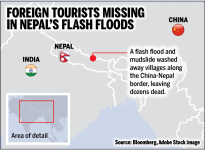
At least 100 people have been killed in the floods, with Reuters reporting that officials suspect an earthquake struck the border region, triggering the collapse of the lower part of a glacier on the Lhende Khola river along the Nepal-Tibet border, which is a tributary of the Bhote Koshi River, causing the floods.

Foreign tourists missing in Nepal's flash floods. TORONTO SUN GRAPHIC
Foreign tourists missing in Nepal’s flash floods. TORONTO SUN GRAPHIC
1787823566325.png
 

spaminator

Hall of Fame Member
Oct 26, 2009
40,741
4,064
113
Nepal flood death toll rises to 547: Police
More than 1,400 people are missing, including hundreds of foreigners.

Author of the article:AFP
AFP
Published Aug 28, 2026 • Last updated 1 day ago • 1 minute read

This screen grab picture from UGC handout video courtesy Nepal's Prime Minister Secretariat taken and released on August 28, 2026 shows the Nepali Army rescuing people trapped inside a tunnel at a hydropower project following a flash flood in Nepal's Rasuwa district. Nepal ordered rescuers searching for survivors of deadly floods to get to safety as it reported a debris dam had burst in Tibet on August 28, bringing risks of new torrents. More than 1,400 people are missing, including trekkers in the Himalayas and scores of Hindu pilgrims to Tibet's sacred snow-capped Mount Kailash. Photo by - /Prime Minister Secretariat, Nepa

Kathmandu, Nepal, Aug 28, 2026 (AFP) — Devastating floods on the Nepal-Tibet border region this week have killed at least 547 people, Nepal’s police said Friday.


Chinese state media earlier confirmed five dead following Wednesday’s disaster, taking the total killed to at least 552.

More than 1,400 people are missing, including hundreds of foreigners.

The US Geological Survey said the disaster — the deadliest for Nepal since a 2015 earthquake — was caused by a glacial collapse that triggered a vast flow of icy debris.

In addition, Indian authorities recovered seven bodies from rivers flowing from Nepal, believed to be victims of the devastating floods, officials said Friday.

Authorities are working to identify the bodies, and the seven bodies in India are not included in the overall toll.
 

spaminator

Hall of Fame Member
Oct 26, 2009
40,741
4,064
113
Nepal recovers bodies but presses on for trapped tunnel workers
Rescuers pulled three dead bodies out of two tunnels, finding routes smothered in mud.

Author of the article:AFP
AFP
Published Aug 31, 2026 • 2 minute read
083126-d20048a79beb456db0b81fc139da308f5d3c1753
Nepal's government says more than 100 workers may still be trapped alive inside multiple tunnels after devastating floods. Photo by Arun SANKAR /AFP
Kathmandu (Nepal) (AFP) — Nepali rescuers raced on Monday in a bid to free dozens of hydropower workers believed trapped in tunnels after devastating floods as search efforts entered a sixth day, officials said.


Rescuers pulled three dead bodies out of two tunnels, finding routes smothered in mud. No contact has yet been made with any of those feared trapped, but the government says more than 100 workers may still be alive inside multiple tunnels.


They are among 933 hydropower workers missing since a wall of mud and debris swept down on Wednesday morning, according to the National Disaster Risk Reduction and Management Authority.

At the Upper Trishuli 3A site, rescuers broke through into the upper part of a mud-swamped tunnel, pumping air inside, then using drilling and excavator machines to dig down.

“When members of the team descended using ropes and called out to those inside, there was no response,” Prime Minister Balendra Shah said in an update on Sunday night.

The Nepal Army said on Monday morning that work continues to “clear water, mud, and sediment from inside the tunnel.”

Specialized Indian, Chinese and South Korean tunnel-rescue teams are also helping.


At another site, Upper Trishuli-1, a Chinese team “entered approximately 300 metres (984 feet) into the tunnel and conducted a search, recovering one body”, the Nepali Army said.


At the Chilime Hydro tunnel, where Indian teams are deployed, rescuers entered 100 metres inside, but then said it was blocked.

“Farther inside, was buried with mud and soil,” the statement added. “During the operation, two bodies were recovered.”

Nepali expert mountain rescue teams — who regularly aid climbers on the world’s highest peaks, including Everest — are also taking part.

Rescue efforts continue to aid the tens of thousands impacted by the devastating floods, with roads smashed and bridges destroyed.

“We are continuing to work for search, rescue and relief operations,” Netra Bahadur Karki, Armed Police Force spokesman, told AFP.

“Rescue teams have now reached most areas, by road or by helicopters. Our priority remains rescue and safety of the people.”

The Nepal Electricity Authority said 11 hydropower stations and one solar power station, with a combined capacity of 431.1 megawatts, had stopped operating, about 10 percent of the country’s installed electricity generation capacity.

Another 15 power projects under construction, with a planned capacity of 470 megawatts, were damaged.
 

spaminator

Hall of Fame Member
Oct 26, 2009
40,741
4,064
113
Five abdominal pain symptoms that mean you should go to the ER right now
Here are a few warning signs - some surprising - that your abdominal pain may need urgent attention.

Author of the article:Washington Post
Washington Post
Trisha Pasricha, MD
Published Sep 02, 2026 • Last updated 20 hours ago • 5 minute read
Upset male squeezing belly with hand because of abdominal pain. Unhappy young man sit on grey couch at home, suddenly feeling strong stomach ache, gastritis problem. Guy suffering from stomach ache
Photo by Yura Yarema /Adobe Stock

Every now and then, I feel sick to my stomach but I’m not sure how sick is enough to go to the ER. What should I do?


Many patients call their physician’s offices overnight to get a gut check on a worrisome symptom, and they leave with the same answer: When in doubt, just go to the emergency room.

It’s rarely the answer someone wants. If they’re calling instead of already driving over, it’s often because they’re hoping to hear reassurance that they don’t need to go to the hospital at 2 a.m. Believe me, as a physician and as a patient, I’ve been on both sides of that conversation.

The problem is it can be impossible to tell someone definitively that “they’re fine” without actually checking their vitals, performing a physical exam and potentially running some tests. Most people recognize that when their pain is a 10 out 10 – or when they see their toilet bowl filling up with bright red blood – they need help.

But over years of taking patient calls overnight, I’ve heard many symptoms that immediately raise red flags – even when they don’t seem alarming to someone without medical training.


While not meant as individualized medical advice, here are a few warning signs – some surprising – that your abdominal pain may need urgent attention.

If your belly pain feels worse when you cough, jump – or if you’re in a car and you roll over a bump – then that may signal an emergency condition called peritonitis.

Peritonitis refers to inflammation of the lining of your abdominal cavity – the space beneath your chest cavity where abdominal organs hang out together. That space becomes inflamed if something bursts open – a perforated bowel, appendix or cyst.

To help make the diagnosis, a physician may order imaging studies or check for “rebound tenderness” – pain that’s worse, not when they press down on your abdomen, but when they release pressure. If a doctor confirms you have peritonitis, it could mean you’ll need a surgery. So don’t wait to get evaluated if this sounds like you.

This is no laughing matter. If you’re experiencing abdominal pain and haven’t been having bowel movements or passing flatus, it could be a sign of a bowel obstruction. That’s an emergency.


Depending on the obstruction’s location, you may also experience severe vomiting and feel like you can’t keep any food or liquid down – which alone is an important reason to go to the ER. In some cases of bowel obstruction, people may find their vomit is a darker-green color. This suggests bile – which normally empties into the small bowel – is actually working its way backward and upward.

Abdominal pain, especially on the right side of your body, accompanied by fever is already a problem – it could be a sign of appendicitis or other intestinal infection. But you should also watch out for this symptom: yellowing of the skin, which medical professionals call jaundice, or yellowing of the whites of the eyes. These could mean you have an infection of the bile ducts.

Bile duct infections, sometimes caused by a blockage, are emergencies we must act on fast. These infections have a high risk of developing into full-blown sepsis, where the bacteria enter the bloodstream. You may need a special procedure to clear and drain the bile ducts as well as intravenous antibiotics.


When we think of blood, we picture shiny and red – but that’s not always the case. Black stool can also be a sign of blood.

When blood mixes with our stomach acid, it can turn black and tarry. And no, really, really dark brown stool isn’t it. I usually ask my patients if it was black like the color of their smartphone screens (and if you’re throwing up, that mixture of acid and blood can look like coffee grounds). If that describes what you’re seeing, you may need an emergency procedure called an esophagogastroduodenoscopy, or EGD, to find and treat the source of the bleeding.

However, odd-colored poop in the absence of other symptoms isn’t always a medical emergency. Taking iron pills or medications like Pepto-Bismol can cause black stools, and artificial dyes and foods like beets can also cause unusual colors that are nothing to be concerned about.

Any time you have abdominal pain and dizziness, it’s an emergency until proved otherwise. That’s because it could be a sign of internal bleeding leading to low blood pressure.


Sometimes, the cause is painful, such as a peptic ulcer. Sometimes it isn’t. For instance, diverticular bleeding famously produces painless bright red blood – and a lot of it – into the toilet bowel. This happens when a vessel in a small pocket of the colon, called a diverticula, bursts.

One dangerous exception that won’t show up in the toilet is a ruptured abdominal aortic aneurysm. This is a life-threatening emergency where the main artery of your body’s blood supply bursts inside the abdominal cavity. People often feel sudden severe pain in their belly, backs and even legs that can quickly lead to shock if enough blood is lost.

The average person survives a ruptured abdominal aortic aneurysm less than 50 percent of the time, even with immediate surgery. (They are uncommon in young people but the risk rises with age; about 1.4 percent of people ages 50 to 84 have one.)

What most of my patients don’t know is that we’re supposed to screen for abdominal aortic aneurysms in all men ages 65 to 75 who have ever smoked cigarettes (at least 100 over the course of their lifetime). While some people who have them may notice a pulsating mass in their abdomen, these aneurysms are often totally asymptomatic for years – until they burst. That’s why anyone who suddenly feels dizzy and feels pain in their belly – even without seeing blood in the toilet – should get help, fast.


Screening involves a one-time quick outpatient ultrasound to see if you have an aneurysm, and depending on its size and growth, we may offer surgery to fix it before it ever becomes an emergency. We typically screen just once in a person’s lifetime, but if an aneurysm is detected, your physician may follow up with repeat surveillance ultrasounds in future.

The problem is that we’re doing an abysmal job with screening: Only 4 percent (four!) of eligible men in the United States have been screened, despite the strong recommendation by the U.S. Preventative Services Task Force.

That means many deaths could be prevented if more people knew about it. So if this is news to you – or to a father, brother or husband who should be screened – have this conversation and get the ultrasound done.