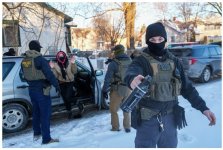
Officers from a wide range of agencies – Immigration and Customs Enforcement (ICE) most prominently, but also Border Patrol, the Bureau of Prisons and others – usually with faces covered and no visible identification, trawl the streets in unmarked vehicles to conduct immigration raids and arrests that often look like kidnappings.
Their tactics have included ramming and smashing up cars, racially profiling as they search for people to arrest, and pushing residents to inform on their neighbours. Agents have also clamped down on protests, frequently opening fire with pepper balls, deploying tear gas and arresting demonstrators.
After federal officers fatally shot U.S. citizens Renee Macklin Good and Alex Pretti last month, the White House promised to wind down the operation.
But it is pressing ahead with its plan to deport all of the country’s undocumented immigrants, as well as many who entered the country with legal status. And there is no guarantee Mr. Trump won’t soon target another city or state.
ICE, U.S. Customs and Border Protection and their parent organization, the Department of Homeland Security, did not respond to requests for comment on this story.
Masked agents using unmarked cars are breaking glass, whisking away shoppers and harassing citizens

apple.news
DHS, primarily through Immigration and Customs Enforcement (ICE) and U.S. Customs and Border Protection (CBP), has authority under 8 U.S.C. §§ 1357 and 1226 to arrest individuals suspected of violating federal immigration laws. While ICE can arrest noncitizens in public spaces without a warrant based on probable cause, they are “generally prohibited” from seizing U.S. citizens.
Clayton Kelly, a mechanic in his 20s, said he did nothing more than verbally criticize federal agents before they violently arrested him. On the morning of Saturday, Jan. 24, shortly after Mr. Pretti was shot in South Minneapolis, Mr. Kelly went to the area with his wife. “Your families are disappointed in you,” Mr. Kelly told The Globe and Mail he said to officers. “You’re a disgrace and you should quit.”
(YouTube & It's Coming Right For Us)
Mr. Kelly had begun walking away when heard one agent say “that’s him, get him.” Officers body-slammed Mr. Kelly into the window of a tattoo parlour, tackled him to the ground and put him in a headlock, he said. Several agents held him down, kneeing him in the spine and smothering him. “I was trying to yell out that I couldn’t breathe, and they were telling me to shut up,” he recalled.
As he lay pinned, Mr. Kelly said, an officer put the nozzle of a can of pepper spray behind his glasses and shot it directly into his left eye. He was bundled into a vehicle and driven to the Whipple Federal Building near the airport, which agents are using as a detention centre.
For the next 10 hours, he was held in a roughly 12-foot-by-10-foot cell with a concrete bench and no sink or toilet.
This section of the building was reserved for U.S. citizens, Mr. Kelly said, and he was eventually joined by several others. He said
officers never identified themselves to him or read him his Miranda rights.
In the hallway outside the cell, Mr. Kelly could hear officers searching people’s belongings and taking their mobile phones.
At one point, an agent had Mr. Kelly confirm which phone was his. When he was released without charges that night, Mr. Kelly said officers refused to give him back the device and said they planned to go through it. Something-something four amendment.
Ten days before his arrest, Mr. Kelly had witnessed part of a police chase that ended with an ICE agent shooting Julio Cesar Sosa-Celis, a Venezuelan migrant, in the leg. Mr. Kelly recorded the aftermath and described what he saw to a reporter. His images of the scene are on the phone he said agents confiscated. Ahhhh….
On Wednesday, the White House said it would start withdrawing “some” of its ICE agents from Minneapolis, “
but said that officers have a responsibility to enforce the law.” (???)
Workers are writing letters, staging strikes and in some cases resigning over how bosses are handling the immigration crackdown.
apple.news
The Department of Homeland Security (DHS) and its under-umbrella agencies (such as ICE and CBP) cannot legally "ignore" the Fourth Amendment to the Constitution. The Fourth Amendment protects all people in the U.S. from unreasonable searches and seizures, regardless of citizenship status, in theory.
However, the legal application of the Fourth Amendment to DHS is complex, as courts have recognized broader authority for federal agents in immigration and border enforcement compared to local police, particularly in areas near the border, or lately in areas not near the border.
Minneapolis, Minnesota, is located approximately 310 to 315 miles (about 500-507 km) south of the Canadian border.
- Warrantless Home Entries: In early 2026, a major debate arose regarding a reported May 2025 memo authorizing ICE agents to enter private homes without a judicial warrant, using only administrative warrants (signed by ICE supervisors, not judges).
- Legal Challenges: Constitutional scholars, lawmakers, and civil rights groups argue that using administrative warrants to enter a private home without consent is a violation of the Fourth Amendment. A federal judge in California previously ruled that ICE administrative warrants do not authorize entry into homes.
- "Reason to Believe": Under immigration law (INA § 287(a)(2)), agents can make warrantless arrests if they have "reason to believe" a person is in the U.S. illegally and likely to escape.
- The "Border Search Exception": CBP has broader authority within 100 air miles of any U.S. "external boundary" to conduct searches and stops without a warrant, which has been upheld by courts as a reasonable exception to the Fourth Amendment.
- "Kavanaugh Stops": Recent legal analysis has highlighted an increase in ICE discretion to use race or ethnicity as a factor for stopping and questioning people in the interior, which critics argue challenges longstanding Supreme Court rulings against profiling.
While DHS may attempt to broaden its enforcement powers through internal memos, these actions are subject to review by federal courts. Federal courts have consistently held that administrative warrants do not allow for nonconsensual entry into homes. Furthermore,
DHS's own policies affirm the duty to abide by Fourth Amendment standards, or not.









 forums.canadiancontent.net
en.wikipedia.org