The world’s largest aircraft carrier,
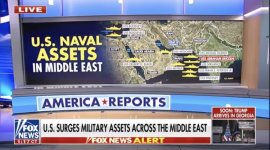
USS Gerald R Ford, steamed past Gibraltar on Friday bound for the Middle East as Donald Trump massed ever more American firepower within striking range of Iran.
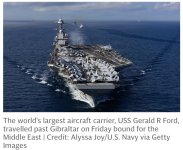
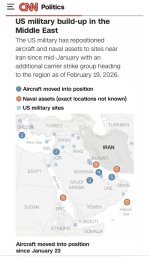
For now, US naval firepower is giving Iran a relatively wide berth. The nuclear-powered USS Abraham Lincoln aircraft carrier – with its crew of more than 5,500 sailors and Marines and its accompanying strike force – is on station off the coast of Oman, some 450 miles away, while
a second carrier, the USS Gerald R Ford, is en route and will arrive within two weeks.
The prospect of this armada going into action raises a vital question: how might Iran’s leadership react? From the moment they learn of any incoming American attack, the regime would have every reason to strike back with all the weapons in its hands in order to inflict maximum carnage. If the Ayatollah believes his regime’s survival is at stake, he will look to use all 1,500 missiles while he still can.
That means any new war would be far more dangerous and escalatory than previous rounds of bloodshed. If Ayatollah Ali Khamenei,
the Supreme Leader, were to conclude that the very survival of the Islamic Republic was at stake, then caution and restraint would be unlikely to feature among his calculations.
Iranian President Masoud Pezeshkian said on Saturday that his country would not bow its head to pressure from world powers amid nuclear talks with the United States.

apple.news
On the contrary, he might judge that the imperative was to fire as many of Iran’s estimated 1,500 ballistic missiles as possible before America – possibly aided by
Israel – could destroy them, acting on the timeless principle of “use them or lose them”.
The primary target of
America’s B-2 stealth bombers would not be the now ruined uranium enrichment facilities at Natanz and Fordow. Instead Trump’s warplanes would be trying to wreck Iran’s means of retaliation by destroying its ballistic missiles and striking at the nerve centres and the leadership of the regime.
“If the whole regime elite believes that it is in a fight for its life, then anyone still alive after the first hit will, rationally, have every reason to strike back and try to impose maximum costs on Trump,” says Marcus Solarz Hendriks, the lead Middle East analyst at Greenmantle, a geopolitical consultancy.
Khamenei’s ability to retaliate has been hugely reduced by Israel’s evisceration of Hamas and Hezbollah, the terrorist groups that Iran supplied with thousands of missiles to be fired in the event of an attack on its territory. Last year’s war cost Iran about half of its arsenal of ballistic missiles, and some 70 per cent of their launchers.
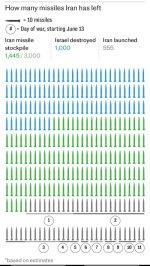
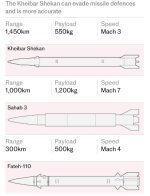
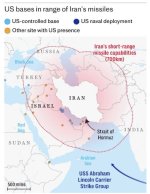
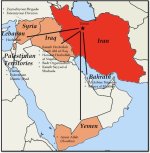
But the roughly 1,500 missiles that are left – and perhaps 100 launchers – would on paper be enough to inflict carnage across the Middle East. Khamenei could fire them at every Gulf state hosting American forces, targeting Qatar once again and perhaps also Bahrain, the headquarters of the US Fifth Fleet.
In total, some 40,000 US military personnel are scattered at various bases across the region, all of them within missile range of Iran. American embassies would also be obvious targets, though they are well defended and the mission in Baghdad is accustomed to dealing with attacks.
Khamenei may also fire his missiles at the oilfields of Saudi Arabia’s Eastern Province and the vital processing facility at Abqaiq, which handles about two thirds of the kingdom’s production. The Houthi rebels who control large areas of Yemen, including the capital Sana’a, retain a large arsenal of Iranian-supplied missiles which they have previously launched at both Saudi Arabia and the United Arab Emirates.
Khamenei might urge them to do so again. If they are willing to risk punitive retaliation, the Houthis may also target the US armada with the advanced anti-shipping missiles that Iran has provided for this purpose. If Trump starts by bombing Iran, he might also find himself attacking Yemen.
Aircraft and warship build-up to reach necessary level in days, say defence officials
apple.news
He would probably need to neutralise the naval wing of the Islamic Revolutionary Guard Corps (IRGC) too - in order to protect US warships and foil any attempt to block the Strait of Hormuz, the vital waterway at the entrance to the Gulf which serves as a conduit for global oil supplies.
And, over the years, the intelligence branch of the IRGC is believed to have planted “sleeper cells” of terrorists and saboteurs in countries across the Middle East – and possibly in Europe – which could be activated.
But Khamenei’s problem is that his enemies know exactly how he might hit back and, in the event of war, America and Israel would do everything within their power to pre-emptively defang Iran.
Hendriks says that Iran has anticipated this by dispersing its missiles and delegating the authority to launch them to local commanders. Even if military headquarters are destroyed and communications disrupted, preventing the transmission of any orders, some missiles might still be fired.
In the same way, Iran has prepared for decapitation strikes against its leadership by creating parallel structures, including a new Defence Council to sit alongside the established Supreme National Security Council.
Whether any of this would survive the first days – or hours – of an American strike is open to question. Yet, this time, Khamenei would have every reason to use whatever is in his hands.
If the Islamic Republic believes its survival is at stake, caution may give way to overwhelming force
apple.news
Let there be no doubt: it could be little more than a New York minute before military muscle-flexing transforms into something different. Iran, for its part, has been conducting large-scale live-fire naval drills with cruise missiles and other weapons, briefly
shutting down the Strait of Hormuz, a global oil choke point for 20 per cent of worldwide crude.
Congress has a duty and obligation to invoke the
War Powers Resolution in such a scenario, as this will not be a tactical one-off strike, nothing like the recent extraction activity in Venezuela or the uranium-enrichment-site bombings last year. This will be all-out, full-scale war. And only Congress has the power to declare war: Article 1, Section 8, of the US Constitution.
That’s what an increasingly likely massive strike against the Middle Eastern state would be, Warren Getler warns. Only Congress can approve it, which is why the US president must come clean with the nation
apple.news









 .
.