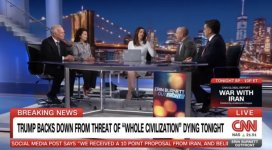
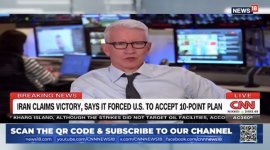
Iran War. . . USA Up 2-0 in the First Period

petros

The Central Scrutinizer
Nov 21, 2008
120,301
14,869
113
Low Earth Orbit
1 hour ago -Politics & Policy

Iran ceasefire fails to quash Dem calls for Trump's removal​


President Trump's announcement of a ceasefire with Iran on Tuesday did little to stem the growing tide of calls from congressional Democrats for his impeachment or removal via the 25th Amendment.

Why it matters: The Republican support needed for these efforts to succeed is highly unlikely to materialize, but Democrats are desperate to show their voters that they are doing everything they can to get Trump out of office.


  • Reps. Shri Thanedar (D-Mich.) and Jasmine Crockett (D-Texas) each sent letters to Vice President J.D. Vance and the Cabinet asking to remove Trump by invoking the 25th Amendment to the Constitution.
  • Rep. John Larson (D-Conn.) introduced articles of impeachment against Trump on Tuesday morning, which cite the war in Iran among many other alleged violations.
  • Rep. Yassamin Ansari (D-Ariz.) also announced plans to file articles of impeachment against Defense Secretary Pete Hegseth for his role in the war.
The latest: Trump announced Tuesday night that he agreed to a two-week ceasefire just over an hour before his stated deadline for Iran to reopen the Strait of Hormuz.
  • Trump had threatened in a Tuesday morning post on Truth Social that if the deadline wasn't met, "a whole civilization will die tonight, never to be brought back again. I don't want that to happen, but it probably will."
  • That statement had Democrats and even a handful of Republicans up in arms, but Vance — despite his reputation as an anti-interventionist — backed up the president, saying, "We've got tools in our toolkit that we so far haven't decided to use."
  • A spokesperson for Vance did not immediately respond to a request for comment.
By the numbers: More than 85 House Democrats had called for President Trump to be impeached or removed via the 25th Amendment as of Tuesday evening.
  • Among those were members of House Democratic leadership and prominent lawmakers such as Rep. Alexandria Ocasio-Cortez (D-N.Y.) and former House Speaker Nancy Pelosi (D-Calif.).
  • The vast majority were progressives, however, with more moderate and swing-district Democrats mostly sticking to calls for an Iran war powers vote.

What they're saying: Several House Democrats made clear their calls for Trump's removal still stand despite the ceasefire agreement.
  • "Just because a President announces he's agreed to a two week ceasefire moments before he threatened to commit war crimes, does not mean he is suddenly fit to serve," Rep. Melanie Stansbury (D-N.M.) said in a post on X.
  • Said Sen. Ed Markey (D-Mass.): I'm glad there is a reported ceasefire deal with Iran. But ... Donald Trump can't simply threaten war crimes with impunity. Congress needs to get back in session now to stop this war and remove Donald Trump."
The bottom line: These efforts were extreme long-shots to begin with, and the ceasefire only further takes the steam out of them.
  • But, to Republicans at least, they are a clear signal of where Democrats may go if they retake one or both chambers of Congress in November.
  • "If the GOP doesn't hold the House, impeachment 3.0 is coming," former Republican congressman and White House chief of staff Mark Meadows said in a post on X.
 

Ron in Regina

"Voice of the West" Party
Apr 9, 2008
31,947
11,589
113
Regina, Saskatchewan
Sounds to me that whoever is in charge in Iran blinked first .
Or Trump looked at the polling numbers for the midterm election (that don’t matter to him) and took what he could. Both Trump and Iran are going to claim victory (Trump has been claiming victory since the beginning of March but this is still going on). We’ll have to see how flexible both (or either) side(s) are going to be in the next two weeks, & this allows time for the ground forces that apparently America will not not use to arrive in the region.
1775617200207.jpegEven if Iran does fully open Hormuz – without conditioning passage on tolls or other payments – its ability to control the key geopolitical chokepoint is more clear now than ever. A president has been set.
1775617142498.jpeg
In a statement after Trump's ceasefire message, Iranian foreign minister Seyed Aragchi said that Iran would halt its "defensive operations" and allow safe passage through the Hormuz "via coordination with Iran's armed forces" (meaning?). He added that the US had accepted the "general framework" of the Iranian 10-point plan.
1775617159314.jpeg
That plan includes the US withdrawing its military forces from the region (meaning what? The Carrier Groups? Or from bases established in neighbouring countries for decades?), lifting economic sanctions on Iran, paying compensation for war damages and allowing Iran to maintain control over Hormuz. It is hard to imagine Trump actually agreeing to any of those conditions – a sign that the next two weeks of negotiations could be treacherous.
1775617237351.jpeg
For the moment, however, this is a partial political victory for Trump. He made a dramatic threat and achieved the desired result. But the ceasefire is a reprieve, not a permanent settlement.
1775617263229.jpeg
The long-term cost of the president's words and actions, and of the war overall, has yet to be fully assessed. The White House is likely to counter that the leverage worked, however.
1775617294771.jpeg
Iran's military has been significantly degraded. Although its Islamic fundamentalist regime is still in power, many of its top leaders have been killed in bombing strikes, and American stockpiles of Patriot and other missiles have been significantly depleted, along with its reputation globally for those that where not anti-American before Trumps second term. Even if the two-week ceasefire does result in a permanent peace, the Iran war – and Trump's recent words – may have fundamentally altered the way the rest of the world views the US.
 

Ron in Regina

"Voice of the West" Party
Apr 9, 2008
31,947
11,589
113
Regina, Saskatchewan
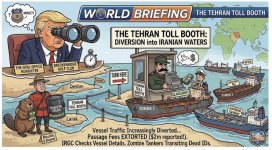
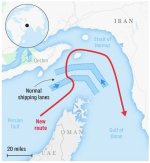
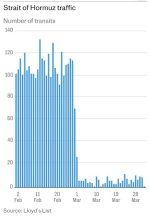
Oil tankers used to sail down the middle of the Strait of Hormuz but since Feb 28, any seeking to cross the 21-mile-wide waterway have had to take a detour. In what has become known as the “Tehran Tollbooth”, vessels must now head closer to the Iranian coastline, nosing themselves between the islands of Qeshm and Larak.

Ship owners then go through a complex – and expensive – process of negotiation. First, according to Bloomberg, they are required to inform intermediary companies linked to the Islamic Revolutionary Guards Corps (IRGC) of the ship’s cargo, destination and ultimate owner.
1775651073208.jpeg
Iran then charges a “toll” of at least $1 per barrel, with the rate rising according to the perceived friendliness of the national operator. Fees must be paid in Chinese yuan, or a cryptocurrency. The average rate for a single oil tanker is $2m (£1.5m). If everything is approved, IRGC boats will finally provide an escort into and out of the “tollbooth”.
In a statement after Trump's ceasefire message, Iranian foreign minister Seyed Aragchi said that Iran would halt its "defensive operations" and allow safe passage through the Hormuz "via coordination with Iran's armed forces" (meaning?).
1775649412219.jpeg
That plan includes the US withdrawing its military forces from the region (meaning what? The Carrier Groups? Or from bases established in neighbouring countries for decades?), lifting economic sanctions on Iran, paying compensation for war damages and allowing Iran to maintain control over Hormuz.
Some analysts believe it could make as much as $500bn (£377bn) in five years.

This system – informal and illegal for now – represents Iran’s biggest win from the war with the United States. It is now the target of the two-week ceasefire announced by Donald Trump. The US President has stated that the pause in fighting is strictly “subject to” the “COMPLETE, IMMEDIATE, and SAFE OPENING” of the Strait of Hormuz.

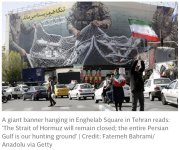
However, Iran’s statement said that any crossing had to be carried out “in conjunction” with the Iranian military – something very different to free passage – and an Iranian official told AP that the deal allowed Tehran to still charge fees.
Both Trump and Iran are going to claim victory (Trump has been claiming victory since the beginning of March but this is still going on). We’ll have to see how flexible both (or either) side(s) are going to be in the next two weeks,
The next two weeks will see which system holds.
1775649681486.jpeg
At moments, Donald Trump has appeared to be attracted by the idea of operating the toll booth himself, rather than opening up free passage. “What about us charging toll?” he said this week. “I’d rather do that than let them have them. Why shouldn’t we? We’re the winner. We won.”
1775649956866.jpeg
1775650320149.jpegWhile the US president had previously threatened to destroy Iran’s “entire civilisation” if it does not surrender and open the strait, that deadline was averted by the last-minute ceasefire agreement. Gulf nations are concerned that Mr Trump will prompt a final, furious round of regional bombardments and then walk away with the strait – at least temporarily – under Tehran’s control.

Some countries might be forced to pay the export toll at first, one Gulf diplomatic source told The Telegraph. Abu Dhabi, Qatar and Bahrain lack alternative pipelines, and supplies of liquid natural gas can only be delivered by ship.

Nations like India might send their own tankers through the strait to collect oil and gas, bearing the “tollbooth” cost themselves. But over time, the Gulf nations will not tolerate a system that funnels vast wealth towards a hostile regime that has already blown up chunks of their critical infrastructure, the diplomatic source said.

Hugo Dixon, a columnist for Reuters, estimated that Tehran could earn $500bn over the next five years, creaming off profits for as long as it takes to construct new pipelines. Even a fraction of that sum would slingshot the Shia nation to regional dominance.
Iran's military has been significantly degraded. Although its Islamic fundamentalist regime is still in power, many of its top leaders have been killed in bombing strikes
It would allow the IRGC to rebuild, many times over, its obliterated military. “I don’t think this war can end if Iran is still running the ‘tollbooth’,” said Ellen R. Wald, a non-resident senior fellow at the Atlantic Council’s Global Energy Centre, based in Washington DC. With negotiations set for Islamabad on Friday, the US will be pushing to dismantle this system.
She said that “Saudi Arabia and the United Arab Emirates and other Gulf countries cannot stand for it” and would eventually “have to build an army and fight”.
1775652354777.jpeg
In the near term, Iran’s enemies could use their own missiles to target the regime’s shadow fleet tankers, which are now transporting double the amount of oil they were before the war – and for almost double the profit.
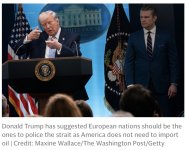
Recently, Mr Trump suggested that the United States had no need to reopen the strait, given bountiful domestic energy supplies. Oil-starved Europe should do the job itself, US super-majors, including Chevron, are heavily involved in the Gulf oil business, often running partnerships, and a permanent Iranian “tollbooth” would seriously undermine the international principle of the freedom of the seas, said Ms Wald.

Under the United Nations Convention on the Law of the Sea, no country can interfere with the “innocent passage” of ships through maritime choke points or straits. Tolls can only be charged at man-made canals, such as the Suez or Panama.😉

Last month, in a letter to the International Maritime Organisation, Iran argued that its “tollbooth” was justified by self-defence. It had to inspect foreign, possibly hostile ships and the fee covered such costs, the regime told the watchdog.🤔Turkey charges a small fee to escort ships through the Dardanelles, but “that’s because it’s a very perilous waterway and Turkey provides coastguard services,” said Ms Wald. Iran’s legal claim was absurd, by contrast, resting simply on extortion.
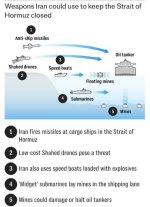
1775650594932.jpeg
(Would Trumps claim to the Strait of Hormuz and America charging tolls “because they clearly won” also be extortion?)

“The United States entered World War One in part to secure freedom of the seas,” Ms Wald added. “Leaving the tollbooth in place now would be like saying, ‘We don’t care about that any more – Britain, you can charge people to enter the English Channel’.” In a worst-case scenario, the law of the sea breaks down and Russia or China take greater control over the choke points in their back yards, or Canada with its northern passage?

Inside Iran, the IRGC would use oil funds to supercharge its ongoing takeover of the entire state, said Dr Andreas Krieg, a senior lecturer at the School of Security Studies at King’s College London. While the overall level of traffic through the strait would fall – sanctions bar Western firms from engaging in any business with the IRGC – the tollbooth windfall “would help to build a military dictatorship”.
1775654853515.jpeg
The IRGC would emerge as a “more radical, more empowered, more financially robust system that can go and build networks east with Russia and China”. The prospect is catastrophic enough for so many nations that it is more likely to collapse than be allowed to take root, said Basil Germond, a professor of international security at Lancaster University.

“Historically, attempts to condition or close strategic straits – including Hormuz in the 1980s ‘tanker war’ – tend to prompt escalation … involving the use of force,” he said. Whether it is seizing Kharg Island, further US bombardments or Gulf counterstrikes, “it is more likely that the quagmire will resolve with further use of kinetic force, rather than the implementation of a stable, widely accepted and enforceable tollbooth”.

Much about the agreement was unclear as the sides presented vastly different visions of the terms.
 

Ron in Regina

"Voice of the West" Party
Apr 9, 2008
31,947
11,589
113
Regina, Saskatchewan
(YouTube & Iran's Oil Targets BOMBED – Ceasefire On Brink Of COLLAPSE)

But hours after the announcement, Iran and Gulf Arab countries reported new attacks Wednesday.

It was not clear if the strikes would scuttle the deal, which U.S. Vice President JD Vance called “fragile.”

Even before the new attacks, much about the agreement was unclear as the sides presented vastly different visions of the terms.

— Iran said the deal would allow it to formalize its new practice of charging ships passing through the Strait of Hormuz, a crucial transit lane for oil. But the details were not clear, nor was it known whether vessels would feel safe using the channel or whether ship traffic had resumed. It also was unclear whether any other country agreed to this condition.

The ceasefire may formalize a system of charging fees in the strait that Iran instituted — and give it a new source of revenue.

The plan allows for both Iran and Oman to charge ships, according to a regional official who spoke on condition of anonymity to discuss negotiations they were directly involved in. The official said Iran would use the money it raised for reconstruction.

That would upend decades of precedent treating the strait as an international waterway that was free to transit and will likely not be acceptable to the Gulf Arab states, which also need to rebuild after repeated Iranian attacks targeting their oil fields.

Iranian Foreign Minister Abbas Araghchi said passage through the strait would be allowed under Iranian military management — further clouding the picture of who would be allowed to transit the waterway.
 

Dixie Cup

Senate Member
Sep 16, 2006
6,599
4,175
113
Edmonton
The ceasefire won't last long since no one can actually trust Iran. They love lying & manipulating so it won't last. That I can pretty much guarantee. They've never lived up to ceasefires before so why would they now?
 

Dixie Cup

Senate Member
Sep 16, 2006
6,599
4,175
113
Edmonton
It lasted 10 minutes before Israel broke it.
No, actually Iran did likely b'cuz the "orders" weren't passed down to their Generals (or whomever is in charge). But of course, as far as you're concerned Petros, Israel is responsible for pretty much everything that has gone wrong in the world so that's nothing new coming from you.
 

petros

The Central Scrutinizer
Nov 21, 2008
120,301
14,869
113
Low Earth Orbit
No, actually Iran did likely b'cuz the "orders" weren't passed down to their Generals (or whomever is in charge). But of course, as far as you're concerned Petros, Israel is responsible for pretty much everything that has gone wrong in the world so that's nothing new coming from you.
Israel has never honored a cease-fire. It's their shtick.
 

Ron in Regina

"Voice of the West" Party
Apr 9, 2008
31,947
11,589
113
Regina, Saskatchewan
I don’t think anybody really knows what’s going on over there, and it’s an absolute tribal mess.
Long after the ceasefire was meant to take effect, Kuwait, the UAE and Bahrain all reported fresh Iranian missile and drone strikes, several of which targeted oil, power and desalination infrastructure vital to the region.

An oil industry source said Saudi Arabia's huge east-west pipeline to the Red Sea had been hit, and damage was being assessed. The pipeline is the main route by which some oil, at least, has been able to bypass the blockaded strait.

Israel also escalated its parallel war in Lebanon, launching what it described as its biggest strikes yet, sending huge columns of smoke above Beirut as buildings crumpled.
 

Ron in Regina

"Voice of the West" Party
Apr 9, 2008
31,947
11,589
113
Regina, Saskatchewan
Wall Street's main indexes climbed to near one-month highs on Wednesday after the U.S. and Iran agreed to a two-week ceasefire, sending crude prices lower ‌on expectations that energy supplies through the Strait of Hormuz could resume…Iran’s oil anyway…not necessarily its neighbours that also use that strait usually.
 

Ron in Regina

"Voice of the West" Party
Apr 9, 2008
31,947
11,589
113
Regina, Saskatchewan
Iran’s powerful parliament speaker Mohammad Bagher Ghalibaf said that three key clauses of the hours-old ceasefire had been “openly and clearly violated” – including a ceasefire in Lebanon - ahead of planned negotiations, and described further talks as “unreasonable”.

He didn’t mention Kuwait, the UAE and Bahrain all reported fresh Iranian missile and drone strikes, several of which targeted oil, power and desalination infrastructure vital to the region, or an oil industry source said Saudi Arabia's huge east-west pipeline to the Red Sea had been hit, and damage was being assessed. The pipeline is the main route by which some oil, at least, has been able to bypass the blockaded strait.🤫

The three violations, Ghalibaf said, were:

Non-compliance with the first clause of the 10-point proposal regarding the ceasefire in Lebanon – a commitment which Pakistan’s prime minister Shehbaz Sharif has also explicitly referred to and declared as “an immediate ceasefire everywhere, including Lebanon and other regions, effective immediately”.

The entry of an intruding drone into Iran’s airspace, which was destroyed in Lar, “in clear violation of the clause prohibiting any further violation of Iranian airspace”.

Denial of Iran’s right to enrichment, which was included in the sixth clause of the framework.
 

Ron in Regina

"Voice of the West" Party
Apr 9, 2008
31,947
11,589
113
Regina, Saskatchewan
Despite Trump's triumphalist language, analysts say Iran is likely to emerge from the conflict as a continuing problem for Washington: militarily weakened but with a more hardline leadership, de facto control over the vital oil-shipping waterway and a buried stockpile of highly enriched uranium.

Trump has touted himself as a master negotiator since his real estate developer days, but some analysts say he can box himself in with his negotiating style and undermine U.S. ⁠credibility on the world stage.

But Trump’s claims of victory over Iran overlooked questions about ‌the effectiveness of mixing maximalist demands, erratic rhetoric and increasingly extreme threats.

His decision on Tuesday to back down and agree to a two-week ceasefire – which critics mockingly called another example of “TACO,” or “Trump always chickens out” – marked the biggest step so far toward de-escalating a 40-day-old war that has shaken the Middle East and disrupted global energy markets.

The approach has an added risk - that adversaries including China and Russia become wise to the strategy.

"The surprise value is wearing off," said a Republican lawmaker who had been in contact with the White House on Tuesday night, referring to Trump's habit of making reversals after tough-sounding threats.
White House press secretary Karoline Leavitt denied that Trump had backed down, telling reporters on Wednesday that his language was part of his "tough negotiating style" and that the world should "take his word very seriously."
(YouTube & Karoline Leavitt answers more questions... | This Hour Has 22 Minutes)
Trump has a pattern of taking extreme negotiating positions, only to backpedal. At times, analysts said, this approach has appeared an intentional strategy while at others it has seemed haphazard, with his aides kept in the dark and the administration rowing back following pressure from financial markets or his MAGA political base.

Trump's change of tack on Iran followed a spike in U.S. gasoline prices and his own slumping approval ratings. Probably just a coincidence though.

Iranian state media on Tuesday reported a statement from the Supreme National Security Council that said the U.S. accepted a plan that included the acceptance of uranium enrichment and lifting of all sanctions -- terms the U.S. and the president himself have long rejected.

"That is false," Leavitt said of the Iranian state media's report on Wednesday.

"The Iranians originally put forward a 10-point plan that was fundamentally unserious, unacceptable and completely discarded. It was literally thrown in the garbage by President Trump and his negotiating team," she said.

Trump on Tuesday night called an Iranian 10-point counterproposal a "workable basis" for negotiations for a long-term peace….so…are they talking about the same Iranian 10-point plan, or two completely different Iranian 10-point plans here???

"The idea that President Trump would ever accept an Iranian wish list as a deal is completely absurd," Leavitt said. "The president will only make a deal that serves in the best interests of the United States of America."

The upcoming talks -- scheduled for Saturday morning local time in Islamabad, Pakistan -- will be led by Vice President JD Vance, White House special envoy Steve Witkoff and Jared Kushner, the White House said on Wednesday. Huh…
(YouTube & Trump says he was advised to attack Iran by Hegseth, Kushner and Witkoff)

Speaking way back on some Monday, US President Donald Trump said he attacked Iran based on the information he had received from his secretary of defence, Pete Hegseth, his secretary of state, Marco Rubio, special envoy Steve Witkoff and son-in-law Jared Kushner…so I’m sure they’ll be very popular at these upcoming talks in Islamabad on Saturday.

Reports indicate that Iranian officials have told the Trump administration they are unwilling to resume talks with Witkoff and Kushner, citing a "deficit of trust" after previous negotiations in February 2026 collapsed, followed by military actions. Some sources have described the Iranians as feeling "stabbed in the back" by the timing of these actions…so that’s not sounding very promising.
 

petros

The Central Scrutinizer
Nov 21, 2008
120,301
14,869
113
Low Earth Orbit
Despite Trump's triumphalist language, analysts say Iran is likely to emerge from the conflict as a continuing problem for Washington: militarily weakened but with a more hardline leadership, de facto control over the vital oil-shipping waterway and a buried stockpile of highly enriched uranium.

Trump has touted himself as a master negotiator since his real estate developer days, but some analysts say he can box himself in with his negotiating style and undermine U.S. ⁠credibility on the world stage.

But Trump’s claims of victory over Iran overlooked questions about ‌the effectiveness of mixing maximalist demands, erratic rhetoric and increasingly extreme threats.

His decision on Tuesday to back down and agree to a two-week ceasefire – which critics mockingly called another example of “TACO,” or “Trump always chickens out” – marked the biggest step so far toward de-escalating a 40-day-old war that has shaken the Middle East and disrupted global energy markets.

The approach has an added risk - that adversaries including China and Russia become wise to the strategy.

"The surprise value is wearing off," said a Republican lawmaker who had been in contact with the White House on Tuesday night, referring to Trump's habit of making reversals after tough-sounding threats.
White House press secretary Karoline Leavitt denied that Trump had backed down, telling reporters on Wednesday that his language was part of his "tough negotiating style" and that the world should "take his word very seriously."
(YouTube & Karoline Leavitt answers more questions... | This Hour Has 22 Minutes)
Trump has a pattern of taking extreme negotiating positions, only to backpedal. At times, analysts said, this approach has appeared an intentional strategy while at others it has seemed haphazard, with his aides kept in the dark and the administration rowing back following pressure from financial markets or his MAGA political base.

Trump's change of tack on Iran followed a spike in U.S. gasoline prices and his own slumping approval ratings. Probably just a coincidence though.

Iranian state media on Tuesday reported a statement from the Supreme National Security Council that said the U.S. accepted a plan that included the acceptance of uranium enrichment and lifting of all sanctions -- terms the U.S. and the president himself have long rejected.

"That is false," Leavitt said of the Iranian state media's report on Wednesday.

"The Iranians originally put forward a 10-point plan that was fundamentally unserious, unacceptable and completely discarded. It was literally thrown in the garbage by President Trump and his negotiating team," she said.

Trump on Tuesday night called an Iranian 10-point counterproposal a "workable basis" for negotiations for a long-term peace….so…are they talking about the same Iranian 10-point plan, or two completely different Iranian 10-point plans here???

"The idea that President Trump would ever accept an Iranian wish list as a deal is completely absurd," Leavitt said. "The president will only make a deal that serves in the best interests of the United States of America."

The upcoming talks -- scheduled for Saturday morning local time in Islamabad, Pakistan -- will be led by Vice President JD Vance, White House special envoy Steve Witkoff and Jared Kushner, the White House said on Wednesday. Huh…
(YouTube & Trump says he was advised to attack Iran by Hegseth, Kushner and Witkoff)

Speaking way back on some Monday, US President Donald Trump said he attacked Iran based on the information he had received from his secretary of defence, Pete Hegseth, his secretary of state, Marco Rubio, special envoy Steve Witkoff and son-in-law Jared Kushner…so I’m sure they’ll be very popular at these upcoming talks in Islamabad on Saturday.

Reports indicate that Iranian officials have told the Trump administration they are unwilling to resume talks with Witkoff and Kushner, citing a "deficit of trust" after previous negotiations in February 2026 collapsed, followed by military actions. Some sources have described the Iranians as feeling "stabbed in the back" by the timing of these actions…so that’s not sounding very promising.
As I said weeks ago, they can't beat Iran and even Hezbollah is hitting the IDF far harder than expected and will score a W.

Gaza genocide is the death of Zionism.
 

Ron in Regina

"Voice of the West" Party
Apr 9, 2008
31,947
11,589
113
Regina, Saskatchewan
As I said weeks ago, they can't beat Iran and even Hezbollah is hitting the IDF far harder than expected and will score a W.
1775736412692.jpegHezbollah began firing rockets and artillery at Israeli positions on October 8, 2023, the day after the Hamas-led attacks on Israel, stating they were acting in support of Gaza.Hezbollah is widely characterized as a terrorist organization that has targeted Israeli civilian infrastructure, causing tens of thousands of residents in northern Israel to evacuate.
Gaza genocide is the death of Zionism.
Israel is striking Hezbollah to halt near-daily rocket fire, destroy military infrastructure, and allow thousands of displaced Israeli residents to return safely to the north, [as explained by Al Jazeera and BBC]. From its inception, a stated goal of Hezbollah has been the destruction of Israel, often initiating cross-border attacks, such as the 2006 Lebanon War.

This intensified conflict, which escalated sharply in September 2024 following Hezbollah's "solidarity" attacks with Hamas, aims to weaken the group and force it away from the border, say reports from BBCand Al Jazeera.

Israel, which invaded Lebanon last month in parallel with the war on Iran to root out the armed group Hezbollah, Tehran's ally, says its actions there are not covered by the ceasefire announced late on Tuesday by Trump. Many analysts view Hezbollah as an Iranian-backed actor aimed at destabilizing Israel, rather than acting purely in the defense of Lebanon.

Washington has also said Lebanon is not covered by the truce, but Iran and Pakistan, which acted as mediator, say it was explicitly part of the deal. A host of countries, including Britain and France, said the truce should extend to Lebanon.

A Pakistani source with knowledge of the discussions said Pakistan was working on ceasefires for Lebanon and Yemen: "It will ⁠be discussed during the (upcoming) talks and we will settle it."
 

petros

The Central Scrutinizer
Nov 21, 2008
120,301
14,869
113
Low Earth Orbit
View attachment 34019Hezbollah began firing rockets and artillery at Israeli positions on October 8, 2023, the day after the Hamas-led attacks on Israel, stating they were acting in support of Gaza.Hezbollah is widely characterized as a terrorist organization that has targeted Israeli civilian infrastructure, causing tens of thousands of residents in northern Israel to evacuate.

Israel is striking Hezbollah to halt near-daily rocket fire, destroy military infrastructure, and allow thousands of displaced Israeli residents to return safely to the north, [as explained by Al Jazeera and BBC]. From its inception, a stated goal of Hezbollah has been the destruction of Israel, often initiating cross-border attacks, such as the 2006 Lebanon War.

This intensified conflict, which escalated sharply in September 2024 following Hezbollah's "solidarity" attacks with Hamas, aims to weaken the group and force it away from the border, say reports from BBCand Al Jazeera.

Israel, which invaded Lebanon last month in parallel with the war on Iran to root out the armed group Hezbollah, Tehran's ally, says its actions there are not covered by the ceasefire announced late on Tuesday by Trump. Many analysts view Hezbollah as an Iranian-backed actor aimed at destabilizing Israel, rather than acting purely in the defense of Lebanon.

Washington has also said Lebanon is not covered by the truce, but Iran and Pakistan, which acted as mediator, say it was explicitly part of the deal. A host of countries, including Britain and France, said the truce should extend to Lebanon.

A Pakistani source with knowledge of the discussions said Pakistan was working on ceasefires for Lebanon and Yemen: "It will ⁠be discussed during the (upcoming) talks and we will settle it."
Did you know that an occupying force is fair game and it's not terrorism?

The victim angle and calling everything antisemitism is dead. Nobody is falling for that bullshit anymore. You can't holowash a genocide. It's over.

Yes, under international humanitarian law (IHL)—primarily the Geneva Conventions and customary rules—the members of an occupying (or occupational) force who are part of the armed forces of the occupying power are generally lawful combatants and thus legitimate military targets.

Key Principles from IHL
The core rule is the principle of distinction:
Parties to a conflict must always distinguish between civilians (who are protected from direct attack) and combatants (or military objectives), who may be lawfully targeted.e9a0f5

Combatants include members of the armed forces of a party to the conflict. They have the right to participate directly in hostilities and, in turn, may be attacked at any time (unless they are hors de combat—wounded, sick, surrendered, or detained).

An occupying force consists of the military personnel deployed by a state that exercises effective control over foreign territory without the consent of the sovereign (as defined in the Hague Regulations and Fourth Geneva Convention). These soldiers retain their status as combatants of their state’s armed forces. They are not reclassified as civilians simply because they are performing occupation duties (administration, security, maintaining order, etc.).

Specific to Occupation
The law of belligerent occupation (Hague Regulations 1907, Fourth Geneva Convention 1949) regulates how the occupying power must treat the local population and administer the territory. It does not strip the occupying troops of their combatant status or make them immune from attack by opposing forces.

Opposing regular armed forces (or organized armed groups in certain contexts) may lawfully direct attacks against these occupation forces as part of ongoing hostilities. Historical examples include attacks on coalition forces during the occupations of Iraq or other conflicts where resistance targeted military personnel and installations.

Rules of Engagement (ROE) for any force are operational directives issued by commanders. They must comply with IHL but can be more restrictive for policy, political, or tactical reasons (e.g., limiting force to self-defense in certain stabilization phases). ROE do not override the underlying legal status under IHL.5a2f9e

Important Limits and Nuances
Direct participation in hostilities (DPH): Civilians (including local inhabitants or settlers) lose protection only for such time as they take a direct part in fighting. Mere presence in occupied territory or support for the occupation does not automatically make someone a target.

Proportionality and precautions: Even when targeting legitimate military objectives (e.g., occupation troops or bases), attackers must take feasible precautions to minimize civilian harm and ensure the expected military advantage outweighs incidental civilian damage.

Unlawful resistance: Irregular fighters or individuals who attack occupation forces without meeting the criteria for combatant status (e.g., no responsible command, no distinctive emblem, no carrying arms openly) risk being treated as unprivileged belligerents. They may face domestic criminal prosecution rather than POW protections, but this does not change the fact that the occupation troops themselves remain targetable.

Self-defense and maintenance of order: Occupation forces have rights under IHL to use force to maintain security and public order, but this is separate from their vulnerability as combatants to attack by the opposing side.

In short: Yes, uniformed or otherwise identifiable members of an occupational armed force are "fair game" as lawful targets under the standard rules of engagement in an armed conflict. IHL does not grant them special immunity due to their role in occupation. This framework aims to regulate warfare by protecting true non-combatants while allowing legitimate military operations to continue.

This is a complex, context-dependent area of law often debated in specific conflicts. Interpretations can vary by state practice, but the above reflects the consensus in IHL sources like the ICRC and military law manuals.
 
Last edited:

Ron in Regina

"Voice of the West" Party
Apr 9, 2008
31,947
11,589
113
Regina, Saskatchewan