


It sells . If it bleeds it leads .Trump Trolls and the media and his political adversaries bite on those trolls every time.
Don't feed the troll.
Or are they really feeding themselves?
Greenland
- Thread starter Tecumsehsbones
- Start date
You are using an out of date browser. It may not display this or other websites correctly.
You should upgrade or use an alternative browser.
You should upgrade or use an alternative browser.


It sells . If it bleeds it leads .
International law applies to everyone, including US, says German finance minister — Reuters
The principles of international law apply to everyone, including the United States, German Finance Minister and Vice Chancellor Lars Klingbeil said on Sunday, in reference to President Donald Trump's threats to seize Greenland.
Germany warns Trump: International law applies to everyone, including US — The Jerusalem Post
"It is solely up to Denmark and Greenland to decide about Greenland's future. Territorial sovereignty and integrity must be respected," Klingbeil said.
A US military seizure of the mineral-rich Arctic island from Denmark, a long-time ally, would send shockwaves through NATO and deepen the divide between Trump and European leaders. 'We increase security in the Arctic together as NATO allies, not in opposition to one another,' Klingbeil said.
Monday's G7 meeting will focus on access to critical minerals as Western countries seek to reduce their dependence on China, given moves by Beijing to impose strict export controls on rare earths.
Trump declared last week that the only constraint on his power is “my own morality, my own mind”. That explains a lot. His idea of right and wrong is wholly subjective. He is his own ethical and legal adviser, his own priest and confessor. He is a church of one. Trump lies to himself as well as everyone else. And the resulting damage is pernicious. It costs lives, harms democracy and destroys trust between nations.
He falsely claims, for example, that Chinese and Russian warships are “all over the place” in Greenland, necessitating a US takeover. Ahoy there! What ships? asks Denmark’s foreign minister, Lars Løkke Rasmussen – who, unlike Washington’s empire-builder, has first-hand knowledge of the self-governing island. Greenlanders dismiss Trump’s comments as nonsense.
Denmark points out it spends billions in Greenland and that a supposed flood of Chinese investment is another White House whopper. Polls show Greenlanders oppose annexation or sale to Trump. They prefer independence, which the US, celebrating 250 years since it rusticated King George III, might be expected to understand.
 Trump says he wants to secure Greenland. In truth, he wants to secure its mineral riches – and make America bigger again.
Opinion | What unites Greenland, Venezuela and Ukraine? Trump’s immoral lies and Europe’s chronic weakness — Guardian US
The president’s inability to tell right from wrong fuels his increasingly dictatorial, illegal and erratic behaviour, says Guardian foreign affairs commentator Simon Tisdall

Donald Trump’s echoing of Russia’s talking points in its war against Ukraine has long been a cause for alarm and dismay in the west. Now an even more disturbing Kremlin precedent dating from the cold war is being evoked by the US president’s fixation on taking over Greenland – that of carrying out attacks on military allies.
The Soviet Union invaded its allied communist partners twice as it engaged in a long ideological and military standoff with the capitalist west, and openly asserted the right to intervene in the affairs of other allies if they deviated from policies dictated by Moscow.
Trump’s repeated assertion that the US “needs” Greenland for national security purposes and his refusal to rule out acquiring it by military force has set Washington on a collision course with Denmark, a Nato ally that has sovereignty over the autonomous, self-governing territory. Trump has said “it may be a choice” between taking control of Greenland and keeping NATO intact.
Trump’s Greenland threats echo dark moments of cold war alliances — Guardian US
Soviet invasions of allies helped destroy the Warsaw Pact – Trump’s dangerous rhetoric risks repeating the mistake inside Nato
“There’s some lessons here about what the purpose of an alliance is. It’s not just deterring adversaries, but also reflecting the interests of the other members, sometimes the smaller members of the alliance. The alliance is a lot stronger if they want to be within it than if they’re coerced by the biggest power in it.”

Trump warned his threats to take Greenland put critical US defence agreements at risk
Exclusive: Obama’s former assistant secretary of state Frank Rose was the last U.S. official to negotiate a defence deal with Denmark and the Greenland Home Rule administration. He spoke to The Independent about the international dispute that could break NATO
 www.independent.co.uk
“We are going to do something on Greenland, whether they like it or not, because if we don’t do it, Russia or China will take over Greenland, and we’re not going to have Russia (like they already do across from Alaska) or China as a neighbor,” Trump said. “I would like to make a deal the easy way, but if we don’t do it the easy way, we will do it the hard way.”
(Denmark has controlled Greenland for roughly 300 years and in 1916 the United States formally recognized Denmark’s interests in Greenland in exchange for the Danish West Indies, which became the U.S. Virgin Islands, but that’s sooo 1916)

Europe’s top leaders rally to defend Greenland against Trump’s threats
8 European leaders say only Denmark and Greenland can determine the future of the giant Arctic island.
 www.politico.eu

What are potential ‘hard ways’ Trump could try to take Greenland?
From paying out Greenlanders or buying the territory or a military attack, we explore the options the US could consider.
Washington has also purchased territory from Denmark in the past. In 1917, the US, under President Woodrow Wilson, bought the Danish West Indies for $25m during World War I, later renaming them the United States Virgin Islands.
While Greenlanders have been open to departing from Denmark, the population has repeatedly refused to be a part of the US. Nearly 85 percent of the population rejects the idea, according to a 2025 poll commissioned by the Danish paper Berlingske.
Denmark and the US were among the 12 founding members of the North Atlantic Treaty Organization (NATO) in 1949 to provide collective security against Soviet expansion.
The North Atlantic Treaty Organization(NATO) is an intergovernmental military alliance between 32 member states—30 in Europe and 2 in North America. Founded in the aftermath of World War II, NATO was established with the signing of the North Atlantic Treaty in 1949. The organization serves as a system of collective security, whereby its independent member states agree to mutual defence in response to an attack by any “outside” (?) party. This is enshrined in Article 5 of the treaty, which states that an armed attack against one member shall be considered an attack against them all.

Trump is desperate to take Greenland. Can NATO defend itself — and is it willing to?
Trump’s ambition for Greenland raises questions about what happens when two NATO members come to blows.
None of those countries want to risk antagonising Donald Trump but with the political temperature rising in Washington and in Copenhagen, six big European powers, including the UK, France and Germany, issued a joint statement on the sidelines of the Ukraine talks. But there was an immense Greenland-shaped elephant in that grand and glittering Paris meeting.
The painful questions for Nato and the EU if Trump takes Greenland
The White House has said that 'utilising the US military is always an option at the commander-in-chief's disposal'
 www.bbc.com
NATO has pretty much outlived its usefulness , imo .
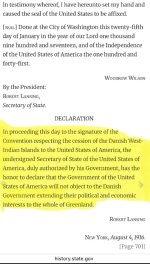
I wonder if this convention regarding the Danish West Indies (now known as the United States Virgin Islands) has also outlived its usefulness?
All the talk about Greenland makes me think the Canadian Arctic is already considered open access in the minds of the U.S.
Not only would Churchill be an excellent location for a pipeline terminal but would also be a good spot for an armed forces base imo.
Not only would Churchill be an excellent location for a pipeline terminal but would also be a good spot for an armed forces base imo.

Here's the response everyone should give: HEY, DONALD QUITE TROLLING!
Eventually, he would stop.
But this is a co-dependent relationship.
They want him to keep going; it riles up their base.
Eventually, he would stop.
But this is a co-dependent relationship.
They want him to keep going; it riles up their base.

🚨NEW WORLD ORDER🚨 #latestnews
Enjoy the videos and music you love, upload original content, and share it all with friends, family, and the world on YouTube.
 www.youtube.com
On a scale of Bald Eagle to Universal Healthcare?

 www.youtube.com
(YouTube & Greenland does not want to be a territory of the United Staes - Denmark stepped in)
www.youtube.com
(YouTube & Greenland does not want to be a territory of the United Staes - Denmark stepped in)
Greenland does not want to be a territory of the United Staes - Denmark stepped in
If you liked this short PLEASE go give my long form content a watch. I am transitioning out of the military and I am trying to build my audience there! One o...
www.youtube.com

Grey's Bay.All the talk about Greenland makes me think the Canadian Arctic is already considered open access in the minds of the U.S.
Not only would Churchill be an excellent location for a pipeline terminal but would also be a good spot for an armed forces base imo.
(Denmark has controlled Greenland for roughly 300 years and in 1916 the United States formally recognized Denmark’s interests in Greenland in exchange for the Danish West Indies, which became the U.S. Virgin Islands, but that’s sooo 1916)
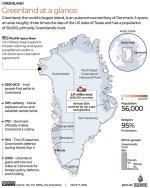
Collective defence is NATO’s governing principle, where Article 5 of the North Atlantic Treaty states that an armed attack against one NATO member is considered an attack against all.None of those countries want to risk antagonising Donald Trump but with the political temperature rising in Washington and in Copenhagen, six big European powers, including the UK, France and Germany, issued a joint statement on the sidelines of the Ukraine talks. But there was an immense Greenland-shaped elephant in that grand and glittering Paris meeting.
This has been a binding pledge since 1949, when the alliance came together and one that has forged solidarity between North America and Europe.
Because Article 5 requires unanimous agreement from all members to be invoked, a conflict between two members would lead to an impasse, as the alliance cannot vote to go to war against itself.
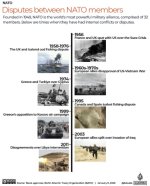
The only time Article 5 has been invoked was following the September 11, 2001, attacks in the US, where the other 18 (at that point) nations in NATO aligned with America for their collective defence.
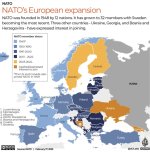 Analysts have said that any attempt by the US to seize Greenland would be an unprecedented move in NATO’s history and raise serious questions about the survival of the alliance and the limits of Article 5, which was designed to defend against an “external” aggressor.
Greenland claims: How close have NATO members come to fighting each other? — Al Jazeera
The US is considering military action to seize Greenland, in a move that could cause divisions within the NATO alliance.
The North Atlantic Treaty
The Parties to this Treaty reaffirm their faith in the purposes and principles of the Charter of the United Nations and their desire to live in peace with all peoples and all governments. They are determined to safeguard the freedom, common heritage and civilisation of their peoples, founded on...
 www.nato.int
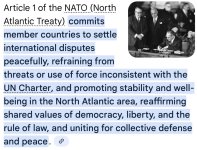
Key Points of NATO's Article 1:
- Peaceful Dispute Resolution: Members agree to resolve conflicts through peaceful means, upholding international peace, security, and justice, as outlined in the UN Charter.
- No Threat or Use of Force: Parties commit to avoiding threats or use of force in international relations, except as consistent with UN purposes.
- Shared Values: It establishes a community of values, including individual liberty, democracy, human rights, and the rule of law, forming the foundation of the Alliance.
- Promoting Stability: Members aim to foster stability and well-being in the Euro-Atlantic region.
- Collective Security Foundation: It sets the stage for the Alliance's core principle of collective defense, as detailed in the famous Article 5, by uniting efforts for peace and security.

Greenland’s harsh environment and lack of infrastructure have prevented rare earth mining
"We are going to do something on Greenland whether they like it or not," Trump said Friday
Author of the article:Associated Press
Associated Press
Josh Funk And Suman Naishadham
Published Jan 11, 2026 • 5 minute read
011126-Trump-Greenland-Rare-Earths
Danish military forces participate in an exercise with hundreds of troops from several European NATO members in Kangerlussuaq, Greenland, Sept. 17, 2025. Photo by Ebrahim Noroozi /AP
Greenland’s harsh environment, lack of key infrastructure and difficult geology have so far prevented anyone from building a mine to extract the sought-after rare earth elements that many high-tech products require. Even if President Donald Trump prevails in his effort to take control of the Arctic island, those challenges won’t go away.
Trump has prioritized breaking China’s stranglehold on the global supply of rare earths ever since the world’s number two economy sharply restricted who could buy them after the United States imposed widespread tariffs last spring. The Trump administration has invested hundreds of millions of dollars and even taken stakes in several companies. Now the president is again pitching the idea that wresting control of Greenland away from Denmark could solve the problem.
“We are going to do something on Greenland whether they like it or not,” Trump said Friday.
But Greenland may not be able to produce rare earths for years — if ever. Some companies are trying anyway, but their efforts to unearth some of the 1.5 million tons of rare earths encased in rock in Greenland generally haven’t advanced beyond the exploratory stage. Trump’s fascination with the island nation may be more about countering Russian and Chinese influence in the Arctic than securing any of the hard-to-pronounce elements like neodymium and terbium that are used to produce the high-powered magnets needed in electric vehicles, wind turbines, robots and fighter jets among other products.
“The fixation on Greenland has always been more about geopolitical posturing — a military-strategic interest and stock-promotion narrative — than a realistic supply solution for the tech sector,” said Tracy Hughes, founder and executive director of the Critical Minerals Institute. “The hype far outstrips the hard science and economics behind these critical minerals.”
Trump confirmed those geopolitical concerns at the White House Friday.
“We don’t want Russia or China going to Greenland, which if we don’t take Greenland, you can have Russia or China as your next door neighbor. That’s not going to happen,” Trump said.
A difficult place to build a mine
The main challenge to mine in Greenland is, “of course, the remoteness. Even in the south where it’s populated, there are few roads and no railways, so any mining venture would have to create these accessibilities,” said Diogo Rosa, an economic geology researcher at the Geological Survey of Denmark and Greenland. Power would also have to be generated locally, and expert manpower would have to be brought in.
Another concern is the prospect of mining rare earths in the fragile Arctic environment just as Greenland tries to build a thriving tourism industry, said Patrick Schröder, a senior fellow in the Environment and Society program at the Chatham House think-tank in London.
“Toxic chemicals needed to separate the minerals out from the rock, so that can be highly polluting and further downstream as well, the processing,” Shröder said. Plus, rare earths are often found alongside radioactive uranium.
Besides the unforgiving climate that encases much of Greenland under layers of ice and freezes the northern fjords for much of the year, the rare earths found there tend to be encased in a complex type of rock called eudialyte, and no one has ever developed a profitable process to extract rare earths from that type of rock. Elsewhere, these elements are normally found in different rock formation called carbonatites, and there are proven methods to work with that.
“If we’re in a race for resources — for critical minerals _ then we should be focusing on the resources that are most easily able to get to market,” said David Abraham, a rare earths expert who has followed the industry for decades and wrote the book “The Elements of Power.”
This week, Critical Metals’ stock price more than doubled after it said it plans to build a pilot plant in Greenland this year. But that company and more than a dozen others exploring deposits on the island remain far away from actually building a mine and would still need to raise at least hundreds of millions of dollars.
Producing rare earths is a tough business
Even the most promising projects can struggle to turn a profit, particularly when China resorts to dumping extra materials onto the market to depress prices and drive competitors out of business as it has done many times in the past. And currently most critical minerals have to be processed in China.
The U.S. is scrambling to expand the supply of rare earths outside of China during the one-year reprieve from even tougher restrictions that Trump said Xi Jinping agreed to in October. A number of companies around the world are already producing rare earths or magnets and can deliver more quickly than anything in Greenland, which Trump has threatened to seize with military power if Denmark doesn’t agree to sell it.
“Everybody’s just been running to get to this endpoint. And if you go to Greenland, it’s like you’re going back to the beginning,” said Ian Lange, an economics professor who focuses on rare earths at the Colorado School of Mines.
Focusing on more promising projects elsewhere
Many in the industry, too, think America should focus on helping proven companies instead of trying to build new rare earth mines in Greenland, Ukraine, Africa or elsewhere. A number of other mining projects in the U.S. and friendly nations like Australia are farther along and in much more accessible locations.
The U.S. government has invested directly in the company that runs the only rare earths mine in the U.S., MP Materials, and a lithium miner and a company that recycles batteries and other products with rare earths.
Scott Dunn, CEO of Noveon Magnetics, said those investments should do more to reduce China’s leverage, but it’s hard to change the math quickly when more than 90% of the world’s rare earths come from China.
“There are very few folks that can rely on a track record for delivering anything in each of these instances, and that obviously should be where we start, and especially in my view if you’re the U.S. government,” said Dunn, whose company is already producing more than 2,000 metric tons of magnets each year at a plant in Texas from elements it gets outside of China.

 torontosun.com
"We are going to do something on Greenland whether they like it or not," Trump said Friday
Author of the article:Associated Press
Associated Press
Josh Funk And Suman Naishadham
Published Jan 11, 2026 • 5 minute read
011126-Trump-Greenland-Rare-Earths
Danish military forces participate in an exercise with hundreds of troops from several European NATO members in Kangerlussuaq, Greenland, Sept. 17, 2025. Photo by Ebrahim Noroozi /AP
Greenland’s harsh environment, lack of key infrastructure and difficult geology have so far prevented anyone from building a mine to extract the sought-after rare earth elements that many high-tech products require. Even if President Donald Trump prevails in his effort to take control of the Arctic island, those challenges won’t go away.
Trump has prioritized breaking China’s stranglehold on the global supply of rare earths ever since the world’s number two economy sharply restricted who could buy them after the United States imposed widespread tariffs last spring. The Trump administration has invested hundreds of millions of dollars and even taken stakes in several companies. Now the president is again pitching the idea that wresting control of Greenland away from Denmark could solve the problem.
“We are going to do something on Greenland whether they like it or not,” Trump said Friday.
But Greenland may not be able to produce rare earths for years — if ever. Some companies are trying anyway, but their efforts to unearth some of the 1.5 million tons of rare earths encased in rock in Greenland generally haven’t advanced beyond the exploratory stage. Trump’s fascination with the island nation may be more about countering Russian and Chinese influence in the Arctic than securing any of the hard-to-pronounce elements like neodymium and terbium that are used to produce the high-powered magnets needed in electric vehicles, wind turbines, robots and fighter jets among other products.
“The fixation on Greenland has always been more about geopolitical posturing — a military-strategic interest and stock-promotion narrative — than a realistic supply solution for the tech sector,” said Tracy Hughes, founder and executive director of the Critical Minerals Institute. “The hype far outstrips the hard science and economics behind these critical minerals.”
Trump confirmed those geopolitical concerns at the White House Friday.
“We don’t want Russia or China going to Greenland, which if we don’t take Greenland, you can have Russia or China as your next door neighbor. That’s not going to happen,” Trump said.
A difficult place to build a mine
The main challenge to mine in Greenland is, “of course, the remoteness. Even in the south where it’s populated, there are few roads and no railways, so any mining venture would have to create these accessibilities,” said Diogo Rosa, an economic geology researcher at the Geological Survey of Denmark and Greenland. Power would also have to be generated locally, and expert manpower would have to be brought in.
Another concern is the prospect of mining rare earths in the fragile Arctic environment just as Greenland tries to build a thriving tourism industry, said Patrick Schröder, a senior fellow in the Environment and Society program at the Chatham House think-tank in London.
“Toxic chemicals needed to separate the minerals out from the rock, so that can be highly polluting and further downstream as well, the processing,” Shröder said. Plus, rare earths are often found alongside radioactive uranium.
Besides the unforgiving climate that encases much of Greenland under layers of ice and freezes the northern fjords for much of the year, the rare earths found there tend to be encased in a complex type of rock called eudialyte, and no one has ever developed a profitable process to extract rare earths from that type of rock. Elsewhere, these elements are normally found in different rock formation called carbonatites, and there are proven methods to work with that.
“If we’re in a race for resources — for critical minerals _ then we should be focusing on the resources that are most easily able to get to market,” said David Abraham, a rare earths expert who has followed the industry for decades and wrote the book “The Elements of Power.”
This week, Critical Metals’ stock price more than doubled after it said it plans to build a pilot plant in Greenland this year. But that company and more than a dozen others exploring deposits on the island remain far away from actually building a mine and would still need to raise at least hundreds of millions of dollars.
Producing rare earths is a tough business
Even the most promising projects can struggle to turn a profit, particularly when China resorts to dumping extra materials onto the market to depress prices and drive competitors out of business as it has done many times in the past. And currently most critical minerals have to be processed in China.
The U.S. is scrambling to expand the supply of rare earths outside of China during the one-year reprieve from even tougher restrictions that Trump said Xi Jinping agreed to in October. A number of companies around the world are already producing rare earths or magnets and can deliver more quickly than anything in Greenland, which Trump has threatened to seize with military power if Denmark doesn’t agree to sell it.
“Everybody’s just been running to get to this endpoint. And if you go to Greenland, it’s like you’re going back to the beginning,” said Ian Lange, an economics professor who focuses on rare earths at the Colorado School of Mines.
Focusing on more promising projects elsewhere
Many in the industry, too, think America should focus on helping proven companies instead of trying to build new rare earth mines in Greenland, Ukraine, Africa or elsewhere. A number of other mining projects in the U.S. and friendly nations like Australia are farther along and in much more accessible locations.
The U.S. government has invested directly in the company that runs the only rare earths mine in the U.S., MP Materials, and a lithium miner and a company that recycles batteries and other products with rare earths.
Scott Dunn, CEO of Noveon Magnetics, said those investments should do more to reduce China’s leverage, but it’s hard to change the math quickly when more than 90% of the world’s rare earths come from China.
“There are very few folks that can rely on a track record for delivering anything in each of these instances, and that obviously should be where we start, and especially in my view if you’re the U.S. government,” said Dunn, whose company is already producing more than 2,000 metric tons of magnets each year at a plant in Texas from elements it gets outside of China.
Greenland’s harsh environment and lack of infrastructure have prevented rare earth mining
"We are going to do something on Greenland whether they like it or not," Trump said Friday.
Greenland would choose to remain Danish over a US takeover, its leader said Tuesday, ahead of crunch White House talks on the future of the Arctic island which President Donald Trump has repeatedly threatened.
Trump has been talking up the idea of buying or annexing the autonomous territory for years, and further stoked tensions this week by saying the United States would take it "one way or the other".
 apple.news
"We are now facing a geopolitical crisis, and if we have to choose between the United States and Denmark here and now, we choose Denmark," Greenland's Prime Minister Jens-Frederik Nielsen said at a press conference.
apple.news
"We are now facing a geopolitical crisis, and if we have to choose between the United States and Denmark here and now, we choose Denmark," Greenland's Prime Minister Jens-Frederik Nielsen said at a press conference.
"One thing must be clear to everyone: Greenland does not want to be owned by the United States. Greenland does not want to be governed by the United States. Greenland does not want to be part of the United States."
Greenland's foreign minister and Danish Defence Minister Troels Lund Poulsen are to meet NATO's Secretary General Mark Rutte on January 19 to discuss the issue.
Trump has been talking up the idea of buying or annexing the autonomous territory for years, and further stoked tensions this week by saying the United States would take it "one way or the other".
'We choose Denmark,' says Greenland ahead of W. House talks — AFP News
Greenland would choose to remain Danish over a US takeover, its leader said Tuesday, ahead of crunch White House talks on the future of the Arctic island which President Donald Trump has repeatedly threatened.
"One thing must be clear to everyone: Greenland does not want to be owned by the United States. Greenland does not want to be governed by the United States. Greenland does not want to be part of the United States."
Greenland's foreign minister and Danish Defence Minister Troels Lund Poulsen are to meet NATO's Secretary General Mark Rutte on January 19 to discuss the issue.
Do they have a military base there now? Good to go in all directions from there.Grey's Bay.
Tough looking topography for running a pipeline though.
There will be a base there. Not many deep water port options in NT but Govt is investing there.Do they have a military base there now? Good to go in all directions from there.
Tough looking topography for running a pipeline though.
Anywho, back in Greenland:
 www.youtube.com
(YouTube & Trump’s got 99 reasons he needs to take over Greenland, and not one of them makes sense)
www.youtube.com
(YouTube & Trump’s got 99 reasons he needs to take over Greenland, and not one of them makes sense)

Trump’s got 99 reasons he needs to take over Greenland, and not one of them makes sense #DailyShow
Enjoy the videos and music you love, upload original content, and share it all with friends, family, and the world on YouTube.
www.youtube.com
So it’s sorta midline between Alaska & Greenland & Minnesota? More or less?There will be a base there. Not many deep water port options in NT but Govt is investing there.
Depending on magnetic pole position.So it’s sorta midline between Alaska & Greenland & Minnesota? More or less?

Which goes to whoever runs the fastest magnetic time-lap.Depending on magnetic pole position.
Trump reiterates desire for Greenland following high-stakes meeting — Reuters
President Donald Trump reiterated on Wednesday that the U.S. needs Greenland and that Denmark cannot be relied upon to protect the island, even as he said that "something will work out" with respect to the future governance of the Danish overseas territory.
Trump reiterates desire for Greenland following high-stakes meeting — Reuters
President Donald Trump reiterated on Wednesday that the U.S. needs Greenland and that Denmark cannot be relied upon to protect the island, even as he said that "something will work out" with respect to the future governance of the Danish overseas territory.
Foreign ministers meet Vance and Rubio at White House
Described meeting as cordial, but American position unchanged
Trump says anything but US control of Greenland is unacceptable
Greenland and Denmark reject US control, stress unity