The Times
October 30, 2006
A note to zealots: fundamentally, Charles Darwin was right all along
Science Notebook by Terence Kealey
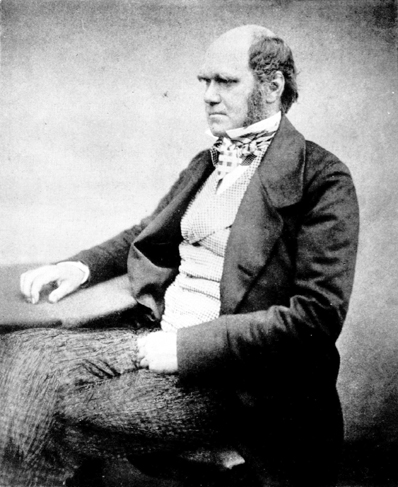
Charles Darwin: a clever man. So clever that he is buried in Westminster Abbey next to two other great English scientists - John Herschel (who invented the words "photography" , "negative" and "positive" and helped in the development of early photography) and Isaac Newton (who discovered gravity).
WHEN I WAS still at school a boy once rushed into the classroom crying that Darwin had been proved wrong — not by one of those lunatic creationists but by a fellow scientist. The scientist was Stephen Jay Gould and he worked as a biologist at Harvard.
Darwin had suggested that evolution was a gradual phenomenon, and that species were always changing to meet new environmental challenges. But Gould noted that the fossil evidence suggested that, actually, many species survived unchanged for hundreds of millions of years, and that stability, not change, seems to be the normal fossil record. The coelacanth, for example, is a fish that seems to have changed little in more than 300 million years.
Gould suggested that, instead of gradual change, evolution occurs in short bursts of intense variation, but that between those bursts many species survive unchanged over hundreds of millions of years.
So, who was right? Darwin or Gould? A recent paper in
Science published by Mark Pagel and his colleagues from Reading University has now addressed the question.
Pagel argued that if evolution happened as Gould suggested, with changes occurring only when new species are being formed, then the DNA record should reveal that an old, stable species such as the coelacanth would show little DNA variation over time. By contrast, an animal such as ourselves, which has been the product of intense species turnover (it’s not so long since we were lemur-like), would show an enormous number of DNA changes.
But if Darwin is right, and if evolution is a continuous phenomenon, then the rates of DNA change in both coelacanths and human beings should be considerable. Indeed, the DNA of a contemporary coelacanth should be hugely different from one 300 million years ago, and the only bits of DNA that would be largely unchanged would be the relatively few ones that controlled the appearance of the fish.
So, what did Pagel find? He found, as so often in disputes in science, that both Darwin and Gould were right. Evolution is, indeed, a continuous phenomenon, and the DNA of old species such as the coelacanth do show much change. But nonetheless they display only about 80 per cent of the change seen in species such as ourselves that has undergone intense species turnover. Thus the formation of new species does involve additional evolutionary change.
Does any of this matter? At one level Gould’s challenging of Darwin was only a technical dispute between biologists, but at another level it is of great importance. We live in a world of ever-increasing religious fundamentalism, confounding Francis Fukuyama’s hope in his book
The End of History, in 1992, that we would all settle into secular liberal democracy.
And religious fundamentalists of many stripes hate evolution by natural selection. They therefore seize on any apparent weakness in the data to proclaim that the world was created at 9am on October 23, 4004BC, as Archbishop Ussher calculated from Genesis (or at whatever date their different holy books determine).
The so-called “missing links” in the fossil record have, therefore, been of comfort to religious fundamentalists. These missing links are the fossils of intermediate species. So, for example, it was once argued that the birds could not have evolved from the dinosaurs because no fossils exist of species that are half dinosaur and half bird. God must have created the birds
de novo.
Subsequently Archaeopteryx — a half-dinosaur half-bird species — has been discovered, though other evolutionary links are still missing. Yet Gould’s theory boosts confidence in evolution, because it explains the missing links. If evolution is compressed into short bursts, then the chances of the transient missing links being fossilised are small.
Contrary to myth, Gould believed in evolution. He was a self-publicist who struck a mighty pose, but he never doubted evolution; he simply used his challenge to Darwin’s particular version to make a stir.
As for the missing links, bring them on, because thanks to Gould and Pagel we know that their very absence only STRENGTHENS the evidence for evolution.
Terence Kealey is the Vice-Chancellor of the University of Buckingham
thetimesonline.co.uk




 . They have found their way to deal with it and are told thats not right..Now who sounds rightous?