B.C. announces it is making daylight time permanent after years of promises
The change comes after years of promises but could lead to an awkward time difference between B.C. and neighbouring U.S. states
Author of the article:Alec Lazenby
Published Mar 02, 2026 • Last updated 13 hours ago • 4 minute read
This will be the last year clocks spring forward after the B.C. government announced Monday it was making daylight time permanent.
The change will take effect Sunday, when clocks move ahead an hour. Permanent daylight time will mean that the typical falling back of clocks by an hour in November will not take place.
“When we change our clocks twice a year, it creates all kinds of problems,” Premier David Eby told reporters at the legislature. “Kids get up at the same time, even though the clocks changed, dogs get up at the same time, even though the clocks changed. Parents lose sleep. Kids lose sleep, and even people without kids or parents, they’re losing an hour of sleep, and they’re getting less sleep, and so what we see is more car accidents and people not feeling well, and impacts that have a huge unnecessary impact on the lives of British Columbians.”
The announcement comes seven years after the B.C. government passed legislation allowing it to end the twice-yearly time changes.
The 2019 legislation followed a public consultation that found 93 per cent of British Columbians were in favour of moving to permanent “daylight time,” but over half of British Columbians also said they would prefer to wait until the U.S. followed suit.
To that end, then-Premier John Horgan and Eby, then attorney general, said they would wait to make the changes.
“Operating at a different time zone from our neighbours to the north and south could create uncertainty and unnecessary confusion for business, consumers and travellers,” said Eby in 2019 while debating the legislation. “That’s why the change proposed would not come into effect immediately. Instead, it would happen by regulation so that we can synchronize our time change with those in the Yukon and in neighbouring U.S. states on the Pacific coast: Washington, Oregon and California.”
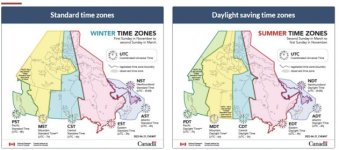
But that hasn’t happened, meaning B.C. could be in the awkward position of being an hour ahead of Washington state, California and Oregon for four months of the year. The change would also mean B.C. would be on the same time as Alberta for four months and an hour behind the rest of the time.
Part of northeastern B.C. currently observing mountain standard time will be brought into alignment with the rest of the province for the full year, while a section of the Kootenays will continue observing the time changes along with Alberta and be one hour ahead during the summer.
Yukon became the first jurisdiction to make a permanent switch to daylight time in 2020. Saskatchewan is also effectively on daylight time year round as it follows central standard time despite being geographically residing in the mountain time zone.
Eby said that he hoped Americans would soon join B.C. in ending “disruptive time changes.”
Ryan Mitton, B.C. legislative director for the Canadian Federation of Independent Business, said there was little consultation with his organization before the announcement that daylight time would be made permanent. He also accused the government of simply trying to distract from criticism of its budget that estimates B.C. will run a $13.3 billion deficit over the coming year.
“We want to make sure we’re all rowing in the same direction and working together to make sure, if you’re a small business and you do work across borders, or, for example, you provide services to businesses in the United States, you want to make sure that the time change isn’t going to cause confusion with those contracts,” said Mitton. “That’s why today’s announcement came as such a surprise, because it was so rushed.”
The other problem with the change to permanent daylight time is that it should be “low on the totem pole” when it comes to government priorities, argued Bridgitte Anderson, CEO of the Greater Vancouver Board of Trade.
She said that the business community instead wants to see the province reverse course on the expansion of the provincial sales tax to professional services, including private security and engineering.
“I just wonder where the priorities are given what has happened since the budget was released, we saw a $13 billion deficit, an increase of $8 billion in the debt and an expansion of the PST, which is going to add costs and red tape headaches for businesses,” said Anderson.
Laura Jones, president of the Business Council of B.C., agreed, arguing that people are lying awake at night thinking about the state of the province’s economy, not changing the clocks twice a year.
University of B.C. economics professor Werner Antweiler said the concerns about how the changes will impact the economy are overblown and that there are many reasons for moving to permanent daylight time, including helping families with young kids or dogs that are impacted by the time switches.
He said he is interested to see whether B.C. moving ahead creates momentum for other provinces and states to join B.C. and the Yukon in moving to daylight time year-round.
“When we spring forward in the spring, we are losing one hour, and that is like imposing a one hour jet lag on the entire population,” said Antweiler. “This actually has led to noticeably more accidents and lesser productivity and even health outcomes, higher hospitalizations.”
For at least one parent, the change is welcome even amid some concerns about what it would mean for children to be walking to school in the dark for more of the winter.
Victoria resident Sarah Van Vugt said she has a child in Grade 2 and another in kindergarten and that walking to school before the sun comes up is sometimes part of living in Canada.
“It sounds like one less thing to worry about, less complexity in the management of time,” she said.

 torontosun.com
The change comes after years of promises but could lead to an awkward time difference between B.C. and neighbouring U.S. states
Author of the article:Alec Lazenby
Published Mar 02, 2026 • Last updated 13 hours ago • 4 minute read
This will be the last year clocks spring forward after the B.C. government announced Monday it was making daylight time permanent.
The change will take effect Sunday, when clocks move ahead an hour. Permanent daylight time will mean that the typical falling back of clocks by an hour in November will not take place.
“When we change our clocks twice a year, it creates all kinds of problems,” Premier David Eby told reporters at the legislature. “Kids get up at the same time, even though the clocks changed, dogs get up at the same time, even though the clocks changed. Parents lose sleep. Kids lose sleep, and even people without kids or parents, they’re losing an hour of sleep, and they’re getting less sleep, and so what we see is more car accidents and people not feeling well, and impacts that have a huge unnecessary impact on the lives of British Columbians.”
The announcement comes seven years after the B.C. government passed legislation allowing it to end the twice-yearly time changes.
The 2019 legislation followed a public consultation that found 93 per cent of British Columbians were in favour of moving to permanent “daylight time,” but over half of British Columbians also said they would prefer to wait until the U.S. followed suit.
To that end, then-Premier John Horgan and Eby, then attorney general, said they would wait to make the changes.
“Operating at a different time zone from our neighbours to the north and south could create uncertainty and unnecessary confusion for business, consumers and travellers,” said Eby in 2019 while debating the legislation. “That’s why the change proposed would not come into effect immediately. Instead, it would happen by regulation so that we can synchronize our time change with those in the Yukon and in neighbouring U.S. states on the Pacific coast: Washington, Oregon and California.”
But that hasn’t happened, meaning B.C. could be in the awkward position of being an hour ahead of Washington state, California and Oregon for four months of the year. The change would also mean B.C. would be on the same time as Alberta for four months and an hour behind the rest of the time.
Part of northeastern B.C. currently observing mountain standard time will be brought into alignment with the rest of the province for the full year, while a section of the Kootenays will continue observing the time changes along with Alberta and be one hour ahead during the summer.
Yukon became the first jurisdiction to make a permanent switch to daylight time in 2020. Saskatchewan is also effectively on daylight time year round as it follows central standard time despite being geographically residing in the mountain time zone.
Eby said that he hoped Americans would soon join B.C. in ending “disruptive time changes.”
Ryan Mitton, B.C. legislative director for the Canadian Federation of Independent Business, said there was little consultation with his organization before the announcement that daylight time would be made permanent. He also accused the government of simply trying to distract from criticism of its budget that estimates B.C. will run a $13.3 billion deficit over the coming year.
“We want to make sure we’re all rowing in the same direction and working together to make sure, if you’re a small business and you do work across borders, or, for example, you provide services to businesses in the United States, you want to make sure that the time change isn’t going to cause confusion with those contracts,” said Mitton. “That’s why today’s announcement came as such a surprise, because it was so rushed.”
The other problem with the change to permanent daylight time is that it should be “low on the totem pole” when it comes to government priorities, argued Bridgitte Anderson, CEO of the Greater Vancouver Board of Trade.
She said that the business community instead wants to see the province reverse course on the expansion of the provincial sales tax to professional services, including private security and engineering.
“I just wonder where the priorities are given what has happened since the budget was released, we saw a $13 billion deficit, an increase of $8 billion in the debt and an expansion of the PST, which is going to add costs and red tape headaches for businesses,” said Anderson.
Laura Jones, president of the Business Council of B.C., agreed, arguing that people are lying awake at night thinking about the state of the province’s economy, not changing the clocks twice a year.
University of B.C. economics professor Werner Antweiler said the concerns about how the changes will impact the economy are overblown and that there are many reasons for moving to permanent daylight time, including helping families with young kids or dogs that are impacted by the time switches.
He said he is interested to see whether B.C. moving ahead creates momentum for other provinces and states to join B.C. and the Yukon in moving to daylight time year-round.
“When we spring forward in the spring, we are losing one hour, and that is like imposing a one hour jet lag on the entire population,” said Antweiler. “This actually has led to noticeably more accidents and lesser productivity and even health outcomes, higher hospitalizations.”
For at least one parent, the change is welcome even amid some concerns about what it would mean for children to be walking to school in the dark for more of the winter.
Victoria resident Sarah Van Vugt said she has a child in Grade 2 and another in kindergarten and that walking to school before the sun comes up is sometimes part of living in Canada.
“It sounds like one less thing to worry about, less complexity in the management of time,” she said.
B.C. makes daylight time permanent after years of promises
The change comes after years of promises but could lead to an awkward time difference between B.C. and neighbouring U.S. states.