A New Cuba?

Twila

Nanah Potato
Mar 26, 2003
14,698
73
48
With Fidel recovering from surgery at 80yrs of age, and with Raoul's wife passing away last month will there be a change in how the USA treats Cuba?

Do you think Raoul will forgo what his wife and his brother fought so passionatley for and welcome the US with open arms?

Or will he talk with the US but tell them what they will and won't be allowed to do inside HIS country?

The US would love to have their playground back, but are they willing to bow to authority?
 

#juan

Hall of Fame Member
Aug 30, 2005
18,326
119
63
The disgraceful record of the American dealings with Cuba since the early 1960s reads like a comic book.
The first time Fidel was in New York after the revolution they gave him a ticker tape parade. Eisenhower laid the first embargo on Cuba and successive administrations either tightened the embargo, or loosened it, depending the almanac or something. The embargo continues to this day. I get the feeling that without the embargo and trade restrictions, American relations with Cuba would have normalized years ago and Castro would be but a memory. The embargo gave Castro the power he needed.
http://tinyurl.com/3d2jfz
 

Twila

Nanah Potato
Mar 26, 2003
14,698
73
48
I think the US installation and support of Batiste gave Fidel the power and support he needed. The subsequent embargo's have only forced him to tighten his hold at all costs to prevent his country from becoming the dirty little playground the US had in the past.
 

Twila

Nanah Potato
Mar 26, 2003
14,698
73
48
Wolf, we can hope. But if history is any indication.. or if the history learned is incorrect how can they ever learn from it?

Many have no idea what started the revolution or how horrible it was in Cuba under Batiste and US domination. Nor do they realize the risk taken by Fidel, Raoul and his wife Vilma. If they only knew....
 

Walter

Hall of Fame Member
Jan 28, 2007
34,892
129
63
Wolf, we can hope. But if history is any indication.. or if the history learned is incorrect how can they ever learn from it?

Many have no idea what started the revolution or how horrible it was in Cuba under Batiste and US domination. Nor do they realize the risk taken by Fidel, Raoul and his wife Vilma. If they only knew....
Some people know.

LABOR RELATIONS: In 1958, an industrial worker in Cuba earned an average salary of the equivalent of $6 US dollars per each 8-hour work day, while an agricultural worker earned the equivalent of $3 US dollars. Cuba then ranked number eight (8) in the world as far as salaries paid to industrial workers, outperformed only by the following countries:
the United States ($16.80)
Canada ($11.73)
Sweden ($ 8.10)
Switzerland ($ 8.00)
New Zealand ($ 6.72)
Denmark ($ 6.46)
Norway ($ 6.10)
As far as salaries for agricultural workers, Cuba was number seven (7) in the world, outperformed only by the following countries:
Canada ($7.18)
the United States ($6.80)
New Zealand ($6.72)
Australia ($6.61)
Sweden ($5.47)
Norway ($4.38)
This data was published by the International Labor Organization in Geneva, Switzerland, in 1960. In 1958, Cuba had a labor force of two million two hundred four thousand workers (2,204,000). The rate of unemployment at that time was 7.07%, the lowest in Latin America, as per data from the Cuban Labor Ministry.
 

#juan

Hall of Fame Member
Aug 30, 2005
18,326
119
63
Notes on Guantánamo Bay

The first U.S. presence on Guantánamo Bay was a Marine battalion that camped there on June 10 1898, and the first American casualties of the Spanish-Cuban-American War were two marines killed there the following day.
Five years later, U.S. President Theodore Roosevelt signed an agreement with Cuba's new government, leasing the bay for 2,000 gold coins per year. The agreement was forced on the new Cuban government through the Platt Amendment, which gave the U.S. authority to interfere in Cuban affairs.
The Lease Agreement signed on February 16 1903, granted the U.S. "the right to use and occupy the waters adjacent to said areas of land and water… and generally to do any and all things necessary to fit the premises for use as coaling or naval stations only, and for no other purpose."
On July 2 1906, (just before the 2nd U.S. military intervention) a new lease was signed in Havana for Guantánamo Bay and Bahía Honda, for which the U.S. would pay $2,000 per year.
The U.S. Naval Base at Guantánamo Bay, the oldest existing U.S. military base outside U.S. territory, sits on a 45-square-mile area (117.6 square kilometers) about the size of Manhattan Island.
After the Platt Amendment was annulled in 1934, a new lease was negotiated between the Roosevelt administration and a Cuban government that included Fulgencio Batista as one of three signatories. Batista emerged as the strong man on the island over the next twenty-five years.
When the Revolution triumphed in 1959, the U.S. banned its soldiers stationed at the bay from entering Cuban territory. The Cuban government asserts that Guantánamo should have been returned to Cuba at this time.
"It's no secret," wrote Rafael Hernández Rodriquez in Subject to Solution: Problems in Cuban-U.S. Relations, "that the main mission of the naval bases in this area of the Gulf is to control, police and spy on Cuba."
During a speech in Chile on December 3 1971, Castro said, "that base is there just to humiliate Cuba; just like a knife stuck in the heart of Cuba's dignity and sovereignty… But from a military standpoint, the base is completely useless."
On January 11 1985, in a speech during a visit to Nicaragua, Castro addressed the potential use of military violence to recover this territory. "What interest can we have in waging a war with our neighbors?" he said. "In our country we have a military base against the will of our people. It has been there throughout the twenty-six years of the revolution, and it is being occupied by force. We have the moral and legal right to demand its return. We have made the claim in the moral and legal way. We do not intend to recover it with the use of arms. It is part of our territory being occupied by a U.S. military base. Never has anyone, a revolutionary cadre, a revolutionary leader, or a fellow citizen, had the idea of recovering the piece of our territory by the use of force. If some day it will be ours, it will not be by the use of force, but the advance of the consciousness of justice in the world."
In an interview with Soviet journalists in October 1985, U.S. President Ronald Reagan said that the purpose of the base was political: to impose the U.S. presence, even if the Cubans didn't want it.
On June 14 2002, at the United Nations General Assembly, Cuba demanded that Guantánamo territory be returned to the island.
The issue of returning Guantánamo to Cuba is complicated by the agreement signed by Batista in 1934. The agreement states: "Until the two Contracting Parties agree to the modification or abrogation of the stipulations of the agreement in regard to the lease to the United States of America of lands in Cuba for coaling and naval stations… the stipulations of that Agreement with regard to the naval station of Guantánamo shall continue in effect."
To the U.S. this means an "open-ended duration" that can only be terminated by mutual agreement. To Cuba it means that Guantánamo Bay is "occupied territory."
While this paper will not attempt to enumerate the many legal aspects of international law invoked by this "occupation," it's important to note that most other "territories held" throughout the world have been returned. The Panama Canal was returned to Panama in January 2000, Hong Kong was returned to China by the United Kingdom in 1997, and Portugal returned Macau Island to China in 1999.
Since 1959, the U.S. sends a check for the lease amount every year, but the Cuban government has never cashed them.
 

Phil B

Electoral Member
Mar 17, 2007
333
10
18
Brighton,UK
The uk returned its leased asset at the end of the lease period - so its slightly confusing to me as to the reason that it is included/mentioned in that article.
 

#juan

Hall of Fame Member
Aug 30, 2005
18,326
119
63
The uk returned its leased asset at the end of the lease period - so its slightly confusing to me as to the reason that it is included/mentioned in that article.

I believe it was mentioned to reinforce a point. If Britain and the other countries returned their leased land, why doesn't America return their's.
 

Phil B

Electoral Member
Mar 17, 2007
333
10
18
Brighton,UK
I believe it was mentioned to reinforce a point. If Britain and the other countries returned their leased land, why doesn't America return their's.

I'm sure they will - at the end of the lease, the same as Britain did at the end of its lease with Hong Kong.
 

Impetus

Electoral Member
May 31, 2007
447
33
18
I'm sure they will - at the end of the lease, the same as Britain did at the end of its lease with Hong Kong.

According to Batista's signed agreement he lease ends when both Cuba and USA agree to end it.

Cuba wants it gone yesterday, so the lease can end anytime the USA agrees...

While G bay is a knife in Cuba's heart, the embargo is a garrotte around its throat.
Slowly improving by trade with countries not recognizing the embargo, like Japan and China.

Cuba as a country and a people have an uncanny knack for sustaining themselves in times of need.

I love vacationing in Cuba...hanging out with the locals, mainly.

Muz
 

Curiosity

Senate Member
Jul 30, 2005
7,326
138
63
California
I understand Canadians do what they can to support Cuba tourism - one branch of my family had a huge wedding there - cost so little and it was absolutely first class in service and weather and beauty

Does Canada have any trade in other matters such as manufacturing or food product with Cuba? Are they also signators to the 'embargo' whatever that means.

Why doesn't Canada take Cuba on as another province and enjoy the year-round agriculture that isn't always available to Canadian farmers and manufacturers.

Has anyone ever offered to negotiate with Castro for this? I know many Caribbean nations have other 'parental' nations - why not Cuba.

The Cuban people are extremely intelligent and bright and would make first class citizens for any nation.
 

Impetus

Electoral Member
May 31, 2007
447
33
18
The day Canada becomes a socialist country, maybe they'll talk...

A Canadian company was negotiating a deal to help Cuba "kick-start" an old nickel mine that was nationalized when Castro started kicking out the American companies. The USA put the executives from that company on the "do not enter USA" list. Imagine what they would do if we started more trade talks...USA is and always will be the biggest thorn in Cuba's side.

Cubans on average are among the best educated people in the world. They have the best doctors, and even developed a glaucoma surgery not available elsewhere. They provide doctors to many South American countries like Venezuela in exchange for oil.

Muz

I understand Canadians do what they can to support Cuba tourism - one branch of my family had a huge wedding there - cost so little and it was absolutely first class in service and weather and beauty

Does Canada have any trade in other matters such as manufacturing or food product with Cuba? Are they also signators to the 'embargo' whatever that means.

Why doesn't Canada take Cuba on as another province and enjoy the year-round agriculture that isn't always available to Canadian farmers and manufacturers.

Has anyone ever offered to negotiate with Castro for this? I know many Caribbean nations have other 'parental' nations - why not Cuba.

The Cuban people are extremely intelligent and bright and would make first class citizens for any nation.
 

Curiosity

Senate Member
Jul 30, 2005
7,326
138
63
California
http://www.nytimes.com/2007/07/27/w...s/People/M/McKinley, James C. Jr.&oref=slogin

Cuba’s Revolution Now Under Two Masters
Rodrigo Abd/Associated Press
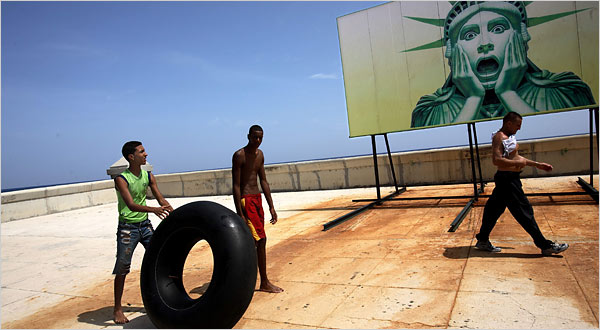
The scene by a billboard in Havana Thursday on the 54th anniversary of the Cuban revolution. With Fidel Castro ill, Cuba is in a kind of limbo


By JAMES C. McKINLEY Jr.
Published: July 27, 2007
CAMAGÜEY, Cuba, July 26 — For the first time, Raúl Castro, the acting president, gave the traditional revolutionary speech during Cuba’s most important national holiday on Thursday, deepening the widespread feeling that his brother Fidel has slipped into semi-retirement and is unlikely to return. Yet Cuba continues to live in a kind of limbo, with neither brother fully in control of the one-party Socialist state.
Enlarge This Image
Jose Goitia for The New York Times
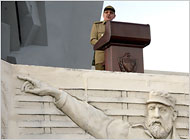
Cuba's acting President Raul Castro spoke behind a sculpture of Fidel Castro, who was absent from the Revolution Day festivities in Cuba on Thursday.

Enlarge This Image
Jose Goitia for The New York Times

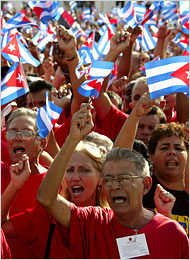
Cubans in Camagüey reacted on Thursday to Raúl Castro, the acting president, as he delivered an annual speech usually given by his brother.


Last year, Fidel Castro, the once all-powerful leader, led thousands of Communist Party faithful in cheers to celebrate the guerrilla attacks on army barracks that set off his revolution a half century ago. It was the last time he was seen in public.
That night, after two long speeches, the gaunt Mr. Castro, now 80, suffered an acute infection and bleeding in his colon from which he has yet to recover. Five days later, he handed over power to his brother Raúl, now 76, and a small group of cabinet officials on a temporary basis.
Since then, Cubans have lived under two masters, the elder Castro, ailing but still very much alive, and his younger brother, the longtime defense minister, who is not yet free to make significant changes.
“The question is why hasn’t there been more dramatic changes,” said Manuel Cuesta Morúa, a moderate opposition leader. “The answer is Fidel Castro continues to govern.”

Since the Communist Party has yet to officially replace Fidel Castro as the head of state, his presence in the wings and his towering history here continue to exert a strong influence in Cuban politics. That has made it difficult for Raúl Castro to shake up the island’s centralized Soviet-style economy, experts on Cuban politics said, though Raúl’s public remarks on Thursday made it clear he would like to.

He scolded the nation for having to import food when it possessed an abundance of rich land and vowed to increase agricultural production. He also said Cuba was seeking ways to secure more foreign investment, without abandoning Socialism.

“No one, no individual or country, can afford to spend more than what they have,” he said. “It seems elementary, but we do not always think and act in accordance with this inescapable reality. To have more we have to begin producing more.”


Mr. Castro spoke before a subdued crowd of about 100,000 people. The holiday commemorates the July 26, 1953, attack by the Castros and a ragtag group of guerrillas on the Moncada army barracks in Santiago de Cuba. The attack ended in disaster, but it was the birth of the rebellion that eventually ousted Fulgencio Batista in 1959.
Raúl Castro’s hourlong speech was studded with references to his charismatic brother’s sayings. He ended the talk with one of Fidel Castro’s more famous quotations about the nature of a Socialist revolution, a passage the crowd mumbled along with him, like a prayer.
Indeed, at times, it seemed almost as if Mr. Castro were eulogizing his brother. “Not even during the most serious moments of his illness did he fail to bring his wisdom and experience to each problem and essential decision,” he said. “These have truly been very difficult months, although with the opposite effect that our enemies expected, those who dreamed chaos would erupt and Cuban Socialism would end up collapsing.”
Since Fidel Castro fell ill, he has had several operations and has said that at least one went badly. He will be 81 next month and gives no sign that he is in a hurry to return to office.
Cuban authorities periodically have released photos and videos showing Mr. Castro looking first gaunt, then later more robust. The last of the images appeared on Cuban television in early June.
Mr. Castro spends most of his time writing essays for the Communist Party newspaper on a variety of topics, from the Iraq war to the defection of Cuban boxers during the Pan-American Games in Brazil this month. He recently blamed the use of dollars and remittances from Cubans in the United States for “irritating inequalities and privileges.”
The columns are rambling and sometimes humorous. “I don’t have time now for films and photos that require me to constantly cut my hair, beard and mustache and get spruced up every day,” he grumbled in one of his essays, titled “Reflections of the Commander in Chief.”
Raúl Castro has taken several small but meaningful steps over the last year that suggest that he wants to open up Cuban society and perhaps move to a market-driven system, without ceding one-party control, not unlike what has happened in China. During the 1990s, he supported limited private enterprise and foreign investment, reforms his brother reversed four years ago.
Since becoming acting president, the younger Mr. Castro has twice offered to enter negotiations with the United States to end a half-century of enmity and sanctions. He repeated that stand on Thursday, noting that President Bush would soon be leaving office “along with his erratic and dangerous administration.”
“The new administration will have to decide whether it will maintain the absurd, illegal and failed policy against Cuba or if it will accept the olive branch that we offered,” he said. Mr. Castro has taken other small steps away from the rigid Communist line his brother follows. Fewer dissidents have been arrested this year than in the past and cadres of party militants have stopped harassing critics, Mr. Cuesta Morúa, the opposition leader, said.
On the economic front, Raúl Castro has allowed the importation of televisions and video disc players. He has told the police to let pirate taxis operate without interference. He pledged to spend millions to refurbish hotels, marinas and golf courses. He even ordered one of the state newspapers to investigate the poor quality of service at state-controlled bakeries and other stores.
Perhaps his most important step, however, was to pay the debts the state owed to private farmers and to raise the prices the state pays for milk and meat. Cubans still live on rations and cope with chronic shortages of staples like beef. Salaries average about $12 a month, and most people spend three-quarters of their income on food, according to a study by Armando Nova González, an economist at the Center for the Study of the Cuban Economy in Havana.
“What a person makes is not enough to live on,” said Jorge, a museum guard who asked that his last name not be used because he feared persecution. “You have to resort to the black market to get along. No, not just to get along, to survive.” He said he and his wife together made about $30 a month, just enough to support their family of four.
But Raúl Castro has disappointed many Cubans who had expected significant changes once he took power. He has always deferred to his brother, and he seems to lack the political power to take major actions until Fidel either gives up total control or dies, experts on Cuba said.
“I would say what is remarkable over the last year is how little has changed,” said Robert A. Pastor, a former aide to President Jimmy Carter and a political scientist at American University. “People have been calm, but of course, big brother has been watching.”
Fidel Castro’s influence extends beyond his new role as columnist in chief. Even as Raúl Castro appears headed toward consolidating his rule, leaders seem reluctant to roll back the elder Mr. Castro’s decision in 2003 to centralize the economy again and restrict the small-scale private enterprises that emerged in the 1990s after the fail of the Soviet Union, several economists and political scientists say.
Fidel Castro’s “main impact on Cuba is not his writings but that he’s alive, and it means Raúl and the others are reluctant to take major initiatives,” said Jorge I. Dominguez, a Harvard professor and Cuba expert.
In his speech, Raúl Castro acknowledged the stubborn problem of low wages and the lack of productivity, saying the economic problems were eating away at the social fabric. He urged Cubans to be patient.
 

CARLOSMAIPXC

Time Out
Jul 27, 2007
16
0
1
que les importa cuba canadienses racistas o quieren imitar a su vecinito usa en creerce dueños del mundo
CANADA SUCK IT