The diplomatic and military contest for control of the strait of Hormuz has intensified alongside the
dramatic scenes of mourning for the death of Iran’s supreme leader Ali Khamenei with a funeral timed to coincide with America’s 250th anniversary, with some claiming Khamenei’s legacy ultimately depends on Tehran’s grip on the waterway, and so the global economy.
Political analysts and international observers interpret this timing as a highly symbolic and calculated move. By staging one of the largest mass gatherings in the country's history on the exact day the U.S. celebrates its independence, the Iranian state aims to assert national strength and signal defiance to a global audience.
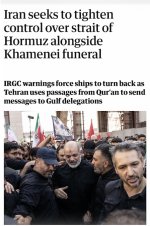
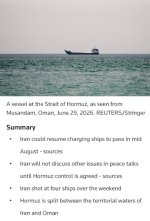
On Saturday July 4th at least eight ships turned around after direct IRGC warnings. The flow of ships on Sunday dropped further. The UK Maritime Trade Operations (UKMTO) centre also said a vessel in the Red Sea sent a distress signal after it was attacked by “unknown armed assailants”

off the coast of the Yemeni port city Hodeidah. UKMTO said authorities were investigating the incident.
“The memorandum of understanding signed digitally on 17 June by the US and Iran required Tehran to use its best endeavours to restore traffic to levels before the blockade.
Iran also agreed it would not seek to impose tolls for 60 days. The memorandum is proving to be a loose guideline of objectives open to conflicting interpretations as opposed to a rigid set of enforceable rules on which both sides rely.
Last week Oman held talks with Iran, and with France and the UK, over future governance of the strait. Oman has a plan based on the strait of Malacca to charge “optional” navigational fees for specific services including safety, docking, route guidance and environmental protection. Iran is insisting that the charges be “obligatory,” with exemptions or preferential treatment offered to "friendly nations".
“As a country where the Hormuz is part of its territorial waters, we will definitely charge service fees,” an official said, denying such charges were a toll.

apple.news
“Donald Trump has accepted that talks between the US and Iran will not resume until Khamenei’s funeral is over, but the clock is ticking towards the 60-day deadline, when the ceasefire would have to be renewed by mutual consent.
Both sides are using the ceasefire to strengthen their military positions, contrary to the US commitment in the memorandum to withdraw forces from the immediate vicinity. The US appears to be building its forces in Jordan. An Iranian army spokesperson said: “We have repeatedly announced that we are using the ceasefire opportunity to enhance our combat capabilities and have not wasted a single moment nor been negligent.”
“Separately, at the funeral in Tehran, Iran sent a subtle but unmistakeable message to visiting Gulf delegations by using passages from the Qur’an as they arrived to pay their respects to the former supreme leader.
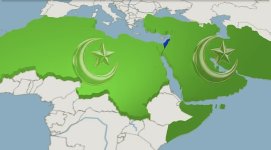
When the Saudi delegation stepped forward to pay respects, a passage was read describing the battle of Badr, fought in 624 in what is now Saudi Arabia, in which one side fought in the cause of God and the other as disbelievers. The passage added: “Allah supports with victory whom he wills,” implying there would be consequences if Saudi chose to support US attacks on Iran.
Qatar was given a message of forgiveness. Tehran chose a verse from Surah al-Fath: “That Allah may forgive you for what preceded of your sin and what will follow and complete his favour upon you and guide you to a straight path …” The message appeared to be that Doha needed to realise its “sin” of supporting the western powers.
“A subtle rebuke was directed at Turkey’s reluctance to pay any economic cost for supporting Iran. The Turkish delegation was treated to Surah an-Nisa, verse 95, which says: “Allah has preferred the mujahideen over those who remain behind with a great reward.”
The Lebanese Hezbollah movement was paired with a passage of unstinting praise. The reciter read a verse from Surah al-Ma’idah, the fifth chapter of the Qur’an, that includes the phrase “party of Allah”, from which Hezbollah takes its name: “And whoever takes Allah and his messenger and those who have believed as allies – then indeed, the party of Allah will be the victors.”
The United Arab Emirates did not send a condolence delegation. Philosophers and scholars highlight that the danger lies when religion is weaponized as a "fervent ideology" rather than acting as a moral guide. Most ethical scholars differentiate between genuine religious ethics and the political manipulation of religion by leaders pursuing non-religious objectives.
IRGC warnings force ships in strait to turn back as Tehran uses passages from Qur’an to send messages to Gulf delegations
apple.news