Iran War. . . USA Up 2-0 in the First Period

Ron in Regina

"Voice of the West" Party
Apr 9, 2008
32,559
11,758
113
Regina, Saskatchewan
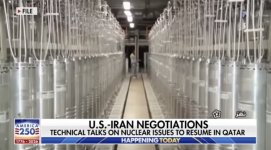
The accord paves the way for 60 days of more in-depth talks on thornier issues such as Iran's nuclear program, although both sides have given conflicting accounts as to what was agreed.
Blah blah blah, and Iranian Foreign Ministry spokesman Esmaeil Baqaei said that officials from his country did not plan to meet directly with Americans this week, despite President Donald Trump saying earlier that there was a meeting at Iran’s request.
1782819236823.jpeg
 

Ron in Regina

"Voice of the West" Party
Apr 9, 2008
32,559
11,758
113
Regina, Saskatchewan
U.S. officials (including Vice President JD Vance) claimed that Iran agreed to allow International Atomic Energy Agency (IAEA) inspectors into the country to check enriched uranium stocks. Iran’s Foreign Ministry and diplomats have pushed back on these claims, stating that no new commitments on nuclear inspectors have been made and that nuclear matters will only be negotiated as part of a final deal.
1782911141410.jpeg
The fate of Iran's stockpile of enriched uranium remains a core stumbling block, with the U.S. pressing for strict enrichment suspensions and transparency, which Tehran has heavily resisted as the U.S. and Iran are “publicly misaligned”(?) on what commitments have been made, leading to disagreements over whether an actual agreement regarding nuclear material is in place or just an American claim.
1782907577437.jpeg
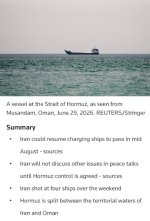
“Passage through the Strait was never previously subject to fees and Tehran's position runs directly counter to U.S. interpretations of the interim Memorandum of Understanding agreed on June 17, and to Washington's stance on what the ultimate post-war arrangements will be.

U.S. President Donald Trump said last week that there would be no tolls charged for passage through the Strait unless Washington decided to impose them itself. Secretary of State Marco Rubio said during a meeting with Gulf states that no country had the right to block shipping or impose fees or tolls for passage through an international waterway.
Iran is determined to secure lasting formal acceptance of control for itself over the Strait of Hormuz once the interim phase expires, and its negotiators will not move to other areas of dispute in ongoing peace talks with Washington until that has been agreed, the sources said.
1782911818099.jpeg
Iran believes new arrangements must govern Hormuz including Iran choosing how vessels enter and leave the Strait, holding the right to deny entry to any it suspects of threatening Iranian security, and charging fees for compulsory services it provides.
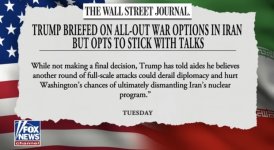
This isn’t a return to full-scale war, but it isn’t peace either, but some grey area so that the Trump Administration doesn’t have to consult Congress. It is a new phase in the conflict: the fight to control Hormuz.

The United States already lost the fight Trump started; it failed to achieve his declared goal of the Iranian regime’s unconditional surrender, or, barring that, Tehran’s acceptance of stringent nuclear restrictions.
1782910737467.jpeg
Now the conflict is over whether Iran controls Hormuz and can charge fees, or if the U.S. can restore the pre-war status quo, with ships transiting freely. Neither Iran nor the U.S. is a signatory of the U.N. Convention on the Law of the Sea that designates Hormuz as an international strait, although Oman, which stretches along its southern coast, is.
Trump’s son-in-law Jared Kushner and golf buddy Steve Witkoff, the president’s top negotiators, are in Qatar this week, with a meeting slated for Tuesday with the country’s prime minister, Sheikh Mohammed bin Abdulrahman bin Jassim Al Thani, to discuss the MOU. U.S. and Iran delegations are expected to participate separately in technical talks with mediators from Qatar and Pakistan on Wednesday, a senior Trump administration official said.
 

Ron in Regina

"Voice of the West" Party
Apr 9, 2008
32,559
11,758
113
Regina, Saskatchewan
Iran and the United States concluded a round of indirect talks on Wednesday with no sign they had made headway toward a lasting peace, focusing instead on ‌issues that they said had been resolved when an interim agreement was announced two weeks ago.

Sources familiar with the discussions said negotiators for the two countries spent two days in Doha discussing maritime traffic in the Strait of Hormuz and unfreezing Iran's funds, two critical issues under the initial agreement.

“In Washington, U.S. President Donald Trump said the two sides were making progress on possible limits to Iran's nuclear program — the main reason (once it was obvious regime change wasn’t going to happen) he launched the war along with Israel in February. "The denuclearization of Iran is moving along well,"(?) he told reporters. "They've had very good meetings, and we'll see."”
“American and Iranian negotiators held separate meetings with Qatari and Pakistani mediators, Qatar's foreign ministry said.

Trump's son-in-law Jared Kushner and top U.S. envoy Steve Witkoff, dispatched to the region for what the White House had billed as "high-level" talks, did not attend the sessions, according to a source who spoke on condition of anonymity.”

Iranian officials also said the two sides must still ‌sort out the terms of a ceasefire they signed two weeks ago before they could tackle more difficult topics, such as possible limits to its nuclear program.
The hidden costs of providing Iran with a $300 billion reconstruction fund and operational control over the Strait of Hormuz include massive global inflation, supply chain vulnerabilities, and geopolitical leverage. These factors present major risks to global stability:
  • Tolls on International Waters: Iran plans to charge commercial ships passing through the strait up to $40 billion annually for "security and environmental services". The United States and Gulf nations strongly reject these unilateral tolls, raising the risk of prolonged legal, diplomatic, and military standoffs.
  • Critical Mineral Bottlenecks: The Strait of Hormuz controls roughly 45% of the global seaborne sulfur trade. Prolonged disruptions and blockades at this chokepoint have already driven up sulfur costs, leading to output reductions and supply delays for critical minerals needed for electric vehicle batteries and defense products.
    • Funding Regional Proxies: Critics and regional allies worry that the $300 billion in potential investments and unblocked funds—even if structured through third parties or private investments rather than direct taxpayer dollars—would free up internal Iranian state capital. This liquidity could be used to heavily re-arm or fund proxy networks in the Middle East.
    • Leverage Over Global Energy: Control of the waterway gives Tehran the unprecedented ability to dictate the flow of a massive percentage of the world's oil and natural gas. This creates continuous geopolitical leverage, allowing Iran to threaten energy shortages or price spikes against countries reliant on the route.
 

petros

The Central Scrutinizer
Nov 21, 2008
120,899
15,007
113
Low Earth Orbit
Iran and the United States concluded a round of indirect talks on Wednesday with no sign they had made headway toward a lasting peace, focusing instead on ‌issues that they said had been resolved when an interim agreement was announced two weeks ago.

Sources familiar with the discussions said negotiators for the two countries spent two days in Doha discussing maritime traffic in the Strait of Hormuz and unfreezing Iran's funds, two critical issues under the initial agreement.

“In Washington, U.S. President Donald Trump said the two sides were making progress on possible limits to Iran's nuclear program — the main reason (once it was obvious regime change wasn’t going to happen) he launched the war along with Israel in February. "The denuclearization of Iran is moving along well,"(?) he told reporters. "They've had very good meetings, and we'll see."”
“American and Iranian negotiators held separate meetings with Qatari and Pakistani mediators, Qatar's foreign ministry said.

Trump's son-in-law Jared Kushner and top U.S. envoy Steve Witkoff, dispatched to the region for what the White House had billed as "high-level" talks, did not attend the sessions, according to a source who spoke on condition of anonymity.”

Iranian officials also said the two sides must still ‌sort out the terms of a ceasefire they signed two weeks ago before they could tackle more difficult topics, such as possible limits to its nuclear program.
The hidden costs of providing Iran with a $300 billion reconstruction fund and operational control over the Strait of Hormuz include massive global inflation, supply chain vulnerabilities, and geopolitical leverage. These factors present major risks to global stability:
  • Tolls on International Waters: Iran plans to charge commercial ships passing through the strait up to $40 billion annually for "security and environmental services". The United States and Gulf nations strongly reject these unilateral tolls, raising the risk of prolonged legal, diplomatic, and military standoffs.
  • Critical Mineral Bottlenecks:The Strait of Hormuz controls roughly 45% of the global seaborne sulfur trade. Prolonged disruptions and blockades at this chokepoint have already driven up sulfur costs, leading to output reductions and supply delays for critical minerals needed for electric vehicle batteries and defense products.
    • Funding Regional Proxies: Critics and regional allies worry that the $300 billion in potential investments and unblocked funds—even if structured through third parties or private investments rather than direct taxpayer dollars—would free up internal Iranian state capital. This liquidity could be used to heavily re-arm or fund proxy networks in the Middle East.
    • Leverage Over Global Energy: Control of the waterway gives Tehran the unprecedented ability to dictate the flow of a massive percentage of the world's oil and natural gas. This creates continuous geopolitical leverage, allowing Iran to threaten energy shortages or price spikes against countries reliant on the route.
What a great idea to attack.

Who gets to fund the rebuilding of Israel's infrastructure and industry?

American taxpayers?
 

Taxslave2

Senate Member
Aug 13, 2022
5,783
3,093
113
So where are all the other arab countries in all this? It seems to me that they are either waiting for the US to fix their problem, or have figured out a different route to move goods.
 

Ron in Regina

"Voice of the West" Party
Apr 9, 2008
32,559
11,758
113
Regina, Saskatchewan

Ron in Regina

"Voice of the West" Party
Apr 9, 2008
32,559
11,758
113
Regina, Saskatchewan
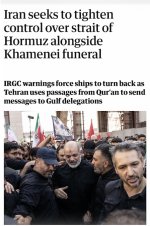
The diplomatic and military contest for control of the strait of Hormuz has intensified alongside the dramatic scenes of mourning for the death of Iran’s supreme leader Ali Khamenei with a funeral timed to coincide with America’s 250th anniversary, with some claiming Khamenei’s legacy ultimately depends on Tehran’s grip on the waterway, and so the global economy.

Political analysts and international observers interpret this timing as a highly symbolic and calculated move. By staging one of the largest mass gatherings in the country's history on the exact day the U.S. celebrates its independence, the Iranian state aims to assert national strength and signal defiance to a global audience.
1783273402438.jpeg
On Saturday July 4th at least eight ships turned around after direct IRGC warnings. The flow of ships on Sunday dropped further. The UK Maritime Trade Operations (UKMTO) centre also said a vessel in the Red Sea sent a distress signal after it was attacked by “unknown armed assailants”😉 off the coast of the Yemeni port city Hodeidah. UKMTO said authorities were investigating the incident.

“The memorandum of understanding signed digitally on 17 June by the US and Iran required Tehran to use its best endeavours to restore traffic to levels before the blockade.

Iran also agreed it would not seek to impose tolls for 60 days. The memorandum is proving to be a loose guideline of objectives open to conflicting interpretations as opposed to a rigid set of enforceable rules on which both sides rely.

Last week Oman held talks with Iran, and with France and the UK, over future governance of the strait. Oman has a plan based on the strait of Malacca to charge “optional” navigational fees for specific services including safety, docking, route guidance and environmental protection. Iran is insisting that the charges be “obligatory,” with exemptions or preferential treatment offered to "friendly nations".
“Donald Trump has accepted that talks between the US and Iran will not resume until Khamenei’s funeral is over, but the clock is ticking towards the 60-day deadline, when the ceasefire would have to be renewed by mutual consent.

Both sides are using the ceasefire to strengthen their military positions, contrary to the US commitment in the memorandum to withdraw forces from the immediate vicinity. The US appears to be building its forces in Jordan. An Iranian army spokesperson said: “We have repeatedly announced that we are using the ceasefire opportunity to enhance our combat capabilities and have not wasted a single moment nor been negligent.”

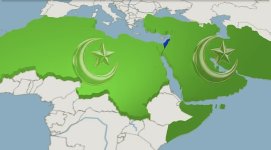
“Separately, at the funeral in Tehran, Iran sent a subtle but unmistakeable message to visiting Gulf delegations by using passages from the Qur’an as they arrived to pay their respects to the former supreme leader.
1783274647785.jpeg
When the Saudi delegation stepped forward to pay respects, a passage was read describing the battle of Badr, fought in 624 in what is now Saudi Arabia, in which one side fought in the cause of God and the other as disbelievers. The passage added: “Allah supports with victory whom he wills,” implying there would be consequences if Saudi chose to support US attacks on Iran.

Qatar was given a message of forgiveness. Tehran chose a verse from Surah al-Fath: “That Allah may forgive you for what preceded of your sin and what will follow and complete his favour upon you and guide you to a straight path …” The message appeared to be that Doha needed to realise its “sin” of supporting the western powers.

“A subtle rebuke was directed at Turkey’s reluctance to pay any economic cost for supporting Iran. The Turkish delegation was treated to Surah an-Nisa, verse 95, which says: “Allah has preferred the mujahideen over those who remain behind with a great reward.”

The Lebanese Hezbollah movement was paired with a passage of unstinting praise. The reciter read a verse from Surah al-Ma’idah, the fifth chapter of the Qur’an, that includes the phrase “party of Allah”, from which Hezbollah takes its name: “And whoever takes Allah and his messenger and those who have believed as allies – then indeed, the party of Allah will be the victors.”

The United Arab Emirates did not send a condolence delegation. Philosophers and scholars highlight that the danger lies when religion is weaponized as a "fervent ideology" rather than acting as a moral guide. Most ethical scholars differentiate between genuine religious ethics and the political manipulation of religion by leaders pursuing non-religious objectives.