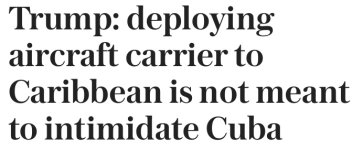
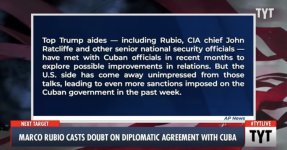
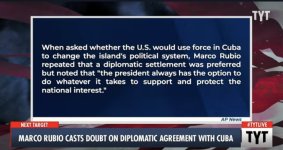
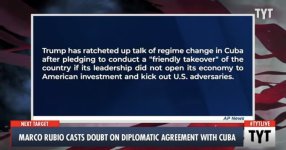
en.wikipedia.org
View attachment 34513
View attachment 34514
View attachment 34515
en.wikipedia.org
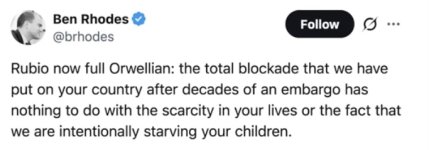
For many months, the U.S. has enforced a blockade that stops Venezuelan and Mexican oil shipments from reaching Cuba. Factories have gone idle. Public transportation sputters. Long lines for basic goods stretch through Havana. Blackouts are commonplace. President Miguel Díaz-Canel
described the U.S. sanctions as “collective punishment” on the Cuban people.
View attachment 34516
The largest foreign mining operation in Cuba is the Moa Joint Venture, which is a massive nickel and cobalt mining operation. The country and nationality of this operation are
Canadian, primarily operated by the Toronto-based resource company
Sherritt International.

A U.S. presidential decree imposed new sanctions on companies doing business with the regime, significantly expanding the comprehensive embargo and making it akin to those aimed at countries such as
Iran, Russia, and North Korea.
Within a week, Sherritt said that it would dissolve its partnership with the state-owned General Nickel Company, ending the Moa Nickel joint venture and other interests in electricity generation and natural gas.

Then, last week, Sherritt announced it would only
suspend its joint venture in Cuba and was in
talks to sell a controlling ownership stake in Sherritt to Gillon Capital, with the apparent blessing of the U.S. State and Treasury Departments.

Gillon is a Dallas-based firm that belongs to the family of Ray Washburne, a real-estate executive who served in the first Trump administration; neither firm responded to a request for comment.
Such a deal, if it goes through, could potentially bring the saga of Cuba’s mineral riches full circle by returning nickel and cobalt mines to U.S. ownership at a time when they have acquired a new strategic importance.
Such a deal might also pave the way for other American businesses; Trump is enamored of the opportunities a pliant Cuba could offer domestic businesses, several U.S. officials told me, much as it did in the Fulgencio Batista era,
leading up to the 1959 revolution.
The Bay of Pigs happened in April 1961 when the U.S. government financed and directed a failed invasion of Cuba by 1,500 CIA-trained Cuban exiles. The primary goal was to overthrow Fidel Castro’s communist government, stop the spread of Soviet influence in Latin America, and install a U.S.-friendly administration.
The Cuban Missile Crisis was caused by the secret Soviet deployment of nuclear missiles in Cuba in 1962. Soviet Premier Nikita Khrushchev orchestrated this move
to deter future U.S. invasions of communist Cuba—following the failed Bay of Pigs invasion—and to counterbalance the U.S. missiles previously stationed in Italy and Turkey.
View attachment 34517Anyway, Cobalt and Nickel minerals are used in manufacturing, including of cellphones and car batteries, and both help explain why the Trump administration is eager to bring Cuba to heel, one way or another. Trump has not been seeking to normalize relations with the post-Castro regime so much as force a conditional surrender.
Inside the Trump administration’s high-stakes fight over the island’s strategic minerals

apple.news
The Trump administration blew up a Canadian company’s business in order to tighten the screws on the regime. But Cuba may be tempted to respond by offering shares in one of its crown jewels to an ally, or at least threatening to do so.
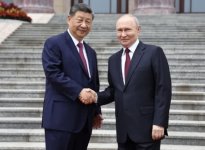
“This is a good chance for China and Russia to step back in,” Diego von Vacano, a political-science professor and Latin America specialist at Texas A&M University, told me.
View attachment 34518In that case, the Trump administration might find that its drive to humble a tiny nearby regime hands further advantage to its chief adversaries in a much bigger, more important battle, but at least the evil Canadians are out.






 .
.

![fidel-castro-caída[1].gif](https://forums.canadiancontent.net/data/attachments/32/32740-e1ab3e49f24effa3c1b4e6d329c703bc.jpg "fidel-castro-caída[1].gif")
 )
)