

Omnibus : 2022 Midterm Elections
- Thread starter B00Mer
- Start date
You are using an out of date browser. It may not display this or other websites correctly.
You should upgrade or use an alternative browser.
You should upgrade or use an alternative browser.




President Donald Trump faced pressure from Republicans on Wednesday to change course after a midterm election rout handed Democrats control of Congress and voters rejected his handpicked candidates in key races.
Republican allies and strategists called for Trump to shake up his White House personnel, restore discipline and scrap policies they blamed for the losses, including the Iran war and tariffs, as his presidency enters its final years. Veteran Republican strategist John Feehery called the results a "huge disaster" for Trump.
"He needs to clean house," Feehery said. "Every day from this point forward, he's becoming more and more lame." But Trump showed little indication that he viewed the election outcome as a reason to change direction.
"I don't view it as a hit on me," he told Fox News late on Tuesday. The White House also struck a defiant public tone, posting a photograph of Trump on social media with the message: "PSA: TRUMP IS STILL YOUR PRESIDENT."
 apple.news
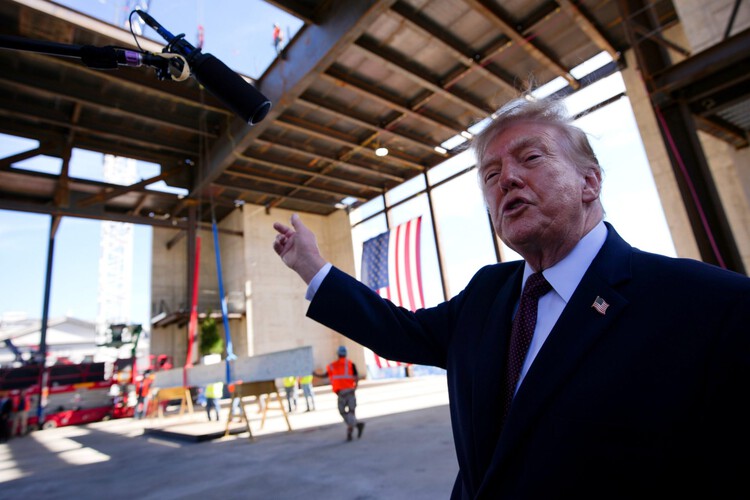
Trump decided to use his first post-election appearance not to address the fury of voters who had turned on him. Instead, Trump thought, this was the moment to wax lyrical about his pet project for nearly 20 minutes. Standing in the White House’s former East Wing, Trump invited reporters to see the progress of his ballroom. “This has been a structure the likes of which has never been seen anywhere,” Trump said.
“This will be the ballroom, he said. “Right here is the ballroom. Over here, you’re going to have magnificent columns on this side, outside exterior columns, very much like the Supreme Court. They’re actually taller and they’re even more magnificent.”
As he watched construction workers engage in efforts to hoist the ballroom’s final beam and an enormous Stars and Stripes skywards, Trump gushed about the joys of limestone, plans for a kitchen that is going to be “top of the line” and a “roof that could actually hold helicopters”.
 apple.news
Asked if he was worried about the possibility that when Democrats take control of Capitol Hill in January they might seek to impeach him all over again, Trump brushed the idea aside. “It would destroy the Democratic Party if they did that,” said a man who is now presiding over the rubble of his own party even as he remains laser-focused on the astonishing properties of granite.
Asked about prospective impeachment a day after his Republican Party suffered a sweeping midterm election loss, Trump said: "I think it would destroy the Democrat Party if they did that," insisting there was "no reason" for him to be impeached like the systemic abuses of presidential power and a pattern of defying court orders, or the whole Iran war thing that completely bypassed Congress, or the Trump administration and his family that are engaging in deep, systemic financial conflicts of interest and "endless amounts of grift" out of the White House.
 apple.news
Republican allies and strategists called for Trump to shake up his White House personnel, restore discipline and scrap policies they blamed for the losses, including the Iran war and tariffs, as his presidency enters its final years. Veteran Republican strategist John Feehery called the results a "huge disaster" for Trump.
"He needs to clean house," Feehery said. "Every day from this point forward, he's becoming more and more lame." But Trump showed little indication that he viewed the election outcome as a reason to change direction.
"I don't view it as a hit on me," he told Fox News late on Tuesday. The White House also struck a defiant public tone, posting a photograph of Trump on social media with the message: "PSA: TRUMP IS STILL YOUR PRESIDENT."
Republicans call for Trump to change course after midterm drubbing — Reuters
President Donald Trump faced pressure from Republicans on Wednesday to change course after a midterm election rout handed Democrats control of Congress and voters rejected his handpicked candidates in key races.
“This will be the ballroom, he said. “Right here is the ballroom. Over here, you’re going to have magnificent columns on this side, outside exterior columns, very much like the Supreme Court. They’re actually taller and they’re even more magnificent.”
As he watched construction workers engage in efforts to hoist the ballroom’s final beam and an enormous Stars and Stripes skywards, Trump gushed about the joys of limestone, plans for a kitchen that is going to be “top of the line” and a “roof that could actually hold helicopters”.
Trump’s extraordinary post-wipeout speech has hit new levels of delusion — The i Paper
The President just delivered a speech so breathtaking in its ignorance that it takes one’s breath away
Asked about prospective impeachment a day after his Republican Party suffered a sweeping midterm election loss, Trump said: "I think it would destroy the Democrat Party if they did that," insisting there was "no reason" for him to be impeached like the systemic abuses of presidential power and a pattern of defying court orders, or the whole Iran war thing that completely bypassed Congress, or the Trump administration and his family that are engaging in deep, systemic financial conflicts of interest and "endless amounts of grift" out of the White House.
Why Trump could be more 'aggressive' as a lame duck president — Global News
The first half of Trump’s fractious second term in office concluded with him set to become a lame duck president vowing to make extensive use of his presidential power.

You are a day late and a paedophile short.He'll clinch the Mid Terms if he releases the Epstein Files.

Across myriad exit polls, voters identified the economy — and the high cost of living, in particular — as well as government corruption, as the most important issues to them.Trump said: "I think it would destroy the Democrat Party if they did that," insisting there was "no reason" for him to be impeached…
NBC News’ exhaustive survey found just 4% identified foreign policy as the most important issue to them this year.
It also found that 74% considered the war to be a “crucial” or “major” motivator for their decision at the ballot box.
But that paled in comparison to the 90% of voters who said the same thing about corruption, and the 89% who said the same about the cost of living.…like the systemic abuses of presidential power and a pattern of defying court orders, or the whole Iran war thing that completely bypassed Congress, or the Trump administration and his family that are engaging in deep, systemic financial conflicts of interest and "endless amounts of grift" out of the White House.
Two years ago, Trump and Vance rode into Washington alongside Republican majorities in the House and Senate with a mandate to lower — or at the very least slow the steady climb of — prices.Republican allies and strategists called for Trump to shake up his White House personnel, restore discipline and scrap policies they blamed for the losses, including the Iran war and tariffs, as his presidency enters its final years. Veteran Republican strategist John Feehery called the results a "huge disaster" for Trump.
Instead of pursuing the anti-inflationary policies voters had hired him to, though, Trump saddled consumers with a bevy of erratic and wide-ranging tariffs, raged against the Federal Reserve for keeping interest rates high and looked on approvingly as his family and friends cashed in on his presidency.
Opinion | JD Vance just dropped his first bomb in a war for the GOP's future — New York Post
Vice President JD Vance lamented one war and lit the match on another in a jaw-dropping statement reacting to the GOP's electoral wipeout.
Compared to that shift, losing the House and Senate is almost incidental.
Trump still possesses expansive authority over foreign policy, national security and federal law enforcement. Clashing with the American president, even a very unpopular one, is no small thing. His executive decrees can still upend businesses and agencies, even if courts ultimately strike them down. The new Congress cannot do much to constrain Trump from making war, in Iran or Greenland or anywhere else, for the next 26 months.
Yet for leaders in Washington and far beyond, the risk calculus involved in dealing with Trump is different now. The expiration date on all of Trump’s inducements and threats looms larger than ever, and the down side of playing by Trump’s rules has come sharply into focus.
A CEO or college president sweating pressure from the White House must ask anew whether it is riskier to cross the president or invite the scrutiny of the Democratic Congress – and perhaps the next president’s Justice Department in 2029.
A foreign leader pushed by Trump to make concessions in a trade deal must now ponder whether it is more important to stay friendly with Trump or to stay on the right side of Americans who have rejected his protectionist policies.
Trump’s Whole Theory of Power is in Ruins — POLITICO
More than any American president, Trump has used fear as a central tool of policymaking. He doesn’t look so fearsome today.