The Trump administration, in practice, is threatening to cut off that lifeline in order to secure access to one of the
world’s richest copper deposits, which it can only access with consent from the Zambian government.
Zambia's government said on Monday that it opposed a U.S. attempt to tie
health funding to access to critical minerals, giving details for the first time about why negotiations with Washington over two proposed agreements have stalled.
Yet according to the
latest UN data, only 31 percent of Zambia’s mineral exports are bound for China — Switzerland is a much larger benefactor, accounting for 62 percent of the African nations’ unrefined copper trade.
Zambia's Foreign Minister Mulambo Haimbe said the United States had offered support of up to $2 billion over the next five years in a
proposed health agreement, but that some of the terms regarding data sharing would violate Zambians' right to privacy?
Data sharing?
I guess Switzerland hasn’t allowed America to use its airspace for reconnaissance flights related to the Iran war, and it hasn’t sent its navy over to open up the Strait of Hormuz, but maybe that’s a different story.
Separately, he said Zambia had objections to the content of a proposed
critical minerals agreement.
Though the exact demands haven’t been made public, the plan involves withholding some
$115 million in support for vital HIV treatment programs, unless the Zambian government gives US companies more access to its vast mineral wealth.
"A further concern... is the coupling of the proposed agreements and frameworks to one another such that the conclusion of the critical minerals agreement is made conditional to the conclusion of the Health MOU," Haimbe said in a statement.
In a March 16, 2026 article, The New York Times reported that it had obtained the draft of a memo indicating that the State Department is considering

www.fpri.org
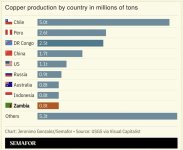
Back to Zambia, the logic looks even slimier once you zoom out. Zambia has copper, sure, but it’s the world’s seventh-largest producer of the stuff. Other countries like Chile have
a lot more to go around, and they send a
much bigger slice to China.
"The Zambian Government has been consistent that the agreements must be considered separately on their respective merits," he added. He did not specify what health data the U.S. was asking for???
Chile, however, only receives a couple million dollars in
US aid each year, a much weaker bargaining chip if you’re Trump or Rubio.
Regarding the critical minerals agreement, he said Zambia was reluctant to accept the terms due to an insistence on preferential treatment for U.S. companies. The U.S. State Department has said that it does not disclose details of bilateral
coherencive shakedowns negotiations.
In this light, the people of Zambia don’t offer a strategic advantage so much as strategic convenience. With 1.3 million people dependent on the largess of the United States, the African nation would seem to have little choice but to submit to the shakedown: a squeeze meant to inflict maximum cruelty with minimum effort.
Health advocates had warned that the proposed health deal linked the money to mining access and brought data-sharing risks, but Zambia's government previously said only that parts of it
were not aligned with the country's interests.
A number of African nations have signed
memorandums of understanding which represent the Trump administration's new approach to foreign aid.
Ghana and
Zimbabwe have rejected them over data sharing demands.
The statement from Haimbe was issued in response to criticism from outgoing U.S. ambassador Michael Gonzales, who accused Zambia
of failing to engage on the health funding offer, something which Haimbe denied?
Zambia's government said on Monday that it opposed a U.S. attempt to tie health funding to access to critical minerals, giving details for the first time about why negotiations with Washington over two proposed agreements have stalled.

apple.news
Work began on a $2.3 billion copper mine in Zambia backed by tech billionaires, including Bill Gates and Sam Altman.
Silicon Valley-based KoBold used AI to help find a previously unknown concentrated copper ore deposit on the site.
apple.news
Zambian Foreign Minister Mulambo Haimbe, in a statement on Monday, also accused President Donald Trump’s administration of seeking to win the preferential minerals deal by linking it to a U.S. offer of US$2-billion in health funding.
Ghana has become the latest African country to reject the United States’ terms for bilateral health assistance, particularly the requirement to share

healthpolicy-watch.news
“The Zambian government rightfully takes the view, first and foremost, that Zambians must have a say on how her critical minerals are used, and second, that no one strategic partner is to be treated preferentially to others,” Mr. Haimbe said.
The agreements were stalled because of U.S. insistence that the health money would be conditional on a minerals deal, he said. It was the first time Zambia has disclosed details of the dispute.
Canadian companies First Quantum Minerals Ltd.
FM-T and Barrick Mining Corp.
ABX-T are among the biggest investors in Zambia’s mining sector, together producing more than half of Zambia’s copper annually. Chinese and Middle Eastern companies are also major players in the Zambian mining sector.
But U.S. investors are scrambling to catch up. Last week, U.S. company KoBold Metals broke ground on the Mingomba copper mine, a planned US$3-billion project that would become Zambia’s biggest copper mine. The company is backed by U.S. billionaires Jeff Bezos and Bill Gates.
African nation rejects Trump administration’s bid for preferential treatment in its mining sector
apple.news
The United States insisted on a 10-year, one-way data-sharing agreement regarding Zambian citizens' health information and biological samples in exchange for a combined health aid and critical minerals package. The proposal, which Zambia has resisted over data privacy concerns, was tied to a $2 billion, 5-year health aid deal meant to replace expiring funding for over 1.3 million Zambians receiving HIV treatment…which is also being linked to Zambia’s copper and other critical minerals.
Zambia must decide by April 30 if it will provide American businesses with preferential access to its minerals, or lose support for 1.3 million people who re...

www.youtube.com
(YouTube & Is the US forcing Zambia to trade minerals for lives?)
(YouTube & U.S Considers Withholding HIV Funds To Access Zambia’s Minerals)
A
missed April 30, 2026 deadline to accept the deal has left funding uncertain.




 .
.