Measles can erase up to 73% of your immune system’s memory
But in recent years, scientists have found something unsettling. How measles changes the immune system is neither simple nor brief.
Author of the article:Washington Post
Washington Post
Trisha Pasricha, MD, The Washington Post
Published Nov 02, 2026 • Last updated 1 day ago • 4 minute read
My sister says there’s no real difference between a child getting the measles vaccine and just catching measles, since either way the child ends up immune. Is she right?
I wouldn’t describe it as “just catching measles.” In the United States, about 1 in 5 unvaccinated people who get measles is hospitalized, and 1 to 3 of every 1,000 children infected will die, according to the Centers for Disease Control and Prevention.
But let’s suppose a child gets measles and has no immediate complications, while another gets the vaccine. Both will be protected against measles afterward.
The problem is the unvaccinated child’s immune system may never be the same.
Doctors have observed for more than a century that measles infection temporarily suppresses the immune system. Children with measles become more susceptible to other infections like ear infections or diarrhea. Today, the most common cause of death among young children with measles is pneumonia.
But in recent years, scientists have found something unsettling. How measles changes the immune system is neither simple nor brief.
In a study published in Science in 2015, researchers analyzed decades of childhood mortality data from the United States, England and Wales, and Denmark. They noticed that in the pre-vaccine era, when measles cases spiked, deaths from other infections rose, too – and not just immediately but for the subsequent two to three years. This pattern didn’t happen when they looked at other vaccine-preventable diseases such as pertussis, a.k.a whooping cough.
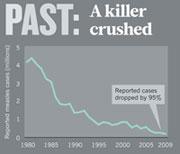
When the measles vaccine arrived, and measles cases fell, deaths from other infectious diseases fell along with them. The scientists estimated that where measles was common, measles infections could have been implicated in as many as half of all childhood deaths from infectious disease.
This could no longer be explained by a transient dip in immune functioning. It pointed to something more long-lasting.
Scientists call this phenomenon measles-induced “immune amnesia,” and it’s one of the most underappreciated – though potentially devastating – consequences of the disease.
Over the course of childhood, our immune system builds a library of memory B cells, T cells and antibodies against the viruses and bacteria we encounter. This library gives our bodies the knowledge and power to respond rapidly the next time we meet the same germ. That’s partially why both a vaccine and an infection provide immunity. Both add to the library to protect against future encounters.
But measles does something most infections cannot: It sets the library on fire.
Researchers have found that within two months of infection, measles wiped out 11 to 73 percent of the range of antibodies children had acquired over their lifetimes. Think about it: all those years of stomach bugs and colds, and within weeks, your immune system forgets how to defend against them.
Children with more severe measles infections tended to lose more antibodies. Meanwhile, children who were vaccinated against measles with the MMR vaccine saw no such losses in their antibody library.
Those antibodies can come back with time, but only by reencountering the germs, which often means getting sick all over again. For three years after a 2014-2015 measles outbreak in Berlin, children infected with measles were 60 percent more likely to return to the hospital with a different infection compared to children in a control group originally seen for a noninfectious condition. Even compared with children initially hospitalized for other infections, those who previously had measles were 30 percent more likely to come back with a new one.
Researchers have been working on possible treatments in animal models to help prevent immune amnesia, but the research is in early days. For now, vaccination is the only reliable protection.
This year, the CDC has recorded over 3,800 measles cases – well past the 2,289 cases reported in 2025. As numbers grow, we’ll need to watch survivors not just in the first few weeks but years afterward.
Measles is transmitted by respiratory droplets and is incredibly contagious – far more so than Ebola, the flu or covid-19. Consider this: The virus stays suspended in the air, so it can linger in a room for up to two hours after an infected person leaves.
It’s no surprise that 90 percent of nonimmune people who are exposed to measles will become infected. But alarming as this is, we have had a remarkably effective tool for decades: two doses of the MMR vaccine provide 97 percent protection against measles. Most people who are vaccinated are protected for life.
I have several patients who are worried about vaccinating their children. While I know the data on the enormous benefits of vaccines, I also know this: Those parents and I want the same thing, which is a healthy child and safe community. It’s easy to shame people for not getting vaccinated or bury them in statistics. In my experience, doing so can quickly shut the door to more dialogue, and it can cause worried, even scared, parents to dig in their heels. Changing minds takes time, empathy, and real curiosity about their concerns before attempting to correct them.
When it comes to measles, I share the idea of immune amnesia often. The difference between the vaccine and the infection isn’t just the risk of the illness itself, which alone can be profound.
It’s the immune library that the illness can harm on its way out.
But in recent years, scientists have found something unsettling. How measles changes the immune system is neither simple nor brief.

torontosun.com