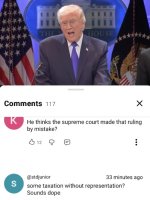
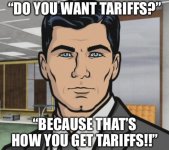
The Tarriff Hype.

Ron in Regina

"Voice of the West" Party
Apr 9, 2008
31,302
11,369
113
Regina, Saskatchewan
Oh, and with NAFTA CUSMA USMCA the North American Free Trade Agreement, the Trump administration had hoped to negotiate a grander bargin (?) with Canada than simply a renewal of the United States-Mexico-Canada Agreement but it doesn’t seem possible at the moment, the U.S. ambassador to Canada said Tuesday?
On Thursday, in Washington, Treasury Secretary Scott Bessent was asked whether the Trump administration wants free trade with allies and friends.

“If Canada, for example, came to the United States and said, ‘We’re going to zero tariffs on the United States,” asked Republican Sen. John Kennedy of Louisiana. “Would [the U.S.] go to zero tariffs?”

Absolutely not,” replied Mr. Bessent.
Before the second Trump administration, nearly everything moving across the world’s longest border did so tariff-free. Yes, Canada had negotiated barriers in some relatively small sectors such as dairy products, while the Americans bent the rules to levy tariffs in discrete sectors including softwood lumber. But for more than 35 years, Canada-U.S. trade was almost entirely free.

Who changed that? Not Canada. Who is threatening to further undermine it? Not Canada. Who keeps saying that the United States-Mexico-Canada Agreement could be done away with, and perhaps replaced with nothing? Not us.

Does it make any difference? The Trump administration convening a conference to try to foster an industrial alliance against China is particularly ironic – given that the Trump administration has spent the last year aggressively degrading and dismantling all such alliances.

Why did China slap tariffs on Canadian canola? Because Canada, following the lead of our U.S. ally, put 100-per-cent tariffs on Chinese electric vehicles. The Biden administration understood that the North American auto industry was under threat from Chinese industrial strategy, and responded with a North American industrial strategy – a strategy of partnering with allies like Canada.

The Trump administration ripped that up. They’ve bullied automakers to shift production to the U.S. from Canada, and there have been repeated public statements from President Donald Trump and his minions that the integrated North American auto industry should be an America-only industry, and that benefits the integrated North American auto industry how?

Former prime minister Stephen Harper gave a speech in Ottawa. It was the 20th anniversary of the formation of his Conservative government. His audience were mostly Conservatives.

He told them to get over their illusions about the situation next door.

Mr. Harper has described himself as the most pro-American prime minister in Canadian history. But on Wednesday, he said that the main challenge facing our country is “a hostile United States that has openly questioned Canadian sovereignty, that has openly broken the trade commitments that we have made to each other and that regularly issues further threats against us.”
 

Ron in Regina

"Voice of the West" Party
Apr 9, 2008
31,302
11,369
113
Regina, Saskatchewan
On Thursday, in Washington, Treasury Secretary Scott Bessent was asked whether the Trump administration wants free trade with allies and friends.

“If Canada, for example, came to the United States and said, ‘We’re going to zero tariffs on the United States,” asked Republican Sen. John Kennedy of Louisiana. “Would [the U.S.] go to zero tariffs?”

Absolutely not,” replied Mr. Bessent.
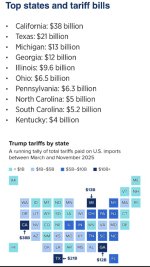
New analysis of U.S. Census data shows that states across the U.S. where key midterm elections will take place this year paid over $134 billion in tariffs in the period since President Donald Trump began implementing widespread trade duties in March 2025 through last November. In all, the U.S. Census data compiled by Trade Partnership Worldwide showed a total of $199 billion in tariffs paid by states during that time period.

Trump has called affordability a "Democratic hoax," and in recent testimony before Congress, Treasury Secretary Scott Bessent said the tariffs "do not cause inflation."

But Trump's tariffs and affordability are expected to be factors in the upcoming midterm election cycle. Recent CNBC survey data from the American consumer and pricing data show that the affordability issues are real and many voters have soured on the economy. A January poll from The New York Times and Siena University found that 54% of voters oppose Trump's tariffs.
1770815090117.jpeg
"Americans struggling with affordability rightly blame tariffs for higher prices on many everyday purchases," said Dan Anthony, executive director of the We Pay the Tariffs small business coalition and president of Trade Partnership Worldwide. "The president could eliminate tens of billions in taxes in the states that will determine the 2026 elections. He just doesn't want to," Anthony said.
Anthony said his coalition is highlighting the new data to counter rhetoric about tariffs being "paid by other companies" and being "paid to Americans" and to "educate the public about how tariffs actually work and who pays the price for them: American small businesses, workers, and consumers."
1770815243953.jpeg
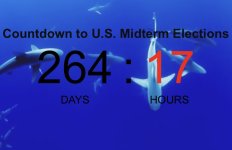
This year, all 435 districts in the U.S. House of Representatives and 33 seats in the U.S. Senate are up for election. The Republicans hold slim majorities in both chambers of Congress. Democrats need to gain four seats to win a majority in the Senate. To keep control of the House, the Republican Party cannot afford to lose more than two seats.

Midterm elections primary season begins March 3 with voters heading to the polls in Arkansas, North Carolina, and Texas.

Chris Gibbs, a Shelby County, Ohio, farmer of corn, soybeans, wheat, alfalfa hay, and a 90-head cow-calf operation, said the tariffs have hit him two-fold. "My operating costs are soaring," said Gibbs. "Tariffs on steel, aluminum and lumber raised the cost on anything I do. From building buildings, barns, buying machinery, trailers, wheels, and parts, and even my fertilizer," he said.

Gibbs said the tariff aid Trump has promised to farmers is a slap in the face to all farmers and Americans. "If these checks ever do come, it is money paid I spent on the tariffs as well as all American consumers," Gibbs said.

With the threat of additional tariffs looming over foreign countries — and the 2026 midterms — House GOP leaders tried to adopt legislation Tuesday night that would prevent any lawmaker from forcing a vote on President Donald Trump’s tariffs until August.

That effort failed, however, 214-217, after three Republicans joined all Democrats to defeat the legislation.
 

Ron in Regina

"Voice of the West" Party
Apr 9, 2008
31,302
11,369
113
Regina, Saskatchewan
As Trump continues to threaten new tariffs, some Republicans have grown wary of surrendering Congress’ ability to effectively veto the president’s import taxes.

The failed vote comes as House Democrats are preparing to force a vote to terminate Trump’s use of emergency powers to impose tariffs on Canada. That resolution is being led by Rep. Gregory Meeks, D-N.Y., the top Democrat on the Foreign Affairs Committee — and with the rule defeated, Democrats could now force a vote as soon as Wednesday on Trump’s Canadian tariffs.

Any effort to block tariffs would still need to pass both the House and Senate. But Democrats are eager to start with Canada, in part because the Senate has previously voted to terminate tariffs on Canadian imports, according to a House Democratic aide.

In a recent Pew Research Center poll, 60% of Americans said they disapprove of Trump’s tariff policies — with 39% saying they strongly disapprove. Even 28% of Republicans said they disagreed with Trump’s tariffs.

The failed vote Tuesday night may be a reflection of the political situation for many GOP lawmakers. As Trump’s popularity continues to sour, some Republicans seem to be looking for ways to distance themselves from the president and some of his most controversial policies.

Others, like Rep. Thomas Massie, R-Ky., seemed to be taking a principled stand. “Congress has the power to tax, not the president,” Massie told Politico. “That includes tariffs.”
 

Ron in Regina

"Voice of the West" Party
Apr 9, 2008
31,302
11,369
113
Regina, Saskatchewan
As Trump continues to threaten new tariffs, some Republicans have grown wary of surrendering Congress’ ability to effectively veto the president’s import taxes.
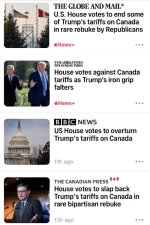
The US House of Representatives has voted to rescind US President Donald Trump's tariffs on Canadian goods.

In a 219 to 211 vote, six Republican lawmakers joined Democrats to back a resolution that seeks to end the tariffs Trump imposed on Canada last year.

The vote is largely symbolic as it will still need to be approved by the US Senate and then approved by Trump, who is very unlikely to sign it into law.

Since his re-election, Donald Trump has imposed a series of tariffs on Canada, recently threatening a 100% import tax in response to Canada's proposed trade deal with China.

As the vote was taking place on the House floor, Trump posted on Truth Social: "Any Republican, in the House or the Senate, that votes against TARIFFS will seriously suffer the consequences come Election time." (??From Whom??)

"TARIFFS have given us Economic and National Security, and no Republican should be responsible for destroying this privilege," he added.

The vote came after US House Speaker Mike Johnson, a Trump ally in Congress, unsuccessfully tried to block discussion on the chamber's floor by lawmakers on Trump's tariffs.
1770901798525.jpeg
With Republicans holding a thin majority in the US House, the six Republican defections along with a near-united front from Democrats was enough to secure the votes.

The measure had been introduced by Democrat Gregory Meeks who said that Trump had "weaponized tariffs" against allies and destabilized the global economy.

"Not only have these tariffs done immense harm to our relationship with Canada, pushing them closer to China, they have driven up prices here at home," he said before the vote.
Representative Don Bacon from Nebraska was one of the six Republicans who crossed the aisle to join Democrats in approving the measure. Before the vote, he said "tariffs have been a 'net negative' for the economy and are a significant tax that American consumers, manufacturers, and farmers are paying."

The bill now heads to the US Senate where Republicans also hold the majority. Even if it cleared that hurdle, it is unlikely to be signed into law by…by…Donald Trump? So what difference are these midterm elections supposed to make again?

Separately, Trump's tariffs are also facing legal scrutiny as the US Supreme Court is set to rule soon on a case questioning the president's legal authority to impose the levies.

Meeks, the top Democrat on the US House Foreign Affairs committee, said the measure on Canada is the first of several bills he plans to introduce that aim to roll back Trump's signature trade action.

"Our fight doesn't stop here," he said in a video posted online before the vote. "I have resolutions also to end trump's tariffs on Mexico, on Brazil, and on his Liberation Day global tariffs."
 

Ron in Regina

"Voice of the West" Party
Apr 9, 2008
31,302
11,369
113
Regina, Saskatchewan
1771021602292.jpeg
1771021618947.jpeg
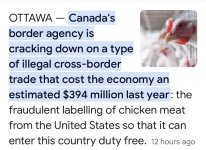
Imported chicken that is being declared as spent fowl is displacing Canadian production and costing Canada millions of dollars.

Chicken meat is being fraudulently declared as spent fowl in order to bypass import controls. This not only takes away jobs and income from Canada’s chicken farmers and processors, but also puts Canadian consumers at risk due to broken food chain traceability.

Spent fowl are old laying hens: a by-product of egg and hatching egg production. While broiler chickens are raised for meat consumption, spent fowl hens are raised to lay eggs, and when their productivity declines, they are processed for their meat, etc…but shenanigans entail and here we are.
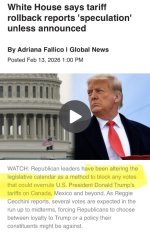
Republican leaders have been altering the legislative calendar as a method to block any votes that could overrule Donald Trump’s tariffs on Canada, Mexico and beyond.

Ordinarily when a president declares an “emergency,”😉 lawmakers have 15 days to vote on it to try and overrule it. On Tuesday, four Republicans defected from an attempt to classify Feb. 10th to July 31st as a single day and ban any votes on tariffs? 2+2=5 comes to mind here…

The U.S. House of Representatives voted this week to remove all of U.S. President Donald Trump’s tariffs on Canada. This has actually happened several times, and this latest attempt is probably going to fail like the others. To take effect, the resolution would need to pass the U.S. Senate, and also evade the presidential veto of Trump himself (the only way to override the veto would be to pass the resolution with a two thirds majority).

As Reggie Cecchini reports, several votes are now expected in the runup to midterms, forcing Republicans to choose between loyalty to Trump or a policy their constituents “might”🤔 be against?
Trump administration officials said on Friday that there would be no changes to President Donald Trump's sweeping tariffs steel and aluminum and thousands of products made from the metals unless Trump announces them. So Damn the Congress, Damn the Senate, Damn the Torpedoes, & Damn the Mid-terms.
1771031774571.jpeg
Speculation of changes to the tariffs comes as Trump pivots to address the rising cost of living for Americans during a mid-term congressional election year.

The Congressional Budget Office on Wednesday said in its annual fiscal forecast that U.S. consumers are bearing about 95% of the costs of Trump's tariffs either through higher prices on imported goods or higher prices charged on domestic manufactured goods.
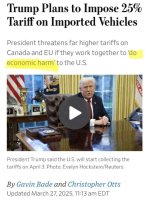
Trump posted Thursday on Truth Social that the tariffs, to take effect on April 3, amounted to a “liberation day”2.0 for the U.S. “FOR YEARS WE HAVE BEEN RIPPED OFF BY VIRTUALLY EVERY COUNTRY IN THE WORLD,” he wrote. “BUT THOSE DAYS ARE OVER” ETC…

The auto tariffs would begin a day after Trump is set to announce a broader slate of trade actions. Trump’s so-called reciprocal tariffs, slated for April 2, were originally planned to equalize U.S. tariffs with those charged by foreign nations. But Trump said the tariffs he plans to implement would likely be lower than that.

Trading partners including Canada and the European Union responded to Trump’s earlier tariffs with duties of their own. Trump “warned☣️ them early Thursday that similar action (so any reaction except capitulation?) would be met with even higher duties from the U.S.
1771027667614.jpeg
“If the European Union works with Canada (In response to Trumps Trumping) “in order to do economic harm to the USA,” (?) large scale Tariffs, far larger than currently planned, will be placed on them both in order to protect the best friend that each of those two countries has ever had (past tense).” Trump posted on Truth Social. Well, that’s a mouthful of…something.

Canadian Prime Minister Mark Carney said Canadian officials would decide whether to pursue actions including retaliatory tariffs after seeing the language of Trump’s executive order.
1771027933179.jpeg
1771028076796.jpeg
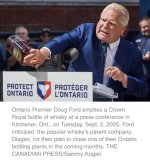
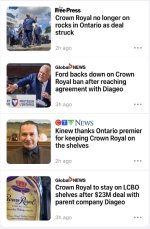
Crown Royal will remain on LCBO shelves after its manufacturer committed to $23 million in new investments in Ontario.
Attorney General Pam Bondi sold between $1 million and $5 million worth of shares of Trump Media the same day that President Donald Trump unveiled bruising new tariffs that caused the stock market to plummet, according to records obtained Wednesday by ProPublica.

Trump’s “Liberation Day” press conferencefrom the White House Rose Garden unveiling the tariffs came after the market closed on April 2. Bondi’s disclosure forms showing her Trump Media sales say the transactions were made on April 2 but do not disclose whether they occurred before or after the market closed, but this would probably be released redacted if it did.

Trades by government officials informed by nonpublic information learned through work could violate the law. Do not attempt insider trading or operate heavy machinery without protection from Trump or you happen to be the attorney general of the United States of America.