Cuba's national electric grid collapsed on Saturday for the second time in a week amid the U.S.-imposed oil blockade, officials announced, as the communist government struggles to keep the lights on for its 10 million people with decrepit infrastructure.

apple.news
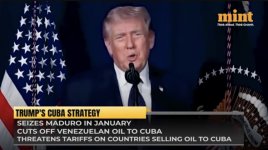
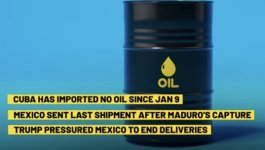
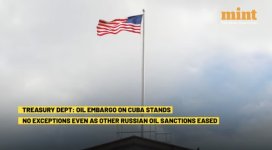
The fuel-starved Caribbean island is facing its biggest test since the collapse of the Soviet Union under a U.S. oil blockade.
apple.news
A tanker carrying fuel originally bound for Cuba on Friday changed its destination to Trinidad and Tobago, according to LSEG ship-tracking data, a blow for the island amid a severe fuel scarcity that has triggered power blackouts.
apple.news
The consequences of Cuba's grave energy crisis can be seen in every area of the Cuban economy.
"Fuel is needed for everything, from energy for hospitals, for homes, for education, for industry, for the production of food, for agriculture, for transportation, for medical care, for the livelihoods of people," Cuba's deputy foreign minister, Carlos Fernández de Cossío Domínguez said. He blamed those problems squarely on the U.S. fuel blockade.
"Since 1972, Canada has maintained the largest flow of visitors to Cuba. It is an important relationship," said de Cossío, who once served as Cuba's ambassador in Ottawa.
The blackouts, he said, are "not a result of Cuban inefficiency, not as the result of Cuba mismanagement of the electrical grid, but because the United States is depriving Cuba of fuel."
Many Cuban dissidents would argue that the country's collapse was very much a result of mismanagement, and of ideology.
But the reality is that the fuel blockade has pushed a tottering economy over the edge, and while the main victims are the Cuban people, Canadian companies are taking a beating, too. And there could be even larger losses down the road.
Canada is the second-biggest source of foreign investment in Cuba, especially in tourism and mining. But Canadian companies with major operations in Cuba, including Sunwing and Sherritt International, now face unprecedented risks to their operations as the economy grinds to a halt and political...
apple.news
“After
Venezuela and Cuba, he will move against Nicaragua, which is the third problematic country in the hemisphere,” Arcos predicted, saying that Trump would look to 'fix' governments that make the US weaker.
A key point of Trump’s second term has been a sort of revival of the 19th-century Monroe Doctrine. The president has asserted that the Western Hemisphere is the exclusive “backyard” of the United States, and has named his new policy the “Donroe' Doctrine.
While the Monroe Doctrine was created to protect newly independent Latin American nations from European colonization, Trump’s policy is rooted in establishing US dominance throughout the Western Hemisphere, with a focus on curbing Chinese and
Russian influence, punishing political rivals, and rewarding those who ally themselves with
his policies.
Trump's new policy, which he calls the “Donroe" Doctrine, aims to establish US dominance throughout the Western Hemisphere by replacing regime leaders with US-allied governments.
apple.news
“Trump wants a pro-American regime in Cuba - one that cooperates with the US and denies any foothold to the Chinese or the Russians,” explained Yaki Dayan, an expert on US affairs and the former Israeli consul in
Los Angeles.
“It’s a message to the rest of Latin America: the US is back in charge of its sphere of influence.”

U.S. President Donald Trump’s warning of possible action against Cuba and threats toward countries supporting it are raising geopolitical concerns. American University professor Philip Brenner joins Jaden Lee-Lincoln to explain the potential global impact, including implications for Canada and...
apple.news






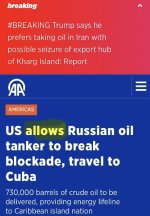


 www.aa.com.tr
 As of March 29, 2026, the tanker is near Cuba, having separated from the escort.