View attachment 36026Good times. Iran's Islamic Revolutionary Guard Corps Navy said on Thursday that four vessels involved in illegal
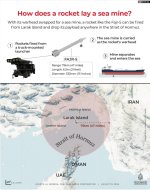
oil transfers in the northern Persian Gulf were simultaneously hit and caught fire after being tracked by its forces on Wednesday. Geography is on Iran’s side as it can fire at ships in the Strait of Hormuz from ground positions along its coast. It can also place sea mines in the strait using
rockets to drop them, so it doesn’t even need a navy to fight this sea battle.
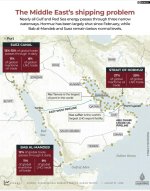
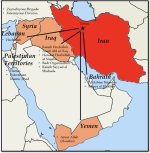
View attachment 36029As predicted decades in advance, the Strait of Hormuz between Iran and Oman, which had been freely open to international shipping before the war, now gives Tehran a means of imposing costs far beyond its borders.
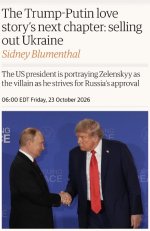
Donald Trump’s fuel agreement with
Vladimir Putin cannot offset the lost oil and diesel caused by the conflict in the Middle East.
Energy experts and market analysts point to major mathematical and logistical deficits that make the deal largely symbolic rather than a true fix for the global energy crisis. with subsequent planned shipments—500,000 metric tons in November and a potential 1 million tons afterward—the amounts remain
too insignificant to close the
massive gap left by disrupted Middle Eastern supply lines, so this is smoke & mirrors to normalize Russian trade for other reasons.
View attachment 36027
The IRGC added that three more vessels collided with mines west of the Strait of Hormuz, and warned the US military that continued provocations could lead to a wider response against its regional bases.
The Trump administration has claimed that the entire series of strikes is fabricated (fake news?) or at least exaggerated, with Trump himself
lashing out on Truth Social and saying, “
They are making up fake hits, mines, and everything else because more oil is coming through the Hormuz Strait now than it did even prior to the beginning of the conflict.”

Iran's Islamic Revolutionary Guard Corps Navy said on Thursday that four vessels involved in illegal oil transfers in the northern Persian Gulf were simultaneously hit and caught fire after being tracked by its forces on Wednesday.

apple.news
Although analysts consider a US attack before the November 3 midterm elections unlikely, sabre-rattling on both sides has raised fears that escalating rhetoric could give way to renewed attacks with control of the Strait of Hormuz and Iranian nuclear facilities in which talks over Iran’s nuclear programme were under way at the end of February are at the heart of the conflict.Trump faces much tougher political pressure before any renewed strikes.
View attachment 36028
Unlike in February before the war began, the
US and Iran would be fighting it out on several different fronts if attacks resume, with Hezbollah’s retaliation against targets in northern Israel after the killing of Iranian Supreme Leader Ali Khamenei in the first US-Israeli air strikes brought Lebanon into the war in early March. A mounting global energy crisis was not on the cards in February, but it is certainly looming now, so this is ‘obviously’ the fault of Ukrainian President Zelenskyy.

The biggest geographical change, however, has been the emergence of the Gulf’s waterways and
energy infrastructure as key targets. Iranian attacks on US military assets and civilian infrastructure have exposed Gulf countries to the consequences of a war they had hoped to avoid. While the Gulf has experienced attacks before, the scale and “velocity” of recent Iranian strikes, including on
oil and gas infrastructure, have marked a significant shift.
Renewed fighting between the forces of the Saudi-backed, internationally recognised government of Yemen and the Iran-backed Houthis has added another front to the regional crisis.
View attachment 36032

en.wikipedia.org
Yemen’s war has expanded to Saudi Arabia as Houthi missile and drone attacks target Saudi airports and
oil infrastructure. Almost immediately after Israel and the US started attacking Iran on February 28, Tehran began disrupting the flow of energy products through the
Strait of Hormuz –
sending oil and gas prices skyrocketing, and now there’s another choke point of a strait in the Middle East
View attachment 36030While the US has demonstrated its ability to strike deep inside Iran (hit & retreat), that destructive capacity has not brought down Iran’s political system nor has it finished off Tehran’s ability to retaliate with strikes on US assets and
energy infrastructure in neighbouring countries, demonstrating the difficulty for Washington in “
translating military superiority into strategic results”.
Trump, who is the leader of the Republican Party, has suggested that he may renew all-out fighting with Iran after the midterm vote next month, and he has promoted the war as a historic success with the increased cost of energy and transportation that has trickled down to the entire economy globally
fuelling inflation at a time when affordability had become one of the key issues in US electoral politics.
View attachment 36031“
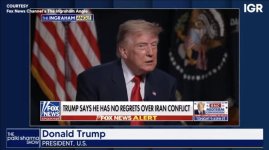
I think it’s one of the greatest things we’ve done. We’ve stopped Iran from having a nuclear weapon,” that Trump himself had said repeatedly that
Iran’s nuclear programme had been “
obliterated” by the June 2025 US strikes against the country’s uranium enrichment facilities, told reporters on Wednesday. US intelligence officials have testified to Congress that they have no evidence that Iran is building a nuclear bomb. “
It’s one of the best things that we’ve done, and it took a lot of courage to do it because no other president was willing to do it.” Despite the overall unpopularity of the war, most Republicans continue to support it.
Iran has set off a new wave of attacks on oil tankers in the Strait of Hormuz, not content to wait for the US to attack after midterms.
apple.news
Trump has seemingly instructed the Pentagon to more or less curtail its aggressive forays within Iran, maybe hoping that if he simply runs out the clock to some kind of Republican midterm victory (or a draw, like retaining the Senate) that Iran will be more receptive to new talks after the election.
Or at least, that’s what Trump has often claimed,
saying things like “
I believe we’ll make a deal right after the election,” and “
I gave absolutely no credence and will not give credence to the election when it comes to Iran; it doesn’t even enter my mind.” It would have a certain logic for the Iranians to figure that if they’re just sitting around waiting for the U.S. to renew its strikes after the midterms, they may as well take the initiative to strike first, before the midterms. Iran clearly had no intention of participating in that campaign to give Republicans the best possible shot to hold off a surging blue wave. You don’t need to look any farther than
the price of a barrel of Brent Crude to see that.





 .