



President Signs Lindsey O. Graham Sanctioning Russia and Iran Act of 2026
President Donald Trump signed a new act expanding and codifying Russia sanctions, authorizing him to impose additional tariffs, and extending sanctions on Iran, all while preserving significant presidential implementation and waiver authority.

Trump takes aim at Russia's energy sector with sanctions bill
The bill is named after the late Senator Lindsey Graham, a staunch advocate of aid for Ukraine.
 www.bbc.com
If the complex energy deal took at least weeks to negotiate, it implies that the Trump administration was actively structuring an import agreement with Vladimir Putin at the exact same time it was publicly championing and signing the sweeping sanctions bill.

Trump announced the deal as his envoy Steve Witkoff and son-in-law Jared Kushner were meeting with Ukrainian officials in Miami to discuss a proposal to end the Russia-Ukraine war. “I believe our team is simply being used as a smokescreen. And that is certainly not fair. It is certainly not how partners should treat each other,” Zelenskyy said.
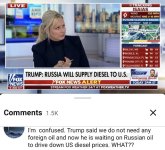
President Donald Trump and his administration have framed the maximum pressure campaign, oil restrictions, and sanctions against Cuba as efforts to target regime repression, human rights abuses, and foreign adversary ties (like…to Russia?) rather than specifically stopping the spread of communism into America. Phew, so no hypocrisy there thankfully!
Trump’s move casts doubt (
 ) on the likelihood of the White House imposing new sanctions on Russia, given that the law that passed overwhelmingly by Congress directs the administration to target countries that purchase Russian oil and gas. Lawmakers this week had urged the Trump administration to act quickly to use the tools available to help Ukraine. “Enough is enough,” the senators wrote. “The President must end his war with Iran instead of funding Russia’s war machine.”
The White House did not immediately respond to questions about who was paying for the Russian diesel or when it would become available. The White House did not immediately respond to questions about who was paying for the diesel
 from Russia and when the fuel being supplied under the agreement would become available. It also did not clarify whether subsequent supplies of Russian diesel set to come next month would be supplied prior to Election Day on Nov. 3.
Trump strikes deal with Putin to get diesel in sharp reversal of US policy weeks before midterms
President Donald Trump says he has struck a deal to obtain diesel from Russia. It's a stunning reversal of years of U.S. pressure on Moscow over its war with Ukraine and an attempt to address high fuel prices ahead of the U.S. midterm elections.

“What does this do to prices? I think probably not much,” said Clayton Seigle, an energy strategist and expert at the Center for Strategic and International Studies. But, Seigle said the new deal is a “great benefit to Russia and to Putin,” who are currently trying to offload their summer-grade diesel for the heavier winter and arctic grades that they will need in the coming months.

“It’s kind of shuffling deck chairs on the Titanic,” said Michael Lynch of the Energy Policy Research Foundation, a non-partisan research institution focused on energy and economics.“If we get diesel from Russia, basically it means that their existing customers are not going to get it and they’ll have to go somewhere else, and that will keep the price basically where it is now,” Lynch said.
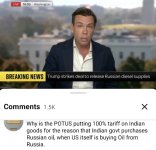
(Russia’s 300,000 tons of diesel fuel in this deal, assuming it all went to America, would satisfy America’s needs for approximately 13-14 hours for perspective)

 enette Wilford