

Conservatives turn down traditional TV debates for leaders
“We quibbled over format, we quibbled over set design, we quibbled over timing,” explained spokesperson Kory Teneycke, a co-founder of the now defunct Sun News, in announcing that the Prime Minister would not participate in any debate organized by the consortium, which includes CBC, CTV, Global and Radio-Canada.
Got that? Set design. In reality, there are main three reasons why the Conservatives are taking such an intransigent stance on televised election debates.
By ending the multi-channel simulcast of the debate and replacing it with isolated events on individual channels with limited reach, the Conservatives not only guarantee fewer Canadians will be watching, they also reverse the balance of power in their negotiations with the broadcasters.
What that bafflegab about set dressing really alludes to is that the consortium was insufficiently compliant with Conservative demands. By breaking up the Consortium, the Conservatives create a group of weak broadcasters in competition with each other and willing to agree to any demand.
As Postmedia columnist Andrew Coyne put it, “fairness is hardly likely to be the result of what is happening now — a riot of ad hoc negotiations, carried out simultaneously and in secret among and between each of the parties and a variety of media outlets, with one party, the Conservatives, holding the advantage of incumbency: a debate without the prime minister is a particularly hard sell.”
Into this void swooped U.S. outlet Bloomberg News with an offer to host a debate focused on the economy. As journalist David Akin, formerly of Sun News and now with Postmedia, put it on his Facebook page:
“Do we really want to outsource our election debates to a media org owned by a US billionaire moderated by a guy who lives in Brooklyn? I don't.”
more
https://ricochet.media/en/441/why-stephen-harper-wants-to-debate-in-the-dark
Tories’ debate proposal not based on best interest of voters
The overall goal of any debate reform should be to expand the election conversation, not restrict it. The latest Conservative proposal fails that test. Rather than build on an already large audience it stands to fragment it.
In the debate over the leaders debates of the upcoming federal campaign, common sense suggests that the public interest would be best served by ensuring that they are available to the largest possible audience.
Over and above any other consideration, the debates have been a powerful tool to raise public awareness in the lead-up to elections. More than 14 million viewers tuned in for the two televised encounters of the 2011 election.
Logic would also dictate that regardless of their official language, all Canadians should have easy access to the debates in English and in French.
Voters should be able to see for themselves how each leader interacts in the other language with the other so-called solitude.
But the overall goal of any reform should be to expand the election conversation, not restrict it.
The latest Conservative proposal fails that test.
Rather than build on an already large audience it stands to fragment it.
The plan would theoretically see Stephen Harper participate in more debates — as many as three in English and two in French — as long as the consortium of major broadcasters is not in charge of any of them.
There is no reasonable rationale for such an exclusion.
more
Tories’ debate proposal not based on best interest of voters Hébert | Toronto Star
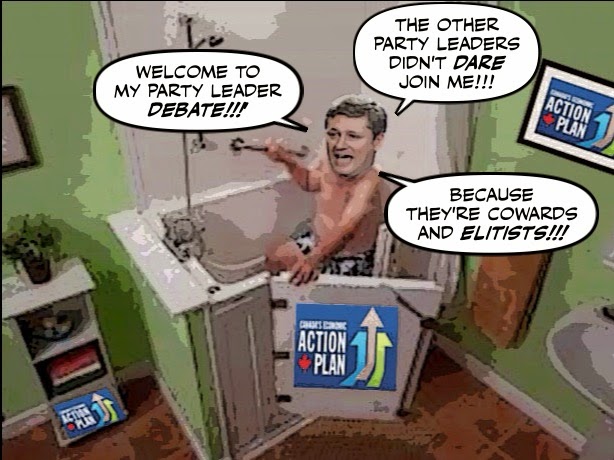
“We quibbled over format, we quibbled over set design, we quibbled over timing,” explained spokesperson Kory Teneycke, a co-founder of the now defunct Sun News, in announcing that the Prime Minister would not participate in any debate organized by the consortium, which includes CBC, CTV, Global and Radio-Canada.
Got that? Set design. In reality, there are main three reasons why the Conservatives are taking such an intransigent stance on televised election debates.
By ending the multi-channel simulcast of the debate and replacing it with isolated events on individual channels with limited reach, the Conservatives not only guarantee fewer Canadians will be watching, they also reverse the balance of power in their negotiations with the broadcasters.
What that bafflegab about set dressing really alludes to is that the consortium was insufficiently compliant with Conservative demands. By breaking up the Consortium, the Conservatives create a group of weak broadcasters in competition with each other and willing to agree to any demand.
As Postmedia columnist Andrew Coyne put it, “fairness is hardly likely to be the result of what is happening now — a riot of ad hoc negotiations, carried out simultaneously and in secret among and between each of the parties and a variety of media outlets, with one party, the Conservatives, holding the advantage of incumbency: a debate without the prime minister is a particularly hard sell.”
Into this void swooped U.S. outlet Bloomberg News with an offer to host a debate focused on the economy. As journalist David Akin, formerly of Sun News and now with Postmedia, put it on his Facebook page:
“Do we really want to outsource our election debates to a media org owned by a US billionaire moderated by a guy who lives in Brooklyn? I don't.”
more
https://ricochet.media/en/441/why-stephen-harper-wants-to-debate-in-the-dark
Tories’ debate proposal not based on best interest of voters
The overall goal of any debate reform should be to expand the election conversation, not restrict it. The latest Conservative proposal fails that test. Rather than build on an already large audience it stands to fragment it.
In the debate over the leaders debates of the upcoming federal campaign, common sense suggests that the public interest would be best served by ensuring that they are available to the largest possible audience.
Over and above any other consideration, the debates have been a powerful tool to raise public awareness in the lead-up to elections. More than 14 million viewers tuned in for the two televised encounters of the 2011 election.
Logic would also dictate that regardless of their official language, all Canadians should have easy access to the debates in English and in French.
Voters should be able to see for themselves how each leader interacts in the other language with the other so-called solitude.
But the overall goal of any reform should be to expand the election conversation, not restrict it.
The latest Conservative proposal fails that test.
Rather than build on an already large audience it stands to fragment it.
The plan would theoretically see Stephen Harper participate in more debates — as many as three in English and two in French — as long as the consortium of major broadcasters is not in charge of any of them.
There is no reasonable rationale for such an exclusion.
more
Tories’ debate proposal not based on best interest of voters Hébert | Toronto Star


