So.... Germany is choosing not to assist other allied nations due to the fact Bush is still in power? Wouldn't it make more sense to just avoid assisting the US forces if that was the case, rather then affecting all the other allies?
Oh no, you misunderstood me. We dont avoid the Canadian or US forces. Today and in the past it is and was possible to demand German forces to assist our allieds in other region of Afghanistan. In the south, too. But only for a short period of time not for a permanent positioning.
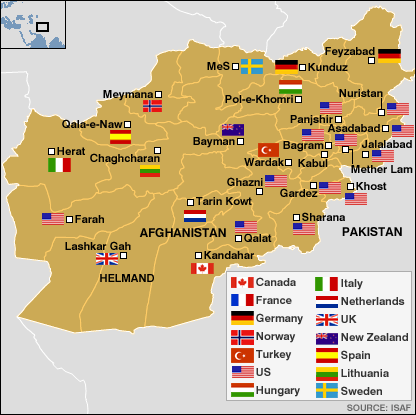
And thats the issue. The US and Canada wants a permanent positioning of 3,000
additional German soldiers
permament in the south, so that Germany had about 6,200 soldiers in Afghanistan. The German government is refusing this demand from Mr. Gates. Their reason are:
1) Germany has already at this time about 7,000 soldiers in permanent global positioning. The German parliament has decided mandates that allows our allieds to demand additional 9,800 German soldiers for Bosnia, Lebanon and Kosovo. To send more forces to Afghanistan could overstretch the military possibilities of Germany.
2) A real combat mission is a threat for the hole German mission in Afghanistan. The former communist party from East Germany, the peace movement, the muslim council and the christian churches could be going in opposition to the German government. The government is scared about this possibility, because they would lost many elections. And we have many elections in 2008 and in 2009 the election for the parliament.
3) Since the German reunion in 1990 the German politicans wants a permanent place and the right of veto in the UN Council. So that Germany will be accepted as a great power, besides China, France, UK, USA and Russia. But President Bush rejects this demand from the German government. Thats another reason why the German government is so loathy about US demands for additional German forces.They say: "we dont want only the cost and the risk of a global responsebility, we want to take part in global decision-making, too."
Thats only a part behind the complex of the controversial subject between Germany and the USA, why the Americans want that we pay more for military and why Germany is so reluctance in Afghanistan. It is part of complex of issues.
In this complex you have to see the end of presidentship of George W. Bush and why i said that the German goverment will follow the demand of a new president. Today George W. Bush is an unpopular, failed and weak president. It is easy to reject his demands and so to avoid the cost and risks of his demands for the German government. Besides this, president Bush is too weak to accept the German demands in global decision-making in the UN council and other international organizations.
That will change with a new, strong president. So that the German government will follow the US demands (at the latest after the German parliament elections in 2009).
True... but back on the whole NATO thing.... if Germany is more-so a passive country now and just isn't designed for offensive combat, etc. as you described, then why did they join NATO to begin with?
When I understand you in the right way, is that a historical question.
At the beginning, western Germany joins the NATO in 1955. Thats is an important historical date for Germany, which I wrote in my posting before about the occupation of Germany.
In the time between 1949-1955, the state supporting westgerman political parties, the Christiandemocrats and the Socialdemocrats had two options, how the occupation of Germany will end:
1) The leader of the Sovietunion, Josef Stalin, offered us in 1952 the reunion of East and West Germany, if the united Germany will be a neutral and noncommitted to the NATO or the Warsaw Pact state. This political model had choosen other states like Austria and Finland before, who were member of the Axis in the Second World War.
2) The another option was the so called "integration into West". To go in the western NATO alliance structures as a decided country.
In this time the Christiandemocrats were the elected German goverment with Konrad Adenauer as the Chancellor. He decided for the second choice, the integration into West. Germany become so to the front state between east and west. Chancellor Adenauer made an agreement in Paris with the western powers, that Germany will be independent, so that the occupation of Germany ends and started a massive rearmament, so that Germany, together with his allieds, can overpower the communist armies of the east. Btw in this times, West Germany was able to mobilize and to arm about 10 Million soldiers in 8 months.
This decision from Chancellor Adenauer was hard fought. The Socialdemocrats blamed him in the German parliament as "the Chancellor of the Allieds!". In this time, that was equal to the statement "you are a high traitor on one country and foe of all Germans!".
I think Chancellor Adenauer wanted the integration into West, because he hoped that France, UK and Germany will be friends and the hostility over two centuries will end. That the so called hereditary-hostillity (in German: "Erbfeindschaft" = the foe of my ancestors will become also my foe and I will fight him to the death) ends. Thats one reason why the forerunner to European Union was born in 1957 (EAG).
I think another reason was, that he dont accepted the loss on German territory to poland and the Sovietunion. He hoped that Germany can reunited and retake this land after a victory over the Warsaw Pact.
Btw this historical role of the state supporting parties is continous to the persent. Christiandemocrats sympathize more with the USA and Socialdemocrats sympathisize more a discrete German politics (Schröders "no" to the Iraq War etc).
In present or better since 1990 after the reunion of Germany, is there a discussion "do we need the NATO?". Christiandemocrats say that we need the membership to realize the German global demands and the Socialdemocrats say that the USA are only one possible foreign partner besides Russia and the EU, with more emphasis to the EU and the US. They want to develop the EU to an own military and foreign-policy agenda as a balance weight to Russia and the USA. But this is problematical with other EU members like the UK or Poland.
Most of the German people say: "We are surrounded by friends. Why we should need a large military, the NATO or combat missions in Afghanistan? They are ok if the cost are less and dont annoying us." Most of the people set their focus on the EU and are more for an isolationistic policy, like the US in the 18th and 19th century.
So, for many Germans the NATO have more a defending character and they dont want an offensive alliance. Maybe they have contrary expectations about the NATO as you. You critisize them as passiv and non offensive (why they are joining?). It is the other expectation about our alliance. The roots of this expactions are in our different history and culture/civilization.
In fact, why did any of these other countries join? If you're not going to allow your forces to hold combat roles as equal or near par with other forces and do what is requested by the collective, then why join up to begin with?
If NATO does split, which wouldn't suprise me in the future, I'm pretty sure Canada wouldn't be one of the last to stick around.
Germany join up the ISAF in Afghanistan, not the Operation Enduring Freedom. Thats a difference. The mission of ISAF is to establish democratic structures, rebuild the economy, to protect this reconstruction and to help-out the OEF forces if the have real problems.
Operation Enduring Freedom is an only military Operation to fight against terrorists, to find and destroy them. German forces are part of this, but their operation area is eastern Africa with Eritrea, Ethopia, Somalia, the Red Sea and the northern Indian Ocean, but not Afghanistan. Because the German government dont want from the beginning equal or near par combat roles in Afghanistan like the EOF forces. Thats why we join the ISAF in north Afghanistan. As the two Operations started was that for everybody ok, but now Germany will be criticized for that.
If NATO does split, that could result in fatal consequences in a long term. Now Europe and America have the same geopolitcial ambitions. After a split could that change in rival ambitions. No one will be profit from this situation.